Category: Doctoral Guides

  • Which Research Council Funds Your PhD? UKRI Doctoral Training by Council and Discipline in Numbers (2026)

    Which Research Council Funds Your PhD? UKRI Doctoral Training by Council and Discipline in Numbers (2026)

    In 2026 UKRI’s seven research councils list 65 current EPSRC centres for doctoral training, 17 MRC and 15 ESRC doctoral partnerships, 16 BBSRC landscape awards and formula-allocated studentships at 50 AHRC, more than 40 EPSRC and more than 60 STFC institutions — and which of those a candidate can apply to is decided by discipline before anything else.

    The figures below come from UKRI’s doctoral landscape award and doctoral focal award investment lists, published in March 2026 and updated through May 2026, and from UKRI’s studentship guidance for students. They describe the funded routes as they stand for candidates starting in 2026 and 2027. Counts are of investments listed by UKRI, not of studentships, except where UKRI gives a studentship figure; where a council publishes no number, that is said rather than estimated. Regulations and application routes differ by institution, so check the partnership’s own pages before applying.

    The two award types, and which councils use which

    UKRI states that landscape awards and focal awards are the two types of doctoral training investment under its collective talent funding scheme. Landscape awards are broad, flexible investments across a council’s subject areas; focal awards are theme-based, strategic and often cross-council, and include the centres for doctoral training. Three councils now allocate landscape awards by formula to individual institutions — EPSRC, STFC and, from 2026, AHRC — while the others award them competitively to consortia. The practical consequence for a candidate: in engineering, physical sciences, astronomy and particle physics, and from 2026 the arts and humanities, the funded studentships sit inside the university you apply to; in the social, biological, medical and environmental sciences they sit inside a regional partnership that recruits across several universities.

    Council Disciplines Landscape award route (2026) Focal awards and CDTs listed (2026) Source, year
    AHRC Arts and humanities Formula from 2026: 50 institutions, 15 studentships each (three a year for five years), final cohort October 2031; plus seven regional training hubs, ten competition-era doctoral training partnerships and the collaborative doctoral partnerships with non-university hosts 13 focal awards, including three Leverhulme-linked centres UKRI investment lists, 2026
    BBSRC Biosciences 16 landscape awards, all with final cohorts starting 2029, two co-funded with NERC 7 focal awards, final cohorts 2028, several in engineering biology and AI UKRI investment lists, 2026
    EPSRC Engineering, physical sciences, mathematics, computing Formula: more than 40 institutions from grants totalling £300 million, a minimum of three studentships per intake year; plus industrial doctoral landscape awards allocated to industry partners 65 current CDTs in nine themes, plus the UKRI AI CDTs awarded by EPSRC; over 70 CDTs from the 2018 round no longer recruit UKRI investment lists, 2026
    ESRC Social sciences, including economics, management, education, psychology 15 doctoral training partnerships, all with final cohorts starting 2028 3 focal awards UKRI investment lists, 2026
    MRC Biomedical and health 17 doctoral training partnerships, all with final cohorts starting 2026 No MRC-led CDT listed; co-funds two led by BBSRC and NERC UKRI investment lists, 2026
    NERC Environmental sciences 23 listed investments, a mix of second-round partnerships with final cohorts in 2024 and new landscape awards with final cohorts in 2029 17 CDTs UKRI investment lists, 2026
    STFC Astronomy, particle and nuclear physics Formula: more than 60 institutions, approximately 220 studentships a year, each of at least three years 5 data-intensive science CDTs, final cohorts 2024 UKRI investment lists, 2026
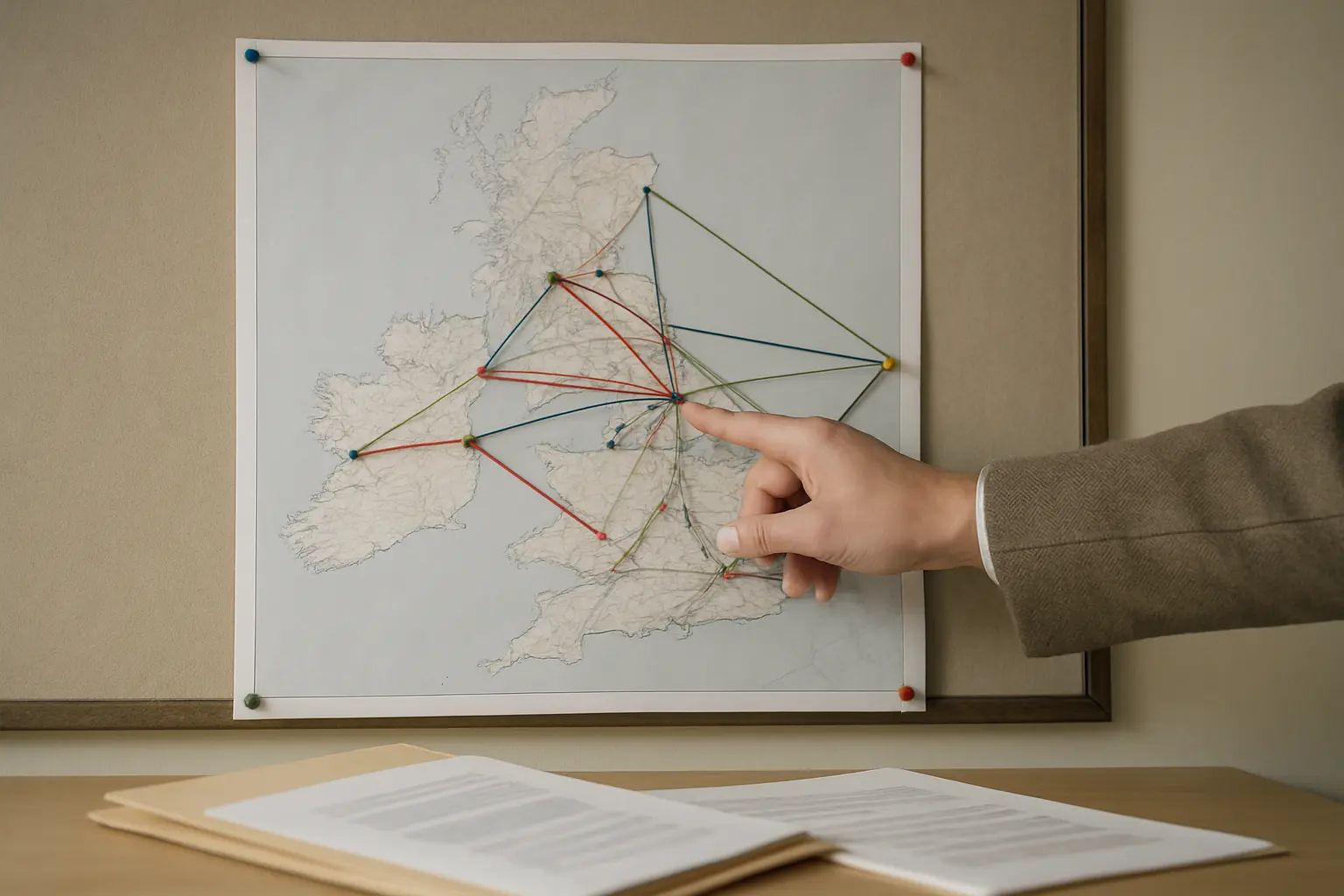
    A candidate’s guide to applying through a doctoral training partnership; the figures on this page show how many such partnerships each council runs.

    What the stipend is worth across every council

    The minimum stipend is set by UKRI and does not vary by council. UKRI’s guidance for students gives £20,780 for 2025 to September 2026 and £21,805 from 1 October 2026, with London weighting taking those to £22,780 and £23,805; the same page notes that EPSRC does not offer a London weighting, although grant holders may pay more within their budgets regardless of location. Part-time students receive a pro-rated amount. The composition of the award — fees, stipend, research training support — and the figures UKRI does not publish are set out in our piece on UK PhD stipends and studentship funding; the council decides where you can apply, not what you are paid.

    Engineering and physical sciences: the largest and most institution-bound map

    EPSRC is the council with the most listed investments and the most formula-driven structure. Its university doctoral landscape awards fund more than 40 institutions from grants totalling £300 million, each with at least three studentships per intake year; the industrial doctoral landscape awards route allocates studentship vouchers to industry partners for four-year doctorates with an academic partner. On the focal side, UKRI lists 65 current EPSRC CDTs grouped in nine themes, and the distribution shows where the council has concentrated its cohort training.

    EPSRC CDT theme Current CDTs listed Examples Source, year
    Advanced materials and physical sciences 12 2D Materials of Tomorrow; Superconductivity; Technology-Enhanced Chemical Synthesis UKRI, 2026
    Engineering 11 Future Fluid Dynamics; Net Zero Aviation; Robotics and AI for Net Zero UKRI, 2026
    Energy and decarbonisation 8 Fusion Power; Engineering Hydrogen Net Zero; Offshore Renewable Energy UKRI, 2026
    Manufacturing and the circular economy 7 Compound Semiconductor Manufacturing; Digital Transformation of Metals Industry UKRI, 2026
    Health technologies 6 Healthcare Data Science; Data-Driven Health; Organ-on-a-Chip Technology UKRI, 2026
    Information and communication technologies 6 Autonomous Intelligent Machines and Systems; Photonic and Electronic Systems; UK Semiconductor Industry Future Skills UKRI, 2026
    AI, robotics, digital security and resilience 5 Machine Learning Systems; Cyber Secure Everywhere; Cyber-Physical Risk UKRI, 2026
    Mathematical sciences 5 Statistics and Machine Learning; STOR-i; Mathematics for our Future Climate UKRI, 2026
    Quantum technologies 5 Quantum Computation and Quantum Communications; Quantum Informatics UKRI, 2026

    For a candidate in computer science or engineering this means two distinct applications exist in the same department: a landscape studentship attached to a supervisor, and a CDT place with a first-year cohort programme. The two shapes are compared in our piece on integrated and traditional PhD routes. UKRI also notes that the CDTs funded in its 2018 round — more than 70 — are no longer recruiting, so a centre named in a paper from 2021 may not exist for a 2026 applicant.

    A new cohort of UKRI-funded doctoral students at a doctoral training partnership induction day
    In the social, biological, medical and environmental sciences the funded place sits inside a regional partnership, not a single university.

    Social sciences: fifteen partnerships and a hard boundary with other councils

    ESRC funds its doctoral training through 15 partnerships, every one listed with a final cohort starting in 2028, and each a consortium: the Scottish Graduate School of Social Science spans 14 institutions, the Midlands Graduate School, the South West, SENSS and NINE partnerships have seven or eight members each, and the LSE partnership is the only single-institution award. The discipline boundary matters more here than elsewhere. Psychology, health services research and human geography sit on the ESRC–MRC–NERC borders, and a project on the wrong side is not fundable by the partnership that reads it. Candidates in management, education, economics and sociology apply through the partnership their target university belongs to; the proposal that gets funded is written to the partnership’s pathways, a point our guide to the research proposal for a UK studentship develops.

    Biosciences, biomedicine and environment: partnerships with different clocks

    The three life-and-environment councils run partnership models on different cycles. BBSRC’s 16 landscape awards all list final cohorts starting in 2029 and run from Cambridge, Norwich, London, the Midlands, the North West, Yorkshire, Scotland and Wales, with two — ILESLA at Oxford and QUARTILES at Aberdeen and Belfast — co-funded with NERC. MRC’s 17 partnerships all list final cohorts starting in 2026, which means a candidate applying for October 2027 should expect a new round of awards rather than the partnerships named today. NERC’s 23 listed investments mix second-round partnerships whose final cohorts started in 2024 with landscape awards running to 2029, several of them successors to the same consortium under a new name. Medical candidates should also note that MRC leads no CDT of its own in the 2026 list and co-funds two led by BBSRC and NERC; the data infrastructure a medical doctorate will actually use is set out in our piece on medical and epidemiology data sources.

    Arts and humanities: the switch to formula funding in 2026

    AHRC is the council whose map changed most. UKRI records that AHRC moved to allocating landscape awards by formula from 2026: 50 institutions, 15 studentships each, three a year for five years, with the final cohort starting in October 2031, supported by seven regional hubs for cohort training. The ten competition-era partnerships — CHASE, LAHP, Midlands4Cities, the North West Consortium, Northern Bridge, Open-Oxford-Cambridge, SGSAH, SWWDTP, technē and the White Rose College — all list their final cohort as 2025, and the collaborative doctoral partnerships with museums, archives and other non-university hosts continue with cohorts of at least three studentships a year. For an applicant in 2026 the practical change is that the studentship is now the institution’s to award, not the consortium’s.

    Astronomy, particle and nuclear physics: many institutions, a fixed annual number

    STFC is the only council for which UKRI publishes an annual studentship figure in the 2026 list: approximately 220 studentships a year across more than 60 institutions, each awarded for at least three years within the council’s core programme. Its five focal awards are all data-intensive science CDTs with final cohorts in 2024, so the landscape route is the live one for 2026 applicants.

    What the figures do not show

    Three gaps should be stated plainly. First, UKRI’s lists count investments, not studentships; outside STFC, AHRC and EPSRC’s minimum-per-intake rule, the number of funded places per partnership is published by the partnership, not by UKRI. Second, the lists describe UKRI routes only; charity, industry and university-funded studentships are not in them, and the trade-offs of going without a council award are set out in our comparison of UKRI studentships and self-funding. Third, none of the figures say who gets the places; UKRI’s own equalities monitoring, which we examine in diversity data on UK doctoral researchers, is the source for that.

    Whatever the council, the application is decided by a proposal written to the partnership’s pathways and the institution’s regulations. Draft your studentship proposal in Tesify: keep the partnership’s criteria, the council’s remit statement and your proposal in one workspace, so that the project you describe sits unmistakably inside the council that will read it. The research is yours; the tool keeps the proposal aligned to the funder.

    Frequently asked questions

    What is the difference between a doctoral landscape award and a focal award?

    UKRI describes landscape awards as broad, flexible investments across a council’s subject areas, and focal awards as theme-based, strategic and often cross-council investments that include centres for doctoral training. Both are types of doctoral training investment under UKRI’s collective talent funding scheme.

    Which councils allocate studentships by formula rather than competition?

    EPSRC and STFC allocate landscape awards by formula to individual institutions, and AHRC changed to a funding formula from 2026. BBSRC, ESRC, MRC and NERC award them competitively to partnerships or consortia of institutions.

    How many ESRC doctoral training partnerships are there in 2026?

    UKRI lists 15 ESRC doctoral training partnerships, each with a final cohort starting in 2028, ranging from the single-institution LSE partnership to the 14-institution Scottish Graduate School of Social Science.

    How many EPSRC centres for doctoral training are currently running?

    UKRI lists 65 current EPSRC CDTs grouped in nine themes, the largest being advanced materials and physical sciences with 12 and engineering with 11, plus the UKRI AI CDTs awarded by EPSRC. The more than 70 CDTs from the 2018 round are no longer recruiting.

    What is the UKRI stipend from October 2026?

    UKRI’s guidance for students gives a minimum stipend of £21,805 from 1 October 2026, or £23,805 with London weighting, up from £20,780 and £22,780 for 2025 to September 2026. EPSRC does not offer a London weighting.

    Does MRC run centres for doctoral training?

    Not as lead funder in the 2026 list. UKRI records MRC as co-funding two focal awards led by other councils, Engineering Biology for Biomedicine led by BBSRC and OneZoo led by NERC, alongside its 17 doctoral training partnerships.

    How many studentships does STFC fund each year?

    UKRI states that STFC funds approximately 220 studentships a year across more than 60 institutions, each for a minimum of three years, through its formula-allocated doctoral landscape awards.

    How did AHRC doctoral funding change in 2026?

    AHRC moved from competitively awarded partnerships to a funding formula: 50 institutions receive 15 studentships each, three a year for five years, with the final cohort starting in October 2031, supported by seven regional training hubs. The ten earlier partnerships list 2025 as their final cohort.

    Which council funds a psychology PhD?

    It depends on the project. ESRC funds psychology within the social sciences, MRC funds biomedical and mental health research, and BBSRC funds neuroscience and animal behaviour; a project on the border is fundable only by the council whose remit it sits in, so check the remit statements before choosing the partnership.

  • Your Psychology PhD Data Are Analysed but the Results and Discussion Chapters Are Not Written: How to Write Them to APA and JARS Standards, Study by Study (2026)

    Your Psychology PhD Data Are Analysed but the Results and Discussion Chapters Are Not Written: How to Write Them to APA and JARS Standards, Study by Study (2026)

    Three studies run, every analysis done, and the results and discussion chapters of your psychology PhD still exist as SPSS output, R scripts and a folder of notes. The funded period ends in months, the supervisor wants a full draft, and each time you open the file the question is the same: which of the forty tests goes in, and what do you say about them?

    The cost of leaving the chapters unwritten is measured in an unfunded writing-up year, a deferred submission, and a viva in which the examiner asks why an analysis that appears in the appendix was not in the results. Psychology examiners now read empirical chapters with the replication crisis in mind, and a results chapter that cannot distinguish confirmatory from exploratory analysis is examined as if the confirmatory analyses were exploratory too. This guide sets out how the empirical chapters of a UK psychology doctorate are built, what the field’s reporting standards require, and the workflow that turns analysed data into examinable chapters in weeks. Open a free Tesify workspace and build the first results chapter alongside as you read.

    Why psychology chapters are examined harder than they were

    The reason is public. In 2015 the Open Science Collaboration reported in Science replications of 100 experimental and correlational studies from three psychology journals: 97% of the original studies had statistically significant results and 36% of the replications did, with replication effects about half the magnitude of the originals and 47% of original effect sizes falling inside the replication’s 95% confidence interval. Four years earlier, Simmons, Nelson and Simonsohn had shown in Psychological Science that flexibility in data collection, analysis and reporting — researcher degrees of freedom — makes it unacceptably easy to accumulate significant evidence for a false hypothesis, and proposed six disclosure requirements for authors and four guidelines for reviewers. A doctoral examiner in 2026 has read both, and reads your results chapter for the degrees of freedom you did not disclose.

    The defence is structural: a results chapter that separates preregistered from exploratory analyses, reports every test that was run, and gives effect sizes with confidence intervals, followed by a discussion that interprets in proportion to that evidence. The APA’s Journal Article Reporting Standards for quantitative research are the checklist most UK psychology departments now expect the thesis to meet, and they are the spine of what follows.

    A general walk-through of a quantitative results chapter; the sections below apply the psychology field’s reporting standards to a doctoral thesis.

    How the empirical chapters of a psychology thesis are shaped

    Most UK psychology PhDs are built as a series of studies, and the thesis either gives each study its own chapter — introduction, method, results, discussion — or groups the studies into empirical chapters that share a method and closes with a general discussion. The choice is set by the programme and the supervisory team, and the DClinPsy thesis follows a different shape again. What every shape shares is that results and discussion are separated at the study level, and that a general discussion chapter integrates across studies. The table sets out what each part carries.

    Part What it contains What it must not contain Length in a three-study thesis
    Study results Participant flow and exclusions, descriptives, assumption checks, confirmatory tests with effect sizes and confidence intervals, then clearly labelled exploratory analyses Interpretation, theory, comparison with prior work 3,000–5,000 words per study, plus tables
    Study discussion What the study found against its hypotheses, in proportion to the effect sizes; the study’s own limitations; what the next study was designed to resolve The general theoretical argument; a limitations list that applies to every study 1,500–2,500 words per study
    General discussion Integration across studies, the theoretical contribution, alternative explanations, limitations as a programme, implications and future work Restatement of each study’s results in turn 8,000–12,000 words

    The results chapter, to JARS standards

    The APA quantitative reporting standards ask for specific things a thesis results section routinely omits. The standards call for the sample size, power and precision to be described, including any power analysis or the method used to determine precision; for inclusion and exclusion criteria, including any post-data-collection exclusion of participants; for the frequency or percentage of missing data, whether it is treated as missing completely at random, missing at random or missing not at random, and the methods actually used to address it; for the results of all inferential tests conducted, including exact p values where null hypothesis significance testing is used; for effect-size estimates and confidence intervals on those estimates; and for a distinction between primary and secondary hypotheses and a discussion of the implications of exploratory analyses. Built as a chapter, that becomes the following order.

    1. Participants and flow. How many were recruited, screened, excluded and analysed, and why, with the rule for exclusion stated as it was decided before the data were seen. If the study was preregistered — the Center for Open Science defines preregistration as specifying the research plan in advance of the study and submitting it to a registry — cite the registration and say where the analysis departed from it.
    2. Descriptives and assumptions. Means, standard deviations and correlations for every variable in the models, and the checks the chosen tests depend on, reported in a sentence each rather than a page.
    3. Confirmatory analyses, hypothesis by hypothesis. One subsection per preregistered or a-priori hypothesis, each giving the test, the exact statistic, the exact p value, the effect size and its confidence interval, and one sentence saying whether the hypothesis was supported. No interpretation.
    4. Exploratory analyses, labelled. Everything else you ran that the thesis relies on, under a heading that says so, with the same reporting and a note that these analyses generate rather than test hypotheses.
    5. Tables and figures that carry the numbers. A table per model, a figure per key effect with confidence intervals drawn, and the text pointing at them rather than repeating them.
    A psychology doctoral researcher checking a results table of effect sizes and confidence intervals against a reporting checklist
    Every hypothesis gets the same five numbers: the statistic, the exact p value, the effect size, its confidence interval and one sentence on support.

    The study discussion and the general discussion

    The study discussion is short and disciplined: what was found against each hypothesis, in language proportionate to the effect size; one or two limitations that belong to this study specifically; and the bridge to the next study, stated as the question this study left open. It does not rehearse the theory. The general discussion is where the doctorate is examined. It integrates the studies into a single account, states the theoretical contribution in the terms of the framework set out in the literature review, takes the strongest alternative explanation seriously before dismissing it, treats limitations as features of the research programme rather than a list, and proposes future work someone could begin. The seven-move structure for a discussion chapter applies with two psychology-specific additions: a paragraph on the robustness of the effects across the studies, with the effect sizes side by side, and an honest statement of what a direct replication would need.

    The discussion also has to handle the literature you cite. A finding that rests on a paper later retracted or failed to replicate is a viva question; our analysis of citing retracted papers shows how often it happens and how to check.

    The workflow that gets the chapters written

    The chapters are slow to write because the evidence lives in three places — the analysis output, the preregistration or analysis plan, and the notes on what each result means — and the writing is an act of reconciliation. The fix is to reconcile once, in a structured document, and write from that.

    1. Build the hypothesis ledger. One row per hypothesis per study: the hypothesis as preregistered or planned, the test, the statistic, exact p, effect size, confidence interval, supported or not, and a column for exploratory analyses that touch it. In Tesify, open a chapter for each study and paste the ledger at the top; every results subsection is written from a row.
    2. Draft the results subsections from the ledger. Because each row already holds the five numbers, the subsection is a sentence of method, a sentence of result and a sentence of support. Tesify drafts the connecting prose in your register from the ledger row and the table you paste beneath it; you check every number against the output.
    3. Write the study discussions against the ledger, not against your hopes. With the effect sizes on screen, the temptation to describe a small, uncertain effect as a finding is visible. The Tesify AI Editor flags overclaiming — significant results described as large, non-significant ones described as trends — so that the language matches the evidence before the supervisor sees it.
    4. Assemble the general discussion from the three study discussions. Put the effect sizes side by side in one table, write the integration paragraph first, then the contribution, the alternative explanation, the programme-level limitations and the replication paragraph. Our guide to turning notes into a chapter covers the same move for qualitative material.
    5. Reconcile before submission. Every number in the text is checked against its ledger row; every hypothesis in the introduction is found in the results; every exploratory analysis is labelled. This is the pass that removes the viva question.

    The judgement stays yours throughout: which analyses were confirmatory, what the effects mean, how far the account can be pushed. What the workspace removes is the reconciliation between output, plan and notes that costs candidates a term. The hypothesis ledger also does something the field now expects: it makes the chain from preregistration to reported result auditable, which is what a variables and hypotheses table does for a management doctorate and what an examiner in psychology looks for first.

    Write your results chapters in Tesify today: one workspace for the hypothesis ledger, the tables and the three empirical chapters, with the AI Editor checking that every claim matches its effect size. The free plan is enough to build the ledger and draft the first results chapter; the data, the analyses and the conclusions remain yours.

    Frequently asked questions

    How much does Tesify cost for a psychology doctoral researcher?

    There is a free plan that is enough to build the hypothesis ledger and draft a results chapter. Paid plans add the capacity for a full thesis with several empirical chapters; pricing is on the site and there is no long contract.

    Will my examiners accept results chapters written with an AI tool?

    Examiners assess whether the analyses, the reporting and the interpretation are yours and correct. The tool drafts connecting prose from your ledger and checks your language against your effect sizes; it does not run analyses or decide what the results mean. Check your department’s policy on AI assistance and declare use where it asks you to.

    Is unpublished participant data safe in Tesify?

    Your workspace is private and unpublished thesis content is not used to train models. Participant-level data should stay in the environment your ethics approval names; what goes into the workspace is the hypothesis ledger, summary statistics and the chapter text, which is all the writing needs.

    What reporting standard does a UK psychology PhD have to meet?

    Most departments expect the APA Journal Article Reporting Standards for quantitative research, which call for power and precision, inclusion and exclusion criteria, missing-data handling, all inferential tests with exact p values, effect sizes with confidence intervals, and a distinction between confirmatory and exploratory analyses. Ethics reporting follows the British Psychological Society’s Code of Human Research Ethics, updated in April 2021.

    Do I have to report analyses that did not work?

    Yes. The reporting standards ask for the results of all inferential tests conducted, and the replication literature is precisely about what happens when they are omitted. Report them, label exploratory analyses as such, and let the discussion say what they mean.

    Should each study have its own discussion as well as a general discussion?

    In most UK psychology theses, yes. The study discussion is short and specific to that study; the general discussion integrates across studies and carries the theoretical contribution. A thesis with only a general discussion tends to lose the study-level limitations.

    What if my studies did not replicate each other?

    Report it and interpret it. A programme in which Study 3 fails to reproduce Study 1’s effect is a legitimate doctoral finding when the results are reported fully and the general discussion explains the candidates for the difference — sample, measure, power — with the effect sizes side by side.

    How long should the results chapter of a psychology PhD be?

    For a three-study thesis, 3,000–5,000 words of results per study plus tables, 1,500–2,500 words of study discussion per study, and a general discussion of 8,000–12,000 words, within whatever overall word limit your regulations set.

  • How to Structure a Computer Science PhD Thesis: Thesis Statement, Contribution Chapters and the 60,000-Word Limit, Step by Step (2026)

    How to Structure a Computer Science PhD Thesis: Thesis Statement, Contribution Chapters and the 60,000-Word Limit, Step by Step (2026)

    A computer science PhD thesis is structured around a single claim — the thesis statement — and the two to four contributions that support it. The standard shape is an introduction that states the claim and lists the contributions, a background chapter, one contribution chapter per major result, an evaluation, related work and a conclusion that returns to the claim. The chapter count is yours; the word limit is not.

    This guide follows the sequence a supervisor would use, with the expected output of each step, a worked chapter plan for a systems thesis, and the word-counting rule that catches people at submission. Regulations differ by institution — the figures below come from one department’s published rules — so check your own research degree regulations before you commit to a plan.

    Why a computer science thesis is shaped differently

    Three things distinguish the discipline. First, the unit of progress is the conference paper, so by the third year most candidates hold two or three peer-reviewed results that were written to stand alone and now have to be made to stand together. Second, the artefact — a system, a proof, a dataset, a prototype — is part of the contribution and has to be described, evaluated and often deposited; at Cambridge the thesis upload page lets candidates deposit a source-code package alongside the editable thesis source. Third, the field has an unusually clear idea of what a thesis is; Olin Shivers’ widely circulated advice puts it in one line: a thesis is an idea, and a dissertation is a document that supports it. Everything below follows from that.

    A computer science academic’s guidelines on writing a dissertation in the field; the eight steps below turn them into a doctoral chapter plan.

    Step 1: Write the thesis statement and the contributions list before any chapter

    Expected output: one sentence and a numbered list of two to four items.

    1. Write the claim as a falsifiable sentence: a learned index can replace a B-tree for read-heavy workloads without a latency penalty, or gradual typing can be made sound without a runtime cost proportional to program size. If the sentence cannot be wrong, it is a topic, not a thesis.
    2. Under it, list the contributions, each one a result you can point to: a design, a proof, a system, a measurement. Each contribution will become a chapter, and each should name the paper it came from if there is one.
    3. Show both to your supervisory team and keep them at the top of every draft. Examiners read the introduction, then the conclusion, then check whether the middle delivered.

    Step 2: Choose the shape: systems, theory or empirical

    Expected output: a chapter list with a working title for each chapter.

    The discipline has three conventional shapes, and the sub-field usually decides which one you are writing.

    Shape Typical sub-fields Chapter sequence Where the evidence lives
    Systems and engineering Operating systems, networks, databases, compilers, architecture, security Introduction · Background · Design · Implementation · Evaluation · Related work · Conclusions A working system and measurements against named baselines and benchmarks
    Theory Algorithms, complexity, semantics, verification, logic Introduction · Preliminaries and definitions · One chapter per theorem or result · Discussion · Conclusions Proofs, with long ones moved to appendices and mechanised proofs cited by repository
    Empirical and human-centred HCI, software engineering, machine learning, computational social science Introduction · Background · One chapter per study or experiment · Cross-study discussion · Conclusions Studies with participants or datasets, reported to the field’s statistical standards
    1. Match your contributions list to a shape. A thesis with one system and three evaluations is a systems thesis with a long evaluation chapter; a thesis with three separate prototypes is three contribution chapters, each with its own evaluation section.
    2. Write a working title for each chapter that names the contribution, not the activity: A log-structured index for skewed reads, not Implementation.
    3. Check the count against your regulations’ word limit, not against a chapter norm. The general pattern of UK theses is set out in our piece on how many chapters a PhD thesis has; computer science sits at the shorter end.

    Step 3: Build the introduction around the claim, the contributions and the publications

    Expected output: a 3,000–5,000-word chapter that a non-specialist examiner can read in twenty minutes.

    1. Open with the problem in two pages: what cannot currently be done, why it matters, and why the existing approaches fall short. This is the only place you argue the problem.
    2. State the thesis sentence from Step 1 verbatim, then the contributions as a numbered list with a forward pointer to the chapter that delivers each one.
    3. Add a publications section listing every paper, with venue and year, and stating which chapters draw on which paper and what your share of the work was for co-authored papers.
    4. Close with a one-paragraph outline of the thesis. The general method for the introduction chapter applies; the computer science version is shorter and more declarative.

    Step 4: Separate background from related work

    Expected output: a background chapter, and a decision on where related work sits.

    The two are routinely conflated and examiners notice. Background is what the reader must know to follow your contributions — the formal model, the architecture, the existing algorithm you extend — and it belongs in one chapter near the front, written for an examiner from an adjacent sub-field. Related work is the argument that your contributions are new, and it belongs wherever the contribution is: either a section at the end of each contribution chapter or a dedicated chapter before the conclusions.

    1. Draft background from your papers’ preliminaries sections, then expand until an adjacent-field examiner could follow the contribution chapters without the papers.
    2. Draft related work from the papers’ related-work sections, then rewrite it as a comparison organised by the dimensions on which your work differs, not as an annotated list.
    3. Do not repeat the literature review of your first-year report; that was written to justify starting, this is written to justify the result.
    A computer science thesis contents page laid out beside a laptop showing experiment output and a stack of conference papers
    Three papers become three contribution chapters once each is rewritten to the thesis’s notation, its baselines and its single claim.

    Step 5: Turn each paper into a self-contained contribution chapter

    Expected output: one chapter per contribution, 8,000–12,000 words, readable on its own.

    A paper is written to be complete in twelve pages; a chapter is written to be one third of an argument. The rewrite is more than expanding the paper.

    1. Unify notation, terminology and figure style across chapters. A system called one thing in chapter three and another in chapter five is the first sign the thesis was stapled together.
    2. Open each chapter with a short statement of which contribution it delivers and how it depends on the previous chapter; close with a summary that hands over to the next.
    3. Restore what the page limit removed: the design alternatives you rejected and why, the full experimental protocol, the negative results.
    4. Give the artefact its own section: what was built, in what language, at what scale, where it is deposited, and under what licence.
    5. Keep the paper’s evaluation in the chapter if it evaluates that contribution alone; move cross-contribution evaluation to Step 6. Our guide to publishing a paper from the thesis describes the reverse journey, and the two rewrites are mirror images.

    Step 6: Write the evaluation the examiners will actually test

    Expected output: an evaluation chapter or sections whose claims map one-to-one onto the thesis statement.

    1. State the questions the evaluation answers, each traceable to a contribution or to the thesis sentence, before any result.
    2. Name the baselines and say why they are the right ones; name the benchmarks, datasets and hardware exactly.
    3. Report variance. For measured systems, repeated runs with the spread; for learned models, multiple seeds; for user studies, the statistical tests appropriate to the design, with effect sizes.
    4. Write a threats-to-validity section — internal, external, construct — and be specific.
    5. Make the results reproducible: scripts, configurations and data with the deposited artefact.

    Step 7: Close with conclusions that return to the thesis statement

    Expected output: a short chapter, rarely more than 3,000 words.

    1. Restate the thesis sentence and say, contribution by contribution, to what extent the evidence supports it. Where it supports it partially, say so; examiners prefer a bounded claim they can accept to an unbounded one they must challenge.
    2. State limitations as consequences of design decisions, not as apologies.
    3. Give future work that a reader could actually start — a specific extension with a reason — rather than a list of everything you did not do.

    Step 8: Count the words the way the regulations do, then cut

    Expected output: a thesis inside the limit by the regulations’ own counting method.

    The limits are lower than in the humanities and they are counted differently from what most candidates assume. At the University of Cambridge, the Department of Computer Science and Technology’s published rule is that a PhD thesis is not to exceed 60,000 words including tables and footnotes, but excluding appendices, bibliography, photographs and diagrams. The department is explicit that tables and equations count — its guidance is to count them as the number of words that text occupying the same area would have — and it suggests estimating the effective count from the PDF with ps2ascii thesis.pdf | wc -w. It warns that a main body of 150 pages or more has probably exceeded the limit, and its Degree Committee has resolved that candidates exceeding 175 pages will be asked to explain, while allowing applications for an extension where there is a compelling case such as an interdisciplinary thesis.

    1. Find the exact wording of your own limit and what it excludes, then measure with a method that matches it, not with your word processor’s count of prose.
    2. Move long proofs, full protocols and code listings to appendices where your regulations exclude them, and keep in the body only what the argument needs.
    3. Cut whole results before cutting sentences. Cambridge’s guidance is blunt that a request for a larger limit is often a sign of too much work included rather than too much done: a good thesis selects from the work rather than reporting every minor result.
    4. Decide the typesetting early; the LaTeX versus Word question is settled in this field by the department’s template and the examiners’ expectations, and changing tools in year three costs a month.

    Worked example: a systems thesis chapter plan

    The candidate holds three papers: a workshop paper describing a storage engine design, a conference paper on its concurrency control, and a second conference paper on its behaviour under skewed workloads. Thesis statement: a log-structured storage engine with epoch-based concurrency control can match the read latency of an in-memory B-tree under skewed workloads while halving write amplification.

    Chapter Content Source Word budget
    1 Introduction Problem, thesis statement, three contributions, publications, outline New 4,000
    2 Background Log-structured storage, concurrency control, workload models, benchmarks used throughout Preliminaries of all three papers, expanded 7,000
    3 Design of the engine Contribution 1, with rejected alternatives Workshop paper 9,000
    4 Epoch-based concurrency control Contribution 2, with correctness argument Conference paper 1 10,000
    5 Behaviour under skew Contribution 3 Conference paper 2 9,000
    6 Evaluation Cross-chapter evaluation against the thesis statement, threats to validity Extended experiments 9,000
    7 Related work Positioning by dimension Related-work sections, rewritten 5,000
    8 Conclusions Claim revisited, limitations, future work New 2,500
    Appendices Proof of serialisability, full configuration tables, artefact description Excluded from the count under this department’s rule

    Total body: about 55,500 words, inside a 60,000 limit with room for the tables and footnotes that the rule counts. The chapter word budgets, fixed in year two, are what stop a 90,000-word draft from happening. The field-by-field contrast is instructive: a law PhD thesis is structured around its argument and may have no methodology chapter at all, whereas the computer science thesis is structured around its evidence.

    Keeping eight chapters consistent across three years

    The characteristic failure in this discipline is not a missing chapter but inconsistency between chapters written a year apart: notation that drifts, a baseline that changes, a contribution claimed in the introduction and quietly narrowed in chapter five. Plan your computer science thesis in Tesify: keep the thesis statement, the contributions list, the chapter word budgets and every draft in one workspace, so that the introduction and the conclusion are written against the same claim, and use the Tesify automatic bibliography to keep the two hundred references from three papers in one consistent style at submission. The system, the proofs and the results are yours; the tool holds the structure steady while you finish them. There is a free plan; start by writing the thesis sentence and the contributions list from Step 1.

    Frequently asked questions

    How many chapters does a computer science PhD thesis have?

    Usually six to eight: an introduction, a background chapter, two to four contribution chapters, an evaluation where the contributions are tested together, related work and a conclusion. The number follows from the contributions list, and regulations set word limits rather than chapter counts.

    Can I use my published papers as thesis chapters?

    Yes, and most candidates do, but the papers have to be rewritten into chapters with unified notation, restored design alternatives and full protocols, and the introduction must state which chapters draw on which papers and your share of the work. A thesis assembled from unaltered papers is a different format with its own regulations.

    What is a thesis statement in a computer science PhD?

    A single falsifiable sentence that the whole dissertation supports, stated in the introduction and revisited in the conclusion. The contributions are the results that support it, and each becomes a chapter.

    Where does related work go in a computer science thesis?

    Either at the end of each contribution chapter, which suits theses built from separate papers, or in a dedicated chapter before the conclusions, which suits a single-system thesis. Background, meaning what the reader needs to follow the work, is a separate chapter near the front in both cases.

    How long is a computer science PhD thesis?

    Shorter than in the humanities. The Department of Computer Science and Technology at Cambridge sets a limit of 60,000 words including tables and footnotes and excluding appendices and bibliography, and warns that a main body of 150 pages or more has probably exceeded it. Other universities set their own limits; check your regulations.

    Do tables, equations and code count towards the word limit?

    At Cambridge, tables and footnotes count and the department advises counting equations as the words that text of the same area would contain; appendices, bibliography, photographs and diagrams are excluded. Code listings belong in appendices or the deposited artefact. Other institutions’ rules differ.

    Does the software I built have to be submitted with the thesis?

    Increasingly the department expects it. Cambridge’s submission process allows a source-code package to be deposited with the thesis, and examiners in systems and machine learning routinely check that results can be reproduced from the deposited artefact.

    Should the evaluation be one chapter or spread across the contribution chapters?

    Both, usually. Each contribution chapter keeps the evaluation that tests it alone; a separate evaluation chapter tests the thesis statement across contributions, against named baselines and benchmarks, with variance reported and threats to validity discussed.

  • Which Financial Databases Should an Accounting or Finance PhD Actually Use? WRDS, Compustat, CRSP, Datastream, Bloomberg, FAME and Companies House Compared (2026)

    Which Financial Databases Should an Accounting or Finance PhD Actually Use? WRDS, Compustat, CRSP, Datastream, Bloomberg, FAME and Companies House Compared (2026)

    For a UK accounting or finance doctorate the working answer is WRDS if your business school subscribes, LSEG Datastream through Workspace for UK and international market data, and Companies House for anything on private UK companies, with Bloomberg reserved for the variables nothing else holds. The table below compares seven sources on the criteria that matter across a four-year thesis; the shortlist and a single recommendation follow.

    Source What it holds UK coverage Typical doctoral access Reproducibility at year three Best for
    WRDS (Wharton Research Data Services) Platform hosting Compustat, CRSP, Audit Analytics, BoardEx, I/B/E/S via LSEG, the London Share Price Database, Bureau van Dijk, TAQ, OptionMetrics, Fama-French factors and more; 350+ TB across 50+ vendors Depends on which vendors the institution licenses; LSPD covers UK equities Institutional subscription; individual account on the business school’s licence High: queries saved as SAS, Python or R code against stable tables Any archival study; the default for empirical accounting and asset pricing
    Compustat (S&P Global Market Intelligence) Standardised company fundamentals, North America and Global files UK listed firms in Compustat Global, with fewer items than the North America file Through WRDS or S&P Capital IQ High through WRDS Financial-statement-based accounting research
    CRSP (now part of Morningstar) US security prices, returns and indices back to 1925 None; US only Through WRDS High Asset pricing and event studies on US markets
    LSEG Datastream 35 million instruments and indicators, 120 years of history, 175 countries; equities, bonds, indices, economics, Worldscope fundamentals, I/B/E/S estimate aggregates Strong; the standard source for UK and European market series Through LSEG Workspace on library or business school seats, Excel add-in, APIs for Python and R Medium: request files and code lists must be archived by you UK and international market-based studies, macro-finance
    Bloomberg Terminal Real-time and historical prices, fixed income, derivatives, ESG, news, Excel add-in Strong A handful of terminals in the library; no remote access; export limits Low: pulls are seat-bound and hard to re-run Bond, derivative and ESG variables unavailable elsewhere
    FAME (Bureau van Dijk, a Moody’s company) Filed accounts, directors and ownership for UK and Irish companies, including private firms Strong; the only structured source for private UK company accounts Library subscription; also as a Bureau van Dijk vendor on WRDS where licensed Medium: exports must be versioned Private-firm, SME, audit and corporate governance studies
    Companies House Registered address, incorporation date, current and resigned officers, filed document images, charges, previous names and insolvency information for every UK company Complete for UK-registered companies Free, public, with bulk products and an API High for the raw filings; the parsing is yours Hand-collected samples, director networks, verifying FAME
    A short introduction to querying WRDS; the sections below judge each source against a UK doctoral project rather than a coursework exercise.

    The ranked shortlist

    1. WRDS — if your school has it, start here

    Wharton Research Data Services is not a database but a platform: an institutional subscription unlocks the vendors the business school has licensed, and the catalogue runs to more than fifty, from S&P Global’s Compustat and Capital IQ to CRSP, Audit Analytics, BoardEx, ISS ESG, PitchBook, Preqin and NYSE TAQ. WRDS reports over 75,000 users in more than 35 countries and over 350 terabytes of data. For a doctoral candidate the decisive feature is not breadth but reproducibility: queries are written and stored as SAS, Python or R code against tables with stable names, so the sample described in chapter three can be regenerated in year four when an examiner asks why the firm count changed. Where it falls short at doctoral scale is UK coverage: the London Share Price Database is available as a vendor and Compustat Global carries UK listed firms, but the platform’s centre of gravity is US, and a thesis on AIM-listed companies or UK private firms will need Datastream and FAME beside it. Check which vendors your institution actually licenses before designing the study; the WRDS catalogue and your library’s subscription are different lists.

    2. LSEG Datastream through Workspace — the UK market-data workhorse

    Datastream is the source UK finance departments have used for decades, and it is now reached through LSEG Workspace, the successor to Eikon, which runs on desktop, web and mobile with Microsoft 365 integration and a Python environment. LSEG describes the database as more than 35 million instruments and indicators across 175 countries with 120 years of history, including 8.5 million active economic series, Worldscope fundamentals and I/B/E/S estimate aggregates. It suits UK and European studies where WRDS is thin: FTSE constituents through time, sterling bond yields, UK macro series, delisted UK firms. Its weakness for a thesis is discipline rather than data. Requests are built interactively in the Excel add-in, and unless you archive every request file, code list and download date, the year-one sample cannot be rebuilt in year three. Treat every pull as a dataset with a version number.

    3. FAME with Companies House — the only route to private UK firms

    Most UK companies are private, and neither Compustat nor Datastream sees them. FAME, from Bureau van Dijk, now a Moody’s company, structures the accounts, directors and ownership that UK and Irish companies file, and it is the standard source for doctoral work on SMEs, audit fees, going-concern opinions, family firms and director networks. Companies House is the primary record behind it: the official service provides company information such as registered address and date of incorporation, current and resigned officers, filed document images, mortgage charge data, previous company names and insolvency information, free of charge, with alerts when a company’s details change. The pairing matters for examination. FAME fields are derived, and a socio-legal examiner or an auditor on the panel will ask whether you checked a sample of FAME values against the filed accounts. Do it, and say so in the methods chapter.

    A library data terminal used by a finance doctoral researcher to extract company and share price data
    Seat-bound terminals are fine for a variable; they are a poor foundation for a sample that must be rebuilt in year three.

    4. Compustat and CRSP — essential for US-market theses, partial for UK ones

    Compustat from S&P Global Market Intelligence is the standardised fundamentals file that empirical accounting is built on; CRSP, now part of Morningstar, holds US security prices and returns back to 1925. Together, matched through the CRSP–Compustat link on WRDS, they are the infrastructure of the US-based literature your thesis will be positioned against. For a UK-focused doctorate they are supporting, not primary: Compustat Global carries UK listed firms with a narrower set of items than the North America file, and CRSP has no UK coverage at all. The decision is about the literature you want to speak to. A thesis replicating a US design on UK data will use Compustat Global and Datastream and defend the differences; a thesis contributing to the US literature will use these two and treat the UK as an out-of-sample test.

    5. Bloomberg — for the variable nothing else holds

    The terminal is unmatched for fixed income, derivatives, ESG scores and news, and most business schools hold a small number of seats. As a thesis foundation it is the weakest option here: access is seat-bound, downloads are subject to limits, and a pull made at a terminal in year one is close to impossible to reproduce exactly in year three. Use it for the specific variables your design needs and nothing else can supply, document the field codes and dates, and build the rest of the sample elsewhere.

    6. Audit Analytics, BoardEx and I/B/E/S — the specialist layers

    Three vendors deserve naming because they define sub-fields. Audit Analytics, now under Ideagen, is the source for auditor changes, fees, restatements and internal-control opinions; BoardEx for director and executive biographies and board interlocks; I/B/E/S, distributed by LSEG, for analyst forecasts and the earnings-surprise literature. All three are reached through WRDS where the institution licenses them, and all three are US-heavy with UK coverage that must be checked firm by firm before the research questions are fixed. The variables table of a management doctorate should name the vendor and the field for every measure, and the same rule applies in accounting and finance.

    The recommendation

    Build the thesis on WRDS if your institution subscribes, take UK and international market series from Datastream through Workspace, and go to FAME and Companies House for private firms. Use Bloomberg for individual variables only. If your institution does not hold WRDS — and many UK business schools outside the largest do not — Datastream plus FAME will carry a UK-focused thesis, and the decision about whether to add a WRDS-based US comparison should be taken before the confirmation of registration, not after. Whatever the mix, the examinable point is the same: every variable in the thesis traceable to a named source, a named field, a download date and a stored query. Our comparison of R, Python, SPSS and Stata covers the tooling that keeps those queries reproducible.

    Access, cost and what to check before you design the study

    None of these sources is bought by the candidate. They are held on library or business school licences, and the gap between what WRDS lists and what your institution has paid for is where doctoral projects stall. Before fixing the research design, obtain in writing from the library which vendors are licensed and for what date range, whether the licence permits the thesis to be deposited with the data appended, and whether access survives a change of institution or a writing-up year. Candidates on a self-funded route should ask the last question twice. The same discipline that our piece on medical and epidemiology data sources describes for health data — application timelines and data-sharing agreements — applies here in milder form: the licence terms decide what the thesis may publish.

    Reproducibility is the criterion examiners now apply

    The methodological turn in empirical finance has reached the viva. Examiners ask for the sample construction table — firm-years at each filter — and increasingly for the code. A study whose sample cannot be rebuilt because the Datastream request was never saved, or because the Bloomberg pull was made once at a terminal, is exposed at exactly the moment it cannot be repaired. Save every request file, record vendor, field, date and licence for each variable, and keep the code that joins them under version control from the first month.

    Keeping that record is a writing problem as much as a data problem. Draft your data and methods chapter in Tesify: keep the sample construction table, the variable definitions with their vendor and field codes, and the chapter text in one workspace, so that the numbers in chapter three and the numbers in chapter five come from the same record. Before submission, the Tesify plagiarism checker lets you check your own manuscript for unattributed overlap with the papers you replicate — a check to run on yourself before the examiners run theirs. The data licences, the queries and the results stay yours; the tool keeps the record consistent.

    Frequently asked questions

    Do I need WRDS for a UK finance PhD?

    Not necessarily. A UK-focused thesis can be built on Datastream through LSEG Workspace for market data and FAME with Companies House for company data. WRDS becomes essential when the thesis positions itself against the US literature or needs Compustat, CRSP, Audit Analytics or BoardEx.

    What is the difference between Compustat and Datastream?

    Compustat is a standardised company fundamentals database from S&P Global, strongest for North America; Datastream is LSEG’s time-series database of more than 35 million instruments across 175 countries, strongest for market data and for UK and European coverage, with Worldscope supplying the fundamentals.

    Is CRSP available for UK stocks?

    No. CRSP covers US securities. The UK equivalent for long-run share prices is the London Share Price Database, available through WRDS where licensed, and Datastream for current and historical UK equity series.

    Where do I get data on private UK companies?

    FAME structures the accounts, directors and ownership that UK and Irish companies file, and Companies House provides the underlying filings free, including document images, officers, charges and insolvency information.

    Can I use Bloomberg for my whole thesis sample?

    It is inadvisable. Terminal access is seat-bound and downloads are limited, so a sample built at a terminal is hard to reproduce when examiners ask. Use Bloomberg for specific variables and build the sample on WRDS or Datastream.

    How do I make my financial data reproducible for the viva?

    Store every query as code or a saved request file, record the vendor, field code, download date and licence for each variable, keep a sample construction table showing firm-years lost at each filter, and version the code that merges the sources.

    Does the university pay for these databases?

    Yes. WRDS, Datastream, Bloomberg and FAME are held on institutional licences through the library or business school. Confirm in writing which vendors and date ranges are licensed before you fix the research design.

    Can I deposit my dataset with the thesis?

    Only if the licence permits it. Most vendor licences prohibit redistributing raw data, so theses deposit the code and the sample construction table and describe how to rebuild the dataset from the licensed source. Companies House data is public and can be deposited.

  • Your Management PhD Has a Topic but No Hypotheses: Research Problem, Questions, Hypotheses and Variables for a Management Doctorate, With Worked Examples (2026)

    Your Management PhD Has a Topic but No Hypotheses: Research Problem, Questions, Hypotheses and Variables for a Management Doctorate, With Worked Examples (2026)

    Eighteen months into a management doctorate you have a topic, a literature review of two hundred papers and a supervisor who keeps asking the same question: what, exactly, are you testing? There is no research problem an examiner would accept, no questions that data could answer, and no hypotheses with named variables. The upgrade panel meets in ten weeks.

    The cost of leaving it there is not abstract. The confirmation of registration is deferred, the funded period keeps running while the design is rebuilt, and a self-funded DBA candidate pays another year of fees for a chapter that could have been written in a month. This guide sets out the chain — problem, questions, hypotheses, variables — with three worked models from the theories management doctorates actually use, and the workflow that gets the chapter drafted while the thinking is still fresh. Open a free Tesify workspace and build the research model alongside as you read.

    Why management doctorates stall here

    Management is a borrowing discipline. Its theories come from economics, sociology, psychology and information systems, and each arrives with its own idea of what a hypothesis is. A strategy thesis built on the resource-based view speaks of resources, capabilities and competitive advantage; an information-systems thesis built on UTAUT speaks of constructs, intentions and moderators; an organisational thesis built on institutional theory may not test hypotheses at all and works through propositions and mechanisms. Candidates read across all three, absorb the vocabulary of each, and end up with a research problem written in one language, questions in another and a conceptual model that belongs to a third. The examiner’s first task is to check that the chain holds; the fix is to build it in one language, deliberately, from the theory you have chosen.

    The chain has four links, and each must be derivable from the one before it.

    Link What it must do Test the examiner applies
    Research problem State a gap or contradiction in what is known, in one paragraph, with the practical stake named Could a reasonable scholar in the field disagree that this is a problem?
    Research questions Turn the problem into two to four answerable questions, each pointing at evidence Does each question have a conceivable answer that would change the problem?
    Hypotheses or propositions State the expected relationship between named constructs, with direction Is each one falsifiable, and does it follow from the theory cited?
    Variables Name the independent, dependent, mediating, moderating and control variables, and how each is measured Can every variable be traced to a hypothesis, an instrument and a data source?
    A short explainer on the form of a testable hypothesis; the worked examples below apply it to management theory.

    Worked model 1: a strategy thesis on dynamic capabilities

    The theory. Teece, Pisano and Shuen defined dynamic capabilities in 1997 as the firm’s ability to adapt, integrate and reconfigure internal and external skills, resources and competences to match a changing environment; Teece’s 2007 refinement split them into sensing, seizing and transforming. It sits on the resource-based view, from Wernerfelt in 1984 and Barney in 1991, which holds that firms differ because their resources differ and that advantage comes from resources that are valuable, rare, imperfectly imitable and non-substitutable.

    Research problem. The literature agrees that sensing capability matters for SME internationalisation but disagrees about when: studies in stable sectors find weak effects, studies in turbulent sectors find strong ones, and no UK study has tested whether environmental dynamism explains the difference.

    Research questions. RQ1: Is digital sensing capability associated with export performance in UK manufacturing SMEs? RQ2: Does environmental dynamism moderate that association? RQ3: Does seizing capability mediate it?

    Hypotheses. H1: Sensing capability is positively associated with export performance. H2: The association is stronger under high environmental dynamism than under low. H3: Seizing capability mediates the association between sensing capability and export performance.

    Variables. Independent: sensing capability, measured by a validated multi-item scale drawn from the dynamic-capabilities literature and cited by source. Dependent: export performance, measured as export intensity and a subjective performance scale. Moderator: environmental dynamism. Mediator: seizing capability. Controls: firm size, firm age, sector, prior export experience. Analysis: hierarchical regression for H1 and H2, a mediation model for H3, with the moderation and mediation tests named in the methods chapter.

    Worked model 2: an information-systems thesis on UTAUT

    The theory. The Unified Theory of Acceptance and Use of Technology, published by Venkatesh, Morris, Davis and Davis in MIS Quarterly in 2003, holds that performance expectancy, effort expectancy and social influence predict the intention to use a technology, that facilitating conditions predict use directly, and that gender, age, experience and voluntariness moderate those effects; the original longitudinal test explained about 70% of the variance in intention. UTAUT2, from Venkatesh, Thong and Xu in 2012, added hedonic motivation, price value and habit for consumer settings.

    Research problem. NHS procurement teams are being asked to adopt AI-assisted contract analysis, adoption is uneven between trusts, and the acceptance literature has been tested mainly on consumers and private-sector employees rather than public-sector professionals whose use is mandated.

    Research questions. RQ1: Which UTAUT constructs predict procurement managers’ intention to use AI-assisted contract analysis? RQ2: Does mandated use change the relative weight of social influence? RQ3: Does professional experience moderate the effect of effort expectancy?

    Hypotheses. H1 to H3: Performance expectancy, effort expectancy and social influence are each positively associated with behavioural intention. H4: Facilitating conditions are positively associated with use behaviour. H5: The effect of social influence on intention is stronger where use is mandated. H6: The effect of effort expectancy on intention weakens with professional experience.

    Variables. Independent: the four UTAUT constructs, using the published items adapted to the setting and reported with reliability. Dependent: behavioural intention, then use behaviour measured by system logs where access is granted. Moderators: voluntariness, experience. Controls: trust size, role, age. Analysis: structural equation modelling, with the measurement model reported before the structural model.

    A research model of boxes and arrows for a management thesis drawn on paper beside a laptop
    Every arrow in the model is a hypothesis; every box is a variable with a named measure. If it cannot be drawn, it cannot be tested.

    Worked model 3: an organisational thesis on institutional theory, without hypotheses

    The theory. Meyer and Rowan argued in 1977 that organisations conform to the rules and belief systems of their environment to gain legitimacy; DiMaggio and Powell in 1983 named the three mechanisms by which they come to resemble one another — coercive, mimetic and normative isomorphism; Scott’s three pillars, regulative, normative and cultural-cognitive, are the later synthesis. Much doctoral work in this tradition is qualitative, and a qualitative thesis does not fake hypotheses. It states propositions and mechanisms.

    Research problem. UK mid-cap firms adopted sustainability reporting at very different speeds in response to the same regulatory pressure, and the literature cannot say whether the variation reflects coercive pressure from regulators, mimicry of sector leaders or the professional norms of finance and sustainability staff.

    Research questions. RQ1: Through which isomorphic mechanisms did sustainability reporting spread among UK mid-cap firms between the regulatory announcement and the compliance date? RQ2: How did finance and sustainability professionals inside the firms interpret and translate those pressures? RQ3: What explains the early and late adopters?

    Propositions. P1: Early adopters were driven mainly by mimetic pressure from sector leaders rather than by the regulator. P2: Normative pressure operated through professional bodies and was carried into firms by newly hired sustainability staff. P3: Late adopters experienced coercive pressure as a compliance cost and decoupled reporting from practice.

    What replaces the variables. Concepts with definitions and indicators: for each isomorphic mechanism, what would count as evidence of it in an interview or a document, and what would count against it. This is the qualitative equivalent of the variables table, and examiners look for it just as hard. Our companion piece on writing up qualitative management research shows what the findings chapter built on these propositions looks like.

    The workflow that gets the chapter written

    The chain above is a document, not an insight, and the fastest way to produce it is to write it as one structured chapter from the start. Here is the sequence supervisors use, with the Tesify step at each stage.

    1. Write the problem paragraph first, in one language. Pick the theory, name its canonical source, and state the gap in its vocabulary. In Tesify, open a chapter for the research design, paste the problem paragraph and the theory’s definition, and keep every later section under it so the vocabulary cannot drift.
    2. Derive the questions from the problem. Two to four, each answerable, each pointing at a data source. Draft them as a numbered list under the problem, so that a question with no source or no theory behind it is visible immediately.
    3. Turn questions into hypotheses or propositions. One per relationship, with direction. Where the theory offers a moderator or a mediator, decide now whether you are testing it, because that decision sets the sample size and the analysis.
    4. Build the variables table. Independent, dependent, mediator, moderator, controls; for each, the construct definition, the instrument and its source, and the data source. Generate the table in your workspace and keep it live: it becomes the spine of the methods chapter and the results chapter.
    5. Draw the model and read it back. Every arrow is a hypothesis; every box is a variable in the table. If an arrow has no hypothesis or a box has no measure, the chain is broken. Fix it here, not at the viva.
    6. Write the chapter around the table. The introduction chapter carries the problem and the questions; the design chapter carries the hypotheses and the variables table. Tesify drafts the connecting prose from your problem, questions and table, in your own register, and the Tesify AI Editor tightens the hypothesis wording so that direction and construct names are consistent from H1 to the results.

    The judgement in every step is yours: which theory, which construct, which relationship is worth three years. What the workspace removes is the drift that comes from holding a problem, twelve hypotheses and thirty variables in separate documents over eighteen months. A candidate who runs this sequence over a fortnight has a design chapter for the upgrade panel; one who leaves it in notes has the same conversation with the supervisor for another term.

    A variables table for a management doctorate being built on a laptop with printed scales beside it
    The variables table is the spine of three chapters: design, methods and results all read from it.

    DBA candidates: the practitioner problem is not yet the research problem

    A DBA starts from practice — Henley’s programme, for one, admits senior executives with a master’s degree and at least five years’ experience, runs over four to six years, and puts candidates through research design modules before the thesis. The recurring failure at the design stage is that the practitioner problem (our firm is losing bids) is written up as the research problem. It is not. The research problem is the gap in what the literature can explain about why firms like yours lose bids, and the questions, hypotheses and variables have to be derivable from that gap, not from the boardroom. The three worked models above all began as practitioner problems; the move that made them doctoral was the sentence that located the gap in a named theory. Our comparison of the professional doctorate and the PhD covers how the assessment differs; the design chain does not.

    Build your research model in Tesify today: problem, questions, hypotheses and the variables table in one workspace, drafted into a design chapter your supervisor can read this week. The free plan is enough to build the model; the thinking stays yours.

    Frequently asked questions

    Does a qualitative management thesis need hypotheses?

    No. A qualitative or interpretive design states propositions and defines its concepts and indicators instead. Examiners look for the same derivability — propositions that follow from the theory and questions that the data can answer — not for hypotheses forced onto a design that cannot test them.

    How many hypotheses should a management PhD have?

    As many as the research model has arrows, and no more. Six to ten is typical for a quantitative thesis with one or two moderators or mediators. Every hypothesis has to be traceable to a research question and to a variable in the table.

    What is the difference between a moderator and a mediator?

    A moderator changes the strength or direction of a relationship, such as environmental dynamism strengthening the effect of sensing capability on performance. A mediator carries the relationship, such as seizing capability transmitting the effect of sensing on performance. The two need different tests and different sample sizes.

    Which theories do UK management doctorates most often build hypotheses on?

    The resource-based view and dynamic capabilities in strategy, UTAUT and its predecessors in information systems, institutional theory in organisation studies, and stakeholder and agency theory in governance and accounting. Each has a canonical source that the hypotheses should be derived from and cite.

    How much does Tesify cost for a doctoral researcher?

    There is a free plan that is enough to build the problem, questions, hypotheses and variables table and draft the design chapter. Paid plans add capacity for a full thesis; the pricing is on the site and there is no long contract.

    Will my examiners object to using an AI writing tool for the design chapter?

    Examiners object to work that is not the candidate’s own. The theory choice, the problem, the hypotheses and the variables are your decisions, made and recorded by you; the tool drafts connecting prose in your register and keeps the documents consistent. Check your institution’s policy on AI assistance and declare use where it asks you to.

    Is my unpublished research model safe in Tesify?

    Your workspace is private to you, and unpublished thesis content is not used to train models. A research model is not participant data; if your thesis later holds identifiable interview or company data, keep that in the approved environment and use the workspace for the writing.

    What if my supervisor rejects the hypotheses?

    That is the process working. Because the chain is written as one structured document, a rejected hypothesis is edited in place with its variables and its arrow in the model, rather than rebuilt across separate notes. Most rejections are about derivability, and the table shows the fix.

  • Which Theoretical Framework Should an Education PhD or EdD Use? Bourdieu, Vygotsky, Bronfenbrenner, Activity Theory and Bernstein for the Doctoral Thesis (2026)

    Which Theoretical Framework Should an Education PhD or EdD Use? Bourdieu, Vygotsky, Bronfenbrenner, Activity Theory and Bernstein for the Doctoral Thesis (2026)

    An education PhD or EdD does not need the right theorist; it needs a theory that does work. UK education theses mostly build on five frameworks — Bourdieu, Vygotsky and sociocultural theory, Bronfenbrenner, cultural-historical activity theory and Bernstein — and the examiners’ test is the same for each: does the framework generate the questions, shape the analysis and explain the findings?

    Below, each framework is set out as a doctoral candidate has to use it: what it explains, what it cannot, the canonical source to cite, and the kind of thesis it fits. Then the chapter itself: where the framework sits, what it must contain, and how the viva tests it. Research degree regulations differ by institution; check your own code of practice for where the framework chapter is expected.

    What does a theoretical framework do in an education thesis?

    Three jobs, and the viva checks all three. It defines the concepts the thesis uses, so that words like learning, capital or participation mean one thing throughout. It generates the research questions, so that the questions are derivable from the theory rather than bolted on. And it structures the analysis, so that findings are read through the framework and the discussion says what the framework could and could not explain. A framework that appears in chapter two and vanishes until the conclusion is the commonest structural failure examiners name, and it is visible from the contents page.

    The choice is also disciplinary signalling: each framework carries a tradition with its own journals, methods and examiners. The table sets out the five that UK education theses most often build on.

    Framework Canonical sources What it explains well What it cannot do Typical doctoral use
    Bourdieu: habitus, field, capital Bourdieu and Passeron, Reproduction in Education, Society and Culture (1970, English 1977); Bourdieu, The Forms of Capital (1986) Why educational inequality persists; how family-acquired cultural capital converts into school success; the rules of a field Individual agency and change; classroom-level learning processes Widening participation, access to elite universities, teacher careers, parental choice
    Vygotsky and sociocultural theory Vygotsky’s work on the zone of proximal development; scaffolding as developed by Wood, Bruner and Ross How learning happens through mediated social interaction; the gap between unaided and assisted performance Structural inequality; institutional politics Classroom interaction, early years, dialogic pedagogy, teacher–pupil talk
    Bronfenbrenner: ecological systems Bronfenbrenner, The Ecology of Human Development (1979); the later bioecological model with Ceci How a child’s development sits inside nested micro, meso, exo, macro and chrono systems Mechanisms inside any one system; it maps, it does not explain Inclusion, SEND, safeguarding, school–family–community studies
    Cultural-historical activity theory (CHAT) Engeström, Learning by Expanding (1987), building on Vygotsky and Leontiev How an activity system — subject, object, tools, rules, community, division of labour — produces contradictions and change Individual meaning-making; it is heavy for small studies Curriculum change, professional learning, technology adoption in schools and colleges
    Bernstein: classification, framing, pedagogic discourse Bernstein, Class, Codes and Control vols 3 and 4 (1975, 1990); Pedagogy, Symbolic Control and Identity (1996, 2000) How knowledge is selected, organised and transmitted; power and control in curriculum and pedagogy Learner experience; affect; it demands fluency in a dense vocabulary Curriculum policy, knowledge in vocational and higher education, assessment
    A short guide to deciding which theories a doctoral thesis should use; the sections below apply the test to the frameworks education theses cite.

    When does Bourdieu fit, and when is he a mistake?

    Bourdieu fits when the thesis is about who gets what from education and why the pattern persists. Reproduction in Education, Society and Culture, written with Passeron, argues that schooling rewards behaviours — accent, dress, deportment, ease — that privileged children acquire at home, so that the system reproduces inequality while appearing to reward merit. The Forms of Capital (1986) supplies the working concepts: cultural capital as competences and qualifications acquired through early, imperceptible family learning; habitus as the lasting, acquired schemes of perception, thought and action that operate below awareness; field as the arena in which people manoeuvre for resources under rules particular to it.

    A doctoral thesis using Bourdieu must operationalise those concepts. The examiner will ask how you recognised habitus in an interview transcript, which capitals you coded for, and what the field was. He is a mistake when the thesis is really about how a child learns to read: Bourdieu explains position, not process, and a classroom-interaction study that borrows his vocabulary will be told in the viva that the theory did no work.

    What does a Vygotskian framework commit you to?

    To a view of learning as social and mediated. Vygotsky’s zone of proximal development — the space between what a learner can do unsupported and what they cannot do even with support — was introduced in the last years of his life before his death in 1934, and it locates learning in interaction rather than in the individual. Scaffolding, developed by Wood, Bruner and Ross in applying the concept, gives the thesis its analytic unit: the moment at which a more capable other adjusts support.

    The commitment is methodological. A Vygotskian thesis needs data on interaction — recorded talk, observed joint activity, artefacts produced together — and an analysis that can show mediation happening. A survey of teacher attitudes cannot carry it. The framework fits early years, dialogic pedagogy, language learning and any study whose question begins with how learning happens between people; it does not fit questions about policy, structure or inequality.

    An education doctoral researcher mapping a theoretical framework on index cards linked by string
    The framework has to connect: concepts on the left, research questions in the middle, analytic categories on the right, every one traceable to a source.

    Why do so many EdD theses use Bronfenbrenner, and what is the risk?

    Because it maps the practitioner’s world. Bronfenbrenner’s The Ecology of Human Development (1979) places the developing child inside nested systems: the microsystem of family, school and peers; the mesosystem of connections between them; the exosystem of settings that affect the child indirectly, such as a parent’s workplace; the macrosystem of culture and socio-economic context; and the chronosystem of change over time. Later, with Stephen Ceci, he recast it as the bioecological model, giving the developing person a more active role in response to criticism that the original underplayed individual differences.

    For an EdD candidate studying inclusion or school–community relations the model organises everything they already know into a diagram, and that is the risk: a diagram is not an explanation. Examiners increasingly ask which version of the model the thesis uses — the 1979 systems or the later bioecological form — and what mechanism inside a system the thesis actually tests. A Bronfenbrenner thesis that stops at mapping will be asked in the viva what the theory predicted, and the candidate needs an answer.

    When is activity theory worth its weight?

    When the object of study is a system under strain. Cultural-historical activity theory runs from Vygotsky through Leontiev to Engeström, whose Learning by Expanding (1987) set out the activity system that doctoral theses now draw as a triangle: subject, object, mediating tools, rules, community and division of labour. The analytic payload is contradiction. When a new assessment policy (a rule) conflicts with a department’s tools or its division of labour, the tensions surface as disturbances in practice, and expansive learning — which Engeström describes as beginning with individuals questioning accepted practice and expanding into a collective movement — is how the system remakes itself.

    CHAT fits doctoral studies of curriculum change, professional learning, technology adoption and partnership working, where the unit of analysis is an institution rather than a learner. It is heavy for small studies, and it demands that you model at least one whole activity system with data on every node, which is a methods commitment to make before ethics approval, not after.

    What does Bernstein let you say that the others do not?

    How knowledge itself is organised and controlled. Bernstein’s classification and framing, from Class, Codes and Control volume 3 (1975), separate power relations between contexts — how strongly subjects, spaces and roles are insulated from one another — from control within contexts, meaning who decides the selection, sequence and pacing of what is taught. Volume 4 (1990) developed the pedagogic device, the mechanism by which knowledge produced elsewhere is recontextualised into curriculum; Pedagogy, Symbolic Control and Identity (1996, second edition 2000) extended it to identity. Behind them sit the elaborated and restricted codes of his earliest work on language and class.

    A Bernsteinian thesis can analyse a curriculum document, an assessment regime or a lesson and say precisely where power and control lie. That precision is bought with vocabulary: examiners from the tradition expect the concepts used exactly. It fits curriculum policy, knowledge in vocational and higher education, and assessment; it fits badly where the question is about how learners feel.

    A doctoral thesis open at the theoretical framework chapter with concept definitions marked in the margin
    The framework chapter ends with the concepts defined, the questions derived and the analytic categories named; the findings chapters then use them.

    Where does the framework chapter go, and what must it contain?

    In most UK education theses it is either the second half of the literature review or a separate chapter three, after the review and before the methodology, and the choice depends on whether the framework emerged from the literature or was chosen before it. Either way the chapter must contain four things: the concepts, defined from the canonical source and not from a textbook summary; the reasons this framework was chosen over its nearest rival, argued rather than asserted; the research questions, shown to follow from the concepts; and the analytic categories that will be used in the findings chapters, with their origin in the framework made explicit. Our guide to building a literature review chapter covers the synthesis that precedes it, and the introduction chapter is where the framework is first named.

    Where a discipline has no methodology chapter the framework carries more weight; the parallel case in law is set out in our piece on how a law PhD thesis is structured. Education always has a methods chapter, so the framework chapter should stop at the analytic categories and let methods explain how they were applied.

    Can an education thesis combine two frameworks?

    Yes, if each does a distinct job and the chapter says which. Bourdieu with Bronfenbrenner is common in widening-participation studies: the ecological model maps the settings, the Bourdieusian concepts explain what happens inside them. Vygotsky with CHAT is a natural pairing because they share a lineage. What examiners reject is eclecticism — five theorists cited, none used in the analysis — and incompatible pairings whose assumptions contradict each other without acknowledgement.

    How does the viva test the framework?

    With three questions, usually early. Why this framework and not its rival? Show me where the framework shaped a finding. What could the framework not explain? The third is the one candidates fail to prepare, and it is the one that shows doctoral judgement: a candidate who can say that Bourdieu explained the pattern of access but not the experience of the students who defied it, and that a different lens would be needed for that, has demonstrated the original contribution examiners are looking for. For EdD candidates the same questions come with a practice edge — what does the framework let a school leader do differently — and the professional doctorate is examined on that answer.

    Holding the framework steady across 80,000 words

    The characteristic failure is drift: habitus defined one way in chapter three and used another in chapter six, a mesosystem that quietly becomes an exosystem, framing used as an ordinary word by chapter seven. The framework is a set of definitions that four years of writing must not erode. Draft your education thesis in Tesify: keep the concept definitions, the canonical sources and every chapter in one workspace, so that a concept defined in year one is used identically in the findings written in year three. The theory choice and the argument remain yours; the tool holds the definitions steady. There is a free plan; start by writing the five concept definitions your thesis depends on.

    Frequently asked questions

    What is the most common theoretical framework in education PhDs?

    In UK education theses, Bourdieu’s concepts of habitus, field and capital are the most frequently used for questions about inequality and access, and Vygotskian sociocultural theory for questions about classroom learning. Bronfenbrenner is especially common in EdD theses by practitioners.

    Do I need a theoretical framework for an EdD?

    Yes. The EdD thesis differs from the PhD in length and scope, not in the requirement for theory; Bristol’s programme, the first taught doctorate outside North America when it began in 1991, and the Institute of Education’s EdD for experienced professionals both examine the use of theory in the thesis.

    What is the difference between a theoretical and a conceptual framework?

    A theoretical framework is an existing theory, cited from its canonical source, applied to your question. A conceptual framework is the model you build for your own study, which may combine concepts from one or more theories with your own. Education theses usually have both, and the chapter should say which is which.

    Which Bourdieu texts should an education thesis cite?

    Reproduction in Education, Society and Culture, written with Passeron and published in 1970 with an English edition in 1977, for the argument about schooling and inequality, and The Forms of Capital from 1986 for the definitions of cultural, social and economic capital. Cite the primary texts, not summaries.

    Is Bronfenbrenner a theory or a model?

    Both, depending on the version. The 1979 ecological systems theory describes nested micro, meso, exo, macro and chrono systems; the later bioecological model developed with Ceci gives the developing person an active role. State which version the thesis uses and what it predicts, not only what it maps.

    When should an education thesis use activity theory?

    When the unit of analysis is an activity system under strain — a department implementing a new curriculum, a college adopting a technology — and the thesis has data on subject, object, tools, rules, community and division of labour. Engeström’s Learning by Expanding from 1987 is the source to cite.

    Can I use Vygotsky without observing classrooms?

    Rarely. A Vygotskian framework claims that learning happens through mediated interaction, so the thesis needs data on interaction: recorded talk, observed joint activity or jointly produced artefacts. Attitude surveys and interviews alone cannot show mediation.

    How long should the theoretical framework chapter be?

    Long enough to define the concepts from source, argue the choice against a rival, derive the research questions and name the analytic categories. In most education theses that is a substantial chapter or half of the literature review; a framework that fits in two pages is usually being cited rather than used.

    What do examiners ask about the theoretical framework in the viva?

    Why this framework rather than its rival, where in the findings the framework shaped the analysis, and what the framework could not explain. Prepare a specific answer to the third; it is the question that demonstrates doctoral judgement.

  • Which Archives and Databases Should a History PhD Actually Use? Discovery, Archives Hub, the BNA, EEBO-TCP and BBIH Compared (2026)

    Which Archives and Databases Should a History PhD Actually Use? Discovery, Archives Hub, the BNA, EEBO-TCP and BBIH Compared (2026)

    For a UK history PhD the catalogue you need first is Discovery at The National Archives, and the database you will cite most is the Bibliography of British and Irish History. Everything else below is a specialist layer on top of those two. The table shows which layer fits which kind of thesis, what each costs a researcher on a stipend, and where each one runs out at doctoral scale.

    Resource What it holds Period Access Best for at doctoral scale Where it falls short
    Discovery (The National Archives) More than 37 million descriptions of records held by The National Archives and more than 3,500 other UK archives; over 9 million records downloadable Medieval to present; deepest for central government Free catalogue; free reader’s ticket at Kew; some downloads charged Finding where a record series lives and building an archive itinerary Descriptions, not documents; depth varies by contributing archive
    Archives Hub (Jisc) Over 1,000,000 descriptions of more than 30,000 collections from over 400 UK institutions, mainly universities and specialist repositories All periods Free Locating the papers of a person, family or organisation held in a university Not every repository contributes; collection-level in places
    British Library Manuscripts, printed books, maps, sound and newspapers; 11 reading rooms in London and one in Yorkshire All periods Free Reader Pass for anyone aged 18 or over Manuscripts and printed rarities no other library holds Some services still recovering from the 2023 cyber-attack; printing not expected back until 2026
    British Newspaper Archive British Library newspapers digitised with Findmypast since 2011; strongest from 1840 1700s to 2000s Subscription (£14.99 a month, or £8.34 a month annually, at December 2024); free in British Library reading rooms; selected 1720–1880 pages free online Provincial and regional press, keyword search across hundreds of titles OCR errors; title gaps; a personal subscription on a stipend
    The Times Digital Archive (Gale) Over 12 million articles from The Times 1785–2019 Institutional licence through your library Political, diplomatic and metropolitan history where the paper of record matters One title; a London and establishment view of events
    British History Online Almost 1,000 volumes of printed primary and secondary sources free, plus 180 premium volumes Medieval to modern Free core; premium by subscription Calendars of state papers, Victoria County History, parliamentary and ecclesiastical records Printed editions, not originals; premium volumes behind the paywall
    EEBO, EEBO-TCP and ECCO EEBO images of roughly 125,000 early English titles; EEBO-TCP full-text transcriptions of about 25,300 of them, public domain since 2015; ECCO for the eighteenth century with about 3,000 TCP transcriptions 1475–1800 EEBO and ECCO institutional; TCP texts free Exact-phrase search and text-mining of early modern print Transcriptions cover a fraction; ECCO OCR is uneven
    Connected Histories Federated search across 24 resources including the Old Bailey Proceedings, London Lives 1690–1800, British History Online, House of Commons Parliamentary Papers and the Charles Booth archive 1500–1900 Free search; some linked resources need a subscription First-pass name and place search across many collections at once A search layer only; content sits on the source sites
    Bibliography of British and Irish History Just over 600,000 records at January 2019, updated three times a year; Brepols with the Royal Historical Society and the Institute of Historical Research Roman period to present Institutional subscription Building the historiography for the literature chapter Subscription; British and Irish history only
    EThOS (British Library) Descriptions of over 650,000 UK doctoral theses from the 1700s onwards; restored after the cyber-attack All periods Free Checking nobody has already written your thesis; finding unpublished doctoral work Full text only where the university repository provides it; an update backlog

    The shortlist, ranked for a history doctorate

    1. Discovery — the catalogue that decides your itinerary

    Discovery is The National Archives’ catalogue and, because it also indexes more than 3,500 other archives across the country, it is the closest thing UK history has to a union catalogue of unpublished sources. Its own figures put the catalogue at more than 37 million descriptions, with over 9 million records available for download. For a doctoral project the value is not the downloads but the map: a search on a place, an institution or a policy returns the record series, the repository and the reference, and from that you can plan which archives to visit and in what order.

    It suits any thesis that touches central government, the courts, the armed services or the colonial administration, and it suits local history because county record office catalogues feed into it. It falls short when the contributing archive has catalogued at collection rather than item level, common for local authority and charity records, so a nil return on Discovery is never proof that the material does not exist. Search the archive’s own catalogue as well, and write to the archivist.

    The National Archives’ own walkthrough of Discovery, including how references and record series are structured.

    2. Bibliography of British and Irish History — the historiography, indexed

    BBIH is the discipline’s own bibliographic database, produced by Brepols with the Royal Historical Society and the Institute of Historical Research, and it is the one resource on this list that examiners will expect to see traces of in your literature chapter. It held just over 600,000 records at the start of 2019 and is updated three times a year, so a search here is the fastest way to prove that your reading of the field is complete. It suits every thesis in British or Irish history, including imperial and Commonwealth topics; it does not cover continental European, American or global history. It is a subscription product, so confirm that your library holds it before you plan your literature review around it. Our guide to building a literature review chapter from hundreds of sources assumes you have run the field bibliography first.

    3. Archives Hub — the papers universities hold

    Jisc’s Archives Hub describes more than 30,000 collections held by over 400 UK institutions, and its strength is exactly what Discovery is weakest on: the personal and institutional papers that sit in university special collections, learned societies, charities and businesses. It suits theses built around individuals, correspondence networks, scientific and literary papers and the records of organisations. It falls short because contribution is voluntary, so an important collection can be absent, and because some entries are collection-level summaries that will not tell you whether a particular letter survives. Run it as the second search, with the same names and places as Discovery.

    4. Connected Histories — one search across the digitised sources

    Connected Histories runs a single federated search across 24 digital resources for British history between 1500 and 1900, including the Old Bailey Proceedings, London Lives 1690–1800, British History Online, the House of Commons Parliamentary Papers and the Charles Booth archive. It suits early modern and nineteenth-century theses where a name, a street or an occupation may surface in a trial, a parish record and a parliamentary paper at once, and it is free to search. It falls short because it is a search layer: the content lives on the source sites, several of which need a subscription, and the same person can appear under three spellings across them.

    5. The British Newspaper Archive and the Times Digital Archive — the press, two ways

    For newspapers a history doctorate usually needs both a breadth tool and a depth tool. The British Newspaper Archive, digitised by the British Library with Findmypast since 2011 and strongest from 1840, is the breadth tool: hundreds of regional and provincial titles searchable by keyword. It is free in the British Library reading rooms and some pages from 1720 to 1880 are free online, but sustained work from your desk means a personal subscription, listed at £14.99 a month or £8.34 a month on an annual plan at December 2024. The Times Digital Archive is the depth tool: more than 12 million articles from 1785 to 2019, licensed to institutions, and the paper of record for parliamentary, diplomatic and City history. Both fall short in the same way: OCR errors mean a nil result is not evidence of absence.

    A researcher comparing an online archive catalogue on a laptop with a printed finding aid
    The online catalogue tells you a series exists; the printed finding aid in the search room often tells you what is actually in the box.

    6. EEBO-TCP, ECCO and British History Online — early modern print and the printed editions

    Early modernists live in a different set of tools. Early English Books Online holds page images of roughly 125,000 titles printed in English or in England before 1700, and the Text Creation Partnership has transcribed about 25,300 of them, released into the public domain in 2015, which makes exact-phrase search and text-mining possible across a large slice of early modern print. Eighteenth-Century Collections Online extends the run to 1800 but with only about 3,000 TCP transcriptions before the funding ran out in 2010, so most ECCO searching depends on uneven OCR. British History Online sits alongside them with almost 1,000 free volumes of printed sources — calendars of state papers, the Victoria County History, ecclesiastical and parliamentary records — and a further 180 volumes behind a premium subscription. They fall short whenever the printed calendar or transcription stands in for the manuscript, which an examiner in the period will notice.

    7. The British Library and EThOS — the reading room and the thesis check

    Anyone aged 18 or over can hold a free British Library Reader Pass, giving access to 11 reading rooms in London and one in Yorkshire, including the Manuscripts and Maps reading rooms. Two years on from the October 2023 cyber-attack most services are back, though printing is not expected to return until 2026, so check the current position before a long trip. EThOS, the British Library’s open discovery platform for UK doctoral theses, has also been restored and now describes over 650,000 theses from the 1700s onwards. Run your topic through it before you commit to a title: an unpublished doctorate on your exact question is the discovery that most often forces a re-scope.

    What none of these tools do

    None of them read the archive for you. Discovery will hand you a reference; it will not tell you that the file is mostly routine correspondence with two pages that matter. BBIH will show you the historiography; it will not tell you where it is wrong. The doctoral work — the selection, the reading against the grain, the argument about what the record can support — happens between the catalogue and the chapter, and it is what your examiners test. For that reason a history doctorate also needs the tools every PhD needs: a reference manager that survives four years and 2,000 archival citations, compared in our review of Zotero, Mendeley and EndNote for a PhD thesis, and a literature-discovery tool for the journal side of the field, compared in our guide to the best AI research assistants for PhD students.

    The recommendation

    Start every history doctorate with three free searches run in one sitting: Discovery, Archives Hub and EThOS. Then add BBIH through your library, because it is the only database on the list built by and for the discipline, and it is what makes a literature chapter defensible. Everything else is period-specific: Connected Histories and EEBO-TCP before 1800, the British Newspaper Archive and the Times Digital Archive after it. Pay for the British Newspaper Archive only once you know which titles and years you need.

    Recording what you find so the thesis can cite it

    The characteristic failure of an archival thesis is not a missing source but an uncitable one: a photograph of a page with no reference, a transcription with the folio number lost, a newspaper cutting with the title but not the date. From the first visit, record for every item the repository, the collection or series, the piece or item reference exactly as the catalogue gives it, the folio or page, and the date you consulted it. The National Archives’ references (a series code, then the piece) are the model; apply the same discipline to a record office’s accession numbers and a university’s box lists. Keep your transcriptions and the source’s own reference together in the same file, and before you paste an unpublished manuscript into any AI tool read our note on unpublished thesis data and AI tools, because an archive’s access conditions can restrict what you may reproduce and where.

    The original contribution of a history thesis is almost always an argument built from sources nobody has combined before. That contribution is only as safe as the references behind it. Draft your history thesis in Tesify and keep the archive references, the transcriptions and every chapter in one workspace, so a document read in year one is cited correctly in the chapter written in year three. The reading and the argument are entirely yours; the tool keeps the references straight. There is a free plan, so you can begin with the first archive visit.

    Frequently asked questions

    What is the best database for a history PhD in the UK?

    For unpublished sources, Discovery at The National Archives, which describes more than 37 million records held there and at over 3,500 other UK archives. For the historiography, the Bibliography of British and Irish History, which held over 600,000 records at January 2019 and is updated three times a year.

    Is Discovery free to use?

    Yes. The catalogue is free to search, and a reader’s ticket for The National Archives at Kew is free. Some digitised records carry a download charge, and records held at other archives must be consulted there or ordered from them.

    What is the difference between Discovery and Archives Hub?

    Discovery is The National Archives’ catalogue and also indexes more than 3,500 other archives, with the greatest depth for central government records. Archives Hub, run by Jisc, describes over 30,000 collections from more than 400 institutions, mainly universities and specialist repositories, so it is stronger for personal and institutional papers.

    Do I need to pay for the British Newspaper Archive?

    Not at first. It is free in British Library reading rooms and selected pages from 1720 to 1880 are free online. Desk-based work over months means a subscription, listed at £14.99 a month or £8.34 a month on an annual plan at December 2024.

    What is BBIH and does my library have it?

    The Bibliography of British and Irish History is a subscription database produced by Brepols with the Royal Historical Society and the Institute of Historical Research, covering British and Irish history from the Roman period to the present. Most UK history departments subscribe; check your library’s database list.

    Can I text-mine early modern sources for free?

    Partly. The EEBO-TCP Phase I transcriptions, about 25,300 titles printed before 1700, have been in the public domain since 2015 and can be downloaded and searched without a subscription. The EEBO page images and ECCO remain institutional products.

    How do I check whether a PhD has already been written on my topic?

    Search EThOS, the British Library’s open platform describing over 650,000 UK doctoral theses from the 1700s onwards, restored after the 2023 cyber-attack. Then search the repositories of the universities strongest in your field, because the EThOS update backlog means recent theses may not yet appear.

    Is the British Library open for research after the cyber-attack?

    Yes. Anyone aged 18 or over can hold a free Reader Pass, reading rooms are open and services such as PCs and scanning have been restored, though printing is not expected to return until 2026.

    What is Connected Histories?

    A free federated search across 24 digital resources for British history from 1500 to 1900, including the Old Bailey Proceedings, London Lives 1690–1800, British History Online and the House of Commons Parliamentary Papers. It searches; the documents themselves sit on the source sites, some of which need a subscription.

  • Where Do UK Medical and Epidemiology PhD Students Get Their Data? UK Biobank, CPRD, HES, OpenSAFELY and the Cohorts in Numbers (2026)

    Where Do UK Medical and Epidemiology PhD Students Get Their Data? UK Biobank, CPRD, HES, OpenSAFELY and the Cohorts in Numbers (2026)

    A UK medical or epidemiology doctorate can be built entirely on data that already exists: UK Biobank holds around 500,000 participants and had 30,000 registered researchers by 2023, CPRD reaches a population of up to 64 million patients, and OpenSAFELY covers roughly 58 million patient records — but every one of these resources is gated by an application, and the application timeline, not the analysis, is the constraint that shapes a three-year candidature.

    What follows is the sourced inventory: what each resource holds, how large it is, how a doctoral researcher gets in, and what the figures imply for planning. Every number carries its source and year in the table; where a figure is a stated reach rather than an active count, the text says so.

    The datasets at a glance

    Resource Scale What it holds Access route for a doctoral researcher Source and year
    UK Biobank About 500,000 participants aged 40–69 at recruitment (2006–2010) Genotyping and sequencing, imaging, biomarkers, lifestyle questionnaires, linked hospital, cancer and death records; over 15 million biological samples Registration and approval of a health-related, public-interest project; results returned to the resource; analysis on the Research Analysis Platform UK Biobank, 2023
    CPRD (Clinical Practice Research Datalink) Reach of up to 64 million patients across the four UK nations Anonymised primary care records: consultations, diagnoses, prescriptions, laboratory results; linkages to HES, ONS deaths, the national cancer registry and MINAP Protocol approval and a data licence, usually through the supervisor’s institution CPRD, MHRA and NIHR, 2012 onwards
    Hospital Episode Statistics (HES) About 16 million admitted episodes a year Every episode of admitted patient care in England, including NHS-funded care by private providers; outpatient and emergency department datasets alongside Application to NHS England, which absorbed NHS Digital on 1 February 2023 NHS England, 2023
    OpenSAFELY About 58 million patient records Pseudonymised primary care records held in place; researchers submit code and receive only aggregated results Approved project with an accredited team; code run against the data inside the platform Bennett Institute, University of Oxford, 2020–2025
    SAIL Databank Population-scale linked data for Wales Anonymised health and administrative datasets inside a trusted research environment at Swansea University Project approval and analysis within the secure environment SAIL Databank, 2026
    ALSPAC (Children of the 90s) More than 14,000 pregnant women recruited April 1991 to December 1992 Birth cohort followed for three decades: the mothers, their children and now the grandchildren, with biological samples and linked records Proposal to the ALSPAC executive at the University of Bristol; data access fees apply University of Bristol, 2026
    Understanding Society 40,000 households, about 100,000 individuals, since January 2009 Annual household panel with health modules, nurse-collected biomarkers and genetic data Free through the UK Data Service; special licence for sensitive files ISER, University of Essex, and ESRC, 2026
    ONS Longitudinal Study A 1% sample of England and Wales: over 500,000 people at each census point, about one million members across 40 years Linked census records since 1971 with births, deaths and cancer registrations Application through CeLSIUS; analysis only in ONS secure settings in London, Newport and Titchfield Office for National Statistics, 2025
    UK Data Service Funded by UKRI through ESRC with £37.5 million to 2030 The national repository for social and economic survey data, including the health-relevant cohorts and panels Registration; safeguarded and controlled data by application UK Data Service, 2025

    UK Biobank: the deep-phenotype cohort

    UK Biobank recruited approximately 500,000 volunteers aged 40 to 69 between 2006 and 2010 and intends to follow them for at least 30 years. It holds more than 10,000 variables per participant, over 15 million biological samples and more than 30 petabytes of data; its genome sequencing, proteomic and imaging datasets are described by the resource as the largest in the world. Access opened to researchers in March 2012 on a single condition set: the project must be health-related and in the public interest, results must be published openly, and findings must be returned to the resource. By 2023, 30,000 researchers from more than 90 countries had registered, more than 9,000 peer-reviewed papers had used the data by November 2023, and the Research Analysis Platform launched in 2021 had over 5,000 users.

    For a doctoral project the implications are two. First, a UK Biobank analysis is almost never a solo application: the approved project is usually the supervisor’s, and the student is added as a named collaborator, which is the fastest route in. Second, the 9,000 papers are the competition. With that many analyses already published on the same 500,000 people, the doctoral contribution has to come from the question, the linkage or the method, not from the dataset itself. Check the published-papers register before committing a chapter to an outcome someone has already reported.

    UK Biobank’s own induction module for new researchers, covering what the resource holds and how access works.

    CPRD and HES: primary care and hospital records at national scale

    The Clinical Practice Research Datalink was launched on 29 March 2012, consolidating the older General Practice Research Database with the Health Research Support Service, and it is jointly funded by the Medicines and Healthcare products Regulatory Agency and the National Institute for Health and Care Research. Its stated reach is a population of potentially up to 64 million patients across England, Wales, Scotland and Northern Ireland — a reach figure, not a count of currently contributing patients, and the distinction matters when you write the methods chapter. The records cover consultations, coded diagnoses, prescribed drugs and laboratory data, and CPRD links them to Hospital Episode Statistics, ONS death registrations, the national cancer registry and the MINAP cardiovascular registry. The historic series shows how the resource grew: 543,100 patients across 57 practices in 1988, 1.2 million in 1990, 4.4 million active patients from 650 practices by 1994.

    Hospital Episode Statistics is the other half of the routinely collected picture: a record of every episode of admitted patient care delivered by the NHS in England, including care done under contract by private providers, with outpatient and emergency department datasets alongside. It runs to about 16 million episodes of care a year. NHS Digital, which collected and published HES, merged into NHS England on 1 February 2023, so applications now go to NHS England’s data access service. For a doctoral researcher the practical point is the same for both: the application is made by or through an institution, it takes months rather than weeks, and it needs a protocol that already states the cohort definition, the codes and the outcomes. Our guide to writing the governance section of a health methodology chapter covers the approvals layer that sits underneath these applications.

    A data access application and data sharing agreement for a doctoral epidemiology study laid out on a desk
    Every national dataset is reached through an application; the protocol it demands is most of the methods chapter written early.

    OpenSAFELY and SAIL: the trusted research environments

    OpenSAFELY inverts the usual model. Rather than releasing copies of raw data, it leaves the pseudonymised primary care records where they are already stored and takes the researcher’s code to the data, returning only aggregated results. The platform covers approximately 58 million patient records and is developed and operated by the Bennett Institute for Applied Data Science in the University of Oxford’s Nuffield Department of Primary Care Health Sciences, having begun as a collaboration between Oxford’s DataLab, the electronic health records group at the London School of Hygiene and Tropical Medicine and the record-system suppliers. Its first analysis, of COVID-19 mortality risk factors, was published in Nature in July 2020; the NHS extended its use to other major diseases by 2023; and in 2025 the Wellcome Trust awarded £17 million, £7 million for talking-therapy outcomes and £10 million for the infrastructure. For a doctoral researcher the model has a cost and a benefit: the analysis must be written as reproducible code before it touches data, and in exchange the whole pipeline is publishable and reviewable, which examiners in the field increasingly expect.

    Wales runs its own trusted research environment, the SAIL Databank at Swansea University, holding anonymised health and administrative datasets for the Welsh population that are analysed inside the secure environment after project approval. Scottish and Northern Irish routes exist on the same pattern. The common feature of every environment in this section is that data never leaves; the doctoral researcher travels to it, by code or by secure desktop, and plans the thesis timetable around approval.

    The cohorts and surveys: ALSPAC, Understanding Society and the ONS Longitudinal Study

    Three long-running studies give a medical doctorate a life-course or population dimension that routine records cannot. The Avon Longitudinal Study of Parents and Children, based at the University of Bristol and known as Children of the 90s, recruited more than 14,000 pregnant women between April 1991 and December 1992 and has followed the mothers, the children and now the next generation since, with biological samples throughout. Understanding Society, directed by the Institute for Social and Economic Research at the University of Essex and funded principally by the Economic and Social Research Council, has surveyed 40,000 households — about 100,000 individuals — annually since January 2009, and includes nurse-collected biomarkers and genetic data alongside the socio-economic panel. The ONS Longitudinal Study links census records for a 1% sample of England and Wales at every census since 1971 with births, deaths and cancer registrations: over 500,000 people at each point and about one million members across its 40-year history, accessible through CeLSIUS and analysed only in the secure settings at ONS offices in London, Newport and Titchfield.

    The gateway for the survey data is the UK Data Service, whose continuation to 2030 was secured by £37.5 million of UKRI funding through ESRC. Understanding Society is downloadable there after registration; the ALSPAC and ONS resources sit behind their own application processes, and ALSPAC charges data access fees that a studentship budget needs to anticipate. The question of how many participants a doctoral analysis needs from any of these is a design question, set out with its conventions in our guide to sample size in postgraduate health research.

    A doctoral researcher planning a data application timeline against the years of a UK PhD
    Application lead times decide the order of chapters: the data request goes in before the literature review is finished, not after.

    What the figures mean for a three-year candidature

    Read together, the numbers say three things. First, the resources are already crowded: 30,000 registered UK Biobank researchers and 9,000 papers mean that novelty lives in the question and the linkage. Second, every route in is institutional. None of the nine resources in the table is opened by a student acting alone; the supervisor’s existing approvals, the university’s data sharing agreements and the sponsor’s governance are the real credentials, so choose a supervisory team by the data it can already reach. Third, the lead time is the cost. Applications that need a protocol, an ethics opinion and a signed agreement routinely consume a year of a registration period whose limits are set out in our piece on how long a UK PhD actually takes, which is why experienced supervisors have the data application drafted in the first term and the literature review written while it is being processed.

    If the doctorate combines routine data with a systematic review, run the review while the application is pending: our guide to the PRISMA systematic review chapter is built for that sequencing. And once data arrives it arrives under conditions: most of the agreements above forbid taking record-level data outside the approved environment, which includes pasting it into any external service — see our note on unpublished thesis data and AI tools before drafting a results chapter anywhere but the approved machine. Tesify is used by doctoral researchers in this position to hold the protocol, the chapter plan and the writing, with only aggregated, publishable results ever leaving the safe haven; start with the free plan and keep the record-level data where the agreement says it must stay.

    Frequently asked questions

    Can a PhD student apply for UK Biobank data directly?

    Registration is open to researchers whose project is health-related and in the public interest, but in practice doctoral researchers are added as collaborators on a supervisor’s approved application. By 2023 the resource had 30,000 registered researchers from more than 90 countries.

    How many people are in UK Biobank?

    Approximately 500,000 volunteers aged 40 to 69 at recruitment, enrolled between 2006 and 2010, with over 15 million biological samples and more than 30 petabytes of data held, and follow-up planned for at least 30 years.

    How many patients does CPRD cover?

    CPRD states a reach of potentially up to 64 million patients across England, Wales, Scotland and Northern Ireland. That is a reach figure rather than a count of currently contributing patients, and the methods chapter should say which.

    What is the difference between CPRD and HES?

    CPRD is anonymised primary care data from general practice, jointly funded by the MHRA and NIHR and launched in 2012. HES records every episode of admitted patient care in NHS England, around 16 million a year, plus outpatient and emergency department datasets. CPRD can be linked to HES for approved projects.

    How does OpenSAFELY differ from downloading a dataset?

    Researchers never receive record-level data. The code is taken to the roughly 58 million pseudonymised records where they are stored, and only aggregated results come back. The platform is run by the Bennett Institute at the University of Oxford.

    Is ALSPAC data free for doctoral research?

    No. Access is by proposal to the study executive at the University of Bristol and data access fees apply, so the cost belongs in the studentship budget. The cohort began with more than 14,000 pregnant women recruited in 1991 and 1992.

    Where can I analyse the ONS Longitudinal Study?

    Only in ONS secure settings in London, Newport and Titchfield, after application through CeLSIUS. The study links census records since 1971 for a 1% sample of England and Wales, over 500,000 people at each census point.

    Which health datasets can I download from the UK Data Service?

    Understanding Society, with its 40,000 households and nurse-collected biomarkers, is available after registration, with some sensitive files under special licence. The service’s funding through ESRC runs to 2030.

  • How Is a Law PhD Thesis Structured? Doctrinal, Socio-Legal and Comparative Theses, Chapter by Chapter (2026)

    How Is a Law PhD Thesis Structured? Doctrinal, Socio-Legal and Comparative Theses, Chapter by Chapter (2026)

    A UK law PhD thesis has no fixed template. Its structure follows the kind of legal research it does: a doctrinal thesis is organised by legal problem and argument, with no methodology chapter; a socio-legal or empirical thesis follows the social-science shape with a full methods chapter; a comparative thesis is organised by jurisdiction or by function. The regulations fix the word limit, not the chapters.

    Import the social-science template into a doctrinal thesis and the examiners will find it oddly shaped; write an empirical thesis without a methods chapter and the viva voce will ask where the method went. Below: what each shape contains, what Oxford and Cambridge actually regulate, and how to build a chapter map you can defend at confirmation of status.

    Why does the type of legal research decide the structure?

    Because the three traditions ask different questions and therefore produce different chapters. Paul Chynoweth, in his chapter on legal research in Advanced Research Methods in the Built Environment (2008), draws the map most UK law schools still teach. Doctrinal research “is concerned with the formulation of legal ‘doctrines’ through the analysis of legal rules” and its “research questions take the form of asking ‘what is the law?’ in particular contexts.” Its methods “are characterised by the study of legal texts and, for this reason, it is often described colloquially as ‘black-letter law’.” Against that sits research about law — “the terms ‘law in context’ and, increasingly, ‘socio-legal research’ are more often used in the UK” — which gathers evidence about how law operates.

    The consequence for structure is direct. An empirical question needs a chapter explaining how the evidence was gathered and why it can bear the weight placed on it. A doctrinal question does not: the argument is the method, conducted in the open through the analysis of authorities. Chynoweth is blunt: “as the process is one of analysis rather than data collection, no purpose would be served by including a methodology section within a doctrinal research publication and one is never likely to find one.”

    A doctorate is not a journal article, though. Terry Hutchinson and Nigel Duncan, in Defining and Describing What We Do: Doctrinal Legal Research (Deakin Law Review, 2012), examined law PhD theses and found that most had a doctrinal component while few candidates identified their work as doctrinal, and that any methodology chapter treated non-doctrinal methods expansively and the doctrinal method barely. Academic lawyers, they argue, now need to “be able to explain their methodology more clearly.” Structurally, that means a short, explicit statement of approach in the introduction rather than a borrowed methods chapter.

    A short lecture on what doctrinal legal research is and how it differs from empirical research about law.

    What does a doctrinal law thesis look like, chapter by chapter?

    The doctrinal thesis is organised by problem, not by research stage. The usual pattern runs as follows.

    1. Introduction. The legal problem; why the existing doctrine is unsettled, incoherent or unjust; the thesis statement in one sentence; the approach, stated explicitly; the jurisdictional and temporal scope; a chapter map.
    2. The doctrinal landscape. A critical account of the existing doctrine and the commentary on it — leading cases, statutory framework, scholarly positions — organised by issue rather than by author. In many theses it is folded into the substantive chapters rather than standing alone.
    3. Three to five substantive analytical chapters. Each takes one component of the problem — one doctrine, one line of authority, one statutory scheme — and works it through: the rule, the authorities, the ambiguities, the competing readings, the candidate’s resolution. Each ends by stating what it has established for the argument.
    4. Synthesis or reform chapter. The reformulation, new principle or legislative proposal, tested against the cases and objections raised earlier.
    5. Conclusion. The contribution stated precisely, its limits, and the questions it opens.

    There is no separate methods chapter, and the order of the substantive chapters is an intellectual decision rather than a procedural one. The general question is answered in our guide to how many chapters a PhD thesis has; a doctrinal law thesis normally sits at five to seven substantive chapters plus introduction and conclusion.

    What does a socio-legal or empirical thesis look like?

    Here the social-science template is the native shape. Oxford’s DPhil in Socio-Legal Studies describes itself as exploring law in society “through empirical and theoretical approaches from social sciences,” and first-year students attend a weekly seminar on Theory and Methods in Socio-Legal Research. The resulting thesis normally has this architecture.

    1. Introduction. The social phenomenon and the legal frame around it; research questions; contribution; chapter map.
    2. Legal framework chapter. A doctrinal chapter setting out the law whose operation is being studied — the chapter socio-legal candidates most often underestimate and the one a doctrinal examiner reads first.
    3. Literature and theoretical framework. The Bodleian’s socio-legal methods guide lists the standard entry points: Banakar and Travers, Theory and Method in Socio-Legal Research (2005); Cane and Kritzer, The Oxford Handbook of Empirical Legal Research (2010); Creutzfeldt, Mason and McConnachie, Routledge Handbook of Socio-Legal Theory and Methods (2019).
    4. Methodology chapter. A full one: design, site and access, sampling, ethics approval, data collection, analysis, reflexivity and limitations, citing the socio-legal methods literature rather than only general social-science texts.
    5. Two to four findings chapters, organised by theme or by research question.
    6. Discussion, returning the findings to the legal framework and the theory — where a socio-legal thesis makes its claim about law, not only about people.
    7. Conclusion, with implications for law reform or practice where the evidence supports them.

    The recurring examiner comment on socio-legal theses is that the law and the social science never meet. Building the discussion around “what does this evidence tell us about how the law works?” is the structural cure; our guide to the discussion chapter of a PhD thesis gives the moves.

    What does a comparative law thesis look like?

    A comparative thesis faces a choice no other law thesis does: organise by jurisdiction or by function. The jurisdiction-by-jurisdiction shape is easier to write and harder to defend, because the comparison arrives late and the earlier chapters read as separate doctrinal essays. The functional shape associated with Zweigert and Kötz organises each chapter around a legal problem and examines how each system solves it, so comparison happens on every page.

    A defensible comparative structure contains an introduction that justifies the choice of jurisdictions; a methodological section — needed here, because functionalism and its critics are genuinely contested choices — covering language competence and source access; substantive chapters organised by problem; and a conclusion that says what the comparison shows. Mathias Siems’s Comparative Law (Cambridge University Press) is the standard survey of the options most UK supervisors expect to see cited.

    A doctoral researcher annotating printed judgments and statutes while building a doctrinal argument
    In a doctrinal thesis the method is the analysis itself, visible in every chapter, rather than a separate chapter describing it.

    What do the regulations actually fix, and what do they leave to you?

    Word limits and front matter, almost entirely. Chapter counts are not regulated. Two published regimes define the count differently.

    Institution and award Limit Included Excluded
    Oxford, DPhil in Law (Examination Regulations 2025–26) 100,000 words All footnotes and appendices Abstract, table of contents, table of cases, table of statutes, bibliography, headers and footers, index
    Oxford, MLitt in Law 50,000 words As above As above
    Cambridge, PhD in Law (Degree Committee) 80,000 words Main text; figures and tables count as 200 words per A4 page Footnotes, appendices and bibliography

    At Oxford the footnotes count; at Cambridge they do not. In a doctrinal thesis, where footnotes routinely take a third of the page, that one difference is worth tens of thousands of words of substantive text under the same nominal limit. Oxford also requires the thesis to “state the number of words to the nearest hundred.” Read your own regulations and the inclusion rule, not just the number.

    Front matter is more standardised: a table of cases and a table of statutes before the main text, alongside abstract and contents. Citation follows OSCOLA, now in its fifth edition, hosted by the Oxford Law Faculty, which removed ibid in favour of a short form cross-referenced to the earlier footnote.

    Where does the methodology go when there is no methodology chapter?

    In the introduction, in a page or two, then demonstrated in the substantive chapters. Examiners look for: which tradition the thesis works in and why the question demands it; any theoretical lens — Hartian, Dworkinian, feminist, law-and-economics — and what work it does; and, where reform is proposed, the standard against which it is judged. Hutchinson and Duncan found that candidates rarely do this.

    The point of greatest exposure is the original contribution to knowledge. A synthesis of existing authorities is not a contribution; a reformulation that resolves a genuine incoherence, or a demonstration that the courts have been applying a rule they have never stated, is. State it in the introduction in one sentence and return to it in the conclusion.

    How do transfer and confirmation of status shape the chapter order?

    More than candidates expect, because the milestones are defined by written work. Oxford’s regulations for research degrees in law require transfer of status normally “in their third or fourth term after admission,” with “a statement of no more than 2,000 words of the subject of the proposed thesis” and “a piece of written work of no more than 10,000 words, relevant to the subject of the proposed thesis.” Confirmation of status, normally no earlier than the sixth term, requires a thesis overview, chapter summaries and “a piece of written work, normally of between 20,000–30,000 words intended to form part of the thesis.”

    So the chapter you write first should be a substantive analytical chapter, not the introduction and not the doctrinal landscape. A 10,000-word chapter that resolves one component of the problem is what a transfer panel can assess; a survey of the literature is not. The same logic governs the upgrade or confirmation review at every UK law school: panels want to see the thesis doing its analytical work at doctoral standard.

    Chapter plan of a law thesis pinned above a desk with cases and statutes grouped under each chapter
    A chapter map for a law thesis assigns authorities to chapters; the ordering is an argument, not a procedure.

    How do you settle your own chapter map?

    Four tests.

    1. The tradition test. Write one sentence beginning “This thesis is a doctrinal / socio-legal / comparative study of …”. If the honest answer is “mixed,” decide which tradition leads and give the other its own clearly bounded chapter rather than blending them throughout.
    2. The method-placement test. Empirical or comparative element present? Then there is a methodology chapter or substantial section, and it cites the relevant methods literature. Purely doctrinal? Then the approach is stated in the introduction and there is no methods chapter.
    3. The repository test. Read three recent, successful theses from your own law school’s repository in your tradition: count the chapters, note where the legal framework sits, check whether the literature stands alone or is dispersed. That is your local convention.
    4. The cumulative test. For each substantive chapter write the sentence it establishes for the overall argument. If two chapters establish the same thing, merge them; if the conclusion relies on something no chapter establishes, a chapter is missing. Our guide to the introduction chapter shows how the resulting map is presented to the examiner.

    Holding a legal argument across 100,000 words

    The characteristic failure of a law thesis is not a weak chapter but a lost thread: an authority read one way in chapter three and another in chapter six, a doctrine quietly redefined by the reform chapter, a table of cases that no longer matches the footnotes. Those are consistency problems across a document written over three or four years, and they are what a doctrinal examiner reads for.

    Draft your law thesis in Tesify: keep the chapter map, the authorities and every chapter in one workspace, so a case analysed in year one can be checked against the way it is used in year three and the bibliography stays consistent from transfer of status to submission. The analysis and the argument remain entirely yours — the tool holds the structure while you do the law. There is a free plan; build the chapter map first and see whether it holds.

    Frequently asked questions

    Does a law PhD thesis need a methodology chapter?

    Only if it has an empirical or comparative element. A purely doctrinal thesis states its approach in the introduction and demonstrates it in the analysis; Chynoweth notes that in doctrinal work “no purpose would be served by including a methodology section.” A socio-legal thesis needs a full methods chapter.

    How many chapters does a law PhD thesis have?

    UK regulations do not set a number. Doctrinal theses commonly run to five to seven substantive chapters plus introduction and conclusion; socio-legal theses follow the social-science shape of roughly seven to nine chapters. Read three recent theses from your own law school’s repository to find the local convention.

    How long is a law PhD thesis in the UK?

    It depends on the institution and on what is counted. Oxford’s DPhil in Law is capped at 100,000 words including footnotes and appendices; Cambridge’s PhD in Law is capped at 80,000 words excluding footnotes, appendices and bibliography. Read your own regulations and the inclusion rule.

    Do footnotes count towards the word limit in a law thesis?

    At Oxford, yes: the DPhil limit includes “all footnotes and appendices.” At Cambridge, no: the Law limit is “exclusive of footnotes, appendices and bibliography.” Because doctrinal footnotes are heavy, the difference can be worth tens of thousands of words of substantive text.

    What is the difference between doctrinal and socio-legal research?

    Doctrinal research asks what the law is, through the analysis of statutes, cases and doctrine, and is often called black-letter law. Socio-legal research asks how law operates in society and collects evidence about it using social-science methods. The first is research in law; the second is research about law.

    Where does the literature review go in a doctrinal thesis?

    Often nowhere as a separate chapter. The existing doctrine and the commentary on it are usually organised by issue and dispersed through the substantive chapters, with a shorter critical account of the field in the introduction or a first chapter.

    Should a comparative law thesis be organised by country or by problem?

    By problem, in most cases. A country-by-country structure produces separate doctrinal essays with the comparison arriving only at the end; the functional structure associated with Zweigert and Kötz organises each chapter around a legal problem and compares the systems on every page. Justify the choice in an explicit methods section.

    What counts as an original contribution in a doctrinal thesis?

    A reformulation of doctrine that resolves a genuine incoherence, a demonstration that courts apply a rule they have never articulated, a new principle tested against the authorities, or a reform proposal justified against a stated standard. A synthesis of existing authority, however thorough, is not by itself a contribution.

  • How to Write the Methodology Chapter of a Nursing PhD Thesis: Design, Governance and Analysis in Eight Steps (2026)

    How to Write the Methodology Chapter of a Nursing PhD Thesis: Design, Governance and Analysis in Eight Steps (2026)

    The methodology chapter of a nursing PhD is where two different examiners meet: a methodologist who wants the design justified against the alternatives, and a clinical academic who wants to know how you got into the ward, who consented, and whether the NMC Code held. This guide sets out the chapter in eight steps, with the UK governance layer — HRA, IRAS, research passports, the NIHR route — that general methodology guides leave out. Research degree regulations differ by institution; check your own code of practice before acting on any step.

    Step 1: Name the paradigm and let it do real work

    Examiners have read a hundred paragraphs on pragmatism, constructivism and post-positivism that changed nothing downstream. Write the paradigm section only to the extent that it decides something. A realist evaluation of a ward-based intervention, a qualitative descriptive study of patient experience and a feasibility trial sit in different paradigms, and the sentence that matters is the one connecting the paradigm to the design you chose and the designs you rejected.

    Expected output: two to four paragraphs ending in a sentence of the form “Because the question asks how and why the intervention works for whom, a realist design was adopted rather than an experimental one.”

    Step 2: Choose the design the field recognises, and justify it against its nearest rival

    Nursing has a small set of doctoral designs that examiners recognise on sight, each with a canonical source you should cite by name.

    Design Doctoral use in nursing Anchor source
    Qualitative descriptive Patient and staff experience where interpretation beyond the data is not the aim Sandelowski (2000), Research in Nursing and Health
    Interpretative phenomenological analysis or hermeneutic phenomenology Lived experience of illness, caring, transition Smith, Flowers and Larkin; van Manen
    Grounded theory Processes: how nurses make decisions, how families adapt Charmaz (constructivist); Glaser and Strauss (classic)
    Complex intervention development and evaluation Developing or feasibility-testing a nursing intervention Skivington et al. (2021), MRC and NIHR framework, BMJ 374:n2061
    Realist evaluation What works for whom in what circumstances, in service change Pawson and Tilley (1997)
    Mixed methods Instrument development, implementation studies Creswell and Plano Clark

    The justification examiners read for is comparative: why qualitative descriptive rather than IPA, why a feasibility study rather than a definitive trial. The 2021 MRC and NIHR framework is worth citing precisely because it replaced the 2008 guidance most textbooks still describe; it frames complex intervention research around four phases — development or identification, feasibility, evaluation and implementation — with core elements that include context, programme theory and stakeholder engagement. A nursing doctorate typically occupies the first two phases, and saying so is a mark of methodological literacy.

    Expected output: a design statement, a rejected-alternatives paragraph, and a sentence locating the study in the MRC and NIHR framework if it involves an intervention.

    A short briefing on what a doctoral methodology chapter for qualitative research has to establish before the methods are described.

    Step 3: Write the governance section as a procedure, not a disclaimer

    This is the section that distinguishes a nursing methodology chapter from a generic one. In England the framework is published by the Health Research Authority, and its student research pages set the doctoral position plainly: doctoral “applicants are eligible to complete health and social care research, subject to relevant approvals being in place.” The HRA also states that students “should not normally take the role of chief investigator at any level of study,” but that “for PhD courses, the student may take the role of chief investigator if the supervisor and the sponsor agree.” Record which arrangement applied to you and why.

    Then set out the route you actually took, with dates.

    1. Is it research? The HRA decision tool and the student research toolkit, which students and supervisors must complete before an application can be submitted through the Integrated Research Application System (IRAS). Service evaluation and audit follow a different route and do not need REC review.
    2. Sponsor. Usually your university. Name the sponsor and the date of sponsorship confirmation.
    3. Ethics. NHS Research Ethics Committee review where participants are NHS patients, relatives, or identifiable data; university ethics committee for staff-only or non-NHS studies. Give the REC reference and date of favourable opinion.
    4. HRA Approval (England) or the equivalent Health and Care Research Wales approval, with the date.
    5. Site access. Capacity and capability confirmation from each NHS organisation, and your own access status. The HRA describes the research passport as “the mechanism for non-NHS staff to obtain an Honorary Research Contract or Letter of Access (LOA) when they propose to carry out research in the NHS.” A nurse employed by the trust where the study runs will not need one; a nurse now in a university post returning to a former ward usually will.
    6. Data protection. UK GDPR lawful basis (for a university, usually public task), the data protection impact assessment if one was required, and the retention period.

    Expected output: a governance table — approval, body, reference, date — followed by a paragraph on what the approvals required you to change in the design. That last paragraph is what examiners cannot get from the appendix.

    Ethics and NHS approval paperwork for a nursing doctoral study laid out beside a laptop
    Governance is a procedure with dates and references, and the chapter should show it as one.

    Step 4: Describe the setting and the sample as a clinician would recognise them

    Describe the setting in the terms a clinical examiner uses: the type of unit, the patient population, the staffing model, the shift pattern, and any service change during data collection — a ward move, a new electronic record, a winter pressures escalation. Naming them shows you understood the site as a nurse rather than a visitor.

    For sampling, name the strategy and its source (purposive, maximum variation, theoretical, consecutive) and give the inclusion and exclusion criteria exactly as approved. For sample size, cite the convention that fits your design rather than a number: information power for qualitative work, a power calculation for a quantitative study, the feasibility conventions for pilot studies. Our companion guide to sample size in postgraduate nursing research sets out those conventions with their sources; cite them and report the achieved sample against the planned one.

    Expected output: a setting paragraph, a sampling paragraph with criteria, a sample-size justification with a named source, and a recruitment flow — approached, declined, consented, withdrawn — as a figure or short table.

    Step 5: Recruitment and consent, including the parts that went wrong

    Nursing recruitment runs through gatekeepers — ward managers, clinical nurse specialists, research nurses — and the chapter should say who identified potential participants, who made first contact, and how you kept the approach from feeling like a request from a colleague that could not be refused. The NMC Code’s requirement to act in people’s best interests and obtain consent applies to a nurse-researcher exactly as it does to a nurse, and examiners from the profession will look for the point where you addressed the dual role.

    Consent should be described as a process, not a signature: the participant information sheet version, the time given to decide, the capacity assessment where relevant, and the arrangements for participants who became unwell during the study. Report withdrawals and the reasons.

    Expected output: a recruitment procedure in numbered steps with the gatekeeper role explicit, and a consent paragraph that names the dual-role problem and your response to it.

    Step 6: Data collection described so that it could be repeated

    For interviews: the topic guide and how it changed, the setting (a side room, a home visit, online), the recording device and transcription approach, and the average duration. For observation: the sampling of shifts and times, the position you took on the ward, and how patients and staff were informed. For surveys and instruments: the validated tool, its licence, the version used, and its reliability in your sample. For intervention studies: the TIDieR checklist items.

    Where an instrument is not validated in your population, say so. Where interviews were transcribed by a service or a tool, name it and state the confidentiality arrangement; our comparison of transcription tools for PhD interviews covers the ethics and data-protection questions that belong in this section.

    Expected output: one subsection per data source, each ending with what was actually collected — number of interviews, hours of observation, response rate.

    Step 7: Analysis, with the version of the method named

    Thematic analysis is the commonest analytic method in nursing theses, and the commonest examiner complaint is that the chapter cites Braun and Clarke’s 2006 paper and then describes something else. Braun and Clarke themselves, in Reflecting on Reflexive Thematic Analysis (Qualitative Research in Sport, Exercise and Health, 2019), revisit the unspoken assumptions of the 2006 paper and distinguish their reflexive approach from coding-reliability and codebook versions. Say which you used. If you claim reflexive thematic analysis, do not report inter-rater reliability; if you used a codebook approach with a second coder, say so and cite that tradition instead.

    For grounded theory, describe coding stages and theoretical sampling. For quantitative analysis, state the software and version, the tests, the handling of missing data and the significance threshold. In every case include a worked example — one theme built from codes with two extracts, or one variable from raw score to test result — because that is how an examiner judges whether the analysis was done as described.

    A nurse researcher coding interview transcripts for the analysis section of a doctoral methodology chapter
    The analysis section should show one theme or one variable worked through, not only a description of the method.

    Expected output: a named method with its version, the steps as you performed them, the software, and one worked example.

    Step 8: Rigour, reflexivity and the reporting checklist

    Use the rigour vocabulary that matches the paradigm — trustworthiness criteria for interpretive work, validity and reliability for quantitative — and report against a published checklist. For interview and focus-group studies the standard is COREQ, the 32-item checklist by Tong, Sainsbury and Craig (International Journal for Quality in Health Care, 2007). For qualitative work that does not fit COREQ, the Standards for Reporting Qualitative Research (O’Brien and colleagues, Academic Medicine, 2014) are the alternative. For quantitative designs, CONSORT for trials, STROBE for observational studies. Put the completed checklist in an appendix and cite it in the chapter.

    Reflexivity in nursing is not a paragraph about your feelings; it is an account of how your clinical identity shaped access, questions, interpretation and what participants chose to tell you. A ward sister interviewing junior nurses gets different data from a stranger; say which you were and what it changed.

    Expected output: a rigour subsection organised by the criteria you named, a reflexivity statement in the first person, and a checklist reference.

    A worked opening for the chapter

    A methodology chapter should open with the design decision, not the philosophy of science. A serviceable first paragraph for a qualitative descriptive study reads: “This chapter sets out the design and conduct of a qualitative descriptive study of how newly registered nurses experience the first year on an acute medical ward. It explains why a descriptive rather than interpretive design was chosen, the governance route through which access to two NHS trusts was obtained, the purposive sampling of fourteen participants, and the reflexive thematic analysis applied to the interview data. It closes with the measures taken to secure trustworthiness and a reflexive account of the researcher’s position as a former ward-based nurse.” Everything the examiner needs is there, and the chapter delivers it in the order announced.

    The chapter is also the part of the thesis your upgrade or confirmation review panel reads most closely, because at upgrade the design is all there is to examine. Write the governance and design sections early, then update them as the study unfolds; the dates and deviations make the final version credible. If your study includes a systematic review chapter, its methods belong in that chapter rather than here, and our guide to the PRISMA systematic review chapter covers that separately.

    Drafting the chapter alongside the study

    The methodology chapter is written twice: once for ethics and upgrade, when it is a plan, and once for submission, when it is a record. Between the two, recruitment slips, a site withdraws and the topic guide changes. The chapter that survives examination records all of it.

    Draft your nursing methodology chapter in Tesify: keep the protocol version, the governance table and the chapter in one workspace so that every deviation is logged where the examiner will read it. The design decisions, the clinical judgement and the reflexivity are yours alone; the tool keeps the record straight from IRAS submission to viva. There is a free plan, so you can start with the governance table today.

    Frequently asked questions

    Does a nursing PhD need NHS ethics approval?

    If participants are NHS patients, their relatives or carers, or identifiable NHS data, yes: NHS Research Ethics Committee review and, in England, HRA Approval. Studies involving only NHS staff as participants usually need HRA Approval but not REC review.

    Can a PhD student be the chief investigator?

    The HRA states that students should not normally be chief investigator at any level, but that for PhD courses the student may take the role if the supervisor and the sponsor agree. Say which arrangement applied and why.

    Do I need a research passport for my nursing PhD?

    Only if you are not employed by the NHS organisation where the research takes place and need access to patients, data or premises. The research passport is the HRA mechanism for obtaining an honorary research contract or letter of access.

    Which version of thematic analysis should I cite?

    The one you used. Braun and Clarke’s 2019 paper distinguishes reflexive thematic analysis from coding-reliability and codebook approaches; citing the 2006 paper while reporting inter-rater agreement mixes two incompatible traditions and examiners notice.

    Which reporting checklist applies to a qualitative nursing study?

    COREQ, the 32-item checklist for interviews and focus groups published by Tong, Sainsbury and Craig in 2007, is the standard. The Standards for Reporting Qualitative Research from 2014 cover designs that COREQ does not fit. Complete the checklist and put it in an appendix.

    Should I cite the MRC complex intervention framework?

    If your study develops or tests a nursing intervention, yes, and cite the 2021 update by Skivington and colleagues in the BMJ rather than the 2008 guidance. State which phase of the framework your doctoral study occupies, usually development or feasibility.

    How do I handle having worked on the ward where I recruited?

    Declare it, describe the dual-role problem for consent and data quality, and report what you did: an independent person for first contact, explicit statements that participation did not affect care or working relationships, and a reflexive account of how the relationship shaped the data.

    Where does the systematic review method go?

    In the review chapter itself, not in the methodology chapter. The methodology chapter covers the empirical study; a systematic review has its own methods, protocol registration and PRISMA reporting.