Category: Tesify Guides

  • A PhD Thesis Chapter Planner That Covers the Whole Candidature, Not Just the Panic

    A PhD Thesis Chapter Planner That Covers the Whole Candidature, Not Just the Panic

    Look at your doctoral plan. It almost certainly schedules the research in detail and then contains a single undifferentiated block, somewhere near the end, labelled “writing up”. That block is where candidatures fail — not because the research went wrong, but because eighty thousand words were left as one task with no internal deadlines, arriving exactly when the funding stops.

    Tesify builds the chapter structure for your whole thesis and keeps it live across the candidature, free to start — so writing is a sequence of finishable pieces from year one instead of a wall in year four. Here is the plan it holds.

    Build the plan backwards from the dates you do not control

    Everything in a doctoral timeline is negotiable except a handful of institutional dates, and most candidates discover them far too late. Put these on the page first, in this order, working backwards:

    1. Maximum registration end. The hard boundary. Extensions exist for exceptional circumstances, not for ordinary overrun.
    2. Examination entry. The invisible one. Imperial College London, for example, requires examination entry “no later than 44 months after the initial date of your registration and at least four months before you submit your thesis” — because that is what triggers the appointment of your examiners. Four months’ notice is a common requirement; three is also widespread. The full procedure is in our guide to submitting your thesis for examination.
    3. Funded period end. Not the same date as registration end, and often a year earlier. Note that funded lengths differ by council — ESRC’s standard model moved to 3.5 years from 2024/25 — and the routes are compared in our page on integrated versus traditional PhDs.
    4. The upgrade or confirmation review. Usually late in year one or during year two, and it requires written work — which makes it the first real writing deadline of the doctorate.
    5. Fieldwork, data collection or lab access windows. Often fixed by seasons, ethics approval, cohort availability or equipment scheduling.

    The space between those dates is your actual writing time. It is always less than it felt, and seeing it early is the entire value of the exercise.

    Then decide what the chapters are — early and provisionally

    You cannot schedule chapters you have not named. Draft the chapter list in year one knowing it will change: five to eight for a conventional monograph, fewer for a paper-based thesis, with the shapes and the reasoning set out in our guide to how many chapters a PhD thesis has.

    For each, write one sentence saying what it establishes. That sentence is what makes the chapter schedulable, because it converts “write chapter four” — which is a fog, not a task — into something with a finish line. Revisit the list after your analysis is done; expect it to change, and treat the change as progress rather than as the plan failing.

    The year-by-year shape

    Year one — write before you feel ready. The methodology chapter is draftable long before it feels appropriate, because you are designing the study now and will never again remember your reasoning this clearly. Draft your literature positioning for the upgrade. Deliverable by the end of year one: an upgrade document, a chapter list, and a methodology draft that exists in some form.

    Year two — protect the writing while the research dominates. This is the year the plan is abandoned, because data collection is genuinely all-consuming and writing has no external deadline. The counter-move is small and non-negotiable: one writing session a week that survives fieldwork, producing analytic memos and revisions to existing chapters rather than new prose. Deliverable: methodology finished, literature review substantially revised, a written analysis plan produced before the data arrives.

    Year three — findings first, introduction last. Draft the findings chapters as analysis completes rather than after all of it does, then the discussion, which is where the contribution is argued. Deliverable: a complete first draft of every substantive chapter, however rough.

    Year three-and-a-half to four — the framing and the polish. Now the introduction chapter, written last because it has to promise exactly what the thesis delivers. Then the conclusion, the abstract, the full read-through, the reference verification and the formatting pass. Deliverable: submission, inside the funded period if at all possible.

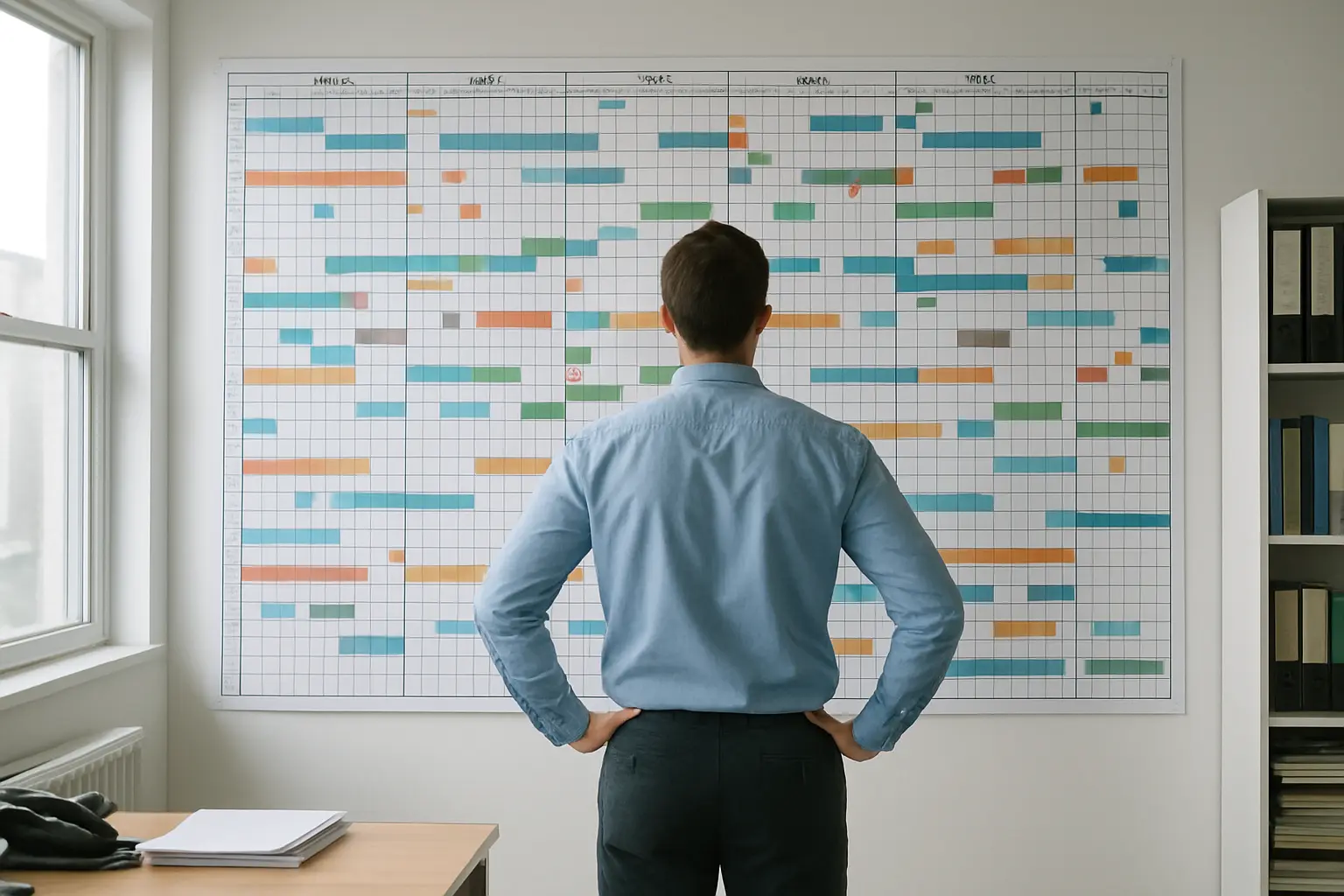
    A board tracking thesis chapters at different drafting stages
    Chapters do not go from nothing to finished. Naming the stages — outlined, drafted, revised, verified — is what makes progress visible in a year when it otherwise feels absent.

    Four rules that make a multi-year plan survive

    Plan in deliverables, not hours. “Work on chapter four this week” is unfalsifiable and will not happen. “Draft the 800 words establishing that participants distinguish availability from responsiveness” either happened or it did not.

    Nothing goes from zero to finished. Track each chapter through stages — outlined, drafted badly, revised, references verified, supervisor-read — because a doctorate contains long stretches where nothing is finished and a great deal is moving. A plan that only records completions will tell you, falsely, that you are not working.

    Re-plan on a schedule, not on a crisis. Once a term, thirty minutes, against reality. Plans do not fail because they slip; they fail because slipping is discovered late and the plan is quietly abandoned rather than adjusted.

    Buffer at the end, and do not spend it in advance. A doctorate with no slack does not survive one bad term. A doctorate with a year of vague slack invites the whole schedule to drift into it. One protected block, defended.

    What the plan is actually protecting you from

    Two costs, and they compound. The first is financial: the unfunded writing-up year, in which the stipend has stopped and the work has not. The second is what that does to you — the sector’s own survey found that among doctoral researchers who had considered leaving, mental or emotional health was the most cited reason at 20%, ahead of financial concerns at 14%, and the writing-up period is where those two pressures meet. The full figures and their caveats are in our page on PhD wellbeing and supervision satisfaction.

    Steady visible progress is not a productivity nicety in that context. It is the difference between a project you are managing and a project that is managing you.

    An early morning writing session as part of a sustained doctoral routine
    Two hundred words a week for three years is more than most theses need. The plan exists to make the routine possible, not to make you work harder.

    Where Tesify fits

    A wall planner tells you when a chapter is due. It does not help you write it, and it does not know what is in it — which is why most doctoral plans end up as an artefact separate from the work, consulted with guilt and eventually ignored.

    Tesify holds the plan and the thesis in the same place. It builds the chapter and section structure for your project, so the plan is made of the actual document rather than a parallel list. It drafts with you section by section, so a planned deliverable is something you can sit down and start. It tracks what exists and what does not across the whole candidature, so progress is visible in year two when it otherwise is not. And it maintains your bibliography in your citation style as you cite, so the reference work that usually lands as a miserable block at the end is simply already done.

    The design commitment matters as much as the features: the reading, the reasoning and the words stay 100% written by you. Tesify carries structure, formatting and momentum — which is precisely the layer that makes a four-year writing plan achievable, and precisely the layer no examiner is assessing. More than 9,000 students and researchers have used it across more than 15,000 chapters, and it is free to start.

    If you are already past the point this plan would have prevented — three years of notes and no chapter — that is a different and entirely recoverable problem, with its own staged method in our notes-to-chapter workflow.

    Do this in the next hour

    1. Find your maximum registration end date, your funded end date and your examination-entry deadline. Write all three down. Most candidates cannot currently name the third.
    2. List your chapters and write one sentence per chapter saying what it establishes.
    3. Place each chapter’s first draft against the year it belongs in, working backwards from submission.
    4. Book the one weekly writing session for the whole of next term.
    5. Put a thirty-minute re-planning appointment in the calendar for the end of term.

    Build the structure in Tesify and start with whichever chapter has the most material. It is free to begin, and the chapter you outline tonight is the one that stops “writing up” being a single block on a plan.

    Frequently asked questions

    How much does Tesify cost?

    There is a free tier, and you can build the full chapter structure and real drafts on it before deciding whether you need more. Weighed against an unfunded writing-up term, the comparison is not close.

    When should I start writing my thesis?

    Year one. The methodology is draftable while you are designing the study, and your upgrade or confirmation review already requires written work. Nothing about a doctorate rewards waiting until you feel ready.

    Is using a planning and drafting tool a research integrity problem?

    Not where it carries structure, formatting and references while you write the substance. Integrity questions arise when a tool produces interpretation, claims or citations you then present as your own reasoning. Follow your institution’s policy and any declaration requirement.

    Will my examiners care that I used a writing tool?

    What examiners test is whether you can discuss your own reasoning — why this design, why this interpretation, what you rejected. A workflow where every judgement is yours leaves you able to answer, which is the only thing the examination is measuring.

    Is my unpublished research safe?

    Your work in Tesify is yours: not published or shared out, and exportable. Keep your own backups as a habit with any tool, and remember that participant data is governed by your ethics approval and data-management plan regardless of the platform.

    How many words a week should I be writing?

    Less than you think, sustained for longer than you think. Eighty thousand words across three years is roughly five hundred a week with substantial time left for revision — the problem is almost never rate, it is that months pass at zero.

    What if my project changes and the plan is wrong?

    It will and it is. Re-plan once a term, in thirty minutes, and treat the change as information. A plan that is adjusted stays useful; a plan that is quietly ignored has stopped being a plan.

    Should I write chapters in order?

    No. Methodology early because you already know what you did, findings as analysis completes, discussion after them, introduction last because it must describe a thesis that exists.

    Do I need a Gantt chart?

    Only if your department asks for one, which some do at the proposal or upgrade stage. For actually running the project, a chapter list with stages and a term-by-term review beats any chart.

    How do I plan around fieldwork or lab access?

    Treat those windows as fixed and schedule writing around them, including inside them — the weekly session during data collection is the single habit that most reliably separates candidates who submit on time from those who do not.

    What if I am part-time?

    The same architecture, stretched, with one addition: part-time candidatures run over enough years that institutional deadlines and even regulations can change beneath you, so the termly re-plan should include a glance at your current code of practice rather than the one you read on arrival.

  • An Academic Paper Writing Tool for PhD Researchers: Getting the Article Out Before the Funding Does

    An Academic Paper Writing Tool for PhD Researchers: Getting the Article Out Before the Funding Does

    There is a paper in your thesis and you know exactly which chapter it is. You have known for eight months. It has not been written, because every week the thesis is more urgent, and a paper that is nobody’s deadline loses to a chapter that is. Then the funded period ends, and the thing you needed on your CV is the thing you never made time for.

    Tesify gives the paper its own structured workspace alongside your thesis, free to start — so drafting it stops competing with your chapters for the same blank document and the same evening. Below: what the delay actually costs, and the workflow that fixes it.

    What not writing it costs, in numbers

    The argument for publishing during candidature is usually made in vague career terms. The 2026 destinations data makes it concrete. Only 41% of working UK doctoral graduates were employed in higher education fifteen months after graduating — lower than the roughly half recorded in every previous analysis in that series — and of those in higher education research, just 7% held an open-ended contract. The figures and their caveats are in our page on UK doctoral career destinations.

    Read those two numbers together and the conclusion is unavoidable: the academic route is a minority destination competed for hard, and the currency it is competed for in is published work. Departments hiring toward the next assessment cycle are looking at output — the mechanics of which are covered in our explainer on the REF and PhD students, including why co-authored work carries institutional value your sole-authored thesis does not.

    Three costs, then, all of them incurred by delay rather than by any decision you consciously made:

    1. The empty CV at the worst moment. Applications for postdoctoral posts open while you are writing up. “Under review at Journal” on an application in month thirty-six is worth more than a published paper in month fifty.
    2. The unfunded year. Peer review takes months you do not control. Start the paper after submission and the first decision arrives when the stipend has stopped.
    3. The weaker viva. Examiners read a peer-reviewed chapter differently, and the reviewer questions you have already answered are the examiner questions you are about to be asked.
    A research office at the end of a funded doctoral period
    The deadline nobody schedules against. Everything you did not publish during the funded period, you publish during the unfunded one.

    Why the paper does not get written

    Not laziness, and not usually lack of material. Three structural reasons, each with a fix.

    It has no deadline. The thesis has supervisors, reviews and a registration end date. The paper has none of these, so it loses every scheduling contest it enters. Fix: give it a false deadline with a witness — a date agreed with your supervisor, in writing, at a supervision meeting.

    It is the wrong shape and you know it. A chapter and an article are different genres: the chapter proves to examiners that you did everything defensibly, the article tells a field one thing it did not know. Deleting a third of a 25,000-word chapter produces a bad article, everyone senses this, and so nobody starts. Fix: never open the chapter file first. Build the article’s architecture empty, then pull material into it.

    It competes for the same document. Most candidates draft the paper in the same environment, the same folder and the same mental mode as the thesis, so the two jobs interfere. Fix: separate workspace, separate outline, separate sitting.

    The workflow, in five sittings

    This assumes the analysis is done and one chapter contains one extractable claim. The procedural detail — prior-publication policy, authorship norms with supervisors, journal selection and the predatory screen — is in our step-by-step guide to publishing a paper from your PhD thesis. What follows is the drafting half, which is where the months disappear.

    Sitting 1: Write the claim and pick the journal

    One sentence stating what the paper shows. Then three candidate journals ranked by where the work you cite most actually appears, and the author guidelines of the first one open in front of you. Every decision after this is made against a real word limit and a real section structure rather than an imagined one.

    Sitting 2: Build the empty architecture

    Introduction, methods, results, discussion — at that journal’s scale and with its headings, as an outline with a word budget per section and nothing in it. In Tesify this is the same structural work the tool already does for thesis chapters, applied to a shorter document: you set the target shape, and the workspace holds it while you fill it.

    Sitting 3: Pull material deliberately

    Now open the chapter, and move only what the claim needs. The literature review shrinks to its load-bearing third. The examiner-proofing — the third robustness check, the full instrument — goes to supplementary material. This is sorting rather than writing, which means it is achievable on a tired evening, and it is most of the job.

    Sitting 4: Rewrite the discussion outward

    The thesis discussion faces inward to your research questions; the paper’s faces the field. This section cannot be lifted and must be written new, and it is the section reviewers judge you on.

    Sitting 5: Format, reference, submit

    Reference style to the journal’s specification, cover letter in three paragraphs, declarations including the thesis origin. An automatic bibliography does the reformatting that otherwise eats an evening per submission — and if the paper is rejected and goes to a second journal in a different style, it does it again for free.

    A journal manuscript laid out in sections during a rewrite from a thesis chapter
    Build the shape first, then move material into it. Starting from the chapter file is what produces a compressed chapter instead of a paper.

    Where Tesify fits, precisely

    Tesify is a structured academic writing workspace rather than a text generator, and for paper writing that distinction is the whole product. It holds the section architecture you set from the journal’s guidelines, drafts with you section by section instead of producing a finished manuscript, keeps your bibliography formatted in the target style as you cite, and sits alongside your thesis chapters in the same workspace so material moves between them without a folder archaeology expedition.

    What it does not do is the part that would sink you: it does not decide what your findings mean, does not write your contribution claim, and does not invent references. Everything of substance stays 100% written by you, which is the only configuration that survives peer review and a viva. More than 9,000 researchers and students have used it across more than 15,000 chapters, and it is free to start.

    If your thesis chapters are themselves the bottleneck, that is a different job with the same tooling — the method is in our notes-to-chapter workflow. And if your doctorate is structured as a thesis by publication, this workflow is not an extra: it is your thesis, run three times.

    The line, stated plainly

    This audience does not forgive a fudge here, so: tools may carry structure, formatting, references and consistency. They may not carry the argument.

    Reasonably delegated — section architecture from a journal’s guidelines; reference formatting and reformatting between journals; checking that your aims, methods and conclusions still agree after cuts; flagging where a draft assumes something it has not established. Never delegated — what the findings mean; the contribution claim; any citation you have not personally opened and read; text you could not defend to a reviewer or an examiner.

    Language polish sits between the two and is governed by your institution’s rules, which genuinely differ across UK universities — some permit tracked minor corrections by a third party or a tool, others treat third-party editing as a misconduct offence. Our guide to AI academic English editing maps the permitted register and how to disclose it. If your journal or institution asks about tool use, answer plainly; a use you can state openly is a use you have already vetted.

    Start with the chapter you already know about

    Not the best chapter. The one with a single claim that stands on its own — you thought of it while reading this. Give it a deadline this week, build the architecture in one sitting, and submit before your registration ends rather than after.

    Open a workspace for the paper in Tesify and build its structure tonight — free to start, your argument, your words, with the clerical layer handled.

    Frequently asked questions

    How much does Tesify cost?

    There is a free tier and you can build real structure and real drafts on it before deciding whether you need anything more. On a stipend, the comparison worth making is not the subscription against zero but against the cost of an unfunded writing-up term.

    Is using an AI writing tool on a journal paper research misconduct?

    Not where it handles structure, formatting, references and consistency checking on work you wrote. It becomes a problem when a tool produces substance — interpretation, claims, or citations — that you then present as your own reasoning. Follow your institution’s policy and your target journal’s declaration requirements.

    Will reviewers or examiners be able to tell?

    The reliable signal is not stylistic. It is whether you can answer questions about your own reasoning — why this analysis, why this interpretation, what you rejected. A workflow where every judgement is yours leaves you able to answer; one where it is not, does not.

    Do journals require me to declare AI use?

    Many now ask, and the safe practice is to answer honestly and specifically: what the tool did, and what it did not. A precise declaration reads as command of the boundary rather than as confession.

    Is my unpublished research safe in an online workspace?

    A fair question to ask of any tool before uploading a manuscript. In Tesify your work is yours — not published or shared out — and exportable, and keeping your own backups is good practice everywhere. Where participant data is involved, your data-management plan and ethics approval govern what may be uploaded at all.

    Can I use it for a paper that is not from my thesis?

    Yes — the workspace is document-agnostic. A collaboration, a review article or a conference paper uses the same architecture-first method, with the target venue’s guidelines setting the shape.

    How is this different from a reference manager?

    A reference manager holds your library; this holds the manuscript. They are complementary, and the automatic bibliography here is about formatting what you cite into the target journal’s style rather than about storing PDFs.

    Should I write the paper before or after submitting the thesis?

    Before, where the analysis allows it. Peer review runs on its own clock, and a decision that arrives during your funded period is a decision you can act on; one that arrives afterwards is one you handle unpaid.

    What if my supervisor wants to be first author?

    That is an authorship conversation to have early and explicitly, against your field’s norms and your journal’s criteria — contribution rather than seniority. Having it before drafting begins is the single best predictor of it going well.

    Can it help with the response to reviewers?

    Yes, as structure: a point-by-point response letter is a document with a known shape, and holding it against the reviewers’ comments is exactly the clerical scaffolding worth automating. The judgements about which criticisms to accept remain yours.

  • Is It Safe to Put Unpublished Thesis Data Into an AI Tool? (2026)

    Is It Safe to Put Unpublished Thesis Data Into an AI Tool? (2026)

    You have four years of unpublished research, a folder of interview transcripts collected under an ethics approval, possibly an industrial partner’s confidentiality agreement, and a text box that will happily accept all of it. The question is not paranoid and it is not rhetorical: doctoral researchers hold the most sensitive material of any student group, and almost nobody has told them where the line is. Tesify is a workspace built to hold a whole thesis, not a chatbot you paste into, and it is free to start — but the point of this page is the reasoning, because you will use more than one tool over four years and you need a rule, not a recommendation.

    This page is about your research material: participant data, unpublished results, and work under a confidentiality agreement. It is not about language editing or authorship, which are a separate question covered in our guide to AI academic English editing, and it is not about proofreading services.

    Start with what the law actually says, because the common claim is wrong

    The claim circulating in most PGR common rooms is that data protection law forbids putting participant data into a third-party tool. That is not what it says, and getting the rule right matters because the true version is both more permissive and more demanding.

    The Information Commissioner’s Office sets out the research provisions plainly. Article 89 of the UK GDPR makes use of those provisions dependent on “appropriate safeguards” taking “the form of technical and organisational measures”, and Article 89 “specifically mentions measures to ensure respect for the principle of data minimisation. This may involve, where possible, anonymising or pseudonymising data.”

    Then comes the sentence that reframes the whole question. On anonymisation, the ICO states: “Anonymous information is not personal data. Data protection law does not apply.”

    So the requirement is not a prohibition on tools. It is a sequence. Data minimisation under Article 5(1)(c) means personal data should be “adequate, relevant and limited to what is necessary in relation to the purposes for which they are processed”, and the ICO’s instruction is to work back from that: “You should first consider whether it is possible to conduct your research without using personal data. If you could carry out your research using anonymised data, then you do not need to process personal data.”

    Where you cannot anonymise, pseudonymisation is the fallback — and the ICO is careful that it is not the same thing: “Pseudonymous data is still personal data and data protection law applies.” Either way, timing matters: “you should ensure that you do anonymisation or pseudonymisation at the earliest possible opportunity, ideally prior to using the data for research purposes.”

    Two hard limits sit on top. Section 19 of the Data Protection Act 2018 states that research-related processing does not satisfy Article 89 if it “is likely to cause people substantial damage or substantial distress” or “is carried out for the purposes of measures or decisions about particular people”, except for approved medical research.

    One currency note, because this is exactly the kind of claim that goes stale: the ICO’s own research-provisions guidance currently carries a banner stating that, due to changes made by the Data (Use and Access) Act, the guidance is under review and may be subject to change. Read the current version rather than a summary — including this one — before relying on it for a decision that matters.

    An interview transcript being anonymised by hand before any tool touches it
    Anonymise at the earliest opportunity and most of the problem disappears — because anonymous information is not personal data at all.

    The four categories, and only one of them is genuinely hard

    1. Your own prose. Your draft chapters, your argument, your literature synthesis. No personal data, no third-party confidentiality, no participants. The only questions here are the tool’s retention terms and your institution’s authorship rules, and both are manageable.

    2. Anonymised or aggregated results. Summary statistics, model outputs, coded themes with no identifiers. On the ICO’s own statement, anonymous information is not personal data and data protection law does not apply — so the analysis here is about commercial confidentiality and prior publication, not about data protection.

    3. Identifiable participant data. Raw interview transcripts with names, places of work and clinical detail; recordings; anything from a small population where deductive disclosure is possible. This is the hard category, and the rule is the sequence above: anonymise or pseudonymise first, at the earliest opportunity, and only then decide what tool touches it.

    4. Third-party confidential material. Data belonging to an industrial partner, an NHS trust or a sponsoring organisation, governed by an agreement you probably signed at the start and have not read since. This category is not governed by data protection reasoning at all — it is governed by a contract, and the contract may prohibit disclosure to any third party regardless of whether personal data is involved.

    What your ethics approval already committed you to

    This is the constraint doctoral researchers forget, and it binds independently of the law. Your ethics application described how data would be stored, who would have access to it and how long it would be kept. Your participant information sheet told people that, and they consented on that basis.

    If your consent form says the recordings will be held on university-managed storage and accessed only by the research team, then routing them through a transcription service or a chatbot is a departure from what your participants agreed to — whatever the tool’s privacy policy says. That is a research-integrity question before it is a legal one, and the remedy is not to reason about it privately but to go back to your ethics committee for an amendment if the workflow has changed. Committees approve amendments routinely; they take a much dimmer view of discovering the change afterwards.

    This bites hardest on audio. Recorded interviews are the most identifiable material most doctoral researchers hold — a voice is a biometric identifier and a transcript may name colleagues, employers and patients. Our comparison of transcription tools for PhD research interviews goes through the accuracy, ethics and cost trade-offs specifically, and the data-handling question there is the same one as here, one step earlier in the pipeline.

    The other two risks nobody frames as data protection

    Your NDA. If your project is industry-sponsored or embedded in an organisation, read the agreement before you read any privacy policy. Confidentiality clauses commonly prohibit disclosure to any third party without written consent, and a cloud tool is a third party. It does not matter that the data is anonymised or that the vendor promises not to train on it. Ask your supervisor or your university’s research contracts team whether the agreement permits third-party processing at all; that is a two-email question with a written answer.

    Prior publication and embargo. Journals care about whether material has been publicly disclosed before submission. Pasting a passage into a tool with confidential-input terms is not publication; posting it into a public forum, a shared community workspace or anywhere indexable can be. If you intend to publish a paper from your thesis or to submit a thesis by publication, keep unpublished material out of anything with a public surface, and keep the embargo question in view from the start rather than at deposit.

    A researcher reading a tool's data retention terms before uploading anything
    Twenty minutes on the terms page, once, covers four years of use. The homepage will not tell you any of it.

    Five questions to ask of any tool, before you upload anything

    1. Is my input used to train the provider’s models, and can I turn that off? Consumer and professional tiers of the same product frequently differ on exactly this. The answer lives in the terms, not the marketing.
    2. How long is my content retained, and can I delete it? “We do not train on your data” and “we delete your data” are different promises, and vendors often make only the first.
    3. Where is it processed, and who else can see it? Sub-processors, staff review for abuse monitoring, and jurisdiction all matter if your ethics approval or your NDA specified storage arrangements.
    4. Is there a written agreement my university would accept? Where personal data is involved, an institution acting as controller needs a proper processing arrangement, not a consumer click-through. Your research office knows which tools already have one.
    5. Can I export everything and leave? A four-year project should never be locked inside a service, and export is also your insurance against a vendor changing its terms mid-candidature.

    Two practical shortcuts. Your university almost certainly has an approved-tools list and a research data management policy; checking them takes ten minutes and answers question four for free. And if you can answer these five questions out loud about every tool in your workflow, you can also answer them in a viva, which is the standard worth holding yourself to — the same test our guide to the notes-to-chapter writing-up workflow applies to authorship.

    A workflow that is defensible end to end

    1. Anonymise or pseudonymise at collection, not at analysis. The ICO’s “earliest possible opportunity” is a genuine instruction, and it also makes every later decision easier.
    2. Keep the identifier key separate, on university-managed storage, and never let it near a third-party service.
    3. Do analysis on the de-identified set. If your method needs the identifiers, that is a design question for your ethics application, not a tooling question.
    4. Choose one workspace for the writing and stay in it. The risk in most doctoral workflows is not one careless upload; it is fragmentation — the same chapter scattered across four services with four different retention policies, none of which you have read.
    5. Record what you did. A short note of which tools you used, for what, and under what settings. It costs nothing, and it turns an awkward viva question into a two-sentence answer.

    That fourth point is the one Tesify is built around. Rather than pasting fragments of your thesis into whatever tool is open, the chapters, structure and bibliography live in one workspace, and your work stays yours — not published, not shared into any public database, and exportable whenever you want it. Everything remains 100% written by you: the research, the reasoning and the words. Start free and keep the whole thesis in one place — which matters most across the long candidatures our page on how long a UK PhD actually takes describes, where a four-year trail of scattered drafts is the real exposure.

    For choosing the discovery and appraisal tools that sit earlier in the pipeline, our comparison of the best AI research assistants for PhD students covers what each does with your queries and your library.

    Frequently asked questions

    Is it against UK data protection law to put my research data into an AI tool?

    Not as a blanket rule. The ICO’s position is that anonymous information is not personal data and data protection law does not apply to it, so the first question is whether you can anonymise. Where you cannot, pseudonymised data is still personal data and the safeguards under Article 89 apply.

    What does “appropriate safeguards” actually mean?

    Technical and organisational measures, with Article 89 specifically naming data minimisation — which the ICO says “may involve, where possible, anonymising or pseudonymising data”. Section 19 of the DPA 2018 adds that research-related processing does not satisfy Article 89 where it is likely to cause substantial damage or substantial distress, or where it is for measures or decisions about particular people, except in approved medical research.

    Is pseudonymised data safe to upload?

    It is still personal data, so the same obligations apply as to any other personal data — it is a risk reduction, not an exemption. Anonymisation is the step that takes the material outside data protection law entirely.

    Does my ethics approval restrict which tools I can use?

    Very likely, because your application described how data would be stored and who would access it, and your participants consented on that basis. If your workflow has changed, submit an amendment rather than proceeding and explaining later.

    Can I put interview recordings into a transcription service?

    Only if your ethics approval and consent documentation cover it, and only after checking the service’s retention terms. Audio is the most identifiable material most doctoral researchers hold, which is why it deserves the most careful handling in the whole pipeline.

    My project has an industrial NDA. Does anonymising solve it?

    No. Confidentiality agreements typically restrict disclosure to third parties regardless of whether the material contains personal data, so the analysis is contractual rather than data-protection-based. Ask your research contracts team for a written answer.

    Will using an AI tool count as prior publication?

    Not where the tool treats your input as confidential. The prior-publication risk comes from public disclosure — forums, shared public workspaces, anything indexable — so keep unpublished material off public surfaces if you intend to publish from the thesis.

    How do I know whether a tool trains on my content?

    Read the terms rather than the homepage, and check whether the setting differs between tiers of the same product. If you cannot find a clear answer, treat that absence as the answer for anything sensitive.

    Do I have to declare tool use to my examiners?

    Follow your institution’s disclosure requirements, which increasingly extend to AI used inside editing tools. A short, accurate statement of what you used and for what is cheap, and it removes the question from the room.

    Is Tesify safe for unpublished doctoral research?

    Your work in Tesify is yours: it is not published or shared into any public database, and you can export it at any time. As with any tool, keep your own exported backups, and apply the anonymisation sequence above to participant data before it goes anywhere.

    Who at my university can give me a definitive answer?

    Your data protection officer or research office for the data protection question, your ethics committee for the consent question, and research contracts for anything under an NDA. All three answers are worth having in writing before you build a workflow around a tool.

  • AI Research Proposal Generator for PhD Applications: What It Can and Cannot Honestly Do (2026)

    AI Research Proposal Generator for PhD Applications: What It Can and Cannot Honestly Do (2026)

    It is application season, the studentship you want closes in three weeks, and the blank document titled “Research Proposal” has not moved in days. Into that anxiety, “AI research proposal generator” is a natural search — and it deserves a straight answer rather than a sales page. The straight answer: a tool that generates a proposal for you is a trap, because the proposal is a promise you will be interviewed on; a tool that structures and drafts it with you is a genuine accelerant. Tesify is built as the second kind, and this page is honest about the difference.

    Why a generated proposal fails even when it reads well

    Three structural reasons, none about detection. The proposal is examined orally: shortlisted applicants are interviewed on their proposal by academics whose job is probing depth — why this gap, why this method, what you will do when access falls through — and fluent text you did not think through collapses in the second follow-up question. The proposal is a research instrument: supervisors read it to decide whether you can think, and a panel that funds a generically plausible project has funded the median of the literature, which is precisely what research is not. And the proposal follows you: it becomes the baseline for your first-year review, so a document describing a project you cannot actually execute is a debt that comes due within twelve months. Generic generated proposals also share a fingerprint every panel now recognises — safe gap, fashionable method, no friction with reality — and mediocrity, not detectability, is what kills them.

    What AI legitimately accelerates

    Underneath the drafting anxiety, a proposal is a set of engineering problems, and machines are good at several of them. Structure: funder and university proposal templates vary, but the load-bearing anatomy — question, positioning in the literature, method, timeline, contribution — is stable, and having it scaffolded kills the blank page without writing a word for you. Compression: proposals live under brutal word limits, and tightening your own overwritten draft to the limit is exactly the mechanical editing a tool does well. Consistency: the aims stated on page one must match the methods on page three and the timeline on page four, and automated cross-checking catches the drift that panels read as sloppiness. Bibliography: application deadlines are exactly when citation formatting should be nobody’s job — an automatic bibliography keeps the references correct while the argument gets your attention. What stays yours, non-negotiably: the question, the reading, the method choice and the words that claim them.

    A research proposal marked up by section
    The sections are standard; the thinking inside them is what gets funded.

    The five questions every panel asks

    Whatever the template, shortlisting panels are reading for five answers, and drafting against them is the fastest quality check available. What exactly do we not know? — a gap stated so specifically that a reader could check it against the literature. Why does it matter, and to whom? — significance argued for a named field or beneficiary, not asserted with adjectives. How will you find out? — a method chosen over its rivals for reasons you give, with the data or access you will actually have. Can it be done in the time? — a work plan whose first year is concrete and whose contingencies are visible. And why you, here? — the fit paragraph connecting your skills and the department’s strengths, which is the section applicants most often forget and interviewers never do. Read your draft once as each question; anywhere you cannot point to the answering sentences, the panel will not find them either.

    The two-week proposal workflow

    Days one to three: define the question and the gap — from your own reading, with your prospective supervisor’s published work in the stack, because fit is a criterion everywhere. Write the one-paragraph pitch first: what we do not know, why it matters, how you will find out. Days four to seven: build the full structure in Tesify from that paragraph — aims and objectives, literature positioning, methodology, work plan — drafting each section against the funder’s actual headings and limits; the full section-by-section content method is in our guide to writing a PhD research proposal for a UK studentship. Days eight to ten: the feasibility pass — timeline against a realistic three-to-four-year candidature, method against your access and skills, scope against the golden rule that a doctorate is examined as a contribution to knowledge, not a career’s worth of ambition. Days eleven to fourteen: feedback from one academic reader and one intelligent outsider, then compression to the word limit and the consistency check. That is a fundable process inside three weeks — with the tool carrying the scaffolding, not the thinking.

    If you are applying for funding, know the numbers

    Proposal quality decides whether you enter a funded pipeline, so anchor the stakes with the published figures: UKRI’s minimum stipend is £20,780 for the current year, rising to £21,805 from 1 October 2026 (London-weighted rates higher), tax-free, with fees covered — the full picture, including what the terms and conditions do and do not guarantee, is in our stipends and funding roundup. Three to four funded years are what a strong proposal is actually buying. Priced that way, the two weeks of real work above are the best-paid fortnight of your early career — and the case for doing it properly rather than generating it is also financial.

    Disclosure, integrity and the application context

    Universities’ AI rules were written mostly for assessed coursework; applications sit in a stricter frame — a proposal is a representation of your abilities to a selection panel, so the authorship bar is higher, not lower. The clean position: use tools for structure, compression, consistency and formatting; write the substance yourself; and if the application asks about AI use, answer plainly. The test that never fails: could you discuss every sentence of your proposal, unprompted, in an interview? With the workflow above the answer is yes by construction — the tool never wrote a claim you did not make. That is also why the “generator” framing undersells what you actually need: not a machine that produces proposals, but a workspace where your proposal gets produced faster. Start yours in Tesify free — structure it tonight, draft it this week, and walk into the interview owning every line, 100% written by you.

    Frequently asked questions

    Can I use AI to write my PhD research proposal?

    You can use AI to structure, tighten and format it; the research thinking and the claims must be yours, because the proposal is examined in interview and becomes your first-year baseline. Generated substance fails at both checkpoints.

    Will universities detect an AI-generated proposal?

    The reliable failure mode is not detection but interview collapse and generic mediocrity — panels fund specific, feasible, personally-owned projects. Treat “would this survive follow-up questions from me?” as the real detector.

    Do I have to disclose AI use in a PhD application?

    Follow each university’s application guidance; where a disclosure question exists, answer it honestly. Structural and editing assistance disclosed plainly costs you nothing; misrepresented authorship in an application is a serious integrity matter.

    How long should a PhD research proposal be?

    Whatever the funder or department specifies — commonly in the 1,000–3,000 word range for UK applications, sometimes shorter for advertised projects. The limit is part of the test: panels read compression as thinking.

    What makes a proposal stand out to a funding panel?

    A precise question the applicant visibly owns, a method matched to it, honest feasibility, and fit with the supervisor and department. Polish helps; specificity decides.

    Is the proposal binding once I start the PhD?

    No — projects evolve, and everyone involved knows it. But it anchors your first progress review, so propose a project you would genuinely execute, not the most impressive-sounding one.

    How is Tesify different from a proposal generator?

    It does not produce proposals. It gives you the section architecture, drafting workspace, consistency checking and automatic bibliography, and you write the content — which is the only version of AI help that survives an interview.

    Can Tesify help after the proposal, too?

    That is the main event: the same workspace structures and drafts the thesis itself, chapter by chapter, across the whole candidature — with the bibliography maintained automatically throughout.

    What should I do if the deadline is one week away, not three?

    Compress the same sequence: two days on question and pitch, three on structured drafting, one on feasibility, one on feedback and cuts. The order matters more than the duration — a day spent drafting before the question is fixed is a day lost.

    Do proposals for advertised (pre-defined) projects still need this work?

    Yes, redirected: instead of proposing a project, you demonstrate command of the advertised one — why it matters, how you would approach it, what you bring. The interview stakes are identical, so the ownership rule is too.

  • AI Academic English Editor for Doctoral Researchers: Polish the Thesis Without Losing Authorship (2026)

    AI Academic English Editor for Doctoral Researchers: Polish the Thesis Without Losing Authorship (2026)

    You have run the study, built the argument, and now the last barrier between you and submission is the sentence-level state of 80,000 words of academic English — which, if English is your second or third language, has been a silent double workload for the entire doctorate. The instinct to hand the manuscript to someone who will “fix the English” is understandable, and it is exactly where careful researchers get into trouble, because universities regulate that hand-off tightly. The legitimate version of the fix exists: an AI editor working inside your own draft, suggestion by suggestion, with you deciding every change. Here is the whole picture, rules included.

    The stakes are real in both directions

    Under-edited, a thesis pays twice: examiners distracted from the contribution by surface errors, and corrections lists padded with typographical items that a systematic pass would have removed — avoidable weeks, when minor corrections deadlines are typically measured in months. Over-edited, it pays worse: a thesis whose prose outruns the candidate’s demonstrated voice invites exactly the authorship questions a viva exists to probe, and “a service rewrote it” is not an answer any examination outcome improves on. The target is the middle: your sentences, systematically corrected, in a process you can describe out loud without discomfort.

    What the rules actually say

    Most UK universities publish proofreading guidance, and the architecture is remarkably consistent — the University of Edinburgh’s guidance on proofreading of student assessments is a usefully explicit example. Students are “normally permitted” to engage a proofreader — a friend, family member, paid professional or an online proofreading tool — to suggest minor changes that improve the readability of written English. What a proofreader may do: correct minor, localised issues of spelling, punctuation, grammar and syntax, with edits tracked; and comment on larger problems without fixing them. What a proofreader must never do: make untracked changes, rewrite text, or produce content on the student’s behalf — that is editing or ghost-writing, and it is academic misconduct. Students remain responsible for every change they accept, must keep before-and-after copies, and — the clause written for this decade — must acknowledge the use of generative AI where it operates inside a proofreading tool.

    Read those rules again and notice something: they describe a workflow, and it is precisely the workflow a suggestion-based AI editor enforces. Tracked, localised corrections; comments rather than rewrites for structural issues; the author deciding each change; a record of what happened. The policy anxiety about AI editing dissolves when the tool is built to operate inside the rules rather than around them — though your own institution’s wording, and your school’s, is the version that governs you, so read it before your final pass.

    Margin corrections on a printed thesis draft
    The permitted register everywhere: minor, localised, tracked — with the author deciding every change.

    What an AI academic editor does well at thesis scale

    Four things, all inside the permitted register. Consistency at volume: an 80,000-word document written over three years drifts — hyphenation, capitalisation of your own key terms, tense conventions between chapters — and a machine finds every instance where a human proofreader finds most. Academic register: flagging conversational phrasing, hedging that collapses (“may possibly suggest”), and the noun-stacked sentences that grow in second-language academic writing like ivy. Grammar in the long tail: article usage and preposition choice — the classic persistent errors for speakers of languages without articles — corrected suggestion by suggestion, which incidentally teaches the pattern as you accept or reject. And error classes humans fatigue on: duplicated words across line breaks, mismatched brackets, citation punctuation.

    What it must not do for you — and what you should not accept even when offered — is generate your argument’s prose: new paragraphs, restructured sections, “improved” versions of whole passages. That is the rewrite line every university’s guidance draws. Structural problems belong in a different, equally legitimate workflow: diagnose them, then rewrite them yourself — our guides to the discussion chapter and the notes-to-chapter writing-up method cover the two places structure most often fails.

    The workflow that keeps authorship yours

    First, finish the thinking before polishing the surface — editing a chapter whose argument will change is double work. Second, run the AI editor chapter by chapter, reviewing suggestions individually: accept the corrections, reject the rewrites, and notice the patterns in what it keeps flagging, because that list is your personal grammar curriculum. Third, keep the before-and-after versions, exactly as proofreading policies require of human proofreading — with a suggestion-based tool inside your own workspace this is automatic, and it is your evidence of a compliant process. Fourth, disclose according to your institution’s formula. A one-line acknowledgement — language-editing suggestions from an AI tool were reviewed and accepted or rejected individually by the author — costs nothing and survives any scrutiny. If a disclosure sentence feels uncomfortable to write, treat that as diagnostic: the process, not the sentence, is what needs changing.

    Why in-draft beats copy-paste editors

    The practical difference between an editor inside your writing workspace and a paste-into-a-box tool is bigger than it looks at thesis scale. In Tesify, the editor works on the draft where it lives — no fragmenting your thesis into pasted chunks, no reassembly errors, no wondering which version is current. The same workspace holds your chapter structure and your automatic bibliography, so the clerical layer — formatting, references, consistency — is handled by machinery while every sentence of argument remains yours: 100% written by you. And because your thesis is unpublished intellectual property, it matters that your draft is not being scattered across tools with retention policies you have never read; in Tesify your work stays yours and exports cleanly. Start free and run your next chapter through it — the suggestion-review loop takes an evening and teaches you your own error patterns faster than any style guide.

    A word to EAL researchers specifically

    Two things are true at once. Your English does not need to be native — examiners assess the contribution, and the QAA-style doctoral criteria nowhere require idiomatic elegance; clear, correct academic English is the standard, and it is reachable. And the workload asymmetry is real: you are writing at doctoral level in your second language while your anglophone peers write in their first, which is precisely why systematic tooling for the mechanical layer is fair rather than suspect. Spending your finite attention on argument instead of article placement is not a shortcut; it is correct resource allocation, and the disclosure line above makes it transparent.

    Frequently asked questions

    Is using an AI editor on my thesis considered misconduct?

    Not where it operates within your university’s proofreading rules: minor, localised language corrections, reviewed and decided by you, with the process documented and disclosed as required. Misconduct starts where generation starts — text produced on your behalf.

    Do I have to tell my examiners I used an AI editor?

    Follow your institution’s disclosure requirements — guidance increasingly asks for acknowledgement of generative AI even within proofreading tools, and Edinburgh’s does explicitly. A one-line acknowledgement is cheap insurance and reads as professionalism, not confession.

    Can I use a paid human proofreader instead?

    Usually yes, within the same rules that bind any proofreader: tracked minor corrections, no rewriting, and often a declaration. Human proofreading and AI editing sit under the same policy architecture; neither may author your text.

    What is the difference between proofreading and editing in these policies?

    Proofreading corrects surface errors — spelling, punctuation, grammar, syntax — locally and visibly. Editing changes substance: structure, argument, meaning, whole sentences. Policies permit the first with conditions and treat the second, done by any third party, human or machine, as misconduct territory.

    Will an AI editor make my thesis sound like it was written by AI?

    A suggestion-based editor correcting your sentences leaves your voice intact — that is the point of accepting changes individually rather than accepting a rewrite. If a tool’s output stops sounding like you, you have crossed from correction into generation; step back.

    Is my unpublished research safe in an online editor?

    Check any tool’s data handling before pasting in unpublished work. In Tesify your thesis is yours — not shared or published — and exportable; keeping your own backups remains good practice with every tool.

    My supervisor says my English is “not the problem”. Should I still edit?

    Probably — supervisors read for argument and forgive surface noise; examiners see the document cold. A systematic consistency pass before submission catches the layer supervisors stopped noticing in year two.

    Can AI editing fix my discussion chapter?

    No — if the discussion is weak, the problem is structural, not grammatical, and language polish will make well-written weakness. Fix the argument first with a proper chapter method, then edit the surface.

    How long does an editing pass on a full thesis take?

    Reviewing suggestions individually, budget an evening or two per chapter — front-loaded on the first chapter while you learn your own patterns, faster thereafter. It compresses dramatically compared with proofreading on paper precisely because the finding is automated and only the deciding is yours.

    Does good English actually change examination outcomes?

    Clean language does not pass a weak thesis, but noisy language taxes examiner attention and inflates corrections lists with fixable items. Removing that tax is one of the few pre-viva improvements entirely within your control in the final month.