Tag: ATLAS.ti

  • NVivo vs ATLAS.ti vs Taguette for Qualitative PhD Research in 2026 (They Are Not All Rivals Any More)

    NVivo vs ATLAS.ti vs Taguette for Qualitative PhD Research in 2026 (They Are Not All Rivals Any More)

    Start with a fact that reframes most of the comparisons you will find online: NVivo and ATLAS.ti are now products of the same company. Lumivero acquired QSR International, NVivo’s publisher, with the legal entity consolidation taking effect on 1 July 2023, and announced its acquisition of ATLAS.ti on 12 September 2024. Lumivero lists both under its research and qualitative data analysis portfolio.

    This matters for two reasons. Older head-to-head comparisons were written when these were competing companies with an incentive to differentiate, so their framing is now dated. And a market where the two dominant tools share an owner is one where you should think harder than usual about lock-in.

    NVivo ATLAS.ti Taguette
    Owner Lumivero Lumivero Rémi Rampin and contributors
    Licence Proprietary Proprietary Open source (BSD 3-Clause)
    Cost to you Commercial; often a university site licence Commercial Free
    UK site licences Common Less common Not applicable
    Feature depth Very high Very high Deliberately minimal
    Access after your registration ends Usually lost Usually lost Retained
    Best suited to Large mixed-method projects in NVivo departments Visual, network-oriented analysis Interview coding where simplicity is a feature

    NVivo

    NVivo is the most widely licensed qualitative analysis package in UK universities, and that institutional footprint is its main practical advantage. The University of Manchester, for example, announced in June 2025 that NVivo 14 and 15 are available for all staff and students working in the UK or Ireland. Where a site licence exists, so usually do local training sessions, library guides and colleagues who can help when something breaks — support that is worth more mid-project than any feature.

    Strengths at doctoral scale. It handles large and heterogeneous datasets well: interviews, focus groups, documents, survey open-text and media in one project. Its matrix and comparison queries are genuinely useful when you want to examine how coding varies across participant attributes, which is exactly the kind of analysis a doctoral project reaches in its second year and an undergraduate project never does.

    Weaknesses. The interface rewards investment; expect to lose real time early. Licensing is the sharper issue — student licences are typically time-limited, and access normally ends with your registration. Lumivero states that it supports two previous versions, which matters if you return to a project after a gap.

    ATLAS.ti

    ATLAS.ti has a long lineage — the company behind it was founded in 1993 — and a distinct analytical character. Where NVivo’s mental model is a hierarchy of codes, ATLAS.ti’s is a network: it is built around linking quotations, codes and memos and then visualising those relationships.

    Strengths. If your analysis is genuinely relational — grounded theory work where you are building connections between concepts rather than counting occurrences within them — the network view is not decoration; it is the analysis. Its quotation-level linking is more natural than NVivo’s for this style of work.

    Weaknesses. UK institutional licences are less common than for NVivo, so you are more likely to be paying yourself or working within a departmental allocation. Its published pricing page was unavailable at the time of writing, so confirm current student licensing directly with the vendor rather than relying on figures quoted in older guides.

    The ownership point again. Two products under one owner may converge, and the differentiation between them may narrow over time. Nothing about that is sinister, but it argues against choosing on the basis of a feature gap that may not persist for the length of your candidature.

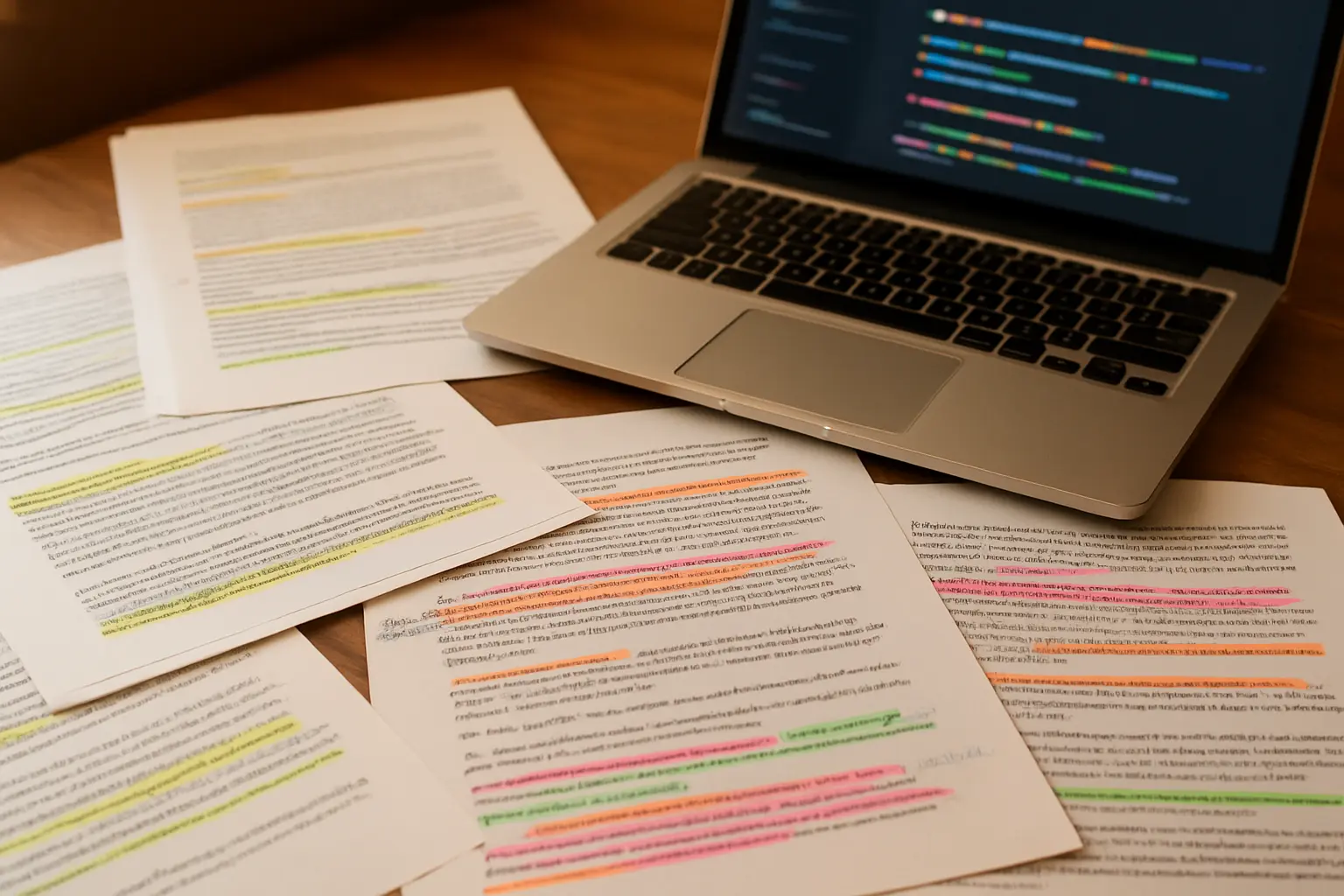
    Colour-coded thematic codes applied across qualitative data
    Software organises coding; it does not perform it. The interpretive decisions remain entirely yours.

    Taguette

    Taguette is free and open source, released under the BSD 3-Clause licence and maintained by Rémi Rampin with contributors. It is actively maintained — its repository showed commits in 2026 at the time of writing — and a hosted version is available alongside a local install.

    One caution when assessing it: its GitHub mirror lists releases only up to 2019, because releases are cut on GitLab rather than the mirror. Read that as a packaging artefact, not as abandonment, which is a mistake some comparison articles make.

    Strengths. It does the core job — importing documents, highlighting, tagging, exporting coded extracts — and it does not expire. Your project remains yours after submission, after your viva and after your registration ends. For interview-based doctoral work with a manageable number of transcripts, the feature gap against the commercial tools is smaller than their marketing implies.

    Weaknesses. Deliberately minimal. No sophisticated query language, no attribute-based matrix analysis, no substantial visualisation. If your project needs to interrogate coding patterns across participant characteristics, you will hit the ceiling. Institutional support is unlikely to exist, so you are your own help desk.

    The criterion doctoral researchers under-weight

    Ask what happens to your project files when your licence ends.

    This is a doctoral problem specifically. Undergraduate projects finish and are never revisited. A doctoral project generates papers for years afterwards — and returning to your coded data to check a claim for a reviewer, eighteen months after submission and six months after your account closed, is a genuinely common scenario.

    Three mitigations, whichever tool you choose. Export your coded extracts in an open format at every major milestone rather than only at the end. Keep your codebook as a separate document, not only inside the software. And before your registration ends, export everything and check the export actually opens.

    The recommendation

    Use NVivo if your university holds a site licence and your department teaches it — local support outweighs feature differences, and it comfortably handles doctoral-scale projects.

    Use ATLAS.ti if your analysis is genuinely network-oriented and you have funded access.

    Use Taguette if your project is interview coding at a moderate scale, if you have no institutional licence, or if long-term access to your own coded data matters more than query features. It is a legitimate scholarly choice, not a compromise.

    And do not overlook the fourth option: coding by hand, in a spreadsheet or a word processor with a disciplined codebook. For a project with fifteen interviews and a reflexive thematic approach, this remains entirely defensible, and some methodologists prefer it on the grounds that it keeps you closer to the data.

    What the software will not decide for you

    No package chooses your analytical approach, and examiners assess the approach rather than the tool. Naming your software in the methods chapter is necessary; it is not a methodology. “Data were analysed using NVivo” describes a container, not a method — you need to state the analytic approach, how codes were generated, how themes were developed and who was involved.

    Nor will any tool tell you when you have enough data, or what your findings mean once coded. That interpretive work is what the discussion chapter exists to carry, and what ultimately supports the claim examined in our guide to stating an original contribution to knowledge. If you are earlier in the process, your analytical strategy is also one of the things a panel probes at the upgrade or confirmation review — and naming a package there without describing a method is a reliable way to invite a difficult question.

    If the coding is done and writing it up is the bottleneck, you can draft those chapters in Tesify from your own themes and extracts — the interpretation stays 100% written by you.

    Frequently asked questions

    Do examiners care which qualitative software I used?

    No. They care that your analytic procedure was systematic, transparent and appropriate to your methodology. A thesis that names a package but cannot describe how codes became themes is weaker than one that coded by hand and explains the process fully.

    Is it acceptable to code a PhD by hand?

    Yes, and it remains common in some methodological traditions. Describe your procedure carefully and keep an auditable codebook. Software makes management easier at volume; it does not confer rigour.

    Can I move a project between these tools?

    Partially, and expect loss. Coded extracts and codebooks usually survive export and import; memos, links and network structures often do not. Choose early and commit, rather than planning to migrate mid-analysis.

    Does using software mean my analysis is quantitative?

    No. These tools organise qualitative data; they do not convert it into numbers. Counting code frequencies is possible but is a choice you make, and in interpretive traditions it is often inappropriate — say what you did and why.

    Will my university licence work on my personal laptop?

    Usually yes, for the duration of your registration and for academic use only. Terms vary, so check your IT services pages, and plan for the licence ending when your registration does.

    Is Taguette still maintained?

    Yes. Its repository showed activity in 2026 and the hosted service was accepting registrations at the time of writing. The stale release list on its GitHub mirror reflects where releases are published, not the state of the project.

    How many transcripts can Taguette handle?

    Enough for a typical interview-based doctoral project. The constraint you will meet is analytical rather than technical — the absence of attribute-based querying — so if you plan to compare coding systematically across participant groups, choose a fuller package from the start.

    Should I mention the software in my methods chapter?

    Yes, with the version number, alongside a full description of the analytic approach. The software belongs in a sentence; the method deserves several pages.