Tag: external examiner

  • Who Examines a PhD Thesis in the UK?

    Who Examines a PhD Thesis in the UK?

    A UK doctoral thesis is normally examined by two people: one external to your university and one internal member of its academic staff. They are nominated by your supervisory team and appointed by a research degrees committee, not chosen by you. Your supervisor cannot be one of them. An independent chair may also attend, without examining.

    That is the shape almost everywhere. What follows is the detail — who is disqualified and why, what a viva chair actually does, what the examiners produce, and the say a candidate genuinely has. Regulations differ between institutions, so the constant here is the architecture; your own code of practice supplies the specifics.

    How many examiners are there, and who are they?

    Two, in the standard case. UCL’s Research Degree Regulations put the rule in its usual form: “One of the examiners must be external to UCL; the other shall normally be a member of staff of UCL. Two external examiners may be appointed in lieu of an internal examiner if, on grounds of academic expertise or other reasons, a suitable individual within UCL cannot be nominated.”

    The two roles are genuinely different. The external examiner is the disciplinary authority — an established researcher at another institution, appointed to judge the work against the standard of the field rather than the standard of your department. They usually lead the questioning and carry most of the weight in the outcome. The internal examiner knows your institution’s regulations and expectations, handles much of the process, and is often the person you deal with afterwards about corrections.

    The two-externals variation matters more than it sounds. It is the normal arrangement where no suitable internal exists — a very specialised topic, a small department — and it is also common where the candidate is a member of the university’s own staff.

    Who chooses them?

    Your supervisory team nominates; a committee appoints. UCL’s formulation: “The duly nominated examiners shall be appointed on behalf of the UCL Research Degrees Committee on the recommendation of the appropriate Departmental Graduate Tutor and Faculty Graduate Tutor.”

    That two-stage structure is the point. Nomination is an academic judgement made by people who know the field and your work; appointment is an institutional check on eligibility, standing and conflicts. Neither stage is yours — but neither is closed to you, which is the next section.

    Do I get any say in who examines me?

    More than most candidates are told, and it is worth using.

    First, you are normally consulted informally, and this is a real conversation rather than a courtesy. You can say that a proposed external’s published position makes them a poor fit for your argument, that you have a conflict, or that you would prefer someone whose work your thesis engages closely. Do it before the nomination goes in, which means having the conversation with your supervisory team months before you submit.

    Second, in some systems you contribute directly to the paperwork. UCL requires candidates “to submit to their supervisor a short description of the content of the thesis in about 300 words”, which “must be included by the supervisor in the Examiner Nomination Form to assist in the appointment of suitable examiners”. That 300 words is doing real work: it is how a committee that has not read your thesis judges whether a proposed examiner covers it. Write it as carefully as your abstract.

    What you cannot do is choose, veto without cause, or contact prospective examiners about the appointment. Approaching someone yourself creates precisely the appearance of influence the two-stage process exists to prevent.

    An examiner nomination form being completed by a supervisory team
    Nomination by the people who know the field, appointment by a committee that checks eligibility. The candidate’s contribution is usually a 300-word description of the thesis — the only part of the process they control directly.

    Who is disqualified from examining me?

    Independence is the whole design, and the exclusions are broader than candidates expect. UCL states that “an examiner must not have acted as either Principal or Subsidiary Supervisor or member of the Thesis Committee of the thesis to be examined, nor have been involved with the candidate or project to be examined, including the MPhil to PhD upgrade process.”

    That last clause catches people out. The academic who sat on your upgrade or confirmation panel — often the obvious internal, since they already know the project — is disqualified for exactly that reason. Having read your work before is the problem, not the qualification.

    Beyond supervision and prior involvement, the standard exclusions are close collaboration or co-authorship with you, a personal relationship, and any financial or professional interest in the outcome. Institutions also watch how often an external has examined at the same university recently, since a familiar examiner is a less independent one.

    Staff candidates get a further layer. At UCL, “in a case where a candidate is a member of UCL staff, examiners from the same department as the student or supervisor(s) should not be used”, and where there is no alternative, explicit Faculty Graduate Tutor approval is required and a viva chair must be appointed.

    What is a viva chair, and will I have one?

    An independent chair is a third person in the room who does not examine. UCL is precise about the role: a viva chair “plays no role in the academic content of the examination of the thesis or the candidate. The role of the viva chair is to be present at the oral examination as a neutral observer and generally to ensure that the examination is conducted appropriately”, offering advice to the examiners on the regulations where appropriate.

    Practice varies widely. Some institutions appoint a chair for every viva; at UCL, a chair is appointed for all oral examinations for candidates based at its Institute of Education, is mandatory in the staff-candidate case above, and may be recommended at the Faculty Graduate Tutor’s discretion in other cases. If a chair is present, treat them as an asset: they are the person who will intervene if the examination goes off the rails procedurally, and they are not assessing you.

    Who else is in the room?

    Your supervisor, possibly, and on your terms. UCL provides that the supervisor “shall be invited, unless the candidate indicates otherwise on their entry form, to attend the viva examination as an observer. The viva examination must otherwise be conducted in private.”

    Two things follow, both worth knowing before you fill in that form. You can decline — the phrase “unless the candidate indicates otherwise” is a genuine opt-out, exercised more often than the silence around it suggests. And if they do attend, their role is strictly limited: the attending supervisor “does not have the right to participate in the examination of the candidate but may contribute if invited to do so by the examiners”. Nobody is coming to your rescue mid-answer, which is worth internalising in advance.

    On format: UCL requires in-person or hybrid examinations to be held on university premises, permits remote examinations, and settles disagreement with a clear default — “where the participants in the examination cannot agree on the format, it must be held in person.”

    A university room set up for a viva voce examination before the candidate arrives
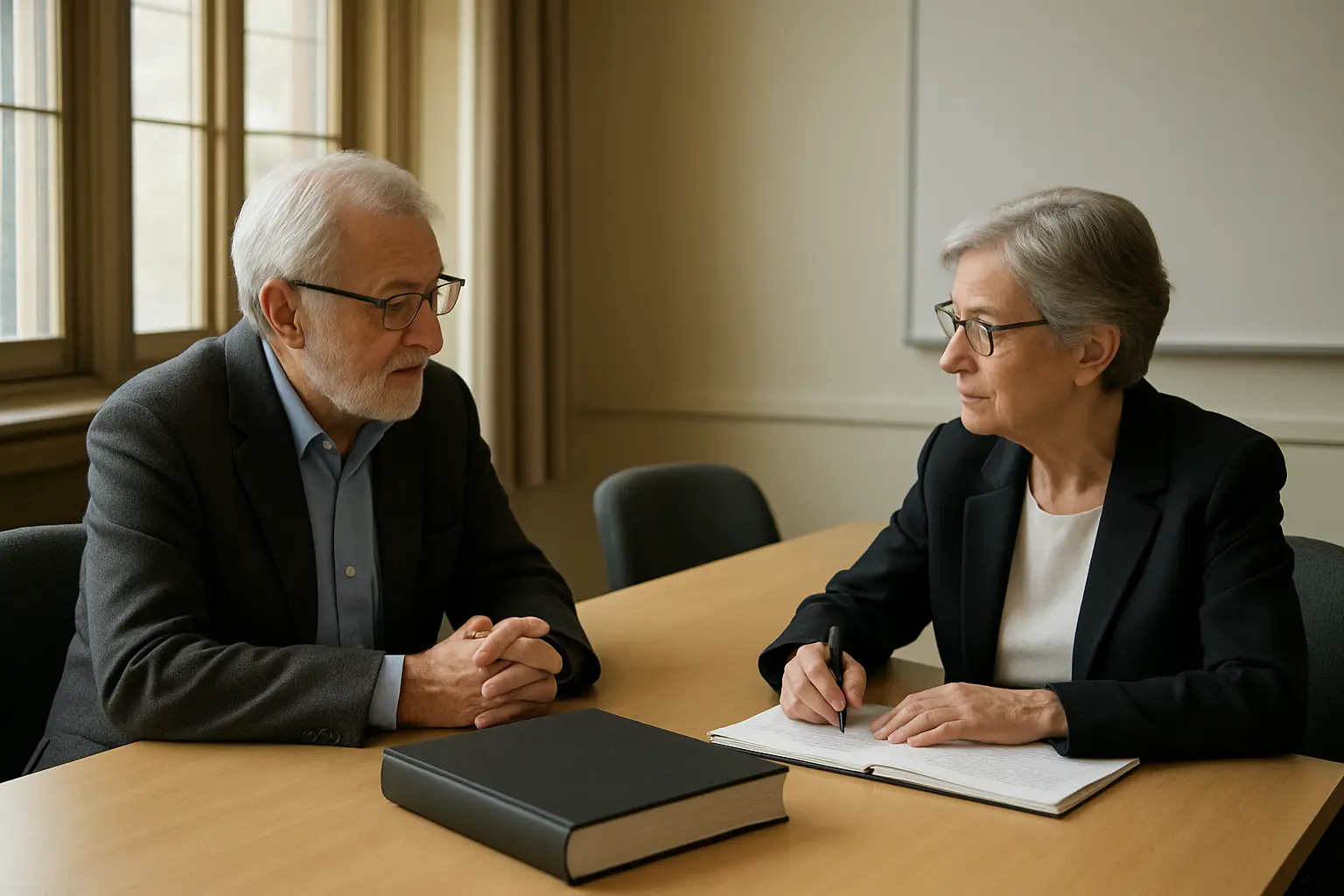
    Two examiners, sometimes an independent chair, sometimes your supervisor as a silent observer — and a private examination otherwise.

    What do the examiners actually produce?

    Three documents, and the sequence explains a lot about how a viva behaves.

    1. Individual preliminary reports, written before the viva and submitted to the university. Your examiners each form an independent view of the thesis on paper before they meet you or each other.
    2. A final joint report after the viva, stating whether the thesis meets the requirements and including a judgement on your performance. At UCL this is released to the student, the supervisor and the Faculty Graduate Tutor.
    3. An optional confidential report to the university. Examiners “have the right to make comments in confidence” in a separate report, which “should not be concerned with the performance of the student” but may raise matters for the institution’s attention.

    The preliminary reports are the reason the standard advice to prepare for your thesis rather than a generic viva is correct: the questions have largely been written before you walk in. What examiners may recommend, and the deadlines attached to each outcome, is a separate question covered in our analysis of UK viva outcomes.

    What happens if my examiners disagree?

    There is a procedure, and it is common: research across published UK institutional documentation found that three quarters of institutions set out an examiner-disagreement procedure. Typically a third examiner is appointed — UCL provides that one “may also be appointed where there is a dispute between two examiners about the result of an examination which they cannot resolve between themselves”.

    From the candidate’s side this is invisible and slow: you will not be told that it is happening, only that the outcome is taking longer than expected. It is not a signal about the quality of your work.

    Can an examiner see my thesis before they are formally appointed?

    No, and the consequence is severe. UCL requires that theses are dispatched by the Research Degrees office and that “direct submission of theses to examiners by students, supervisors or departments/divisions is not permitted”, adding that theses go only to formally appointed examiners and only after examination entry — and that “any exam conducted without meeting either of these requirements would be void.”

    The practical instruction is simple: send your thesis to the office named in your regulations and to nobody else, which is one of the steps in our guide to submitting a PhD thesis for examination.

    How should knowing this change your preparation?

    Three concrete moves. Read your external’s two or three papers closest to your topic, because they read your thesis through their own work and the “how does your work relate to X” question comes from there — and if you have published, they may have read that too, which is one more argument for getting a paper out during candidature. Write the 300-word description with the same care as your abstract, since it shapes who is appointed. And prepare for two readers with different jobs: the external asking whether the field has gained something, the internal asking whether the thesis meets the institution’s criteria.

    Everything else is rehearsal, which our guide to viva preparation covers in full. Before any of that, though, the thesis has to exist — and Tesify keeps the chapters and the bibliography structured while you write it, 100% written by you.

    Frequently asked questions

    How many examiners does a UK PhD have?

    Normally two — one external to the university and one internal member of staff. Two externals may be appointed where no suitable internal exists, and that is also common where the candidate is employed by the university.

    Can my supervisor be my examiner?

    No. Supervisors are excluded everywhere, and the exclusion typically extends to anyone previously involved with the project — including members of your upgrade or confirmation panel.

    Can I choose my own examiners?

    No, but you should be consulted. Your supervisory team nominates and a committee appoints; your influence is exercised through that conversation and through any description of the thesis you contribute to the nomination paperwork.

    Can I object to a proposed examiner?

    You can raise a genuine conflict of interest or a substantive concern with your supervisor or graduate tutor, and it should be considered. What you cannot do is veto a properly qualified examiner because you find their published position uncongenial.

    What is an independent chair at a viva?

    A third person who attends but does not examine, present as a neutral observer to ensure the examination is conducted properly and to advise the examiners on the regulations. Some institutions appoint one for every viva; others only in specified cases.

    Will my supervisor be in my viva?

    Usually only if you want them there — at many institutions the supervisor is invited unless the candidate indicates otherwise on the entry form. If they attend, they observe and may speak only if the examiners invite them to.

    Do the examiners decide the outcome before the viva?

    They form individual views on the thesis beforehand and write preliminary reports, but the outcome is determined after the oral examination and is not normally disclosed to the candidate in advance — verifying authorship and engagement is part of what the viva is for.

    What if the two examiners disagree?

    Most institutions have a formal procedure, commonly the appointment of a third examiner. It happens out of your sight and usually shows up only as a longer wait for the result.

    Can my viva be held online?

    Remote and hybrid examinations are widely permitted. Where participants cannot agree on the format, regulations commonly default to in person, and in-person or hybrid examinations are normally required to take place on university premises.

    How senior does an external examiner have to be?

    They must be an established researcher of appropriate standing in the field with relevant expertise, and institutions also check how recently and how often they have examined there. Seniority in itself is not the criterion — independence and expertise are.

    When are examiners appointed?

    At examination entry, which is typically three to four months before you submit. This is why the examiner conversation belongs well before your thesis is finished rather than after.

    Is what happens in the viva confidential?

    Yes. All matters relating to the examination are treated as confidential, and examiners are not permitted to divulge the content of a thesis while any access restrictions granted by the university remain in place.