Tag: PhD corrections

  • How to Complete Your PhD Corrections and Write the Response Letter (2026)

    How to Complete Your PhD Corrections and Write the Response Letter (2026)

    You passed. Somewhere in the relief is a document listing between four and forty things that must change before the degree is conferred, a deadline you have not read carefully, and no instruction anywhere on how to actually do this. Corrections are the least-taught stage of a UK doctorate and one of the most procedurally exacting, because the person marking your work this time already knows exactly what they asked for.

    This is the procedure, in order, with the expected output of each step. As always, research degree regulations differ sharply between institutions — and on corrections they differ by a factor of three, so your own code of practice governs you rather than this page.

    Step 1: Read the deadline before you read the corrections

    The correction period is shorter than most candidates assume and it starts earlier. Cambridge’s Degree Committee guidance is explicit that the clock runs “from the date your official result email is sent” — not from when you open it, not from when your supervisor is next free, and not from when you feel ready to start.

    How long you get is genuinely institutional. Two named universities:

    Outcome University of Birmingham University of Sheffield
    Minor corrections Normally one month Three months
    Major corrections Normally six months Six months
    Revise and resubmit Normally one year One year

    A threefold difference on the most common outcome is not a rounding error. If you have absorbed “you get three months for minors” from a friend at another institution, check.

    One more fact that catches part-time candidates out. Sheffield states that its three-month minor-corrections period applies “regardless of whether they are registered as full-time or part-time”, and says the same of its six-month major period and its one-year resubmission limit. A part-time candidate with a full-time job gets exactly the same window as a funded full-timer.

    Extensions exist but are not routine. Birmingham allows a request through its Research Progress and Awards Sub-Panel “in exceptional cases”. Ask early if you need one; a request made in the final week reads as poor planning rather than exceptional circumstance.

    Expected output: the exact date your corrections are due, taken from your official result email, written into your calendar with a two-week buffer marked before it.

    Step 2: Turn the report into a numbered list before you change anything

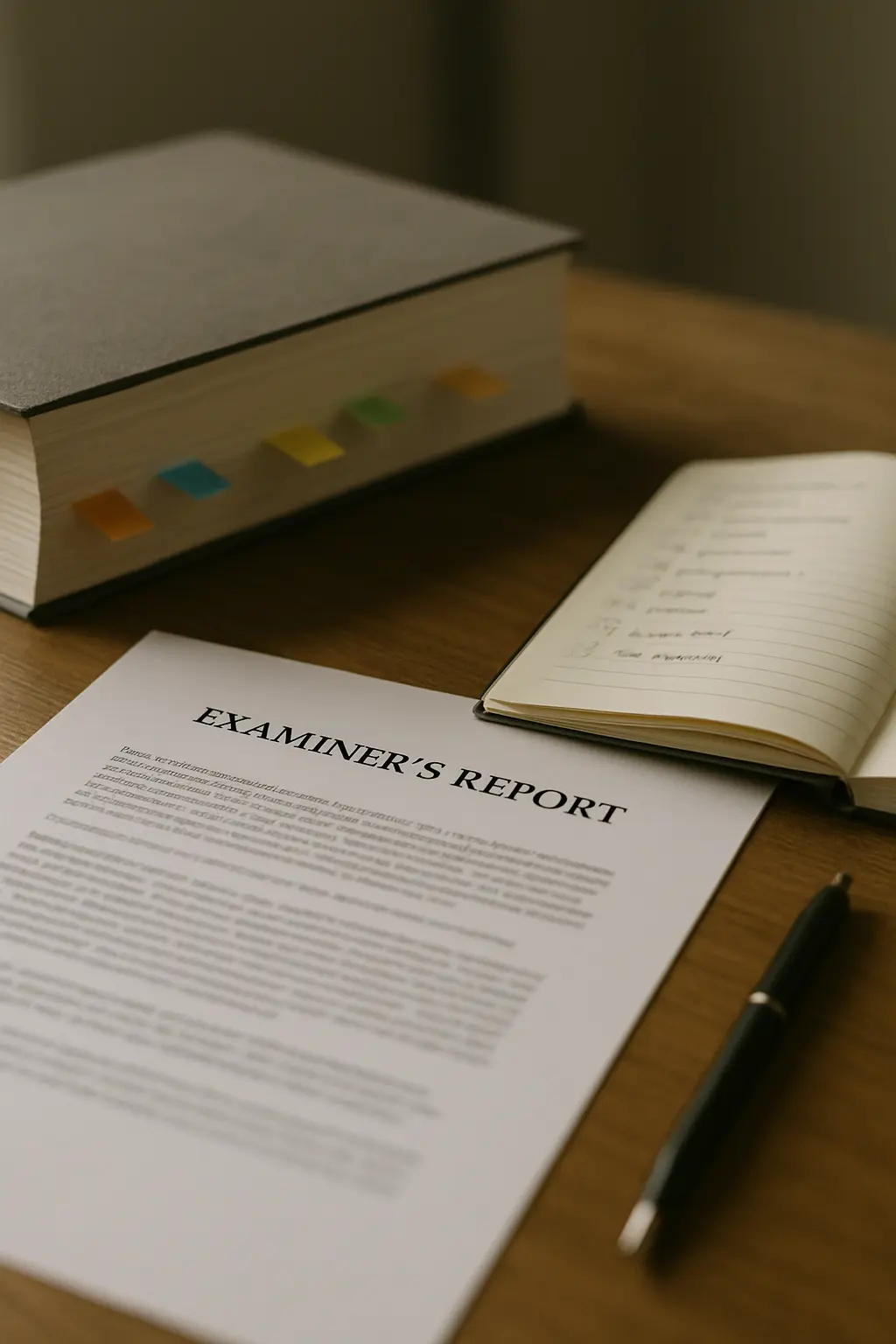
    Examiners’ reports are prose. Prose is a terrible format for tracking completion, and the single most common cause of returned corrections is not disagreement but omission — a correction buried in the middle of a paragraph that nobody noticed was a separate requirement.

    Read the report twice and extract every distinct requirement into a numbered list, splitting compound sentences into separate items. “The candidate should clarify the sampling strategy in Chapter 3 and reconsider the claim on p. 142” is two items, not one. Then classify each as typographical, presentational, referencing, clarification, additional analysis or substantive argument — because the last two are the only ones that need real thinking and they should get your first week, not your last.

    Expected output: a numbered list where every item is one action, with the report’s page reference attached to each.

    A corrections table being built row by row against the examiners' numbered points
    One row per requirement. This table is both your project plan and, later, the document you hand back.

    Step 3: Build the corrections table now, not at the end

    The deliverable at the end of this process is not just a corrected thesis. Cambridge’s guidance is precise about what accompanies it: the candidate submits the corrected thesis together with “a separate list of the corrections made, including the original and new page numbers”, and the list “should describe precisely how the earlier text has been amended – with page, paragraph and line references”, ordered “in page order”.

    Build that table as you work rather than reconstructing it afterwards from memory and a diff. Five columns are enough: the examiner’s numbered point, what they asked for in your own words, what you did, where it now is (page, paragraph, line), and a status flag. Filling a row as you complete each item costs seconds; reverse-engineering thirty rows from a finished document costs a weekend and produces errors.

    Order the finished list by page number rather than by examiner point, as Cambridge asks. Your examiner is going to read it with the thesis open beside them, moving forwards through the document, and a list that jumps between chapters makes that impossible.

    Expected output: a live table with one row per correction, sortable by page number, updated as you go.

    Step 4: Do the substantive items first, in consultation

    Typographical corrections feel productive and are worth almost nothing in risk terms — nobody has ever failed to satisfy examiners because a hyphen survived. What returns corrections is a substantive point handled shallowly: an examiner asked you to reconsider a claim and you softened its wording instead of engaging with the objection.

    Where a requirement is ambiguous, do not guess. Birmingham’s advice is to “raise any queries regarding the required corrections with your supervisor who will liaise with the examiner(s) on your behalf”, and Cambridge similarly says to discuss corrections with your supervisor, who can put your questions to the examiners if necessary. That is the sanctioned route, and it exists because a direct approach to an external examiner mid-corrections is not.

    Two substantive patterns come up repeatedly. Where an examiner asks for an additional analysis, run it and report it honestly even if the result is inconvenient — a null finding reported cleanly is a stronger response than a paragraph explaining why the analysis was not necessary. And where an examiner disputes a claim, you have three legitimate options: qualify it, remove it, or defend it with evidence. All three are acceptable. Ignoring it is not.

    Your supervisory team handles this process routinely and you will do it once; use them.

    Step 5: Write the response letter

    Some institutions require a formal covering letter; all of them benefit from one. Its job is to make the examiner’s check as fast as possible, and its tone is professional rather than grateful or defensive.

    A worked extract, in the shape examiners find easiest to check:

    Dear Dr [Internal] and Professor [External],

    Thank you for examining my thesis and for the report of [date]. I have now completed the required corrections. The revised thesis is attached, together with a list of all changes made, presented in page order with original and revised page references. Changes are marked in the accompanying tracked copy.

    Two items may benefit from a short note.

    Point 4 (sampling strategy, Ch. 3). I have added a new subsection 3.4.2 (pp. 78–80) setting out the recruitment route, the inclusion criteria and the point at which recruitment closed, and have revised the limitations section (p. 191) to state the resulting constraint on transferability explicitly.

    Point 9 (claim on p. 142). On re-examining the evidence I agree that the original claim was stronger than the data support. The sentence now reads as a qualified observation (revised p. 145) and the corresponding statement in the conclusion (p. 203) has been aligned with it.

    I am happy to provide any further clarification.

    Four rules make that letter work. Address every point, including the trivial ones, even if the entry is one line. Where you have not done what was asked, say so and explain why, rather than hoping the omission passes — an examiner who finds an unaddressed point without explanation reads the whole submission more suspiciously. Give the new page reference for every change, because that is the number your examiner needs. And do not argue at length; if a point genuinely requires a defence, make it in two sentences and put the substance in the thesis.

    Expected output: a one-to-two page letter, the corrections list in page order, and a tracked or highlighted copy if your institution asks for one.

    A corrected thesis finished and ready to go back to the examiners
    The corrected thesis, the list in page order, and the letter. Three documents, and the second is the one that gets you signed off quickly.

    Step 6: Send it to the right person

    Who approves your corrections depends on the outcome and the institution. Sheffield states that “one of the examiners will be required to approve the corrections once they have been completed. This is normally undertaken by the internal examiner.” Birmingham splits it by severity: minor corrections are reviewed by the internal examiner only, while major corrections require approval from both the internal and the external.

    Routing matters administratively as well. Cambridge’s guidance has candidates submit the corrected work and the list of corrections directly to the relevant examiner or examiners, and asks that the Student Registry be copied on emailed submissions so the record can be updated. Sending only to your examiner, or only to the office, leaves half the system unaware that you have finished.

    Expected output: a dated email to the correct examiner or examiners, with your graduate office copied, and the sent copy saved.

    Step 7: Deposit, and then stop

    Approval of corrections is not the end of the administrative sequence — the approved final version still has to be deposited in your institution’s repository, and the award normally follows the deposit rather than the viva. Two things are worth doing in the same week: check the version you deposit is the corrected one, which sounds unnecessary until you have four near-identical files, and get any embargo application in at deposit rather than afterwards, particularly if you intend to publish a paper from the thesis.

    Then stop revising. Corrections are a bounded task defined by someone else’s list, and the temptation to keep improving a thesis you are finally free to leave alone is the most common reason a one-month deadline becomes a three-month problem.

    How to make corrections shorter next time — and this time

    Correction lists are padded with items that were preventable. Typographical and formatting points accumulate in a document written over four years, and they are the reason the internal examiner’s list runs to two pages instead of half a page. A consistency pass before submission removes most of them, which is the argument our guide to AI academic English editing makes in detail. Structural inconsistency — a claim in Chapter 2 that the conclusion has outgrown — is the other big category, and it is a cross-referencing problem that gets worse the longer a thesis is assembled from separate files, as our comparison of LaTeX and Word at thesis scale sets out.

    What corrections rarely include, and what candidates most fear, is a demand to redo the research. The published outcome architecture across UK institutions shows how corrections sit relative to the more serious recommendations — the data is in our analysis of UK viva outcomes, and knowing which recommendations your examiners could actually make is the fastest way to shrink the fear before your viva.

    If the corrections themselves involve real writing — a new subsection, a rewritten discussion passage, a chapter that has to be re-argued in six weeks — Tesify holds the structure and the bibliography while you draft, so the new material lands in a document that is still internally consistent and correctly referenced. Every word remains 100% written by you, and it is free to start.

    Frequently asked questions

    What is the difference between minor and major corrections?

    Severity and who checks them. Minor corrections are typographical, presentational and small clarifications, normally approved by the internal examiner alone. Major corrections involve substantive change — additional analysis, reworked argument — and at Birmingham require approval from both the internal and the external examiner.

    How long do I get to complete PhD corrections?

    It is institutional and the range is wide. Birmingham allows normally one month for minor corrections and six for major; Sheffield allows three months and six respectively. Both allow a year for a revise-and-resubmit. Read your own result email for the date that binds you.

    Do part-time students get longer for corrections?

    Not at Sheffield, which states that its three-month minor, six-month major and one-year resubmission periods apply “regardless of whether they are registered as full-time or part-time”. Check your own regulations, but do not assume a pro-rata extension exists.

    When does the correction period start?

    From the date of your official result notification, not from when you begin work. Cambridge’s guidance times it “from the date your official result email is sent”, which is why candidates who take a fortnight to recover from the viva effectively have a fortnight less.

    Do I have to submit a list of corrections?

    At many institutions yes, and everywhere it helps. Cambridge asks for “a separate list of the corrections made, including the original and new page numbers”, describing “precisely how the earlier text has been amended – with page, paragraph and line references”, ordered in page order.

    Can I disagree with a correction?

    Yes, if you do it properly: address the point, explain your reasoning briefly, and either defend the original with evidence or qualify it. What is not acceptable is silently omitting a requirement. Where a point is ambiguous, raise it with your supervisor, who can put it to the examiners on your behalf.

    Who do I send the corrected thesis to?

    Normally the examiner or examiners who set the corrections, with your graduate office or student registry copied so the record is updated. Cambridge asks explicitly for the registry to be copied on emailed submissions.

    What happens if I miss the corrections deadline?

    Ask for an extension before it passes rather than after. Birmingham permits requests through its Research Progress and Awards Sub-Panel “in exceptional cases”, which is a real route and a narrow one. An unexplained overrun puts the award at risk.

    Can corrections change the outcome of my viva?

    Corrections are the condition attached to an outcome already recommended, so satisfying them secures that outcome. Failing to satisfy them, or missing the deadline, is where the risk sits — not in the corrections themselves.

    Should I mark my changes in the thesis?

    Provide a tracked or highlighted copy alongside the clean one unless your institution says otherwise. It costs you nothing and it turns your examiner’s check from a re-read into a verification.

    Is there a formal template for the response letter?

    Most UK institutions publish requirements for the corrections list rather than for a letter, so there is no sector template. The shape that works is short: thanks, confirmation that the corrections are complete, the list attached in page order, and notes only on the points that genuinely need explaining.