Tag: The National Archives

  • Which Archives and Databases Should a History PhD Actually Use? Discovery, Archives Hub, the BNA, EEBO-TCP and BBIH Compared (2026)

    Which Archives and Databases Should a History PhD Actually Use? Discovery, Archives Hub, the BNA, EEBO-TCP and BBIH Compared (2026)

    For a UK history PhD the catalogue you need first is Discovery at The National Archives, and the database you will cite most is the Bibliography of British and Irish History. Everything else below is a specialist layer on top of those two. The table shows which layer fits which kind of thesis, what each costs a researcher on a stipend, and where each one runs out at doctoral scale.

    Resource What it holds Period Access Best for at doctoral scale Where it falls short
    Discovery (The National Archives) More than 37 million descriptions of records held by The National Archives and more than 3,500 other UK archives; over 9 million records downloadable Medieval to present; deepest for central government Free catalogue; free reader’s ticket at Kew; some downloads charged Finding where a record series lives and building an archive itinerary Descriptions, not documents; depth varies by contributing archive
    Archives Hub (Jisc) Over 1,000,000 descriptions of more than 30,000 collections from over 400 UK institutions, mainly universities and specialist repositories All periods Free Locating the papers of a person, family or organisation held in a university Not every repository contributes; collection-level in places
    British Library Manuscripts, printed books, maps, sound and newspapers; 11 reading rooms in London and one in Yorkshire All periods Free Reader Pass for anyone aged 18 or over Manuscripts and printed rarities no other library holds Some services still recovering from the 2023 cyber-attack; printing not expected back until 2026
    British Newspaper Archive British Library newspapers digitised with Findmypast since 2011; strongest from 1840 1700s to 2000s Subscription (£14.99 a month, or £8.34 a month annually, at December 2024); free in British Library reading rooms; selected 1720–1880 pages free online Provincial and regional press, keyword search across hundreds of titles OCR errors; title gaps; a personal subscription on a stipend
    The Times Digital Archive (Gale) Over 12 million articles from The Times 1785–2019 Institutional licence through your library Political, diplomatic and metropolitan history where the paper of record matters One title; a London and establishment view of events
    British History Online Almost 1,000 volumes of printed primary and secondary sources free, plus 180 premium volumes Medieval to modern Free core; premium by subscription Calendars of state papers, Victoria County History, parliamentary and ecclesiastical records Printed editions, not originals; premium volumes behind the paywall
    EEBO, EEBO-TCP and ECCO EEBO images of roughly 125,000 early English titles; EEBO-TCP full-text transcriptions of about 25,300 of them, public domain since 2015; ECCO for the eighteenth century with about 3,000 TCP transcriptions 1475–1800 EEBO and ECCO institutional; TCP texts free Exact-phrase search and text-mining of early modern print Transcriptions cover a fraction; ECCO OCR is uneven
    Connected Histories Federated search across 24 resources including the Old Bailey Proceedings, London Lives 1690–1800, British History Online, House of Commons Parliamentary Papers and the Charles Booth archive 1500–1900 Free search; some linked resources need a subscription First-pass name and place search across many collections at once A search layer only; content sits on the source sites
    Bibliography of British and Irish History Just over 600,000 records at January 2019, updated three times a year; Brepols with the Royal Historical Society and the Institute of Historical Research Roman period to present Institutional subscription Building the historiography for the literature chapter Subscription; British and Irish history only
    EThOS (British Library) Descriptions of over 650,000 UK doctoral theses from the 1700s onwards; restored after the cyber-attack All periods Free Checking nobody has already written your thesis; finding unpublished doctoral work Full text only where the university repository provides it; an update backlog

    The shortlist, ranked for a history doctorate

    1. Discovery — the catalogue that decides your itinerary

    Discovery is The National Archives’ catalogue and, because it also indexes more than 3,500 other archives across the country, it is the closest thing UK history has to a union catalogue of unpublished sources. Its own figures put the catalogue at more than 37 million descriptions, with over 9 million records available for download. For a doctoral project the value is not the downloads but the map: a search on a place, an institution or a policy returns the record series, the repository and the reference, and from that you can plan which archives to visit and in what order.

    It suits any thesis that touches central government, the courts, the armed services or the colonial administration, and it suits local history because county record office catalogues feed into it. It falls short when the contributing archive has catalogued at collection rather than item level, common for local authority and charity records, so a nil return on Discovery is never proof that the material does not exist. Search the archive’s own catalogue as well, and write to the archivist.

    The National Archives’ own walkthrough of Discovery, including how references and record series are structured.

    2. Bibliography of British and Irish History — the historiography, indexed

    BBIH is the discipline’s own bibliographic database, produced by Brepols with the Royal Historical Society and the Institute of Historical Research, and it is the one resource on this list that examiners will expect to see traces of in your literature chapter. It held just over 600,000 records at the start of 2019 and is updated three times a year, so a search here is the fastest way to prove that your reading of the field is complete. It suits every thesis in British or Irish history, including imperial and Commonwealth topics; it does not cover continental European, American or global history. It is a subscription product, so confirm that your library holds it before you plan your literature review around it. Our guide to building a literature review chapter from hundreds of sources assumes you have run the field bibliography first.

    3. Archives Hub — the papers universities hold

    Jisc’s Archives Hub describes more than 30,000 collections held by over 400 UK institutions, and its strength is exactly what Discovery is weakest on: the personal and institutional papers that sit in university special collections, learned societies, charities and businesses. It suits theses built around individuals, correspondence networks, scientific and literary papers and the records of organisations. It falls short because contribution is voluntary, so an important collection can be absent, and because some entries are collection-level summaries that will not tell you whether a particular letter survives. Run it as the second search, with the same names and places as Discovery.

    4. Connected Histories — one search across the digitised sources

    Connected Histories runs a single federated search across 24 digital resources for British history between 1500 and 1900, including the Old Bailey Proceedings, London Lives 1690–1800, British History Online, the House of Commons Parliamentary Papers and the Charles Booth archive. It suits early modern and nineteenth-century theses where a name, a street or an occupation may surface in a trial, a parish record and a parliamentary paper at once, and it is free to search. It falls short because it is a search layer: the content lives on the source sites, several of which need a subscription, and the same person can appear under three spellings across them.

    5. The British Newspaper Archive and the Times Digital Archive — the press, two ways

    For newspapers a history doctorate usually needs both a breadth tool and a depth tool. The British Newspaper Archive, digitised by the British Library with Findmypast since 2011 and strongest from 1840, is the breadth tool: hundreds of regional and provincial titles searchable by keyword. It is free in the British Library reading rooms and some pages from 1720 to 1880 are free online, but sustained work from your desk means a personal subscription, listed at £14.99 a month or £8.34 a month on an annual plan at December 2024. The Times Digital Archive is the depth tool: more than 12 million articles from 1785 to 2019, licensed to institutions, and the paper of record for parliamentary, diplomatic and City history. Both fall short in the same way: OCR errors mean a nil result is not evidence of absence.

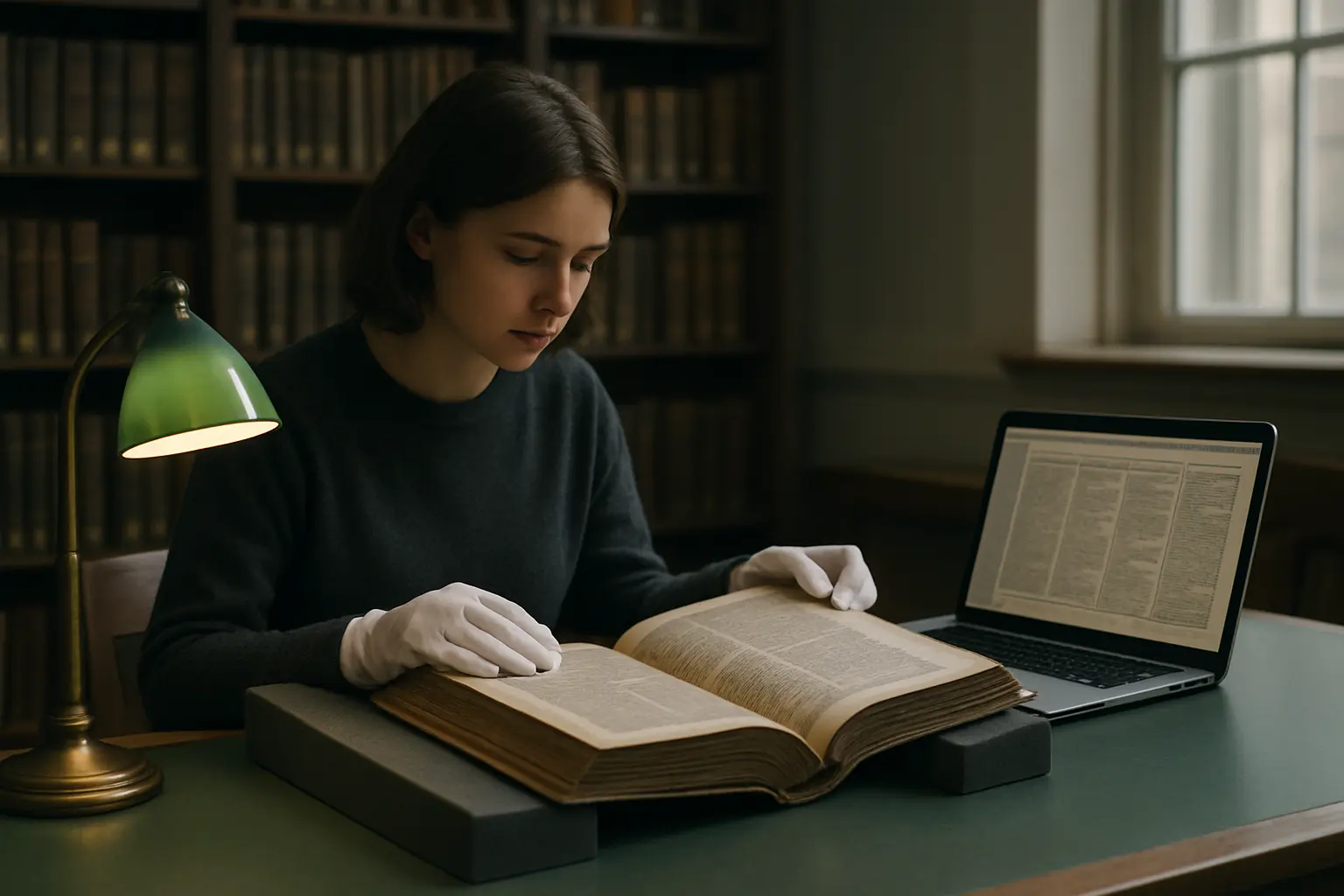
    A researcher comparing an online archive catalogue on a laptop with a printed finding aid
    The online catalogue tells you a series exists; the printed finding aid in the search room often tells you what is actually in the box.

    6. EEBO-TCP, ECCO and British History Online — early modern print and the printed editions

    Early modernists live in a different set of tools. Early English Books Online holds page images of roughly 125,000 titles printed in English or in England before 1700, and the Text Creation Partnership has transcribed about 25,300 of them, released into the public domain in 2015, which makes exact-phrase search and text-mining possible across a large slice of early modern print. Eighteenth-Century Collections Online extends the run to 1800 but with only about 3,000 TCP transcriptions before the funding ran out in 2010, so most ECCO searching depends on uneven OCR. British History Online sits alongside them with almost 1,000 free volumes of printed sources — calendars of state papers, the Victoria County History, ecclesiastical and parliamentary records — and a further 180 volumes behind a premium subscription. They fall short whenever the printed calendar or transcription stands in for the manuscript, which an examiner in the period will notice.

    7. The British Library and EThOS — the reading room and the thesis check

    Anyone aged 18 or over can hold a free British Library Reader Pass, giving access to 11 reading rooms in London and one in Yorkshire, including the Manuscripts and Maps reading rooms. Two years on from the October 2023 cyber-attack most services are back, though printing is not expected to return until 2026, so check the current position before a long trip. EThOS, the British Library’s open discovery platform for UK doctoral theses, has also been restored and now describes over 650,000 theses from the 1700s onwards. Run your topic through it before you commit to a title: an unpublished doctorate on your exact question is the discovery that most often forces a re-scope.

    What none of these tools do

    None of them read the archive for you. Discovery will hand you a reference; it will not tell you that the file is mostly routine correspondence with two pages that matter. BBIH will show you the historiography; it will not tell you where it is wrong. The doctoral work — the selection, the reading against the grain, the argument about what the record can support — happens between the catalogue and the chapter, and it is what your examiners test. For that reason a history doctorate also needs the tools every PhD needs: a reference manager that survives four years and 2,000 archival citations, compared in our review of Zotero, Mendeley and EndNote for a PhD thesis, and a literature-discovery tool for the journal side of the field, compared in our guide to the best AI research assistants for PhD students.

    The recommendation

    Start every history doctorate with three free searches run in one sitting: Discovery, Archives Hub and EThOS. Then add BBIH through your library, because it is the only database on the list built by and for the discipline, and it is what makes a literature chapter defensible. Everything else is period-specific: Connected Histories and EEBO-TCP before 1800, the British Newspaper Archive and the Times Digital Archive after it. Pay for the British Newspaper Archive only once you know which titles and years you need.

    Recording what you find so the thesis can cite it

    The characteristic failure of an archival thesis is not a missing source but an uncitable one: a photograph of a page with no reference, a transcription with the folio number lost, a newspaper cutting with the title but not the date. From the first visit, record for every item the repository, the collection or series, the piece or item reference exactly as the catalogue gives it, the folio or page, and the date you consulted it. The National Archives’ references (a series code, then the piece) are the model; apply the same discipline to a record office’s accession numbers and a university’s box lists. Keep your transcriptions and the source’s own reference together in the same file, and before you paste an unpublished manuscript into any AI tool read our note on unpublished thesis data and AI tools, because an archive’s access conditions can restrict what you may reproduce and where.

    The original contribution of a history thesis is almost always an argument built from sources nobody has combined before. That contribution is only as safe as the references behind it. Draft your history thesis in Tesify and keep the archive references, the transcriptions and every chapter in one workspace, so a document read in year one is cited correctly in the chapter written in year three. The reading and the argument are entirely yours; the tool keeps the references straight. There is a free plan, so you can begin with the first archive visit.

    Frequently asked questions

    What is the best database for a history PhD in the UK?

    For unpublished sources, Discovery at The National Archives, which describes more than 37 million records held there and at over 3,500 other UK archives. For the historiography, the Bibliography of British and Irish History, which held over 600,000 records at January 2019 and is updated three times a year.

    Is Discovery free to use?

    Yes. The catalogue is free to search, and a reader’s ticket for The National Archives at Kew is free. Some digitised records carry a download charge, and records held at other archives must be consulted there or ordered from them.

    What is the difference between Discovery and Archives Hub?

    Discovery is The National Archives’ catalogue and also indexes more than 3,500 other archives, with the greatest depth for central government records. Archives Hub, run by Jisc, describes over 30,000 collections from more than 400 institutions, mainly universities and specialist repositories, so it is stronger for personal and institutional papers.

    Do I need to pay for the British Newspaper Archive?

    Not at first. It is free in British Library reading rooms and selected pages from 1720 to 1880 are free online. Desk-based work over months means a subscription, listed at £14.99 a month or £8.34 a month on an annual plan at December 2024.

    What is BBIH and does my library have it?

    The Bibliography of British and Irish History is a subscription database produced by Brepols with the Royal Historical Society and the Institute of Historical Research, covering British and Irish history from the Roman period to the present. Most UK history departments subscribe; check your library’s database list.

    Can I text-mine early modern sources for free?

    Partly. The EEBO-TCP Phase I transcriptions, about 25,300 titles printed before 1700, have been in the public domain since 2015 and can be downloaded and searched without a subscription. The EEBO page images and ECCO remain institutional products.

    How do I check whether a PhD has already been written on my topic?

    Search EThOS, the British Library’s open platform describing over 650,000 UK doctoral theses from the 1700s onwards, restored after the 2023 cyber-attack. Then search the repositories of the universities strongest in your field, because the EThOS update backlog means recent theses may not yet appear.

    Is the British Library open for research after the cyber-attack?

    Yes. Anyone aged 18 or over can hold a free Reader Pass, reading rooms are open and services such as PCs and scanning have been restored, though printing is not expected to return until 2026.

    What is Connected Histories?

    A free federated search across 24 digital resources for British history from 1500 to 1900, including the Old Bailey Proceedings, London Lives 1690–1800, British History Online and the House of Commons Parliamentary Papers. It searches; the documents themselves sit on the source sites, some of which need a subscription.