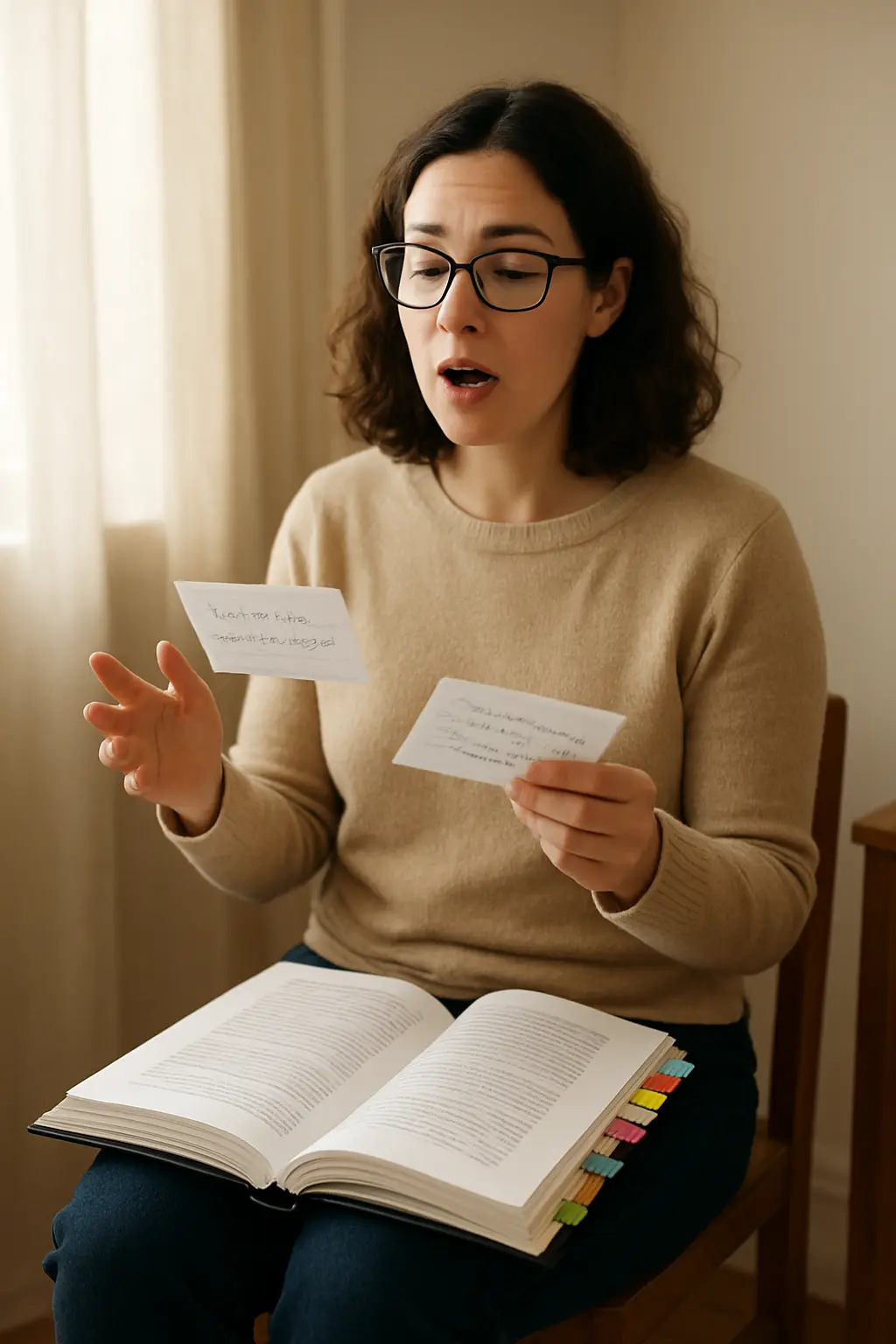
Your thesis is submitted, the date is set, and you are about to spend two to four hours defending three or four years of work to two people who have read it more recently than you have. The instinct is to reread the thesis. That is necessary but insufficient — the viva is an oral examination, and reading silently does not rehearse speaking.
What follows is a rehearsal method rather than a reading list, and it is built from the one asset you already have: your own thesis. If you want help turning it into a question bank you can practise against, you can do that in Tesify.
What the viva is for
Two purposes, and understanding both changes how you prepare.
The first is to establish that the thesis makes an original contribution. The second, less discussed, is to verify that the work is yours. The QAA notes that in the UK examiners do not normally reveal the outcome to the candidate in advance of the oral examination, precisely because one of its purposes is to check both the authorship of the thesis and the candidate’s engagement with the described research process.
That second purpose is why the questions are so often about why rather than what. An examiner establishing authorship does not ask you to recite your findings. They ask why you chose this method over the obvious alternative — because only someone who made the decision can answer.
The eight questions almost every candidate is asked
Prepare an answer to each of these, out loud, before you prepare anything else.
- Summarise your thesis in a few minutes. Almost universal as an opener. Have a two-minute version and a five-minute version.
- What is your original contribution? One sentence, then elaboration if invited.
- Why did you choose this topic? Sounds like small talk. It is establishing that the project was yours from the start.
- Why this methodology and not [obvious alternative]? Expect this for every major design decision.
- What are the limitations of your study? Volunteer three, each with its consequence analysed.
- What would you do differently? Answer substantively. “Nothing” reads as a lack of critical distance.
- How does your work relate to [named study]? Usually a paper by the external examiner or someone in their circle.
- What next — publication, further research? Have a specific answer, not an aspiration.
If you can answer these eight fluently and aloud, you have covered a substantial share of most vivas.
Generating the questions only your thesis provokes
The generic list gets you to competent. What distinguishes a comfortable viva is having anticipated the questions specific to your thesis — and here AI assistance is genuinely well suited, because generating challenges to an argument is a structural task rather than an interpretive one.
Work through your thesis chapter by chapter and, for each, produce questions of these kinds:
- Decision questions. Every methodological choice invites “why not otherwise?”. Sampling, instrument, analytical approach, exclusions, time period, case selection.
- Weak-point questions. Where is the argument thinnest? A small sample, a contested measure, a chapter that leans on one source, an inference the data only partly supports.
- Boundary questions. How far do your claims generalise? Where would they stop holding?
- Contradiction questions. Where does your work disagree with established findings, and how do you account for it?
- Definition questions. Every key construct: how did you define it, and why that definition?
Feed your own chapter summaries, methodological decisions and known limitations in, and ask for the hardest questions an examiner could put. You are not asking a tool to assess your work — you are asking it to stress-test a structure you built. The answers must be yours.
Two chapters deserve the most attention. Your methodology, because that is where decisions cluster. And your discussion, because that is where the contribution is argued — the moves it makes are set out in our guide to writing the discussion chapter, and examiners test each one.

The step candidates skip
Answer out loud. Not in your head — aloud, in full sentences, ideally to another person or a recording.
The gap between knowing something and being able to explain it under mild pressure is large, and it only closes with practice. Doctoral researchers who have rehearsed silently routinely discover in the room that a point they understand perfectly comes out as three false starts.
Record yourself answering the eight standard questions and listen back once. It is uncomfortable and it is the highest-yield hour of preparation available. Listen for whether you answered the question asked, whether you stopped when you were done, and whether you hedged so heavily that the claim disappeared.
Then arrange a mock viva if your department offers one. A mock with people who have not read your thesis closely is still worth doing — much of what you are practising is the act of explaining, not the specific content.
Know what can actually happen
Anxiety feeds on vagueness, so replace it with the published facts. Examiners at UK institutions have a defined set of recommendations available to them, and corrections are the ordinary outcome rather than a judgement against you — our data on UK viva outcomes across 127 institutions sets out exactly which outcomes exist and the timescales attached to each. The QAA’s own position is that only a minority of candidates fail the doctoral assessment outright.
Read your institution’s research degree regulations before the day so you know which outcomes are available to your examiners, and be ready for the contribution question specifically, since it is the one the whole examination circles — our guide to what counts as an original contribution to knowledge covers how to state it in a form that invites questions you have prepared for.
Practical preparation in the final fortnight
- Reread your thesis with fresh eyes, marking anything you would now express differently. Keep a list — volunteering “on reflection I would frame this differently” is a strength, not an admission.
- Tab the physical copy so you can find any chapter, table or figure in seconds. Fumbling costs composure.
- Read your examiners’ relevant work. Not everything — the two or three papers closest to your topic. Question 7 comes from here.
- Prepare a one-page summary of your contribution, methods and key findings to glance at during the examination if permitted.
- Prepare your errata list. Bringing a list of typographical errors you have already spotted is a mark of professionalism.
On the day
Take your time answering. A three-second pause reads as considered; a rushed answer to a question you misheard is much harder to recover from. Ask for clarification if you need it — that is normal academic conversation, not weakness.
When you do not know, say so, and then say what you would do to find out. Examiners are not testing recall; they are testing judgement. “I did not examine that, but the way to test it would be…” is a strong answer.
And treat disagreement as the point rather than a threat. A viva is the first conversation you will have with senior colleagues as a peer, and examiners frequently push on a point precisely because it is interesting. Defend your position with evidence, and concede where the evidence genuinely does not support you — being able to distinguish the two is a doctoral skill being assessed.
Where Tesify fits
Tesify works from your own thesis: it helps you build a question bank chapter by chapter, tighten your contribution statement, and structure your answers so you can rehearse against them. It does not answer for you, and the defence you give remains 100% written and spoken by you.
If your corrections land afterwards, the same workflow carries into revising chapters against examiner comments — the drafting approach described in our guide to turning notes into chapters applies equally to turning examiner reports into revisions.
Prepare for your viva in Tesify.
Frequently asked questions
How long does a UK viva last?
Commonly two to four hours, though there is no fixed duration and practice varies by institution and discipline. Length is not a signal of how it is going — a long viva often means the examiners find the work interesting.
Will the examiners tell me the outcome beforehand?
Not normally. The QAA notes that UK examiners do not usually reveal the outcome in advance of the oral examination, since part of its purpose is to verify authorship and your engagement with the research process.
Can I take my thesis and notes into the viva?
Almost always yes for an annotated copy of your thesis, and usually for brief notes, but confirm with your institution beforehand. Tab your copy so you can navigate it quickly.
Is it acceptable to use AI to prepare for a viva?
Preparing is not being examined — the examination is what you say in the room. Using a tool to generate practice questions from your own thesis is a rehearsal aid, much like a mock viva. What matters is that the answers are your own understanding, which is exactly what the examination tests.
What if I am asked about a paper I have not read?
Say so honestly and engage with the substance: ask what it argues, and respond to that. Pretending to know a paper is far more damaging than not knowing it, and examiners sometimes raise very recent work precisely to see how you think on your feet.
Should I have a mock viva?
Yes, if it is available. The benefit is mostly in practising the act of explaining under mild pressure, which is why even a mock with someone outside your specialism has value.
What if I disagree with an examiner?
Say so, with reasons and evidence. A defensible disagreement demonstrates exactly the independent judgement a doctorate certifies. What weakens your position is either capitulating on a point you have good evidence for, or defending one you do not.
How should I handle a question about a limitation I already know about?
Welcome it. Name the limitation, state its consequence for your findings, and explain what you did to mitigate it or how you accounted for it in your conclusions. A limitation you have already analysed is a prepared answer, not an attack.
