Tag: viva

  • Who Examines a PhD Thesis in the UK?

    Who Examines a PhD Thesis in the UK?

    A UK doctoral thesis is normally examined by two people: one external to your university and one internal member of its academic staff. They are nominated by your supervisory team and appointed by a research degrees committee, not chosen by you. Your supervisor cannot be one of them. An independent chair may also attend, without examining.

    That is the shape almost everywhere. What follows is the detail — who is disqualified and why, what a viva chair actually does, what the examiners produce, and the say a candidate genuinely has. Regulations differ between institutions, so the constant here is the architecture; your own code of practice supplies the specifics.

    How many examiners are there, and who are they?

    Two, in the standard case. UCL’s Research Degree Regulations put the rule in its usual form: “One of the examiners must be external to UCL; the other shall normally be a member of staff of UCL. Two external examiners may be appointed in lieu of an internal examiner if, on grounds of academic expertise or other reasons, a suitable individual within UCL cannot be nominated.”

    The two roles are genuinely different. The external examiner is the disciplinary authority — an established researcher at another institution, appointed to judge the work against the standard of the field rather than the standard of your department. They usually lead the questioning and carry most of the weight in the outcome. The internal examiner knows your institution’s regulations and expectations, handles much of the process, and is often the person you deal with afterwards about corrections.

    The two-externals variation matters more than it sounds. It is the normal arrangement where no suitable internal exists — a very specialised topic, a small department — and it is also common where the candidate is a member of the university’s own staff.

    Who chooses them?

    Your supervisory team nominates; a committee appoints. UCL’s formulation: “The duly nominated examiners shall be appointed on behalf of the UCL Research Degrees Committee on the recommendation of the appropriate Departmental Graduate Tutor and Faculty Graduate Tutor.”

    That two-stage structure is the point. Nomination is an academic judgement made by people who know the field and your work; appointment is an institutional check on eligibility, standing and conflicts. Neither stage is yours — but neither is closed to you, which is the next section.

    Do I get any say in who examines me?

    More than most candidates are told, and it is worth using.

    First, you are normally consulted informally, and this is a real conversation rather than a courtesy. You can say that a proposed external’s published position makes them a poor fit for your argument, that you have a conflict, or that you would prefer someone whose work your thesis engages closely. Do it before the nomination goes in, which means having the conversation with your supervisory team months before you submit.

    Second, in some systems you contribute directly to the paperwork. UCL requires candidates “to submit to their supervisor a short description of the content of the thesis in about 300 words”, which “must be included by the supervisor in the Examiner Nomination Form to assist in the appointment of suitable examiners”. That 300 words is doing real work: it is how a committee that has not read your thesis judges whether a proposed examiner covers it. Write it as carefully as your abstract.

    What you cannot do is choose, veto without cause, or contact prospective examiners about the appointment. Approaching someone yourself creates precisely the appearance of influence the two-stage process exists to prevent.

    An examiner nomination form being completed by a supervisory team
    Nomination by the people who know the field, appointment by a committee that checks eligibility. The candidate’s contribution is usually a 300-word description of the thesis — the only part of the process they control directly.

    Who is disqualified from examining me?

    Independence is the whole design, and the exclusions are broader than candidates expect. UCL states that “an examiner must not have acted as either Principal or Subsidiary Supervisor or member of the Thesis Committee of the thesis to be examined, nor have been involved with the candidate or project to be examined, including the MPhil to PhD upgrade process.”

    That last clause catches people out. The academic who sat on your upgrade or confirmation panel — often the obvious internal, since they already know the project — is disqualified for exactly that reason. Having read your work before is the problem, not the qualification.

    Beyond supervision and prior involvement, the standard exclusions are close collaboration or co-authorship with you, a personal relationship, and any financial or professional interest in the outcome. Institutions also watch how often an external has examined at the same university recently, since a familiar examiner is a less independent one.

    Staff candidates get a further layer. At UCL, “in a case where a candidate is a member of UCL staff, examiners from the same department as the student or supervisor(s) should not be used”, and where there is no alternative, explicit Faculty Graduate Tutor approval is required and a viva chair must be appointed.

    What is a viva chair, and will I have one?

    An independent chair is a third person in the room who does not examine. UCL is precise about the role: a viva chair “plays no role in the academic content of the examination of the thesis or the candidate. The role of the viva chair is to be present at the oral examination as a neutral observer and generally to ensure that the examination is conducted appropriately”, offering advice to the examiners on the regulations where appropriate.

    Practice varies widely. Some institutions appoint a chair for every viva; at UCL, a chair is appointed for all oral examinations for candidates based at its Institute of Education, is mandatory in the staff-candidate case above, and may be recommended at the Faculty Graduate Tutor’s discretion in other cases. If a chair is present, treat them as an asset: they are the person who will intervene if the examination goes off the rails procedurally, and they are not assessing you.

    Who else is in the room?

    Your supervisor, possibly, and on your terms. UCL provides that the supervisor “shall be invited, unless the candidate indicates otherwise on their entry form, to attend the viva examination as an observer. The viva examination must otherwise be conducted in private.”

    Two things follow, both worth knowing before you fill in that form. You can decline — the phrase “unless the candidate indicates otherwise” is a genuine opt-out, exercised more often than the silence around it suggests. And if they do attend, their role is strictly limited: the attending supervisor “does not have the right to participate in the examination of the candidate but may contribute if invited to do so by the examiners”. Nobody is coming to your rescue mid-answer, which is worth internalising in advance.

    On format: UCL requires in-person or hybrid examinations to be held on university premises, permits remote examinations, and settles disagreement with a clear default — “where the participants in the examination cannot agree on the format, it must be held in person.”

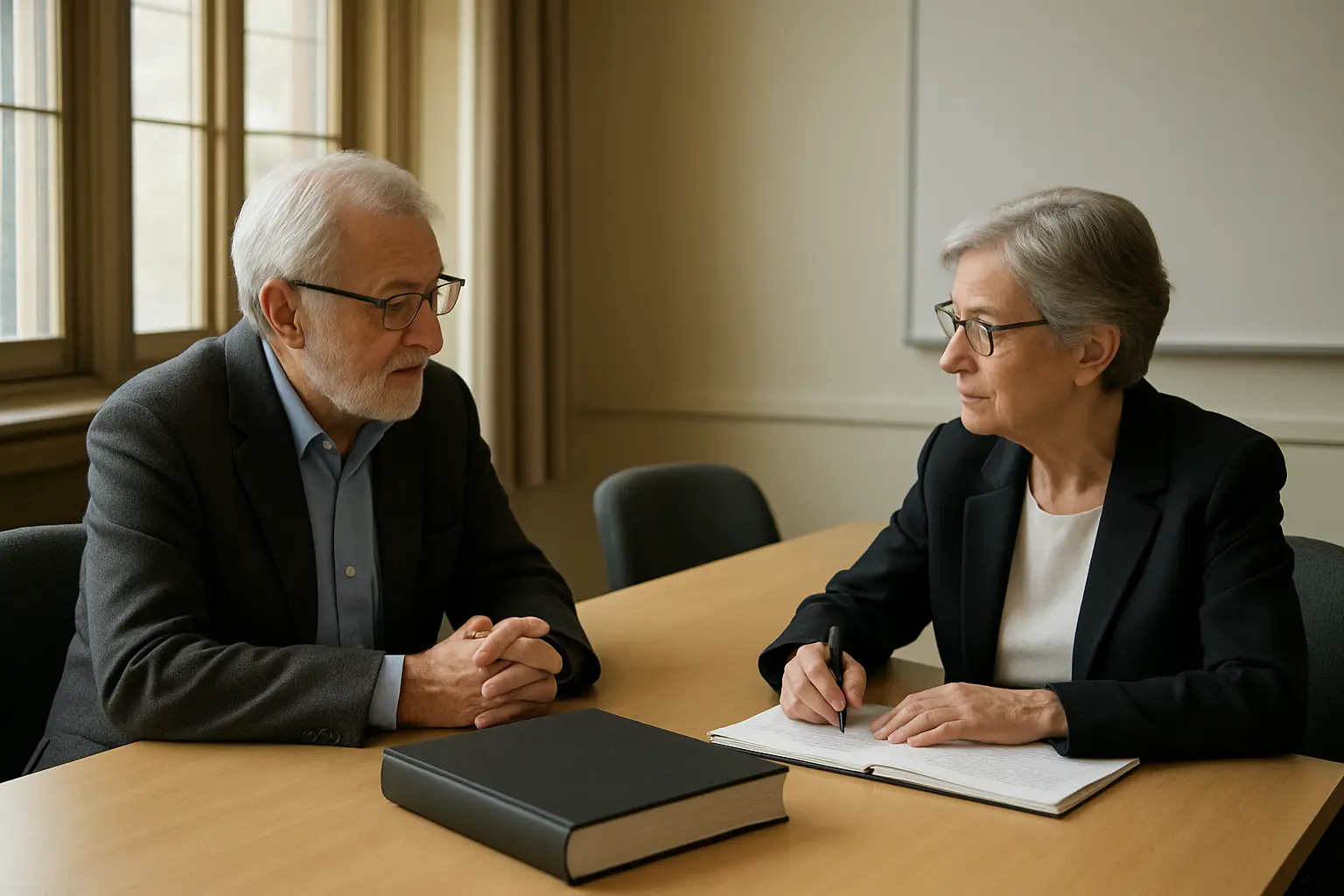
    A university room set up for a viva voce examination before the candidate arrives
    Two examiners, sometimes an independent chair, sometimes your supervisor as a silent observer — and a private examination otherwise.

    What do the examiners actually produce?

    Three documents, and the sequence explains a lot about how a viva behaves.

    1. Individual preliminary reports, written before the viva and submitted to the university. Your examiners each form an independent view of the thesis on paper before they meet you or each other.
    2. A final joint report after the viva, stating whether the thesis meets the requirements and including a judgement on your performance. At UCL this is released to the student, the supervisor and the Faculty Graduate Tutor.
    3. An optional confidential report to the university. Examiners “have the right to make comments in confidence” in a separate report, which “should not be concerned with the performance of the student” but may raise matters for the institution’s attention.

    The preliminary reports are the reason the standard advice to prepare for your thesis rather than a generic viva is correct: the questions have largely been written before you walk in. What examiners may recommend, and the deadlines attached to each outcome, is a separate question covered in our analysis of UK viva outcomes.

    What happens if my examiners disagree?

    There is a procedure, and it is common: research across published UK institutional documentation found that three quarters of institutions set out an examiner-disagreement procedure. Typically a third examiner is appointed — UCL provides that one “may also be appointed where there is a dispute between two examiners about the result of an examination which they cannot resolve between themselves”.

    From the candidate’s side this is invisible and slow: you will not be told that it is happening, only that the outcome is taking longer than expected. It is not a signal about the quality of your work.

    Can an examiner see my thesis before they are formally appointed?

    No, and the consequence is severe. UCL requires that theses are dispatched by the Research Degrees office and that “direct submission of theses to examiners by students, supervisors or departments/divisions is not permitted”, adding that theses go only to formally appointed examiners and only after examination entry — and that “any exam conducted without meeting either of these requirements would be void.”

    The practical instruction is simple: send your thesis to the office named in your regulations and to nobody else, which is one of the steps in our guide to submitting a PhD thesis for examination.

    How should knowing this change your preparation?

    Three concrete moves. Read your external’s two or three papers closest to your topic, because they read your thesis through their own work and the “how does your work relate to X” question comes from there — and if you have published, they may have read that too, which is one more argument for getting a paper out during candidature. Write the 300-word description with the same care as your abstract, since it shapes who is appointed. And prepare for two readers with different jobs: the external asking whether the field has gained something, the internal asking whether the thesis meets the institution’s criteria.

    Everything else is rehearsal, which our guide to viva preparation covers in full. Before any of that, though, the thesis has to exist — and Tesify keeps the chapters and the bibliography structured while you write it, 100% written by you.

    Frequently asked questions

    How many examiners does a UK PhD have?

    Normally two — one external to the university and one internal member of staff. Two externals may be appointed where no suitable internal exists, and that is also common where the candidate is employed by the university.

    Can my supervisor be my examiner?

    No. Supervisors are excluded everywhere, and the exclusion typically extends to anyone previously involved with the project — including members of your upgrade or confirmation panel.

    Can I choose my own examiners?

    No, but you should be consulted. Your supervisory team nominates and a committee appoints; your influence is exercised through that conversation and through any description of the thesis you contribute to the nomination paperwork.

    Can I object to a proposed examiner?

    You can raise a genuine conflict of interest or a substantive concern with your supervisor or graduate tutor, and it should be considered. What you cannot do is veto a properly qualified examiner because you find their published position uncongenial.

    What is an independent chair at a viva?

    A third person who attends but does not examine, present as a neutral observer to ensure the examination is conducted properly and to advise the examiners on the regulations. Some institutions appoint one for every viva; others only in specified cases.

    Will my supervisor be in my viva?

    Usually only if you want them there — at many institutions the supervisor is invited unless the candidate indicates otherwise on the entry form. If they attend, they observe and may speak only if the examiners invite them to.

    Do the examiners decide the outcome before the viva?

    They form individual views on the thesis beforehand and write preliminary reports, but the outcome is determined after the oral examination and is not normally disclosed to the candidate in advance — verifying authorship and engagement is part of what the viva is for.

    What if the two examiners disagree?

    Most institutions have a formal procedure, commonly the appointment of a third examiner. It happens out of your sight and usually shows up only as a longer wait for the result.

    Can my viva be held online?

    Remote and hybrid examinations are widely permitted. Where participants cannot agree on the format, regulations commonly default to in person, and in-person or hybrid examinations are normally required to take place on university premises.

    How senior does an external examiner have to be?

    They must be an established researcher of appropriate standing in the field with relevant expertise, and institutions also check how recently and how often they have examined there. Seniority in itself is not the criterion — independence and expertise are.

    When are examiners appointed?

    At examination entry, which is typically three to four months before you submit. This is why the examiner conversation belongs well before your thesis is finished rather than after.

    Is what happens in the viva confidential?

    Yes. All matters relating to the examination are treated as confidential, and examiners are not permitted to divulge the content of a thesis while any access restrictions granted by the university remain in place.

  • How to Submit Your PhD Thesis for Examination in the UK (2026)

    How to Submit Your PhD Thesis for Examination in the UK (2026)

    Everything about finishing a doctorate that is not writing happens in the last six months, and almost none of it is taught. Candidates who have handled a four-year research project competently routinely discover in month forty-three that a form they have never heard of was due a term ago. This is that procedure, in order, with the expected output of each step stated so you can tell whether you have done it.

    One caveat that governs everything below: research degree regulations differ between institutions more than in almost any other area of UK higher education, and in some universities they differ between faculties. Every step here tells you what to look for; your own code of practice tells you what it is.

    Step 1: Find the deadline that is not your submission deadline

    The date most candidates plan around is when the thesis is due. The date that actually catches people out is examination entry — the formal notice that you intend to submit, which triggers the appointment of your examiners and typically falls months earlier.

    Imperial College London states it plainly: to be able to submit, “you need to complete your examination entry on MyImperial no later than 44 months after the initial date of your registration and at least four months before you submit your thesis. This allows the university to appoint your nominated examiners as well as confirming you have completed all your markers and milestones.” Four months is the common notice period across UK institutions, though three months is also widespread, and the mechanism is the same everywhere: no entry, no examiners; no examiners, no viva.

    Output: two dates in your calendar — your submission target, and your examination-entry deadline four months before it — plus the name of the form and the office that receives it, taken from your own regulations rather than from this page.

    Step 2: Have the examiner conversation early

    Examination entry usually requires nominated examiners, which means the conversation with your supervisor about who should examine you happens before the thesis is finished. Imperial’s guidance puts it in the same breath as the entry deadline: “Together with your supervisor, you should talk about suitable examiners, both internal and external.”

    You are not appointing anyone — nomination sits with the supervisory team and approval with a committee — but you are entitled to be consulted, to raise a conflict of interest, and to say if a proposed external’s published position makes them a poor fit for your argument. Do it while there is time to change the nomination. Your supervisory team handles this routinely; you will do it once.

    Output: agreed names, submitted through whatever nomination process your institution runs, and a note in your records of when it went in.

    A planner with submission and examination-entry dates circled months apart
    Two dates, one of them invisible until you go looking for it. Examination entry is the deadline that quietly governs when you can submit at all.

    Step 3: Read the presentation requirements — and read them now, not later

    Every institution publishes format rules, and reformatting eighty thousand words in submission week is a miserable, entirely avoidable job. The University of Reading’s Rules for Submission of Theses (November 2025) is a representative example of the shape they take: A4 portrait, “a font size no less than 11 point and no more than 12 point”, commonly sans-serif “since they are generally easier to read on screens and at small sizes”, line spacing “normally one-and-a-half or double”, margins “not be less than 15 mm”, and pages numbered — Reading gives the reason, which is that examiners need to “refer you easily to a page during the viva”.

    Check four things specifically, because they are the ones that vary and the ones that bite: the abstract’s word limit (Reading advises “typically around 300 words”), whether your institution prescribes a title-page layout, what the overall word limit includes, and whether any digital accessibility requirements apply to the file you deposit.

    Output: your document already in the required format, with a template applied rather than manual fixes — which is much easier if your writing environment handles long documents properly, a decision covered in our comparison of LaTeX and Word at thesis scale.

    Step 4: Assemble the front matter

    The parts of a thesis nobody drafts and everybody needs on the last afternoon. Typically: title page, abstract, declaration of original authorship, acknowledgements, contents, lists of tables and figures, and any list of abbreviations.

    The declaration is worth doing properly because it is a formal statement. Reading prescribes the exact wording, which is a useful model for what these look like:

    “Declaration: I confirm that this is my own work and the use of all material from other sources has been properly and fully acknowledged.”

    Reading has the candidate’s name printed underneath and notes that “a handwritten signature is not required” — a small modernisation that tells you how much these documents have changed since electronic submission arrived. If your thesis includes co-authored or published material, the declaration usually expands into a contribution statement; that requirement is built into the regulations for a thesis by publication and applies to any thesis incorporating papers.

    Output: a complete front matter section, with the declaration in your institution’s exact prescribed wording rather than a paraphrase.

    Step 5: Get the language help question right before you submit, not after

    This is the step where an honest candidate can walk into a misconduct problem, because UK institutions genuinely disagree with each other. Some permit third-party proofreading within tight limits — minor, localised corrections, tracked, with the author deciding every change. Reading takes the opposite line, stating that the use of a third-party proof-reader or editor “is an offence under the University’s Academic Integrity and misconduct regulations”, while explicitly allowing “grammar and spell-checking software (e.g. Grammarly or checking functionality in word)” with a warning about distorted meaning and mishandled technical terms.

    Two institutions, two incompatible rules, one confident piece of advice circulating in every PGR common room. Read yours. The full map of what the permissive regimes actually allow, and how to stay inside it, is in our guide to AI academic English editing for doctoral researchers.

    Output: a sentence you could say to your examiners describing exactly what help your text received — and, where your institution requires it, that sentence written into your declaration.

    Step 6: Submit to the right place, in the right format

    Electronic submission is now the norm and the printed thesis is largely gone. Reading’s rules record the change explicitly: “A thesis is submitted in an electronic format. Candidates should email a pdf of their thesis… The former requirement to submit printed theses has been discontinued though Candidates may choose to print and bind copies for their own use.”

    Two practical traps. First, the recipient is an examinations office, not your supervisor — Reading is emphatic that submissions go “to the Doctoral Examinations Officer, and not to the candidate’s Supervisor, School or Department”, and a thesis emailed to a supervisor is a thesis not submitted. Second, file size: a PDF full of images can exceed an email limit, and the fix is to tell the examinations office in advance rather than discovering it at 4pm on the deadline.

    And the hard boundary underneath all of it: submission must fall within your maximum registration period, with extensions granted only in exceptional circumstances. If you can see that you will not make it, that conversation belongs with your supervisor months early, not days late.

    Output: a submission confirmation, from the correct office, saved.

    A thesis document being formatted to institutional presentation requirements
    Formatting is clerical work with a deadline attached. Applying the template in month thirty-six costs an afternoon; doing it in submission week costs the week.

    Step 7: Use the gap between submission and viva

    Expect weeks to a few months while examiners read. Three things belong in that window.

    1. Start an errata list. Reread your own thesis and log every typographical error you find. Bringing that list to the viva is a mark of professionalism and it removes those items from your corrections list, where they otherwise consume weeks of your time for no intellectual gain.
    2. Rehearse aloud. Not rereading — speaking. The eight questions almost every candidate faces, and the method for generating the ones only your thesis provokes, are in our guide to viva preparation.
    3. Read your regulations on outcomes. Knowing which recommendations your examiners can actually make, and the correction deadlines attached to each, converts a large vague fear into a small specific one — the architecture across UK institutions is set out in our analysis of viva outcomes.

    Output: an errata list, a recorded practice run of the opening summary, and a printed copy of your institution’s outcome categories.

    Step 8: Know what happens to the thesis afterwards

    After a successful examination and any corrections, you deposit a final approved copy in your institution’s repository, and that deposit is normally a condition of the award — the degree is conferred after it, not before. Most universities allow a time-limited embargo where there is a genuine reason: commercial sensitivity, participant confidentiality, or a publisher’s requirement, which you should investigate before signing anything if you are planning to publish a paper from the thesis. Embargoes are applied for, not assumed, and the application usually happens at deposit.

    The checklist

    Six months out: examination entry submitted, examiners nominated, presentation requirements read. Three months out: thesis formatted to the template, front matter drafted, declaration wording copied exactly. One month out: full read-through, references verified against sources, abstract finalised to its word limit. Submission week: final PDF checked page by page, sent to the examinations office, confirmation saved. Between submission and viva: errata list, rehearsal aloud, outcome regulations read.

    Almost all of that is clerical, and clerical work at the end of a doctorate competes directly with the preparation that actually affects the outcome. Keeping the document itself in order for the whole four years is what makes the last six months survivable. Tesify holds the structure and the bibliography while you write — chapters, sections and references maintained as you cite, so the formatting pass is a pass rather than a project. Every word remains 100% written by you. If you are still deciding how the document should be divided in the first place, our guide to how many chapters a PhD thesis has covers that decision.

    Frequently asked questions

    When do I have to give notice that I am submitting my thesis?

    Commonly four months before submission, sometimes three. Imperial requires examination entry “at least four months before you submit your thesis” and no later than 44 months after registration. Find your own institution’s notice period in year three, not year four.

    Do I still have to submit a printed, soft-bound thesis?

    Increasingly not. Reading’s current rules state that “the former requirement to submit printed theses has been discontinued”, with electronic PDF submission standard and printing left to the candidate’s own preference. Some institutions retain a print requirement, so check rather than assume.

    Who do I send my thesis to?

    An examinations office, not your supervisor. Reading is explicit that submissions go to the Doctoral Examinations Officer “and not to the candidate’s Supervisor, School or Department”. A thesis sent to the wrong recipient has not been submitted.

    Can I choose my own examiners?

    No, but you should be consulted. Your supervisor nominates and a committee approves; your role is to discuss suitable names, flag conflicts of interest and raise concerns while the nomination can still change.

    How long is the wait between submission and the viva?

    Typically some weeks to a few months, depending on examiner availability and your institution’s scheduling. Ask for the expected timescale when you submit, and use the gap for rehearsal rather than for waiting.

    What formatting rules apply to a UK thesis?

    They are institutional, and typically cover paper size, font size, line spacing, margins and page numbering — Reading, for instance, specifies A4, 11–12 point, one-and-a-half or double spacing and margins of at least 15 mm. Apply your template long before submission week.

    Am I allowed to use a proofreader?

    It depends entirely on your institution, and UK universities genuinely contradict each other on this. Some permit tracked, minor, localised corrections; Reading treats the use of a third-party proof-reader or editor as a misconduct offence while allowing spelling and grammar software. Read your own policy before anyone touches your text.

    What is the declaration of original authorship?

    A formal statement, usually with prescribed wording, confirming the work is yours and that all material from other sources is properly acknowledged. Where your thesis contains co-authored or published material, it normally expands into a statement of your specific contribution.

    Can I submit after my registration period ends?

    Only with an extension, which is granted in exceptional circumstances rather than for ordinary overrun. If the date looks unreachable, raise it with your supervisor well before it arrives — late requests have fewer options attached.

    What happens to my thesis after I pass?

    You deposit an approved final copy in the institutional repository, normally as a condition of the award, where it becomes a citable record of your research. Time-limited embargoes are available for genuine reasons and are applied for at deposit.

    Should I bring anything to the viva?

    An annotated copy of your thesis, tabbed so you can navigate it in seconds, and your errata list. Confirm what your institution permits in the room, since practice varies.

  • How to Complete Your PhD Corrections and Write the Response Letter (2026)

    How to Complete Your PhD Corrections and Write the Response Letter (2026)

    You passed. Somewhere in the relief is a document listing between four and forty things that must change before the degree is conferred, a deadline you have not read carefully, and no instruction anywhere on how to actually do this. Corrections are the least-taught stage of a UK doctorate and one of the most procedurally exacting, because the person marking your work this time already knows exactly what they asked for.

    This is the procedure, in order, with the expected output of each step. As always, research degree regulations differ sharply between institutions — and on corrections they differ by a factor of three, so your own code of practice governs you rather than this page.

    Step 1: Read the deadline before you read the corrections

    The correction period is shorter than most candidates assume and it starts earlier. Cambridge’s Degree Committee guidance is explicit that the clock runs “from the date your official result email is sent” — not from when you open it, not from when your supervisor is next free, and not from when you feel ready to start.

    How long you get is genuinely institutional. Two named universities:

    Outcome University of Birmingham University of Sheffield
    Minor corrections Normally one month Three months
    Major corrections Normally six months Six months
    Revise and resubmit Normally one year One year

    A threefold difference on the most common outcome is not a rounding error. If you have absorbed “you get three months for minors” from a friend at another institution, check.

    One more fact that catches part-time candidates out. Sheffield states that its three-month minor-corrections period applies “regardless of whether they are registered as full-time or part-time”, and says the same of its six-month major period and its one-year resubmission limit. A part-time candidate with a full-time job gets exactly the same window as a funded full-timer.

    Extensions exist but are not routine. Birmingham allows a request through its Research Progress and Awards Sub-Panel “in exceptional cases”. Ask early if you need one; a request made in the final week reads as poor planning rather than exceptional circumstance.

    Expected output: the exact date your corrections are due, taken from your official result email, written into your calendar with a two-week buffer marked before it.

    Step 2: Turn the report into a numbered list before you change anything

    Examiners’ reports are prose. Prose is a terrible format for tracking completion, and the single most common cause of returned corrections is not disagreement but omission — a correction buried in the middle of a paragraph that nobody noticed was a separate requirement.

    Read the report twice and extract every distinct requirement into a numbered list, splitting compound sentences into separate items. “The candidate should clarify the sampling strategy in Chapter 3 and reconsider the claim on p. 142” is two items, not one. Then classify each as typographical, presentational, referencing, clarification, additional analysis or substantive argument — because the last two are the only ones that need real thinking and they should get your first week, not your last.

    Expected output: a numbered list where every item is one action, with the report’s page reference attached to each.

    A corrections table being built row by row against the examiners' numbered points
    One row per requirement. This table is both your project plan and, later, the document you hand back.

    Step 3: Build the corrections table now, not at the end

    The deliverable at the end of this process is not just a corrected thesis. Cambridge’s guidance is precise about what accompanies it: the candidate submits the corrected thesis together with “a separate list of the corrections made, including the original and new page numbers”, and the list “should describe precisely how the earlier text has been amended – with page, paragraph and line references”, ordered “in page order”.

    Build that table as you work rather than reconstructing it afterwards from memory and a diff. Five columns are enough: the examiner’s numbered point, what they asked for in your own words, what you did, where it now is (page, paragraph, line), and a status flag. Filling a row as you complete each item costs seconds; reverse-engineering thirty rows from a finished document costs a weekend and produces errors.

    Order the finished list by page number rather than by examiner point, as Cambridge asks. Your examiner is going to read it with the thesis open beside them, moving forwards through the document, and a list that jumps between chapters makes that impossible.

    Expected output: a live table with one row per correction, sortable by page number, updated as you go.

    Step 4: Do the substantive items first, in consultation

    Typographical corrections feel productive and are worth almost nothing in risk terms — nobody has ever failed to satisfy examiners because a hyphen survived. What returns corrections is a substantive point handled shallowly: an examiner asked you to reconsider a claim and you softened its wording instead of engaging with the objection.

    Where a requirement is ambiguous, do not guess. Birmingham’s advice is to “raise any queries regarding the required corrections with your supervisor who will liaise with the examiner(s) on your behalf”, and Cambridge similarly says to discuss corrections with your supervisor, who can put your questions to the examiners if necessary. That is the sanctioned route, and it exists because a direct approach to an external examiner mid-corrections is not.

    Two substantive patterns come up repeatedly. Where an examiner asks for an additional analysis, run it and report it honestly even if the result is inconvenient — a null finding reported cleanly is a stronger response than a paragraph explaining why the analysis was not necessary. And where an examiner disputes a claim, you have three legitimate options: qualify it, remove it, or defend it with evidence. All three are acceptable. Ignoring it is not.

    Your supervisory team handles this process routinely and you will do it once; use them.

    Step 5: Write the response letter

    Some institutions require a formal covering letter; all of them benefit from one. Its job is to make the examiner’s check as fast as possible, and its tone is professional rather than grateful or defensive.

    A worked extract, in the shape examiners find easiest to check:

    Dear Dr [Internal] and Professor [External],

    Thank you for examining my thesis and for the report of [date]. I have now completed the required corrections. The revised thesis is attached, together with a list of all changes made, presented in page order with original and revised page references. Changes are marked in the accompanying tracked copy.

    Two items may benefit from a short note.

    Point 4 (sampling strategy, Ch. 3). I have added a new subsection 3.4.2 (pp. 78–80) setting out the recruitment route, the inclusion criteria and the point at which recruitment closed, and have revised the limitations section (p. 191) to state the resulting constraint on transferability explicitly.

    Point 9 (claim on p. 142). On re-examining the evidence I agree that the original claim was stronger than the data support. The sentence now reads as a qualified observation (revised p. 145) and the corresponding statement in the conclusion (p. 203) has been aligned with it.

    I am happy to provide any further clarification.

    Four rules make that letter work. Address every point, including the trivial ones, even if the entry is one line. Where you have not done what was asked, say so and explain why, rather than hoping the omission passes — an examiner who finds an unaddressed point without explanation reads the whole submission more suspiciously. Give the new page reference for every change, because that is the number your examiner needs. And do not argue at length; if a point genuinely requires a defence, make it in two sentences and put the substance in the thesis.

    Expected output: a one-to-two page letter, the corrections list in page order, and a tracked or highlighted copy if your institution asks for one.

    A corrected thesis finished and ready to go back to the examiners
    The corrected thesis, the list in page order, and the letter. Three documents, and the second is the one that gets you signed off quickly.

    Step 6: Send it to the right person

    Who approves your corrections depends on the outcome and the institution. Sheffield states that “one of the examiners will be required to approve the corrections once they have been completed. This is normally undertaken by the internal examiner.” Birmingham splits it by severity: minor corrections are reviewed by the internal examiner only, while major corrections require approval from both the internal and the external.

    Routing matters administratively as well. Cambridge’s guidance has candidates submit the corrected work and the list of corrections directly to the relevant examiner or examiners, and asks that the Student Registry be copied on emailed submissions so the record can be updated. Sending only to your examiner, or only to the office, leaves half the system unaware that you have finished.

    Expected output: a dated email to the correct examiner or examiners, with your graduate office copied, and the sent copy saved.

    Step 7: Deposit, and then stop

    Approval of corrections is not the end of the administrative sequence — the approved final version still has to be deposited in your institution’s repository, and the award normally follows the deposit rather than the viva. Two things are worth doing in the same week: check the version you deposit is the corrected one, which sounds unnecessary until you have four near-identical files, and get any embargo application in at deposit rather than afterwards, particularly if you intend to publish a paper from the thesis.

    Then stop revising. Corrections are a bounded task defined by someone else’s list, and the temptation to keep improving a thesis you are finally free to leave alone is the most common reason a one-month deadline becomes a three-month problem.

    How to make corrections shorter next time — and this time

    Correction lists are padded with items that were preventable. Typographical and formatting points accumulate in a document written over four years, and they are the reason the internal examiner’s list runs to two pages instead of half a page. A consistency pass before submission removes most of them, which is the argument our guide to AI academic English editing makes in detail. Structural inconsistency — a claim in Chapter 2 that the conclusion has outgrown — is the other big category, and it is a cross-referencing problem that gets worse the longer a thesis is assembled from separate files, as our comparison of LaTeX and Word at thesis scale sets out.

    What corrections rarely include, and what candidates most fear, is a demand to redo the research. The published outcome architecture across UK institutions shows how corrections sit relative to the more serious recommendations — the data is in our analysis of UK viva outcomes, and knowing which recommendations your examiners could actually make is the fastest way to shrink the fear before your viva.

    If the corrections themselves involve real writing — a new subsection, a rewritten discussion passage, a chapter that has to be re-argued in six weeks — Tesify holds the structure and the bibliography while you draft, so the new material lands in a document that is still internally consistent and correctly referenced. Every word remains 100% written by you, and it is free to start.

    Frequently asked questions

    What is the difference between minor and major corrections?

    Severity and who checks them. Minor corrections are typographical, presentational and small clarifications, normally approved by the internal examiner alone. Major corrections involve substantive change — additional analysis, reworked argument — and at Birmingham require approval from both the internal and the external examiner.

    How long do I get to complete PhD corrections?

    It is institutional and the range is wide. Birmingham allows normally one month for minor corrections and six for major; Sheffield allows three months and six respectively. Both allow a year for a revise-and-resubmit. Read your own result email for the date that binds you.

    Do part-time students get longer for corrections?

    Not at Sheffield, which states that its three-month minor, six-month major and one-year resubmission periods apply “regardless of whether they are registered as full-time or part-time”. Check your own regulations, but do not assume a pro-rata extension exists.

    When does the correction period start?

    From the date of your official result notification, not from when you begin work. Cambridge’s guidance times it “from the date your official result email is sent”, which is why candidates who take a fortnight to recover from the viva effectively have a fortnight less.

    Do I have to submit a list of corrections?

    At many institutions yes, and everywhere it helps. Cambridge asks for “a separate list of the corrections made, including the original and new page numbers”, describing “precisely how the earlier text has been amended – with page, paragraph and line references”, ordered in page order.

    Can I disagree with a correction?

    Yes, if you do it properly: address the point, explain your reasoning briefly, and either defend the original with evidence or qualify it. What is not acceptable is silently omitting a requirement. Where a point is ambiguous, raise it with your supervisor, who can put it to the examiners on your behalf.

    Who do I send the corrected thesis to?

    Normally the examiner or examiners who set the corrections, with your graduate office or student registry copied so the record is updated. Cambridge asks explicitly for the registry to be copied on emailed submissions.

    What happens if I miss the corrections deadline?

    Ask for an extension before it passes rather than after. Birmingham permits requests through its Research Progress and Awards Sub-Panel “in exceptional cases”, which is a real route and a narrow one. An unexplained overrun puts the award at risk.

    Can corrections change the outcome of my viva?

    Corrections are the condition attached to an outcome already recommended, so satisfying them secures that outcome. Failing to satisfy them, or missing the deadline, is where the risk sits — not in the corrections themselves.

    Should I mark my changes in the thesis?

    Provide a tracked or highlighted copy alongside the clean one unless your institution says otherwise. It costs you nothing and it turns your examiner’s check from a re-read into a verification.

    Is there a formal template for the response letter?

    Most UK institutions publish requirements for the corrections list rather than for a letter, so there is no sector template. The shape that works is short: thanks, confirmation that the corrections are complete, the list attached in page order, and notes only on the points that genuinely need explaining.

  • Preparing for Your Viva with AI: Rehearsing the Questions Examiners Will Actually Ask

    Preparing for Your Viva with AI: Rehearsing the Questions Examiners Will Actually Ask

    Your thesis is submitted, the date is set, and you are about to spend two to four hours defending three or four years of work to two people who have read it more recently than you have. The instinct is to reread the thesis. That is necessary but insufficient — the viva is an oral examination, and reading silently does not rehearse speaking.

    What follows is a rehearsal method rather than a reading list, and it is built from the one asset you already have: your own thesis. If you want help turning it into a question bank you can practise against, you can do that in Tesify.

    What the viva is for

    Two purposes, and understanding both changes how you prepare.

    The first is to establish that the thesis makes an original contribution. The second, less discussed, is to verify that the work is yours. The QAA notes that in the UK examiners do not normally reveal the outcome to the candidate in advance of the oral examination, precisely because one of its purposes is to check both the authorship of the thesis and the candidate’s engagement with the described research process.

    That second purpose is why the questions are so often about why rather than what. An examiner establishing authorship does not ask you to recite your findings. They ask why you chose this method over the obvious alternative — because only someone who made the decision can answer.

    The eight questions almost every candidate is asked

    Prepare an answer to each of these, out loud, before you prepare anything else.

    1. Summarise your thesis in a few minutes. Almost universal as an opener. Have a two-minute version and a five-minute version.
    2. What is your original contribution? One sentence, then elaboration if invited.
    3. Why did you choose this topic? Sounds like small talk. It is establishing that the project was yours from the start.
    4. Why this methodology and not [obvious alternative]? Expect this for every major design decision.
    5. What are the limitations of your study? Volunteer three, each with its consequence analysed.
    6. What would you do differently? Answer substantively. “Nothing” reads as a lack of critical distance.
    7. How does your work relate to [named study]? Usually a paper by the external examiner or someone in their circle.
    8. What next — publication, further research? Have a specific answer, not an aspiration.

    If you can answer these eight fluently and aloud, you have covered a substantial share of most vivas.

    Generating the questions only your thesis provokes

    The generic list gets you to competent. What distinguishes a comfortable viva is having anticipated the questions specific to your thesis — and here AI assistance is genuinely well suited, because generating challenges to an argument is a structural task rather than an interpretive one.

    Work through your thesis chapter by chapter and, for each, produce questions of these kinds:

    • Decision questions. Every methodological choice invites “why not otherwise?”. Sampling, instrument, analytical approach, exclusions, time period, case selection.
    • Weak-point questions. Where is the argument thinnest? A small sample, a contested measure, a chapter that leans on one source, an inference the data only partly supports.
    • Boundary questions. How far do your claims generalise? Where would they stop holding?
    • Contradiction questions. Where does your work disagree with established findings, and how do you account for it?
    • Definition questions. Every key construct: how did you define it, and why that definition?

    Feed your own chapter summaries, methodological decisions and known limitations in, and ask for the hardest questions an examiner could put. You are not asking a tool to assess your work — you are asking it to stress-test a structure you built. The answers must be yours.

    Two chapters deserve the most attention. Your methodology, because that is where decisions cluster. And your discussion, because that is where the contribution is argued — the moves it makes are set out in our guide to writing the discussion chapter, and examiners test each one.

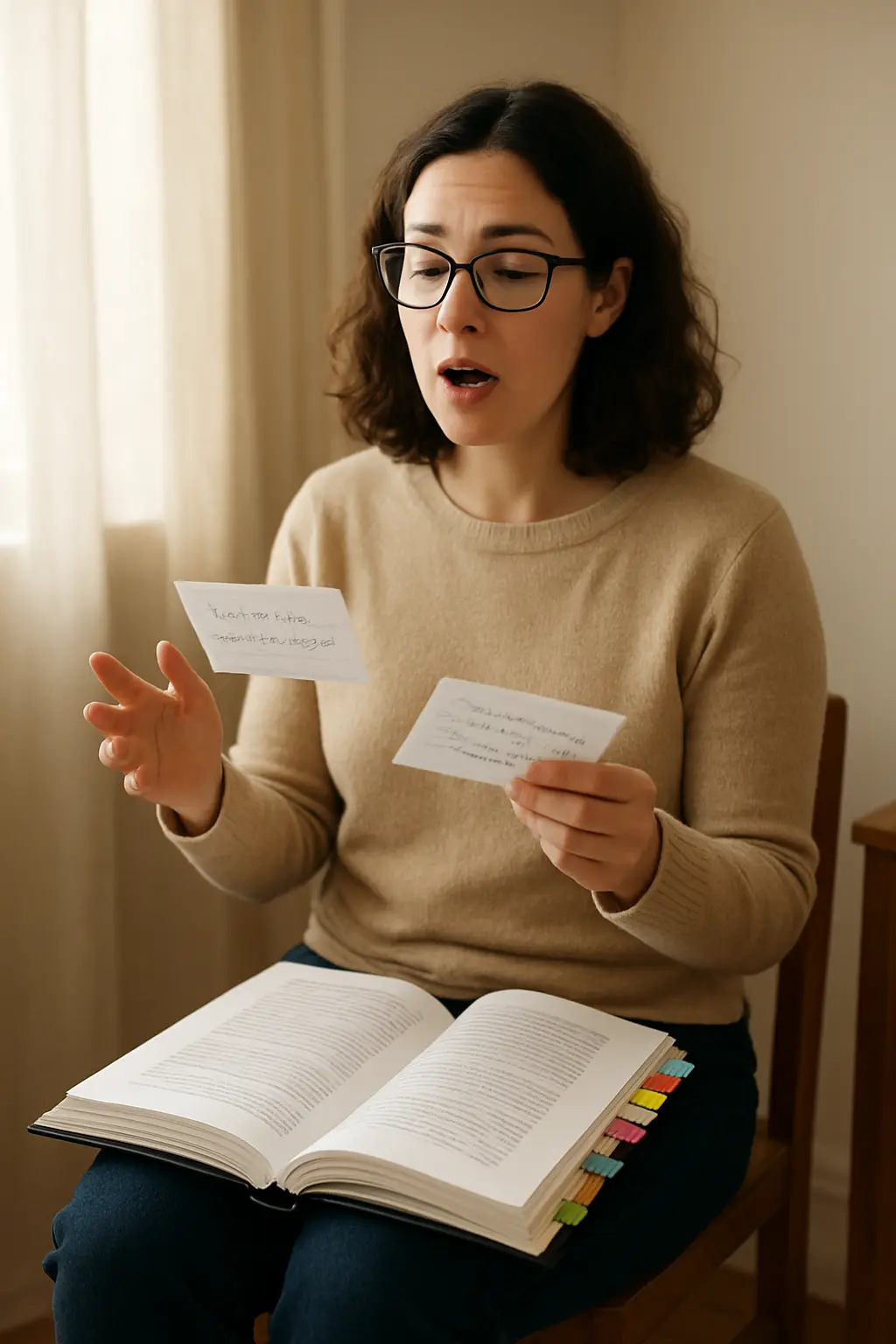
    Handwritten question cards used to rehearse for a viva voce
    A question bank is only useful if you answer from it aloud — silent rehearsal does not transfer to the room.

    The step candidates skip

    Answer out loud. Not in your head — aloud, in full sentences, ideally to another person or a recording.

    The gap between knowing something and being able to explain it under mild pressure is large, and it only closes with practice. Doctoral researchers who have rehearsed silently routinely discover in the room that a point they understand perfectly comes out as three false starts.

    Record yourself answering the eight standard questions and listen back once. It is uncomfortable and it is the highest-yield hour of preparation available. Listen for whether you answered the question asked, whether you stopped when you were done, and whether you hedged so heavily that the claim disappeared.

    Then arrange a mock viva if your department offers one. A mock with people who have not read your thesis closely is still worth doing — much of what you are practising is the act of explaining, not the specific content.

    Know what can actually happen

    Anxiety feeds on vagueness, so replace it with the published facts. Examiners at UK institutions have a defined set of recommendations available to them, and corrections are the ordinary outcome rather than a judgement against you — our data on UK viva outcomes across 127 institutions sets out exactly which outcomes exist and the timescales attached to each. The QAA’s own position is that only a minority of candidates fail the doctoral assessment outright.

    Read your institution’s research degree regulations before the day so you know which outcomes are available to your examiners, and be ready for the contribution question specifically, since it is the one the whole examination circles — our guide to what counts as an original contribution to knowledge covers how to state it in a form that invites questions you have prepared for.

    Practical preparation in the final fortnight

    1. Reread your thesis with fresh eyes, marking anything you would now express differently. Keep a list — volunteering “on reflection I would frame this differently” is a strength, not an admission.
    2. Tab the physical copy so you can find any chapter, table or figure in seconds. Fumbling costs composure.
    3. Read your examiners’ relevant work. Not everything — the two or three papers closest to your topic. Question 7 comes from here.
    4. Prepare a one-page summary of your contribution, methods and key findings to glance at during the examination if permitted.
    5. Prepare your errata list. Bringing a list of typographical errors you have already spotted is a mark of professionalism.

    On the day

    Take your time answering. A three-second pause reads as considered; a rushed answer to a question you misheard is much harder to recover from. Ask for clarification if you need it — that is normal academic conversation, not weakness.

    When you do not know, say so, and then say what you would do to find out. Examiners are not testing recall; they are testing judgement. “I did not examine that, but the way to test it would be…” is a strong answer.

    And treat disagreement as the point rather than a threat. A viva is the first conversation you will have with senior colleagues as a peer, and examiners frequently push on a point precisely because it is interesting. Defend your position with evidence, and concede where the evidence genuinely does not support you — being able to distinguish the two is a doctoral skill being assessed.

    Where Tesify fits

    Tesify works from your own thesis: it helps you build a question bank chapter by chapter, tighten your contribution statement, and structure your answers so you can rehearse against them. It does not answer for you, and the defence you give remains 100% written and spoken by you.

    If your corrections land afterwards, the same workflow carries into revising chapters against examiner comments — the drafting approach described in our guide to turning notes into chapters applies equally to turning examiner reports into revisions.

    Prepare for your viva in Tesify.

    Frequently asked questions

    How long does a UK viva last?

    Commonly two to four hours, though there is no fixed duration and practice varies by institution and discipline. Length is not a signal of how it is going — a long viva often means the examiners find the work interesting.

    Will the examiners tell me the outcome beforehand?

    Not normally. The QAA notes that UK examiners do not usually reveal the outcome in advance of the oral examination, since part of its purpose is to verify authorship and your engagement with the research process.

    Can I take my thesis and notes into the viva?

    Almost always yes for an annotated copy of your thesis, and usually for brief notes, but confirm with your institution beforehand. Tab your copy so you can navigate it quickly.

    Is it acceptable to use AI to prepare for a viva?

    Preparing is not being examined — the examination is what you say in the room. Using a tool to generate practice questions from your own thesis is a rehearsal aid, much like a mock viva. What matters is that the answers are your own understanding, which is exactly what the examination tests.

    What if I am asked about a paper I have not read?

    Say so honestly and engage with the substance: ask what it argues, and respond to that. Pretending to know a paper is far more damaging than not knowing it, and examiners sometimes raise very recent work precisely to see how you think on your feet.

    Should I have a mock viva?

    Yes, if it is available. The benefit is mostly in practising the act of explaining under mild pressure, which is why even a mock with someone outside your specialism has value.

    What if I disagree with an examiner?

    Say so, with reasons and evidence. A defensible disagreement demonstrates exactly the independent judgement a doctorate certifies. What weakens your position is either capitulating on a point you have good evidence for, or defending one you do not.

    How should I handle a question about a limitation I already know about?

    Welcome it. Name the limitation, state its consequence for your findings, and explain what you did to mitigate it or how you accounted for it in your conclusions. A limitation you have already analysed is a prepared answer, not an attack.

  • PhD Viva Outcomes in the UK: What the Data From 127 Institutions Actually Shows (2026)

    PhD Viva Outcomes in the UK: What the Data From 127 Institutions Actually Shows (2026)

    There is no sector-wide UK dataset of PhD viva outcomes. No body publishes a national breakdown of how many candidates pass outright, receive minor or major corrections, are referred, or fail — and any figure presented as “the UK PhD pass rate” is not drawn from one.

    That is an unsatisfying headline, so it is worth being precise about how it was established and what can be evidenced instead — because a great deal can.

    Why no national pass rate exists

    The organisations that would hold such data do not collect it.

    HESA, now part of Jisc, collects student and qualification records but no examination-outcome field for research degrees. The UK Performance Indicators that once carried research-degree measures were discontinued after 2020/21, and the research-output indicator was last released in 2014 for the 2012/13 year.

    The UK Council for Graduate Education publishes postgraduate sector data covering enrolments, not outcomes. The QAA sets out what the doctoral examination involves without publishing frequencies. And individual universities publish their research degree regulations — which list the outcomes available — rather than statistics on how often each is used.

    A caution about the figure you may have seen. A pass rate of roughly 96% circulates widely. It traces to a commercial website reporting freedom-of-information requests to 14 UK universities covering 2006 to 2017. That is not peer-reviewed, not sector-wide, drawn from a small and self-selected group of institutions, and in part up to two decades old — and the source itself concedes that institutions did not all supply comparable corrections data. It should not be cited as a UK pass rate, and we are not citing it as one here.

    What is actually evidenced: the outcomes available to examiners

    The best available UK evidence comes from Stan Taylor’s study Developments in the Doctoral Examination in the UK, published by the UK Council for Graduate Education in August 2022. It examined the published documentation of UK degree-awarding institutions; documentation was publicly available for 127 institutions, 98% of those with their own research degree awarding powers (access was restricted to internal staff at four others).

    Read the table below for what it is: a census of what examiners may recommend, not how often they do.

    Outcome available to examiners Institutions Share of 127
    Outright pass, no further changes 127 100%
    Pass subject to minor corrections 121 95%
    Pass subject to major corrections 80 66%
    Corrections with no minor/major distinction 6 5%
    Pass subject to a satisfactory viva or further test 34 28%
    Refer and resubmit 124 98%
    Award of a lower degree 127 100%
    No degree awarded, no resubmission 127 100%
    Published procedure where examiners disagree 92 75%

    Source: Taylor, S. (2022), Developments in the Doctoral Examination in the UK, UK Council for Graduate Education.

    Two readings are worth drawing out. Every single institution retains both the best outcome and the worst — an outright pass and no award — which is why no one can promise you the viva is a formality. And a third of institutions do not offer a “major corrections” category at all, which means the same body of work could be classified differently at two universities. When someone tells you they got major corrections, that label is institution-relative.

    How long you get to make corrections

    The same study recorded the time limits attached to each outcome. These are the most practically useful figures in this article, because they tell you what to plan for.

    Outcome Time allowed Institutions
    Minor corrections (of the 121 offering it) One to two months 24 (20%)
    Up to three months 79 (66%)
    More than three months 11 (9%)
    Major corrections (of the 80 offering it) Six months 64 (80%)
    More than six months 11 (14%)
    Refer and resubmit (of the 124 offering it) Up to 12 months 97 (78%)
    Up to 18 months 18 (15%)
    24 months 4 (3%)

    This aligns closely with the QAA’s account, which notes that providers define these terms differently, particularly in the length of time candidates are given, but that three to six months for minor changes and six to twelve months for major changes are not uncommon.

    Two operational details from the same study. Minor corrections were in most cases signed off by the internal examiner alone, with no further viva. Major corrections were normally signed off by both examiners, again without a further viva. For resubmissions, a second viva was mandatory at 12 institutions (10%) and at the examiners’ discretion at 89 (72%).

    A bound doctoral thesis awaiting examination
    Corrections are the normal outcome, not the exception — and the timescale is set by your institution, not by convention.

    What the QAA says about failure

    On the question candidates actually worry about, the QAA is reassuring without being specific: the oral examination is a difficult experience for some and may lead to a recommendation that the candidate should not be awarded a doctoral degree, but only a minority of candidates fail the doctoral assessment outright.

    It adds that in most providers, examiners have the option of awarding a different qualification such as an MPhil where that is more appropriate to the candidate’s achievements — which the UKCGE data confirms is available at all 127 institutions. Note that this is a different decision from being registered for MPhil before an upgrade, a distinction covered in our guide to the MPhil to PhD upgrade.

    Two further points from the QAA that shape expectations usefully. Corrections leave no trace: once amendments are made, there is no indication in the award certification of the corrections the examiners required, and the UK doctorate is not graded or classified in any way — it is pass or fail only. And on the day itself, in the UK examiners do not normally reveal the outcome to the candidate in advance of the oral examination, because one of its purposes is to check both the authorship of the thesis and the candidate’s engagement with the research process.

    What this means for you

    Expect corrections. They are available at nearly every institution and are the ordinary result of doctoral examination, not a mark against you. Planning as though an outright pass is the default sets you up to read a normal outcome as a failure.

    Find your own institution’s outcome list. Because a third of institutions have no major-corrections category and time limits vary substantially, only your own research degree regulations tell you what can happen and how long you will have. Read them before your viva, not after.

    Budget for the correction period. If your funding, visa or employment plans assume submission is the end, check the timescales above. Three months of minor corrections is the single most common allowance, and it is not optional time.

    Do not benchmark yourself against a pass rate. There is not one. What determines your outcome is whether the thesis demonstrates an original contribution and whether you can defend it — the standard examined in our guide to what counts as an original contribution to knowledge, and argued most directly in your discussion chapter.

    If corrections have landed and turning examiner comments into revised chapters is the task in front of you, you can work through them in Tesify from your own thesis and your own responses — 100% written by you.

    Frequently asked questions

    What percentage of PhD students pass their viva?

    No reliable UK-wide figure exists, because no body collects examination outcomes nationally. The QAA states only that a minority of candidates fail the doctoral assessment outright. Figures circulating online derive from small freedom-of-information samples rather than national data.

    Can you fail a PhD viva?

    Yes. All 127 institutions in the UKCGE study retained the outcome of no degree awarded with no opportunity to resubmit, and all retained the option of awarding a lower degree. It is not the common outcome, but it is a real one.

    What is the difference between minor and major corrections?

    Broadly, minor corrections address typographical errors and small changes to text or tables, while major corrections involve more substantive changes to the thesis. The definitions are institution-specific, and 6 of the 127 institutions surveyed made no distinction at all — so your own regulations are the only authority.

    How long do minor corrections take?

    Two-thirds of institutions offering minor corrections allow up to three months, a fifth allow one to two months, and around one in ten allow longer. Check your regulations for your own limit.

    Will I have a second viva after corrections?

    Usually not for corrections — minor corrections are typically signed off by the internal examiner and major corrections by both examiners, without a further oral. For a resubmission, a second viva was mandatory at 10% of institutions and at the examiners’ discretion at 72%.

    Do corrections appear on my certificate?

    No. The QAA states that once amendments are made there is no indication in the award certification of the corrections required, and that the UK doctorate is pass or fail only with no grading or classification.

    Will the examiners tell me the outcome before the viva?

    Not normally in the UK. The QAA notes that examiners do not usually reveal the outcome in advance, since part of the viva’s purpose is to verify authorship and your engagement with the research.

    What happens if my examiners disagree?

    Three-quarters of institutions in the study had a published procedure for examiner disagreement, typically involving an additional independent examiner or a referral to a higher committee. If this concerns you, the procedure will be set out in your institution’s research degree regulations.

    Is “refer and resubmit” a failure?

    No. It is a judgement that the thesis is not yet at the required standard but is capable of reaching it. It was available at 124 of the 127 institutions, with 78% allowing up to twelve months to revise. It extends the process; it does not end it.