A clinical medicine PhD or MD(Res) timeline has to be built backwards from a regulatory dependency chain most non-clinical theses never face: Research Ethics Committee review (a published 60-day target, currently running at a 27–30 day median), local NHS R&D approval at every participating site, and — for a clinical trial of an investigational medicinal product — a combined MHRA review with its own separate clock. Below is the method, with the HRA’s own published timescales and a worked multi-year plan. Recruitment and follow-up figures in the worked example are illustrative; only the regulatory timescales are quoted from the HRA’s own pages.
Step 1: Map the regulatory dependency chain before you plan a single research month
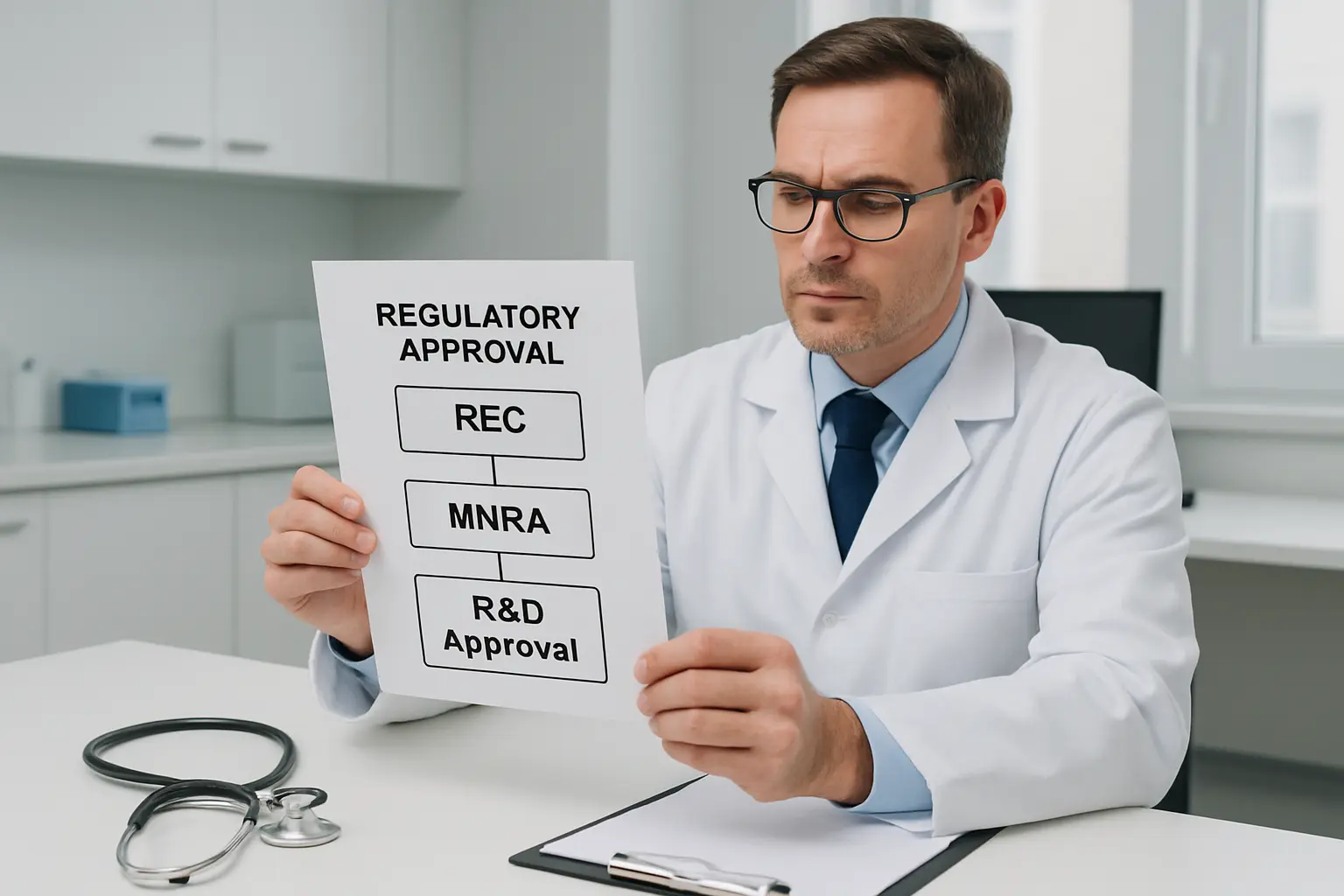
A clinical thesis cannot start data collection until every one of several approvals is in place, and some of them run sequentially rather than in parallel. The chain, in the order a candidate typically clears it: sponsorship confirmation from the university or NHS trust, Research Ethics Committee (REC) review, MHRA review if the study is a clinical trial of an investigational medicinal product (a CTIMP), and local NHS R&D approval — formally, Confirmation of Capacity and Capability — at every individual site that will recruit participants. A non-interventional or database study skips MHRA entirely; a multi-site CTIMP has to clear all four, and the R&D step has to be repeated, separately, at every site.
Step 2: Build the REC review window into the plan at the published target, not the current average
The Health Research Authority states its own target directly: “Our target is for a REC review to be completed and the outcome shared with applicants within 60 days of a valid application being received.” Current performance is faster — median review times for January–March 2026 were 30 days for commercial research and 27 days for non-commercial research — but a thesis timeline should be built against the 60-day target, not the current median, because a candidate has no control over which figure their own application lands on. If the committee requests further information, the clock effectively stops on your side while you respond, so the safest planning assumption is 60 days from a valid application to outcome, plus time to prepare the application itself (typically two to four weeks for a first-time applicant working with their supervisor and sponsor).
Step 3: For a CTIMP, add the combined MHRA/REC review clock on top
Where the study is a clinical trial of an investigational medicinal product, the HRA and MHRA run a combined review with its own published timescales, distinct from a standard REC-only review: a validation check the HRA aims to complete within one working day; an initial decision, or a request for further information, within a maximum of 30 calendar days of the application being confirmed valid; up to 60 calendar days for the sponsor to respond to any request; and a final outcome within a maximum of 10 calendar days of that response being received. Added together, the worst-case combined review clock for a CTIMP — validation, initial review, a full information request, and final outcome — runs to roughly 100 calendar days, and a thesis timeline for trial-based clinical research should budget for that ceiling rather than the faster path where no further information is requested.
Step 4: Budget separately for local NHS R&D approval at every site
Confirmation of Capacity and Capability is assessed locally by each participating NHS trust’s own R&D office, and the HRA does not publish a single network-wide turnaround figure for it — the honest planning approach is to contact each site’s R&D office as early as the REC application is submitted, not after ethics approval lands, and to treat this step as running in parallel with REC review wherever the trust allows. A multi-site study should budget meaningfully more slack here than a single-site one, because R&D turnaround varies trust by trust and a thesis timeline that assumes every site clears at the same pace as the fastest one is a timeline that will slip. A single named contact within each site’s R&D office, established before the REC application is even submitted, is the most reliable way a candidate can shorten this step in practice.

Step 5: Set a recruitment window based on an eligible-population estimate, not a hope
A worked recruitment calculation, illustrative: if the target sample is 120 participants, the eligible population at the recruiting site sees roughly 15 potentially eligible patients a month, and historical consent rates in comparable studies run around 40%, the arithmetic gives roughly 6 recruits a month — a 20-month recruitment window before any attrition allowance, not the 8 months a naive division of “120 participants over a rough guess of monthly footfall” might suggest. Building the calculation from an eligible-population estimate and a realistic consent rate, rather than backfilling a window to match the funded period, is what protects the rest of the timeline from a recruitment shortfall discovered in year three. Adding a second recruiting site roughly halves the window in principle, but each additional site adds its own R&D approval step from Step 4, so the trade-off is rarely as clean as the recruitment arithmetic alone suggests.
Step 6: Set the follow-up and data-collection period around the primary endpoint, not the calendar
Where the primary outcome is measured at a fixed point after enrolment — six months, a year, a defined clinical event — the last participant recruited still has to complete that follow-up before analysis can start, which means the recruitment window and the follow-up horizon compound rather than run separately. A thesis timeline that ends recruitment in month 20 with a 12-month follow-up endpoint needs data collection to run to month 32, not month 20.
Step 7: Leave a genuine buffer between the end of data collection and submission
Analysis, writing, supervisor and co-author review cycles, and the governance sign-offs some clinical theses require before submission (data-sharing confirmations, a final statement on the research being conducted in line with the approved protocol) routinely take four to six months even when the analysis plan was fixed in advance. Treating this as a fixed post-data-collection phase, rather than assuming writing happens “alongside” the final months of data collection, is the single most common clinical-thesis timeline correction supervisors make. Tools that keep a chapter draft moving during the analysis phase — Tesify’s thesis planning workflow among them — are built for exactly this overlap, where the methods and early-results framing can be drafted before the very last participant’s follow-up data is even in.
How does a part-time or clinical-fellowship route change this timeline?

A clinical academic completing a PhD alongside ongoing clinical duties — an NIHR or Wellcome clinical fellowship, for instance — typically stretches every phase above over the same total calendar time but with fewer research days per week, rather than compressing the regulatory steps themselves; REC and R&D timescales are fixed by the regulator regardless of the candidate’s own working pattern. What genuinely changes is recruitment: clinical duties limit the number of clinic sessions available for participant identification each week, so the eligible-population arithmetic in Step 5 should use the candidate’s actual protected research time, not their nominal full-time equivalent, when estimating the monthly recruitment rate.
A worked clinical PhD timeline (illustrative)
| Phase | Months (illustrative) | Depends on |
|---|---|---|
| Protocol development, sponsorship, REC/R&D application prep | 1–4 | Supervisor and sponsor sign-off |
| REC review (published 60-day target) + local R&D at first site | 4–7 | Valid application submitted |
| Additional site R&D approvals (multi-site study) | 6–9 | REC approval as a precondition at most sites |
| Recruitment (illustrative eligible-population calculation) | 9–29 | All required site approvals in place |
| Follow-up on last-recruited participants | 29–41 | Primary endpoint horizon |
| Analysis and thesis writing | 36–45 (overlapping late follow-up) | Locked analysis plan |
| Submission buffer | 45–48 | Supervisor/co-author review cycles |
Notice what the arithmetic does: with a 20-month recruitment window and a 12-month primary endpoint, this illustrative plan runs to about four years — beyond a standard three-year studentship. That is exactly why the Step 5 calculation belongs before the funded period and any extension are agreed, not after recruitment has started.
Where this sits against the site’s other planning pieces
This timeline is specific to the regulatory chain a clinical trial or NHS-recruited study has to clear; the site’s general PhD thesis chapter planner covers the writing-side milestones (upgrade, funded end, examination entry) that apply across every discipline and should be built on top of the regulatory timeline here, not instead of it. The governance route itself — HRA and IRAS approval evidence, research passports, ward-level recruitment access — is covered in full in the site’s nursing PhD methodology chapter piece, which shares the same NHS governance chain even though it is written for a different clinical discipline. For the data-source side of a medical or epidemiology thesis that does not go through this REC/R&D chain at all — a database or routinely collected data study — see the site’s piece on where UK medical and epidemiology PhD students get their data. Ethics and consent requirements outside the strictly NHS route are covered from a different discipline’s angle in the site’s sociology and social work research ethics piece, useful chiefly as a contrast for candidates whose clinical study also recruits through non-NHS routes.
Frequently asked questions
Is the 60-day REC review figure a legal maximum or just a target?
It is the HRA’s own stated target, described on its performance pages as the standard the committee aims to meet — current performance runs well inside it (27–30 days median for January–March 2026), but a timeline should still be built against the 60-day figure since an individual application is not guaranteed the median outcome.
Does the 100-day combined MHRA/REC estimate apply to every clinical study?
No — it applies specifically to a clinical trial of an investigational medicinal product (a CTIMP), where MHRA and REC review run as a combined process. A non-CTIMP interventional or observational study goes through REC review alone, without the MHRA clock added on top.
Can R&D approval run at the same time as REC review?
At many sites, yes, and doing so is one of the biggest timeline savings available — but some trusts require REC approval as a precondition before they will process R&D approval, so this has to be confirmed with each site’s own R&D office rather than assumed.
What happens to the timeline if the REC requests further information?
The clock effectively pauses on the applicant’s side while the response is prepared, then resumes once it is submitted — which is exactly why the safer planning figure is the full 60-day target rather than the current faster median.
How should I estimate a realistic recruitment window before I have any real data?
Start from an eligible-population estimate at the recruiting site or sites (ask the clinical team for a rough monthly count of patients meeting the entry criteria), apply a conservative consent-rate assumption drawn from comparable published studies where possible, and divide the target sample by that monthly figure — as the worked calculation in Step 5 shows, this usually produces a longer window than an optimistic top-down guess.
Does a purely database-based medical PhD need any of this timeline?
A study using only pre-existing, appropriately governed datasets — the kind covered in the site’s medical data-sources piece — usually clears a lighter ethics/governance route and does not face the REC/MHRA/R&D chain a prospective recruiting study does, though data-access-agreement lead times with the dataset custodian can themselves take months and should be budgeted separately.
Should the write-up buffer really be four to six months on top of data collection?
For most clinical theses, yes — the figure reflects the combined time for locked-plan analysis, drafting, supervisor and co-author review cycles, and any governance sign-off the thesis needs before submission, and supervisors report it is the phase candidates most often underestimate.
Does adding a second recruiting site always shorten the overall timeline?
Not automatically — it shortens the recruitment window in principle but adds a fresh R&D approval step at the new site, so the net saving depends on how quickly that second site’s R&D office can turn the application around relative to the recruitment time it saves.
How does a clinical fellowship or part-time route change the plan?
The regulatory timescales themselves do not change, but the eligible-population arithmetic in Step 5 should use the candidate’s actual protected research time rather than a nominal full-time figure, since clinical duties limit the sessions available for recruitment each week.