
You have a clinical psychology PhD topic — anxiety, emotion regulation, a transdiagnostic mechanism — and a supervisor who has just asked for the actual hypotheses, and “I think early adversity affects adult anxiety” is not one. A hypothesis is only testable once every construct in it has been operationalised into a named, measurable variable, with a stated direction and a stated relationship between them. Below is the method, two fully worked examples, and the operationalisation table that turns a clinical idea into something a statistical model can actually test. Every example is invented for illustration, not drawn from a real study.
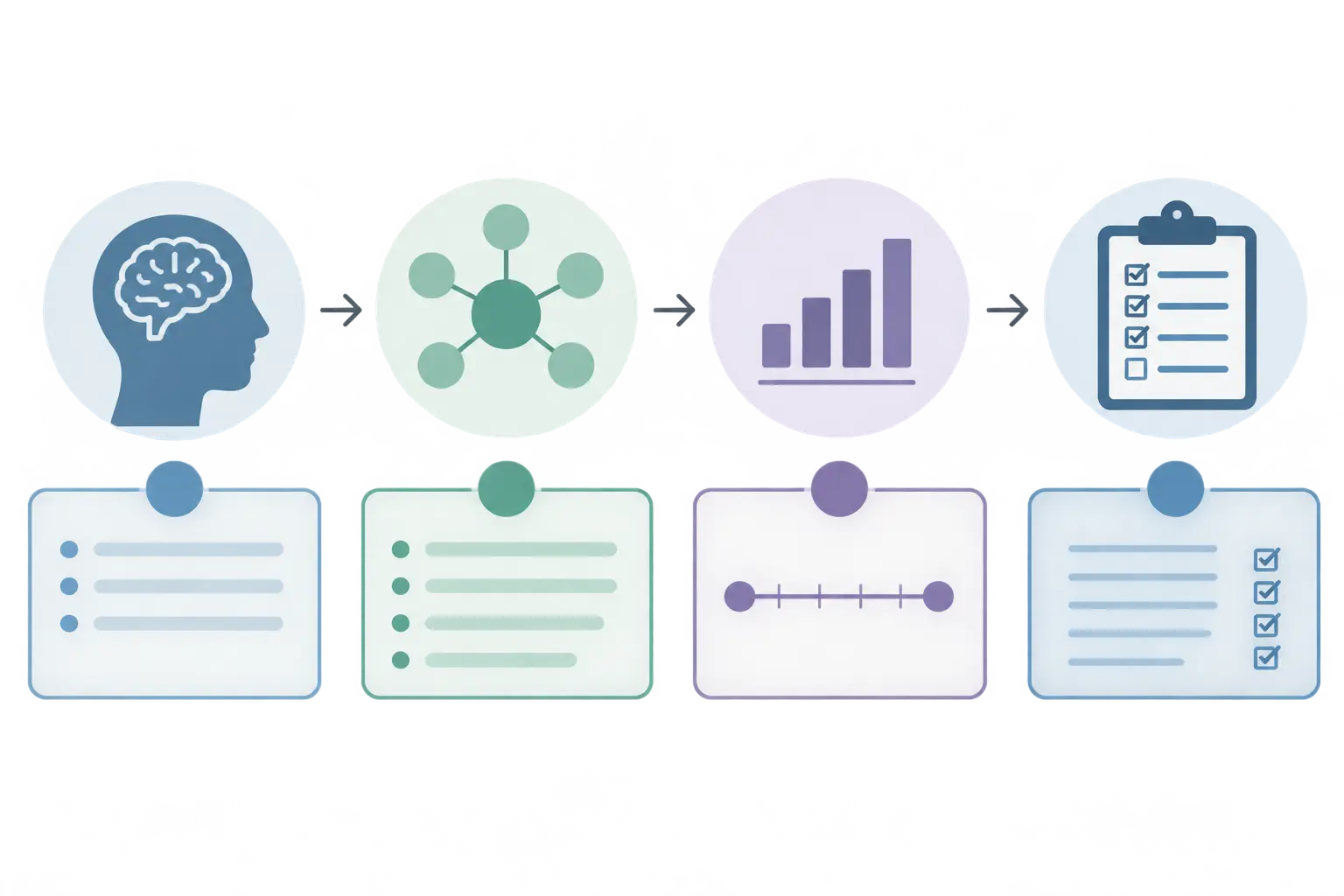
Why does clinical psychology need its own version of this, beyond the generic hypotheses guide?
This site’s own guide to research problem, questions, hypotheses and variables covers the field-level method any doctorate can use; clinical psychology adds two things that field-level guide does not: variables almost always have to map onto a validated clinical instrument with its own published cut-offs and scoring convention (covered separately in this site’s comparison of validated psychology instruments), and hypotheses in a clinical population raise a distinct question the generic guide does not: is the effect you are hypothesising clinically meaningful, not just statistically significant at your sample size. Both of these are specific enough to clinical psychology to need their own worked treatment.
What does a vague hypotheses section actually cost you?
A hypotheses section that reads as a set of general interests rather than testable statements does not just draw supervisor red pen — it stalls the entire methodology chapter behind it, because a sample-size calculation, an analysis plan and a pre-registration (where the study design calls for one) all require a specific, operationalised hypothesis to be calculated against. Candidates commonly discover this gap only when they sit down to write the analysis plan and realise their own stated hypotheses do not actually specify which test would confirm or disconfirm them — a delay that, at the stage most funded studentships allow only three or four years, can cost real months rather than an afternoon’s rewrite. Getting the operationalisation right before the ethics application goes in, not after, is the difference between a methodology chapter that writes itself from the hypotheses and one that has to be reverse-engineered from data already collected.
Step 1: Name the construct precisely, not the general area
“Anxiety” is not a construct you can hypothesise about directly — it has to be narrowed to a specific, named psychological construct with an established measurement tradition: anxiety sensitivity (fear of anxiety-related bodily sensations themselves, distinct from anxiety symptoms generally), experiential avoidance, intolerance of uncertainty, or a specific DSM-defined disorder’s symptom severity are all more precise starting points than “anxiety” alone. A worked narrowing, illustrative: starting from “I’m interested in anxiety and early adversity,” narrow to “does childhood emotional neglect predict adult anxiety sensitivity, and is that relationship mediated by difficulties in emotion regulation?” — three named constructs (childhood emotional neglect, anxiety sensitivity, emotion regulation difficulties), each with an established measurement tradition, rather than one broad area.
Step 2: Operationalise each construct into a named, measurable variable
Every construct needs a stated operational definition: which validated instrument measures it, what the resulting variable actually is (a continuous score, a categorical cut-off, a binary diagnosis), and whether it is your independent variable, dependent variable, mediator or moderator. A worked operationalisation table, illustrative:
| Construct | Instrument (illustrative) | Resulting variable | Role in the model |
|---|---|---|---|
| Childhood emotional neglect | Childhood Trauma Questionnaire, emotional neglect subscale | Continuous score, 0–25 | Independent variable |
| Emotion regulation difficulties | Difficulties in Emotion Regulation Scale (DERS) | Continuous total score | Mediator |
| Anxiety sensitivity | Anxiety Sensitivity Index-3 | Continuous total score | Dependent variable |
| Current depressive symptoms | PHQ-9 | Continuous score, or clinical cut-off ≥10 | Covariate, controlled for |
Step 3: Write the hypothesis with a stated direction and relationship
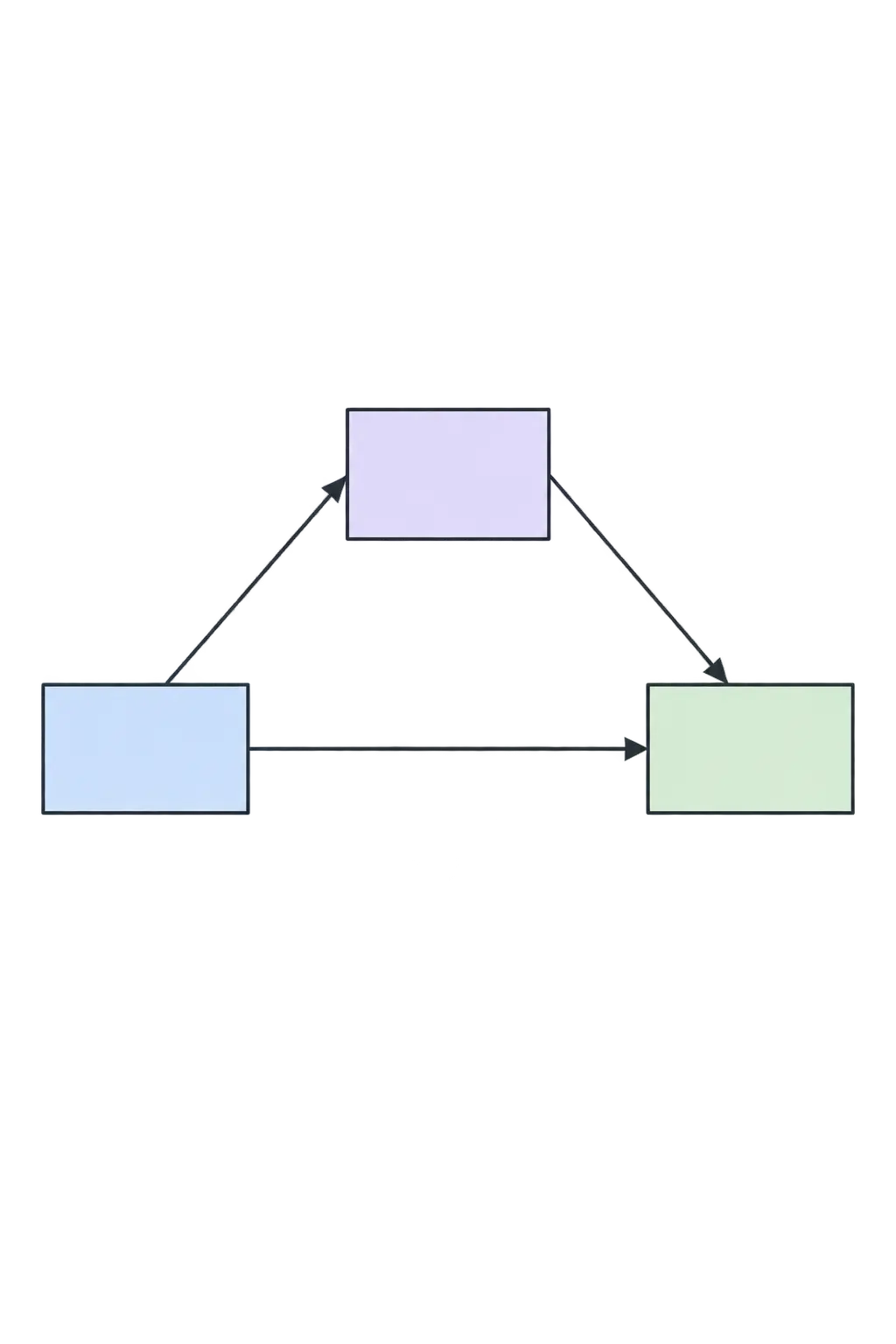
A defensible hypothesis names the variables, states the direction of the relationship, and states the type of relationship (direct, mediated, moderated) rather than leaving any of the three implicit. A worked example, illustrative: “H1: Higher childhood emotional-neglect scores will be associated with higher adult anxiety-sensitivity scores. H2: This relationship will be partially mediated by difficulties in emotion regulation, such that emotional neglect predicts greater emotion-regulation difficulties, which in turn predict higher anxiety sensitivity, controlling for current depressive symptoms.” Note the second hypothesis states the mediation pathway in full — predictor, mediator, outcome, in that order — rather than simply asserting “emotion regulation will mediate the relationship,” which leaves the actual pathway for an examiner to guess at.
A second worked example: an intervention hypothesis
For a clinical trial or intervention-based thesis, the hypothesis structure is slightly different — it compares a treatment condition against a control, on a named outcome, with a stated expected direction and (where the design supports it) an expected effect size or clinically meaningful threshold. A worked example, illustrative: “H1: Participants receiving eight sessions of exposure-based CBT will show a significantly greater reduction in anxiety-sensitivity scores (ASI-3) from baseline to post-treatment than participants on a waitlist control, with an expected between-group effect size of at least a small-to-moderate magnitude. H2: The proportion of participants achieving a clinically meaningful reduction (a change exceeding the ASI-3’s published reliable change index) will be significantly higher in the treatment group than the waitlist group.” H2 here deliberately distinguishes statistical significance from clinical significance — a common examiner probe in clinical psychology specifically, since a statistically significant group difference on a large sample can still represent a change too small to matter to an actual patient.
What makes a clinical psychology hypothesis too vague to test?
Four patterns recur. First, a hypothesis that names a construct but not an instrument — “participants with more early adversity will have worse mental health outcomes” cannot be tested until “mental health outcomes” is operationalised into a specific, named measure. Second, a hypothesis with no stated direction — “there will be a relationship between X and Y” is a null hypothesis’s alternative in its weakest form, and most supervisors will ask for a directional hypothesis wherever the existing literature supports predicting one. Third, a mediation or moderation claim stated as a single sentence without naming the pathway in the order variables actually flow — as the worked H2 above demonstrates, the mediator has to be named as sitting between the predictor and the outcome, not simply asserted to be involved. Fourth, a hypothesis that silently omits a plausible confound the design could easily measure — a hypothesis about emotion regulation and anxiety sensitivity that never mentions controlling for current depressive symptoms, given how strongly the two commonly co-occur in clinical populations, invites an examiner to ask whether the observed relationship is really about anxiety sensitivity specifically or about general negative affect more broadly. Naming the covariate in the hypothesis itself, as the worked H2 above does, closes that objection before it is raised rather than leaving it for the discussion chapter to address after the fact.
How does this connect to the eventual results and discussion chapters?
Hypotheses written this precisely at the proposal or upgrade stage pay off directly at the writing-up stage — this site’s own guide to writing the results and discussion chapters to APA and JARS standards covers reporting each hypothesis’s outcome study by study, which is far easier when each hypothesis was already stated with a named variable, direction and relationship type from the start, rather than reconstructed loosely from a vaguer research question after the data has already been collected.
Common operationalisation mistakes in clinical psychology specifically
Beyond the vagueness patterns above, clinical psychology theses run into two further, field-specific traps. Using a screening instrument’s cut-off score as though it were a clinical diagnosis — the PHQ-9’s commonly cited cut-off is a screening threshold, not a diagnostic one, and a hypothesis that treats “PHQ-9 ≥ 10” as equivalent to “clinical depression” overstates what the instrument itself claims to do. And conflating a trait-level construct with a state-level one — anxiety sensitivity is measured as a relatively stable trait-like tendency, while momentary anxiety symptoms fluctuate day to day, and a hypothesis that treats a single time-point measurement of the latter as evidence about the former needs to justify that assumption explicitly rather than leave it implicit.
Recommendation
Write every hypothesis against three checks: is every construct named and mapped to a specific instrument, is the direction stated, and is the relationship type (direct, mediated, moderated) spelled out in the order the variables actually flow. A supervisor reading a hypotheses section that passes all three checks can move straight to critiquing the theory behind it, rather than sending it back to ask what you actually mean — and a tool built to check a methodology section against exactly this kind of structural precision, such as Tesify’s thesis workspace, catches an unnamed mediator or an undirected hypothesis before a supervisor does.
Frequently asked questions
Do all my hypotheses need to be directional?
Not necessarily — where the existing literature genuinely conflicts or is too thin to predict a direction, a non-directional hypothesis is defensible, but state explicitly that this is why, rather than defaulting to non-directional out of caution.
How many hypotheses should a clinical psychology PhD have?
There is no fixed number — it should match what your design can actually test with adequate statistical power, and a thesis with far more hypotheses than the sample size supports is a common reason a proposal is sent back for revision.
Can I revise my hypotheses after I start collecting data?
Pre-registered or trial-registered studies generally cannot without formally amending the registration; exploratory or non-pre-registered studies have more flexibility, but any revision after seeing the data needs to be reported transparently as exploratory rather than presented as though it were the original hypothesis.
Is it a problem if my hypothesis is not supported by the data?
No — a clearly stated, well-operationalised hypothesis that is not supported is a legitimate and reportable finding; what damages a thesis is a vague hypothesis that cannot actually be tested one way or the other, not a precise one that turns out to be wrong.
What is the difference between a mediator and a moderator in a clinical psychology hypothesis?
A mediator explains the mechanism by which a predictor affects an outcome (it sits on the causal pathway between them); a moderator changes the strength or direction of that relationship depending on its own level, without itself being on the causal pathway — the two require different statistical models and should never be used interchangeably in a hypothesis statement.
Does this method apply to qualitative clinical psychology research too?
No — qualitative designs generate research questions rather than testable hypotheses with operationalised variables; a mixed-methods clinical thesis needs both, stated separately, with the quantitative strand following the method above and the qualitative strand following its own research-question conventions.
Can Tesify write my hypotheses for me?
No, and it should not — the theoretical judgement behind which constructs, instruments and directions are defensible for your specific clinical population has to be yours and your supervisor’s. What a structuring tool can do is check that a hypothesis you have already reasoned through is stated with every construct named, a direction given and the relationship type spelled out, catching the kind of implicit gap a supervisor would otherwise have to send back.