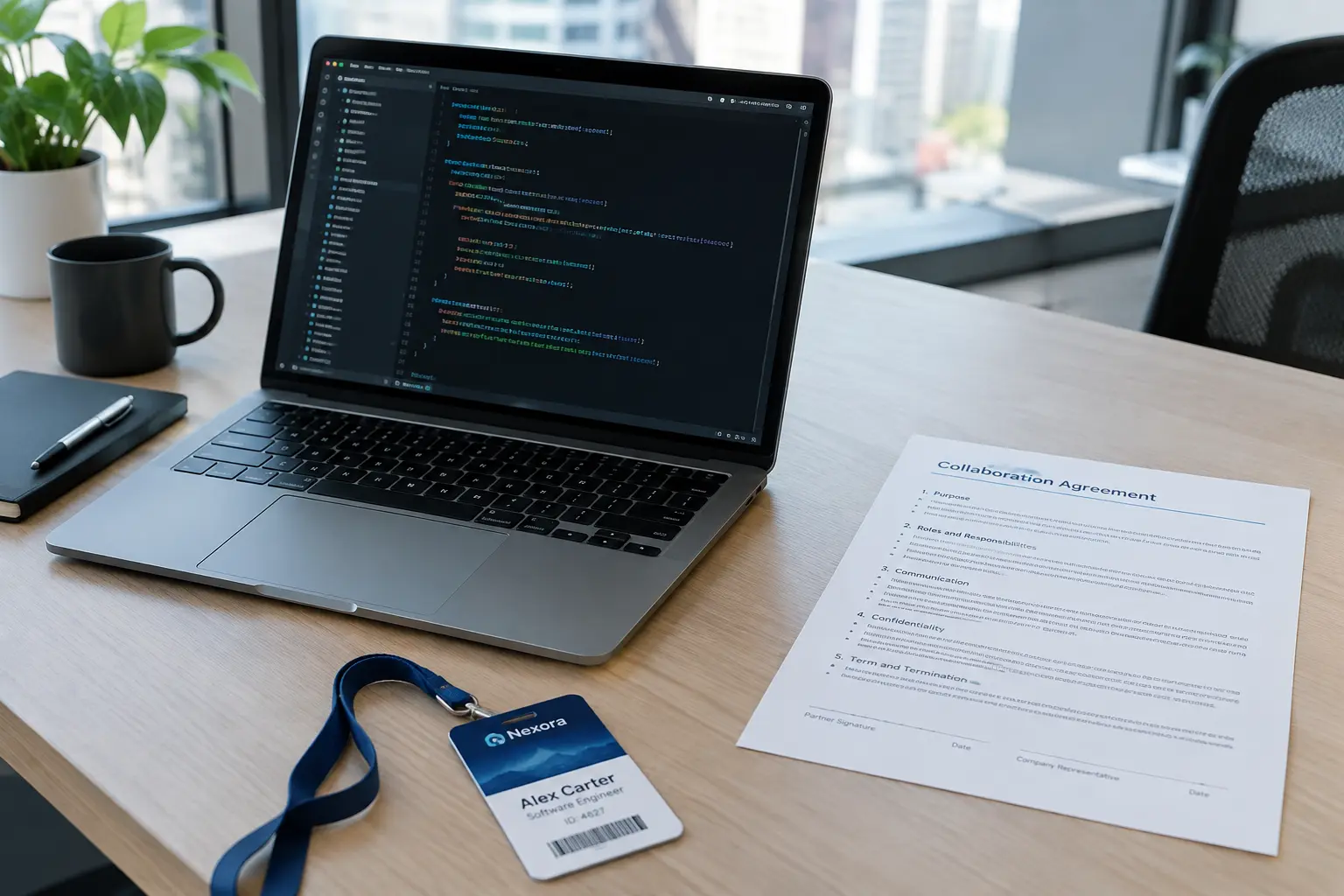
An iCASE studentship funds your PhD with an industry sponsor alongside UKRI, but the money is the easy part. The friction shows up later: what the company will let you publish, who owns the intellectual property in your results, and how a confidentiality agreement written for a commercial project squares with a thesis that has to be examined and deposited publicly.
What is an iCASE studentship actually worth, and what does it commit you to?
Under UKRI’s Industrial CASE training grant terms (the scheme now sits within EPSRC’s Industrial Doctoral Landscape Awards, IDLA), each studentship funded by an ICASE 2024 grant is worth at least £140,000 across its four-year duration: £98,000 from the grant and at least £42,000 from the industrial partner, whose cash contribution cannot be used to cover any difference between home and international fees. UKRI strongly supports using part of the industrial partner’s contribution to enhance your stipend. In return, the industrial partner commits to offering at least three months’ worth of placements — which you may choose to decline, and which can be split into as many sessions as suit the project rather than one continuous block. Placements are expected on the partner’s premises, but if that is not possible or appropriate an alternative such as a virtual placement or a placement with an alternative partner should be sought. The partner must also cover all the expenses you incur as a result of time spent with them. ICASE grants themselves have a five-year duration even though each studentship is four years, and universities must offer the option of part-time study, which is worth knowing if your own start date falls late in a grant’s funding window.
Is the sponsor actually your employer?
Not usually in the formal sense: an iCASE student is a registered doctoral student funded partly by a company, not normally a member of its staff. Many candidates, though, either come to the studentship from that company, work inside its teams during placements, or are doing a part-time PhD alongside a job with the same organisation, and in all of those cases the methodological problem is the same one an employee-researcher faces — you are studying an organisation whose interests, data and people you are close to. Everything below applies whichever way round that relationship runs; just describe it accurately in the thesis rather than calling the sponsor your employer if it is not.
Who actually supervises an iCASE project, and does that change the day-to-day?
UKRI’s terms refer to both an academic supervisor and an industry project supervisor, and expect contact to be maintained between the two supervisors and the student throughout the award. In practice that means an academic supervisor at the university and an industrial supervisor at the partner organisation who oversees the placement work and may sit in on progress reviews. The two do not always agree on priorities — the academic supervisor is judging progress against the thesis’s own contribution, the industrial supervisor against the project’s commercial deliverables — and a candidate caught between the two without a clear escalation route can end up carrying that tension alone. Agreeing explicitly, early, how disagreements between the two supervisors will be resolved is worth doing before it becomes necessary, not after.
Who actually owns the intellectual property in your PhD results?
UKRI’s terms require a formal collaboration agreement between the university and the industrial partner covering ownership of intellectual property and rights to exploitation, put in place before the project begins. UKRI states that it is not able to advise on collaboration agreements and IP issues and points to the government’s Lambert Toolkit instead. It also sets a limit: the agreement must not conflict with UKRI’s terms or prevent the dissemination of research results in accordance with academic custom and practice. Beyond that, the answer is not standardised: it depends on what your specific collaboration agreement says, and that agreement is negotiated between the university and the company, not something you draft yourself as the student. Read your own project’s collaboration agreement early, specifically the IP and publication clauses, rather than assuming a default. Three questions are worth asking your supervisor or the university’s research office directly, in writing, before the project gets far along: who owns any code, algorithm or method you personally develop during the placement; whether the company has a right of pre-publication review over the thesis or any papers drawn from it, and if so, how long that review window is; and what happens to your own position if the company is later acquired or the collaboration agreement is renegotiated mid-project. These are exactly the points where a gap between what a candidate assumed and what the agreement actually says tends to surface, often close to submission.
What actually has to go in the methods chapter when the organisation studied is one you work inside?
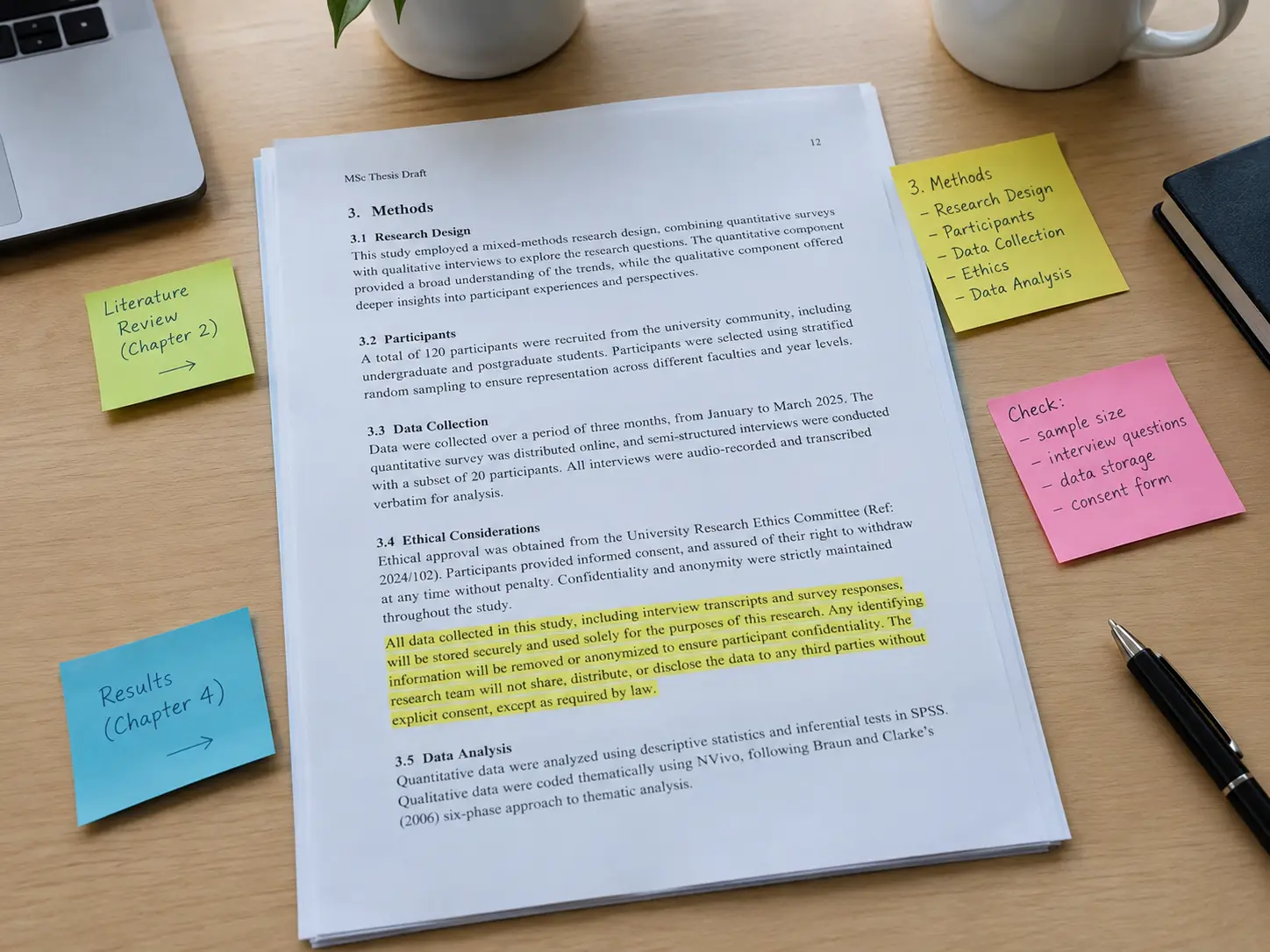
Four things, at minimum, that a purely academic PhD does not need to address. First, the access agreement itself — how it was negotiated, what it permits and what it restricts, described as part of the methodology rather than left implicit. Second, a positionality statement addressing your dual role as insider and researcher explicitly: what advantage that access gave you, and what bias or bounded perspective it might also have introduced. Third, a data ownership and confidentiality statement, distinguishing clearly between data that belongs to the company and cannot appear in the public thesis, and findings that can be reported, generalised or anonymised sufficiently to publish. Fourth, if any part of the thesis draws on commercially sensitive material, a note on how that material was handled — anonymised, generalised, or excluded — and why. A worked, illustrative pattern for this fourth point: rather than presenting a real client’s raw performance data, a compliant thesis might report the method applied to it, the class of result observed (a percentage improvement range, a category of failure mode), and an explicit statement that the specific client identity and exact figures are withheld under the collaboration agreement — giving an examiner enough to assess the contribution without breaching the confidentiality the industrial partner is relying on. Building an industry-embedded doctorate that survives viva covers the same insider-researcher positionality and generalisability issues for a DBA case-study thesis in more depth; the underlying methodological problem — researching an organisation you are embedded in — is the same one, just arriving via a different funding route.
Does a thesis built on company data have to be public in the same way as any other?
The general expectation is still full examination and eventual deposit, but check your own institution’s policy on thesis embargoes for commercially sensitive material rather than assuming either a blanket exemption or no accommodation at all — UK universities vary in what they allow and how it has to be requested, and it is a Doctoral College or graduate school process, not something negotiated informally with your examiners after the fact. Raise it early with your supervisor and, if your collaboration agreement anticipates confidential findings, get the embargo question settled well before submission rather than discovering a conflict at the point of deposit. Where an embargo is granted, it typically restricts public access to the deposited thesis for a defined period rather than the examination itself — your examiners still need to read the full thesis.
How does this interact with using AI tools on genuinely confidential project data?
Is it safe to put unpublished thesis data into an AI tool? covers the general confidentiality risk of pasting your own unpublished research into a third-party AI service; an iCASE studentship adds a second, often stricter layer on top of that — the company’s own data-handling and confidentiality policy, which may prohibit certain tools or data categories entirely regardless of what your university’s own guidance says. Where the two policies conflict or are unclear, the company’s data-handling terms are typically the binding constraint for anything touching its commercially sensitive material, since that is what your collaboration agreement is actually protecting.
Does an industry-embedded project actually change the shape of the thesis itself?
Structurally, less than the confidentiality and access questions suggest. How to structure a computer science PhD thesis covers the standard shape — thesis statement, contribution chapters, the word-limit discipline — and an iCASE thesis still needs to follow it: a clear original contribution to knowledge, not simply a description of work delivered to the company. The difference sits almost entirely in the methods chapter (access, positionality, data handling) and, where relevant, in how commercially sensitive results are generalised or anonymised for the contribution chapters — not in the overall architecture of the thesis.
How early should the access and confidentiality questions be settled?

Before the research proposal is finalised, ideally. How to write a PhD research proposal in computer science covers the proposal’s general structure; for an iCASE project specifically, the proposal is also the point where a candidate should already know, in outline, what the collaboration agreement permits to be published, so the proposed contribution is not accidentally built around a question the confidentiality terms will later make impossible to report on fully. Sketching the placement blocks against the university’s own term dates at this stage, even roughly, also avoids the scheduling clash where a placement period lands directly on top of an annual progress review or a conference deadline. A supervisor who has taken an iCASE student through to completion before is worth seeking out for this reason: they will already have seen where the friction points between the two institutions tend to show up.
Frequently asked questions
How much is an iCASE studentship actually worth?
For ICASE 2024 grants, at least £140,000 across the four-year duration: £98,000 from the grant and at least £42,000 from the industrial partner.
How much time do I have to spend at the industrial partner?
The partner commits to offering at least three months’ worth of placements, which you may decline, which can be split into multiple sessions, and which can be virtual or with an alternative partner if an on-premises placement is not possible or appropriate.
Who pays my expenses during a placement?
The industrial partner covers all expenses you incur as a result of periods spent with them; you should not be out of pocket for placement time.
Who owns the IP in my thesis results?
It depends on the collaboration agreement between the university and the industrial partner, which UKRI requires but does not advise on — read your own agreement’s IP and publication clauses directly rather than assuming a default.
Can the company stop me publishing my thesis?
UKRI’s terms say the collaboration agreement must not prevent dissemination of research results in accordance with academic custom and practice, but pre-publication review and time-limited embargoes for commercially sensitive material are common, institution-specific arrangements worth raising early.
Do I need a positionality statement if I am researching an organisation I work inside?
Yes — addressing your dual role as insider and researcher explicitly, including what advantage and what bias that position introduces, belongs in the methods chapter.
Can I use AI tools on the company’s confidential project data?
Check the company’s own data-handling policy first; it is typically the binding constraint for commercially sensitive material, regardless of what your university’s own AI-use guidance permits more broadly.
Is a part-time iCASE studentship an option?
Yes — UKRI’s terms require universities to offer the option of part-time study alongside the four-year studentship.
Does an iCASE thesis look structurally different from a standard computer science PhD thesis?
Not in its overall architecture — it still needs a clear original contribution to knowledge, not a description of delivered work. The difference is concentrated in the methods chapter’s access, positionality and confidentiality sections.
What happens if the industrial partner’s confidentiality requirements conflict with what my examiners need to see?
Examiners still need to be able to assess the full thesis; a confidentiality conflict of this kind should be raised with your supervisor and Doctoral College well before submission, not discovered at the point the thesis is sent out for examination.
Do I have both an academic and an industrial supervisor?
Yes — UKRI’s terms refer to an academic supervisor and an industry project supervisor, and expect contact between both of them and the student throughout the award.
What if my academic and industrial supervisors disagree about priorities?
Agree an escalation route for this explicitly and early, rather than waiting for a genuine disagreement to surface mid-project.
Writing the methods chapter this actually requires
Access agreements, positionality, data ownership and confidentiality all belong in the methods chapter as explicit, argued sections, not footnotes. Tesify is used by 9,000+ students across 15,000+ chapters to work through exactly this kind of structured methods writing, and the thesis stays 100% written by you.