
Every UK criminology PhD needs university research ethics committee approval before fieldwork starts, and most need a second, separate approval on top of that: HMPPS’s National Research Committee (NRC) if the research involves prisons, probation or offenders in the justice system, plus data-protection compliance under UK GDPR and the Data Protection Act 2018 for anything involving offending histories or criminal-record data. Here is who approves what, and where doctoral criminology research sits inside each process.
Does Every Criminology PhD Need University Ethics Committee Approval?
Yes, without exception. Whatever the topic — policing, sentencing, desistance, cybercrime, victimology, penology — your university’s research ethics committee has to approve the project before you collect any data from a human participant, and usually before you can even approach a gatekeeper organisation for access. This is the same baseline that applies across every UK social-science doctorate, and it sits on top of, not instead of, any subject-specific approval a criminology project also needs.
What differs by discipline is the risk profile the committee is assessing. A criminology ethics application typically has to address disclosure of unreported offences, participant safety around organised crime or gang-related topics, researcher safety during fieldwork in custodial or high-risk community settings, and the confidentiality limits that apply when a participant tells you something a professional in the room would be obliged to report.
What Does the British Society of Criminology’s Statement of Ethics Actually Require?
The British Society of Criminology’s Statement of Ethics, revised in 2015 by Azrini Wahidin, Loraine Gelsthorpe, Terry Gillespie, Nic Groombridge and Jennifer Fleetwood, is the field’s own reference point — most UK ethics committees expect a criminology application to engage with it even though your university’s own committee, not the BSC, grants approval. The Statement describes itself explicitly as “a frame of reference to encourage and support reflective and responsible ethical practice,” and as “an aspirational code, not a prescriptive one” — it sets expectations rather than a rulebook to tick through.
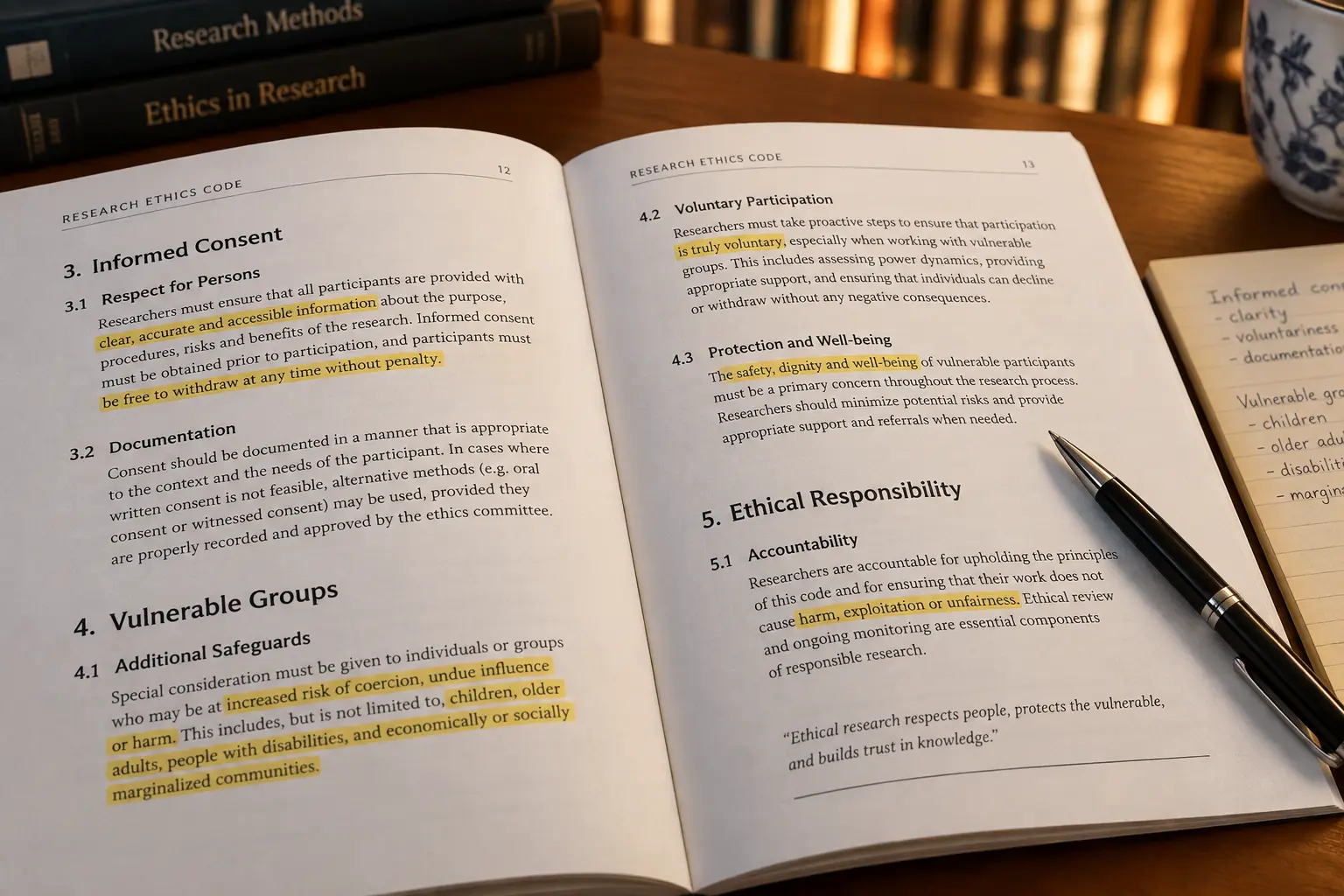
Four elements come up repeatedly in criminology ethics applications built around it:
- Informed consent, explained substantively. The Statement says researchers should explain “what the research is about, who is undertaking and financing it, why it is being undertaken, and how any research findings are to be disseminated” — not just ask for a signed form.
- Vulnerable groups. Extra care applies where participation is sought from “children and young people, older people, those with a learning disability or cognitive impairment, or individuals in a dependent or unequal relationship” — a category that covers a large share of criminology’s usual participant groups. The Statement says group assent given by a gatekeeper should be avoided wherever possible, and that it is not appropriate to assume penal and care institutions can give consent on behalf of the people in them.
- Minimising harm. Researchers are expected to minimise “physical, psychological, discomfort or stress” to participants and to protect their “dignity and autonomy” — language your ethics application should echo when you describe risk mitigation.
- Confidentiality limits, set out in advance. In prison research especially, participants may disclose unreported offences during an interview. Rather than offering absolute confidentiality, the Statement suggests researchers consider making the limits of confidentiality clear to respondents — and ethics committees will expect that to happen before a participant discloses anything, not be renegotiated afterwards.
The Statement is organised into sections — including researchers’ general responsibilities, responsibilities towards the discipline and towards research participants, and case studies with FAQs — and it is worth citing the specific section your ethics application is responding to, rather than the document as a whole.
Do You Need Separate Approval to Research in a Prison or With Probation?
Yes, and this is the approval that catches criminology PhD students out because it runs in parallel with, not instead of, your university’s own ethics committee. Anyone planning research that applies research methods — interviews, surveys, observation, focus groups — involving staff or offenders inside a prison, the Probation Service, or HM Prison and Probation Service (HMPPS) headquarters must apply separately to the HMPPS National Research Committee (NRC), via the department’s own online application portal.
The eligibility rules are specific by level of study, and worth knowing before you plan a custodial fieldwork timeline around them:
- Undergraduate students: the NRC does not accept applications at this level at all — not even with MoJ or HMPPS business support attached.
- Master’s students: applications cannot be processed without written evidence of business support from a named senior role — a Prison Group Director for custody settings, a Regional Probation Director for community settings, or Deputy Director level for an HQ request — uploaded with the application.
- Doctoral students: the Committee does accept applications at this level, and business support, while described as beneficial, is not a requirement for a PhD applicant the way it is for a Master’s applicant.
The NRC’s own stated remit covers making sure the applicant, MoJ and HMPPS get best value from the research given its resource and operational impact, assessing the research’s robustness and relevance, and handling data protection, security and ethics consistently across applications. Where a project also needs health or social care research approval — a criminology-and-mental-health thesis touching NHS services, for instance — that route runs through the Integrated Research Application System (IRAS) instead of a separate NRC form.
What About Research With Offenders, Ex-Offenders or Victims Outside an Institution?
Research conducted in the community rather than inside a prison or probation setting — interviewing ex-offenders after release, working with a victim-support charity, surveying people who have experienced a specific offence type — does not trigger the NRC route, but it still needs your university ethics committee to treat participants as a vulnerable or higher-risk group under the BSC’s own framework. Practically, this usually means a distress protocol (what you do, and who you signpost a participant to, if disclosure of trauma or an unreported offence happens mid-interview), a clear statement of the limits of confidentiality given before the interview starts, and a plan for secure storage of any material that could identify someone as a victim or an offender.
Where a gatekeeper organisation is involved — a charity, a youth offending team, a local authority safeguarding board — most ethics committees also want to see the gatekeeper’s own written agreement to access, submitted alongside your ethics application rather than promised as a future step. The instruments you use to collect that data matter here too: a semi-structured interview guide or survey built around clearly bounded questions is easier for a committee to assess for risk than an open-ended design, and the general principles for building one are covered in how to design data collection instruments for postgraduate research. Access and sample size are the other two variables an ethics committee scrutinises together with your instrument — a sampling approach that is realistic about how many ex-offenders or victims a single gatekeeper organisation can actually put you in touch with over a funded period is covered in how to choose and justify a sampling strategy.
What Data Protection Rules Apply to Criminology Research?
Criminology research routinely handles data that UK data protection law gives extra protection. Information about someone’s criminal convictions and offences is “criminal offence data”: it is not one of the special categories under Article 9 of UK GDPR, but it is treated separately under Article 10 and the Data Protection Act 2018, with its own conditions and safeguards — and if the same material also reveals health, ethnicity or other special-category information, the special-category rules apply as well. In practice, this means your ethics application has to describe a genuine data management plan, not a placeholder paragraph: how identifiable data is stored (encrypted, access-controlled, on university-approved systems rather than a personal laptop or a general cloud account), how long it is retained after the thesis is examined, and how it is anonymised or destroyed at the end of that period. The BSC’s own Statement of Ethics expects researchers to comply with the relevant data protection and human rights legislation, and your university’s data protection office will expect the lawful basis and conditions to be named explicitly.

If you are using an AI tool anywhere in the analysis or writing-up stage, treat unpublished interview data, case files or any material naming a real participant, offender or victim the same way you would treat it in a printed notebook: it does not go into a general-purpose AI tool’s training data or a third-party server without checking that tool’s own data-handling terms first — the general principles are covered in is it safe to put unpublished thesis data into an AI tool, and they apply with extra force to criminal-record and offending-history data specifically. With Tesify, the thesis itself stays 100% written by you — and the same rule about keeping identifiable participant data out of any third-party tool applies there too.
How Does This Compare With Sociology and Social Work Ethics Approval?
The shape is the same as for a sociology or social work PhD: university ethics committee approval is universal and mandatory, and a second, sector-specific approval — NHS Health Research Authority approval for research recruiting through NHS or regulated social care services, HMPPS’s NRC for research recruiting through prisons or probation — sits alongside it only when your recruitment route actually runs through that sector. A criminology thesis that never approaches a prison, a probation service or an HMPPS setting does not need NRC approval at all; one that does needs it in addition to, not instead of, university ethics committee sign-off. Confirm which route applies to your specific access plan with your supervisor and your university’s research ethics office before you approach any gatekeeper, since assuming the wrong route is one of the more common reasons a criminology ethics application gets sent back for resubmission.
Frequently Asked Questions
Does a criminology PhD always need ethics committee approval?
Yes. University research ethics committee approval is mandatory for every UK criminology doctorate that involves human participants, regardless of topic.
What is the British Society of Criminology’s Statement of Ethics?
A 2015 revision of the Society’s ethics guidance, written by Azrini Wahidin, Loraine Gelsthorpe, Terry Gillespie, Nic Groombridge and Jennifer Fleetwood. It describes itself as an aspirational frame of reference for responsible research practice, not a prescriptive rulebook, and covers informed consent, vulnerable groups, harm minimisation, confidentiality limits and legal compliance.
Do I need separate approval to interview people in prison?
Yes. Any research applying methods such as interviews, surveys, observation or focus groups with staff or offenders inside a prison, the Probation Service or HMPPS headquarters needs separate approval from the HMPPS National Research Committee, in addition to university ethics committee approval.
Can undergraduate or Master’s students get NRC approval?
The NRC does not accept applications from undergraduate students at all. Master’s applications need written business support from a named senior role (Prison Group Director, Regional Probation Director, or Deputy Director for HQ requests) uploaded with the application.
Is it easier for PhD students to get NRC approval than Master’s students?
The Committee does accept doctoral-level applications, and business support is described as beneficial rather than required at that level — a materially lower bar than the Master’s requirement for a mandatory supporting letter.
Can institutional consent from a prison replace individual participant consent?
No. The BSC’s Statement of Ethics says every effort should be made to secure free and informed consent from individual participants, that gatekeeper group assent should be avoided wherever possible, and that it is not appropriate to assume penal and care institutions can consent on participants’ behalf.
What counts as a vulnerable group in criminology research?
The BSC’s Statement names children and young people, older people, people with a learning disability or cognitive impairment, and people in a dependent or unequal relationship — a category that covers a large share of criminology’s typical participant groups, including many offender and victim populations.
Do I need to declare the limits of confidentiality before an interview?
You should. The BSC’s Statement suggests making the limits of confidentiality clear rather than promising absolute confidentiality, and ethics committees will expect this to happen before a participant discloses anything — especially in prison and offender research, where an unreported offence may come up during the interview itself.
Does criminology research count as processing special category data?
Not in itself. Offending-history information is criminal offence data, which UK GDPR handles under Article 10 and the Data Protection Act 2018 rather than as an Article 9 special category — but it carries its own conditions and safeguards, and any health, ethnicity or other special-category details in the same material bring the special-category rules into play as well.
Does research with ex-offenders in the community need NRC approval?
Not unless it recruits through a prison, probation service or HMPPS setting. Community-based research with ex-offenders or victims still needs university ethics committee approval and usually a distress protocol, but not the separate NRC route.