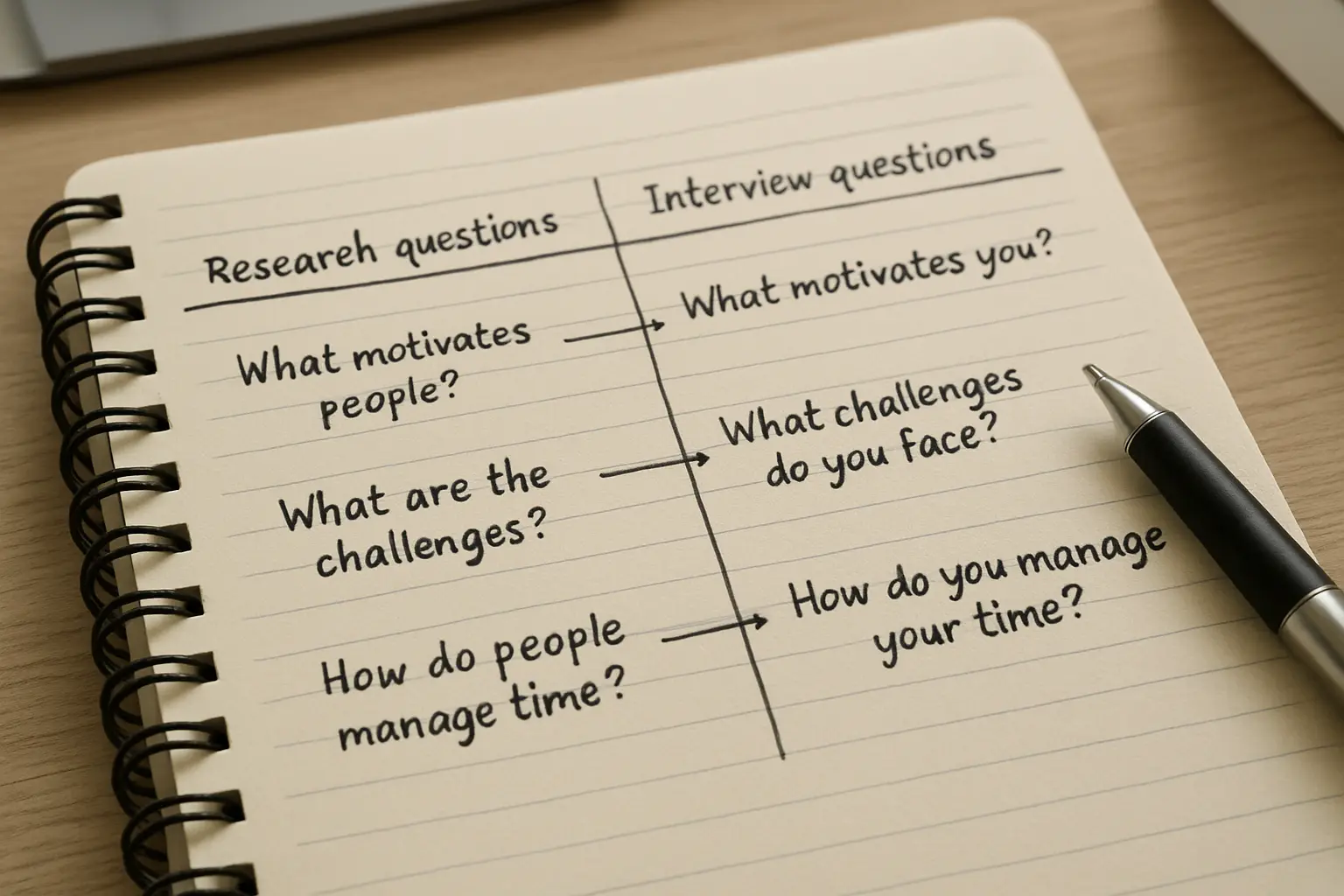
Ethics approval for your school-based fieldwork came through months ago, the headteacher has agreed access, and the interview guide is still a page of loosely related questions that do not map back to your research questions. A defensible interview or focus-group guide for an education PhD needs four things: every question traceable to a research question, a structured opening and closing protocol, planned probes rather than improvised follow-ups, and — where participants are under 18 — assent and gatekeeper procedures that satisfy BERA’s fifth-edition Ethical Guidelines for Educational Research (2024), not just your university’s generic template.
Why “I’ll just ask what I need to know” fails at viva
A common education PhD failure mode is a topic guide built the week before fieldwork starts, with questions that sound reasonable individually but do not, as a set, actually generate data that can answer the thesis’s stated research questions. An examiner reading the methodology chapter checks this directly: for each research question, which interview or focus-group questions were designed to generate data relevant to it. A guide built without that mapping visible usually means the candidate discovers gaps only once transcripts are in front of them — by which point re-fielding is rarely possible.
Step 1: Map every question back to a research question, in a table
| Research question | Interview/focus-group question(s) | Question type |
|---|---|---|
| How do teachers describe their adoption of a new digital assessment tool? | “Walk me through the first time you used the tool with a class.” | Narrative/descriptive opener |
| What barriers do teachers report to sustained use? | “What has made it harder to keep using the tool as the term went on?” | Probing |
| How does the tool change what teachers say about their own practice? | “Has anything about how you plan lessons changed since you started using it?” | Reflective |
This mapping is illustrative, built for a study of teacher digital-tool adoption, but the discipline generalises: if a question in the guide cannot be traced to a cell in this table, either the question is unnecessary or a research question is missing its own coverage.
Step 2: Build the opening and closing protocol before the substantive questions
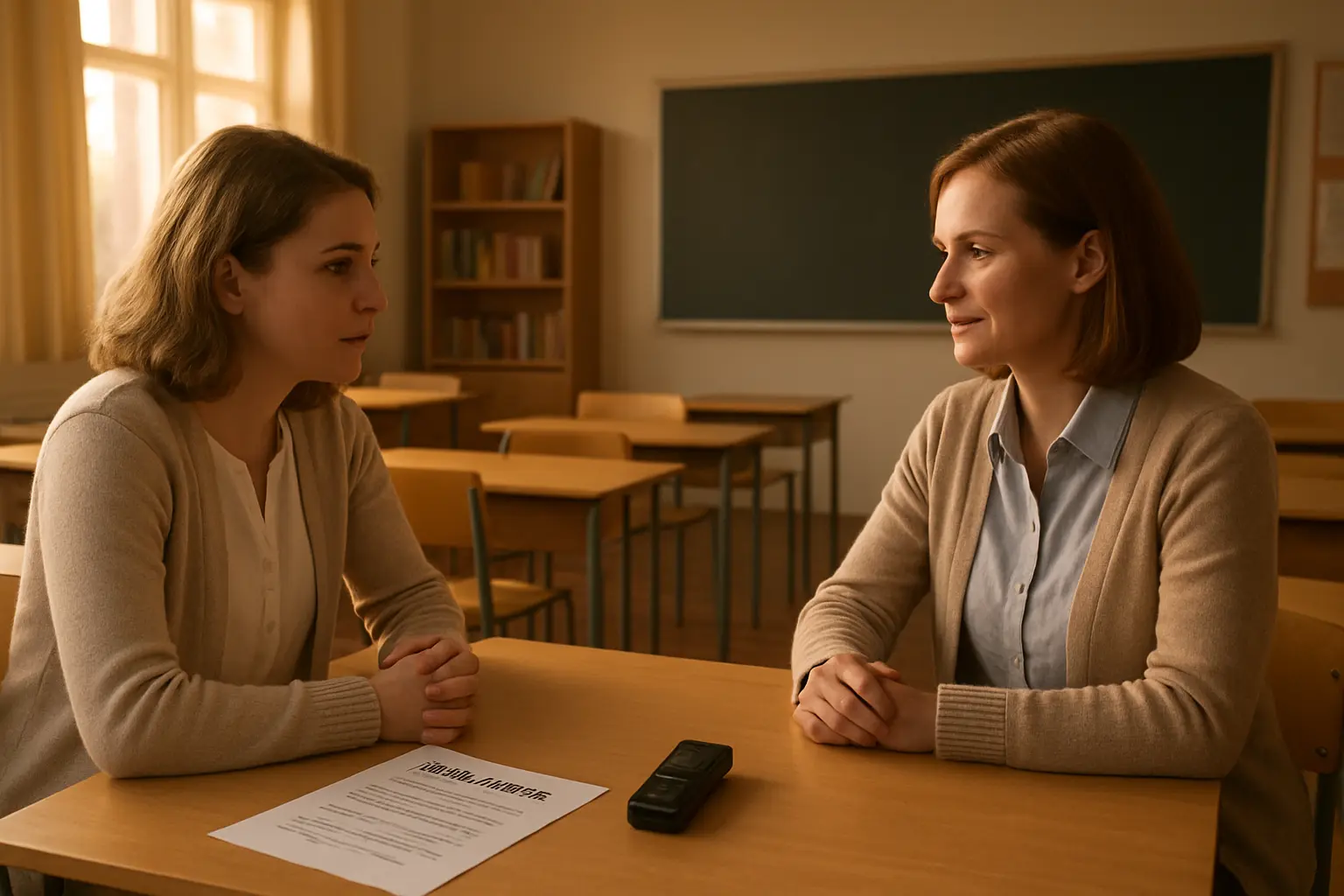
The first two minutes set the consent and rapport foundation for everything that follows: a restated purpose in plain language, confirmation the participant has read and understood the information sheet, confirmation of recording consent, and an explicit reminder of the right to stop or decline any question — this last point is not optional politeness, it is BERA’s own principle. The closing protocol needs a debrief question (“is there anything about this you expected me to ask that I didn’t?”) and a reminder of what happens next with their data and how to withdraw it if they choose to, within whatever window your ethics approval specifies.
Step 3: Write probes in advance, not just headline questions
A guide of headline questions alone under-prepares a novice interviewer for the moment a participant gives a one-sentence answer to a question meant to generate rich data. Planning two or three generic probes per headline question — “can you say more about that,” “what did that feel like at the time,” “how did other people respond” — gives an interviewer something practised to reach for rather than an improvised, potentially leading follow-up invented under pressure.
Step 4: Assent, gatekeepers and safeguarding when participants are under 18
BERA’s fifth-edition Ethical Guidelines for Educational Research (2024) are explicit that the principles of consent apply to children and young people as well as adults, using the term assent for participants under the age of legal consent, and that researchers should take into account the rights and duties of those with legal responsibility for a child — usually meaning parental or guardian consent alongside the child’s own assent, not instead of it. The guidelines also state that researchers should think about whether to approach gatekeepers (a school, a local authority) before directly approaching participants, and note this is “usually a requirement,” alongside adopting the host institution’s own ethical approval and safeguarding procedures. This gatekeeper-first logic is not unique to education research — the site’s piece on research ethics and consent for a sociology or social work PhD covers the same structural requirement for a different set of institutional gatekeepers. One clarification worth being precise about: BERA’s own guidelines do not themselves mandate a DBS (Disclosure and Barring Service) check — that requirement typically comes from the school’s or local authority’s own safeguarding policy and from your host university’s separate safeguarding rules, so confirm both routes rather than assuming BERA’s ethics guidance alone covers it.
Step 5: Build the right to withdraw into the guide, not just the information sheet
BERA’s guidelines state plainly that researchers should recognise the right of all participants to withdraw “for any or no reason,” and that participants should be informed of this right and how to exercise it — a principle too often left to the written information sheet alone and never restated aloud. Building a spoken reminder into both the opening and closing protocol (rather than assuming a document read, possibly weeks earlier, is enough) is the practical way this principle actually reaches the participant at the moment it matters, and is also the kind of detail an examiner checking ethical rigour specifically looks for evidence of in the methodology chapter.
Step 6: Design for group dynamics if you are running a focus group, not a series of solo interviews

A focus-group guide needs questions phrased to invite discussion between participants, not just sequential individual answers to the same question the facilitator asks each person in turn — “does anyone see this differently” and “what do people think about what [participant] just said” do work an individual-interview guide never needs. The facilitator role also needs planning in the guide itself: how a dominant voice will be gently redirected, how a quiet participant will be drawn in without singling them out uncomfortably, and — specific to education research with pupils — how peer pressure among children who know each other from the same class or year group will be managed so a genuinely dissenting view is not simply suppressed by group conformity.
Step 7: Pilot the guide before the real fieldwork window opens
A pilot with one or two participants outside the main sample (a colleague’s class, a willing former student, a pilot school) surfaces the questions that read clearly on paper but land confusingly out loud, and tests realistic timing — a guide that looks like a comfortable length on paper often runs well over once probes and participant tangents are included. Adjustments made after a pilot should be noted in the methodology chapter as evidence of a deliberate, tested instrument rather than a first draft used unchanged.
A worked excerpt (illustrative topic guide)
Opening: “Thank you for agreeing to talk with me today. As we discussed on the information sheet, I’m interested in your experience using [the tool] this term. There are no right or wrong answers — I’m interested in your own experience. You can skip any question or stop at any point. Is it still okay for me to record this conversation?”
Q1 (narrative opener): “Walk me through the first time you used the tool with a class.” Probes: “What were you expecting?” / “What actually happened?”
Q2 (probing): “What has made it harder to keep using the tool as the term went on?” Probes: “Can you give me a specific example?” / “How did you work around that?”
Q3 (reflective): “Has anything about how you plan lessons changed since you started using it?” Probes: “In what way?” / “Would you have said that at the start of term?”
Closing: “Is there anything about this you expected me to ask that I didn’t? Thank you again — here’s a reminder of how to get in touch if you’d like to withdraw anything you’ve said, up until [date].”
Where this sits against the site’s other instrument pieces
This piece goes deep on one artefact — the interview or focus-group guide itself, with the group-dynamics and under-18 assent detail a general treatment cannot cover — where the site’s cross-discipline piece on designing data collection instruments for postgraduate research introduces the interview topic guide as one of three generic templates alongside a questionnaire and an observation schedule. Use that piece for the wider instrument landscape and this one when the interview or focus-group guide itself, specifically for education fieldwork with school gatekeepers, is the thing you are stuck on. The theoretical framework that will ultimately make sense of what these interviews or focus groups produce is a separate, earlier decision — the site’s piece on choosing a theoretical framework for an education PhD covers Bourdieu, Vygotsky, Bronfenbrenner and the other frameworks UK education theses actually build on.
Once the guide exists, the harder part starts
A well-built guide still produces transcripts that need coding, a step that eats months when done manually with no structure — Tesify’s thesis writing workflow is built to help turn coded qualitative data into a findings chapter draft once the analysis itself is done, so the guide above is the first of several stages this process needs to move through before a chapter exists, not the last.
Frequently asked questions
Is the worked topic guide above from a real published study?
No. It is invented for illustration, built around a teacher digital-tool-adoption topic to show the shape and register a defensible guide needs.
What edition of the BERA guidelines should I be citing?
The fifth edition, published 2024 — the fourth edition (2018) is now superseded; check the reference number on your own copy against BERA’s own publications page before citing it in your ethics application or methodology chapter.
Do I need separate parental consent and child assent, or does one cover both?
Both, normally — BERA’s guidelines treat consent from those with legal responsibility for the child and the child’s own assent as separate, complementary requirements, not one substituting for the other.
Does BERA require a DBS check for researchers interviewing children?
Not directly in the ethical guidelines document itself — that requirement typically comes from the school’s own safeguarding policy and your host university’s separate safeguarding rules, both of which should be checked alongside BERA’s ethics guidance rather than assumed to be the same thing.
How many probes should I plan per headline question?
Two or three is a practical range — enough to have something ready if the initial answer is thin, without so many that the guide becomes a rigid script the interviewer feels obliged to work through regardless of how the conversation is actually going.
What if my focus group has a participant who dominates the discussion?
Plan the redirect language in the guide itself in advance — a prepared, neutral phrase (“that’s really useful, I’d like to hear what others think too”) is easier to deploy in the moment than an improvised one, and having it planned reduces the risk of a redirect that reads as dismissive to the participant being redirected.
How long should a pilot interview or focus group actually be before the main fieldwork?
There is no fixed rule, but running the pilot early enough to still adjust the guide, recruit route and consent materials before the real fieldwork window opens is the practical constraint — a pilot run the week before main data collection starts leaves no time to act on what it reveals.
Should the guide be shared with participants or gatekeepers in advance?
Sharing the topic areas (not necessarily every exact question) with a gatekeeper such as a headteacher is common practice and often expected as part of gaining institutional access, while sharing every exact question with participants in advance can sometimes produce more rehearsed, less spontaneous answers — a judgement call that depends on what the specific research question needs.
Does the right to withdraw have to be repeated at both the start and end of the interview?
It is stronger practice to do so — BERA’s principle is that participants are informed of the right and how to exercise it, and restating it at both points, rather than relying on a written information sheet read once, is the more defensible version of meeting that principle in practice.
Can a participant withdraw their data after the interview has already happened?
Usually yes, within a window stated in the consent materials and confirmed again in the guide’s closing protocol — the exact cut-off (often tied to a stage such as the start of analysis or submission) should be set by the candidate’s own ethics approval, not assumed to be open-ended indefinitely.