
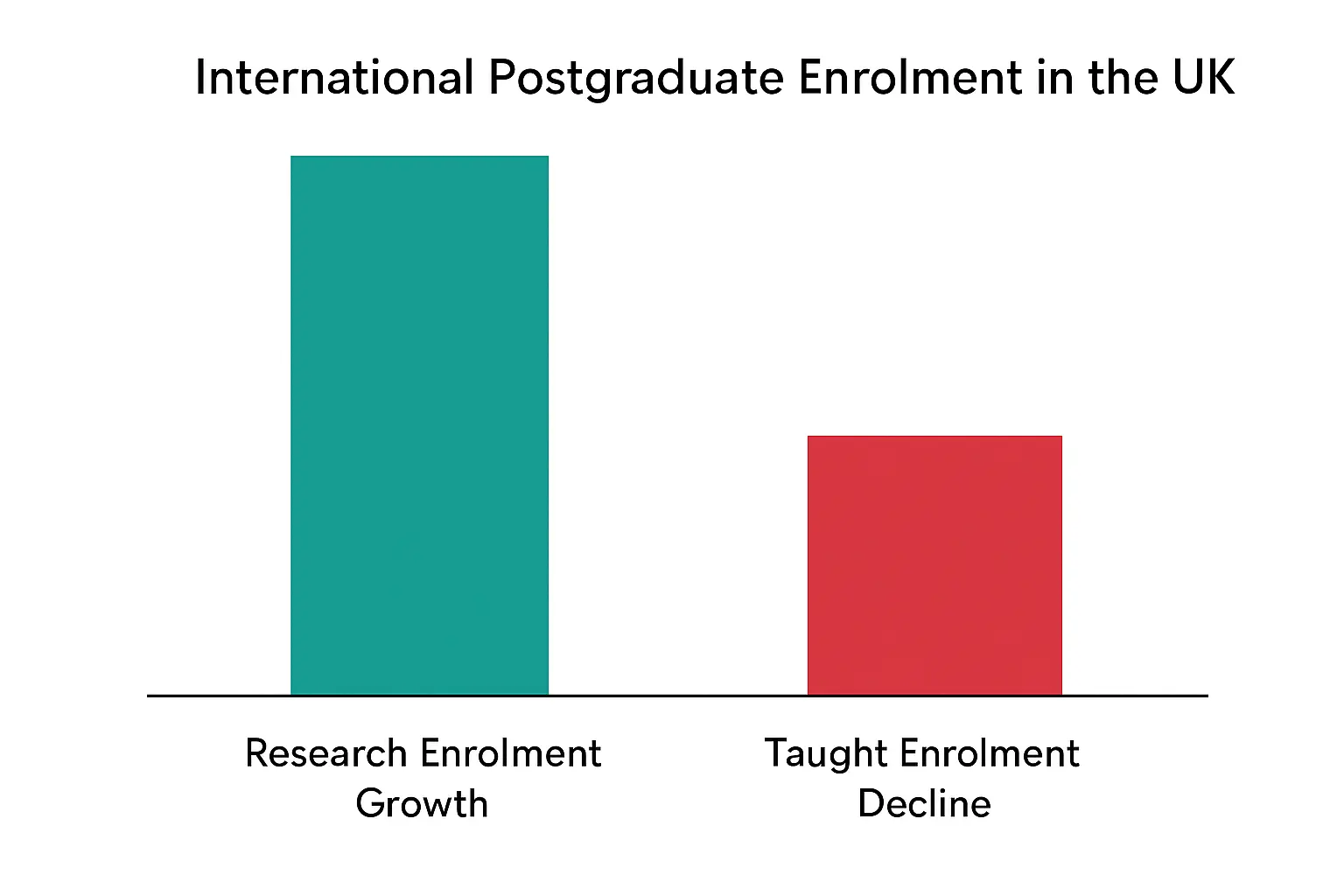
Nearly 51,000 international students were enrolled on UK postgraduate research programmes — the level that includes PhDs — in 2024/25, a 7% increase on the year before, even as international enrolment on taught postgraduate courses fell sharply over the same period. The divergence is not organic demand growth: postgraduate research programmes are exempt from the UK’s 2024 dependants ban that applies to taught postgraduate students, and the growth is concentrated among nationalities most affected by that ban. The figures below are drawn from ApplyBoard’s and ICEF Monitor’s published analyses of HESA enrolment data; HESA’s own data-mining tools are restricted to the institutions that contribute data to HESA.
How many international students are on UK postgraduate research programmes?
Nearly 51,000 international students pursued postgraduate research-level study — the category HESA uses that includes PhD, MPhil and other doctoral-level research degrees — in the UK in 2024/25, according to ApplyBoard’s analysis of HESA enrolment data. That represents a 7% increase on 2023/24, at a time when international enrolment on taught postgraduate courses (master’s programmes) declined significantly over the same period. The two levels moved in opposite directions in the same year, which is the headline finding worth understanding rather than just quoting.
Why did research enrolments grow while taught postgraduate enrolments fell?
The UK’s dependants ban, introduced in January 2024, prevents most taught postgraduate international students from bringing family members with them — but the ban does not apply to postgraduate research students. ApplyBoard’s analysis states plainly that, because postgraduate research programmes are not subject to the dependants ban, it is likely some prospective students shifted their target course type from taught to research programmes specifically to retain the right to bring dependants. This is a policy-driven course-switching effect, not a straightforward signal of rising research-specific demand for UK doctoral study, and the two should not be conflated when reading the headline growth figure.
What does the dependants ban actually restrict, and why does research study sit outside it?
Since January 2024, most people starting a taught postgraduate course in the UK on a Student visa have not been able to bring a partner or children as dependants, a change the UK government introduced as part of a wider set of measures to reduce net migration. The exemption for postgraduate research students — PhD and other research-degree candidates — was carried over from the policy’s design specifically because research degrees were treated differently in earlier reviews of the Student visa route, and that distinction is what the enrolment figures above are actually reacting to. The policy detail changes; a prospective applicant should treat the exemption as current as of the data reported here, not as a permanent feature of the visa system.
How did the growth split between EU and non-EU students?
The growth was concentrated among non-EU students. ApplyBoard’s analysis found non-EU enrolments in research programmes rose 11% year on year, while ICEF Monitor’s separate analysis of the same underlying HESA data put the non-EU research increase at 10.5% — the two independent analyses converge closely despite minor rounding differences in methodology. Both sources agree EU enrolments in research programmes moved the opposite way, falling 12% over the same period, a pattern consistent with the EU’s exclusion from the specific visa dynamics driving the non-EU shift.
Which nationalities drove the growth?
ApplyBoard’s analysis names the growth as concentrated among student populations most affected by the dependants restrictions — specifically Nepal, Bangladesh, Pakistan, Nigeria, Sri Lanka and India. These are broadly the same nationalities that saw the sharpest declines in taught postgraduate enrolment over the same period, reinforcing the course-switching explanation rather than pointing to research-specific demand growth from these countries independently.
What visa route do international PhD students actually use?
International doctoral researchers in the UK study on the Student visa route, the same broad route as other international students, rather than a route specific to research degrees — the material difference the figures above turn on is not a different visa category but the dependants-ban exemption that applies specifically to postgraduate research-level study within that same Student visa system. A prospective doctoral candidate should check the current Student visa eligibility and dependant rules directly on GOV.UK at the point of application, since visa policy in this area has changed more than once in the last two years and a figure correct at the time of writing may not hold by the time of a real application.
What should this data actually change about an application decision?
For a prospective international applicant, the practical implication is not that a UK doctorate is now easier to get funded or more in demand generally — it is that the relative attractiveness of a research degree over a taught master’s has shifted specifically for applicants who need to bring dependants, and that shift is visible in the enrolment data rather than being a marketing claim. It does not change admissions competitiveness, supervisor capacity or funding availability at any specific institution, all of which still need checking directly with the department in question. A candidate should also weigh that a course-switching effect driven by visa policy is not the same as a signal that UK doctoral research training itself has become more internationally competitive or higher-ranked this year — the two are easy to conflate in headline reporting and worth separating deliberately.
What should supervisors and graduate schools note about this shift?
For supervisors and doctoral college or graduate school administrators, a policy-driven rise in international research applications has practical downstream effects worth planning for rather than treating purely as a recruitment win: cohorts shaped substantially by visa-policy course-switching may include applicants whose primary motivation was retaining dependant rights rather than a settled research interest in the specific project on offer, which is worth probing gently at interview rather than assumed away. It also means application volume from the specific nationalities named above may not track historical patterns a department has planned recruitment or induction capacity around, and a graduate school reviewing its own admissions data this year should expect the composition, not just the volume, of its international applicant pool to have shifted.
The figures at a glance
The table below collects every figure cited in this article in one place, each with the specific published analysis of HESA data it was drawn from.
| Metric | 2024/25 figure | Source |
|---|---|---|
| International postgraduate research (incl. PhD) enrolment | Nearly 51,000, up 7% year on year | ApplyBoard analysis of HESA data |
| Non-EU research enrolment change | +11% (ApplyBoard) / +10.5% (ICEF Monitor) | ApplyBoard and ICEF Monitor analyses of HESA data |
| EU research enrolment change | −12% | ApplyBoard and ICEF Monitor analyses of HESA data |
| Nationalities most associated with the shift | Nepal, Bangladesh, Pakistan, Nigeria, Sri Lanka, India | ApplyBoard analysis of HESA data |
How does this compare with the UK’s overall PhD population?
This site’s own guide to how many PhD students are there in the UK sets out the total postgraduate research population from HESA’s own published figures; read alongside that piece, the international-specific figures here show that international students make up a substantial and, on the research-degree level specifically, currently growing share of that total population — though the growth this year is better explained by visa-policy-driven course-switching than by rising underlying demand for UK doctoral study specifically.
What does this mean for funding and stipends?
International and Home (UK) doctoral researchers are not funded on the same terms — UKRI studentships and the minimum doctoral stipend rate are calculated for Home-fee students, and international students on a UKRI-funded studentship are typically charged the institution’s own international fee rate rather than the Home rate, a gap this site’s own UK PhD stipend and studentship funding guide sets out in more detail. An international applicant weighing a UK doctorate against other destinations should check a specific institution’s international fee and any dedicated international scholarship schemes directly, since these vary far more by institution than the Home-rate figures do.
Frequently asked questions
Does “postgraduate research” mean the same thing as “PhD” in these figures?
Broadly, but not exactly — HESA’s postgraduate research category includes PhD, MPhil, and other research-based doctoral and pre-doctoral degrees together, so the nearly 51,000 figure is not a PhD-only count, though PhD students make up the large majority of it.
Is the growth in international research enrolment likely to continue?
The published analyses attribute the 2024/25 growth substantially to a specific, time-bound visa-policy effect (the dependants ban’s exemption for research programmes) rather than to organic rising demand, so whether it continues depends significantly on whether that policy exemption itself changes — check current GOV.UK guidance rather than assuming last year’s trend continues automatically.
Why does this article cite analyses of HESA data rather than HESA’s own tools?
HESA’s own data-mining tools are available only to institutions that contribute data to HESA, so the figures in this article come from two independent third-party analyses of HESA’s published enrolment data, which agree closely with each other.
Do international PhD students pay the same fees as UK students?
No — international doctoral researchers are typically charged the institution’s own international fee rate, which is usually substantially higher than the Home rate UKRI studentships are calculated against; check a specific institution’s current fee schedule directly, since it varies by institution and subject.
Which UK universities host the most international PhD students?
The published analyses cited here do not break this down by institution — a prospective applicant wanting institution-level figures should check a specific university’s own published international student statistics or its most recent HESA return directly.
Does the dependants ban affect current international PhD students already in the UK, or only new applicants?
The policy detail on who is affected and from what date is a live, changing area of UK visa policy — check current GOV.UK Student visa guidance directly for the rules that apply at your specific stage of study, rather than relying on a figure from a single point in time.
Can an international PhD graduate stay in the UK to work after finishing?
The UK’s Graduate visa route allows eligible international graduates, including doctoral graduates, to remain and work for a period after completing their degree — the specific eligibility conditions and current length of that route should be checked directly on GOV.UK, since post-study work policy has also changed more than once in recent years.
Should a graduate school treat this year’s international applicant growth as a stable new baseline?
Not without caution — because the growth is substantially attributable to a specific visa-policy exemption rather than organic demand, a graduate school planning multi-year capacity should treat the current level as potentially sensitive to future policy changes rather than assume it as a permanent new baseline.
Why do the ApplyBoard and ICEF Monitor figures for non-EU growth differ slightly (11% versus 10.5%)?
Both are independent third-party analyses of the same underlying HESA dataset rather than HESA’s own published headline figure, and small differences of this kind are typical when two analysts apply slightly different rounding, date cut-offs or category definitions to the same raw data — the close convergence between the two figures is itself a reason for confidence in the general direction and scale of the trend, even without a single authoritative HESA figure to cite directly.