
A UK law PhD title is built from three parts in a fixed order: the legal object or problem, the method or lens applied to it, and the jurisdictional or comparative scope — and it almost never contains a question mark. Below is the construction formula broken down, followed by 30 worked illustrative examples across doctrinal, socio-legal, comparative and international law, and what changes when the title has to survive from year one to submission. All 30 titles are invented for illustration, not drawn from real theses.
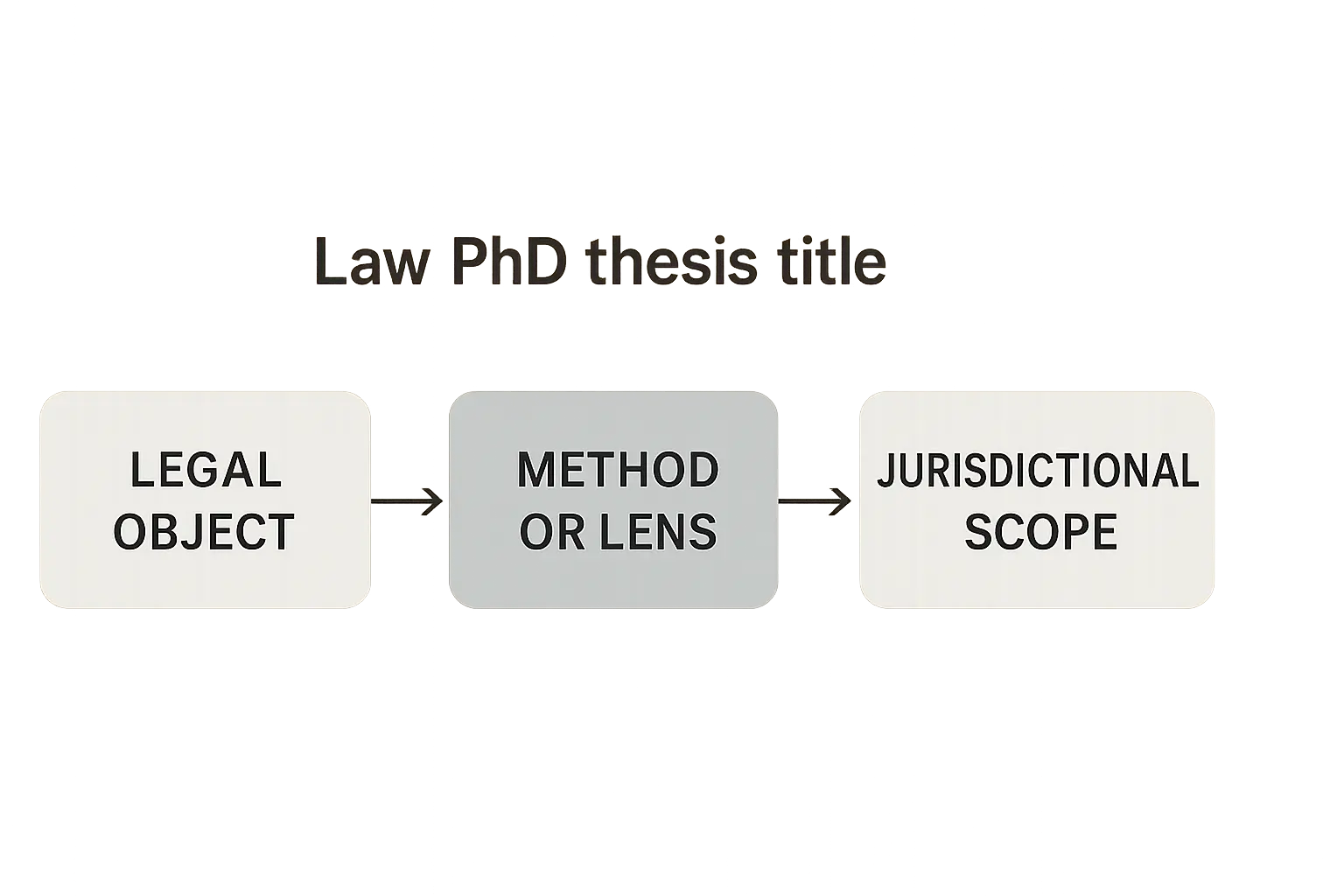
What is the actual formula behind a working law PhD title?
Read against the structure of a UK law thesis, a title has to signal which of the three broad thesis types it is before a reader opens the abstract: doctrinal (the object is a rule or body of rules), socio-legal (the object is a rule’s effect on people or institutions, studied empirically), or comparative (the object is how two or more legal systems treat the same problem differently). The formula is: [legal object] + [analytical method] + [scope]. A worked breakdown of one example: “Algorithmic Decision-Making in UK Employment Law: A Doctrinal and Human Rights Analysis” — object (algorithmic decision-making in employment law), method (doctrinal plus human-rights framing), scope (UK). A title that omits the method signals an under-theorised thesis before the viva even starts; a title that omits the scope invites an examiner to ask whether the candidate actually means UK law, EU-retained law, or something wider.
30 worked title examples, by sub-field
Each example below states its type in brackets. All are illustrative constructions, not real thesis titles.
Doctrinal and constitutional law
- “The Doctrine of Parliamentary Sovereignty After Miller: A Doctrinal Re-Examination” (doctrinal)
- “Judicial Review of Prerogative Powers: Scope and Limits in Contemporary UK Public Law” (doctrinal)
- “Devolution and the Sewel Convention: A Constitutional Analysis of Non-Justiciability” (doctrinal)
- “Proportionality as a Ground of Review: Convergence Between Human Rights and Common Law Reasoning” (doctrinal)
Socio-legal and empirical law
- “Access to Justice in the Small Claims Track: A Socio-Legal Study of Litigants in Person” (socio-legal)
- “Policing Domestic Abuse Under Coercive Control Legislation: A Socio-Legal Study of Frontline Implementation” (socio-legal)
- “Employment Tribunal Outcomes and Legal Aid Withdrawal: An Empirical Legal Study” (socio-legal)
- “Legal Consciousness Among Gig-Economy Workers: A Qualitative Socio-Legal Study” (socio-legal)
Comparative law
- “Corporate Criminal Liability: A Comparative Study of the UK Failure-to-Prevent Model and the US Responsible Corporate Officer Doctrine” (comparative)
- “Data Protection Enforcement: A Comparative Analysis of the UK GDPR and the EU GDPR Post-Brexit” (comparative)
- “Surrogacy Regulation: A Comparative Study of England and Wales, California and Greece” (comparative)
- “Whistleblower Protection: A Comparative Legal Study of the UK, Germany and the United States” (comparative)
Commercial, company and financial law
- “Directors’ Duties and ESG Disclosure: A Doctrinal Analysis of Section 172 Companies Act 2006” (doctrinal)
- “Cross-Border Insolvency After Brexit: A Doctrinal and Comparative Study of Recognition Regimes” (doctrinal/comparative)
- “Algorithmic Trading and Market Abuse Regulation: A Doctrinal Study of Regulatory Gaps” (doctrinal)
- “Third-Party Litigation Funding: A Socio-Legal Study of Access to Justice in Commercial Disputes” (socio-legal)
Criminal law and criminology-adjacent law
- “Joint Enterprise Liability After Jogee: A Doctrinal Analysis of Secondary Party Culpability” (doctrinal)
- “Sentencing Guidelines and Racial Disparity: An Empirical Study of Crown Court Outcomes” (socio-legal)
- “Digital Evidence and the Right to a Fair Trial: A Doctrinal Study of Disclosure Obligations” (doctrinal)
International, environmental and human rights law
- “State Responsibility for Climate Harm: A Doctrinal Study of Customary International Law Obligations” (doctrinal)
- “Climate Litigation as a Regulatory Strategy: A Comparative Study of the UK, Netherlands and Germany” (comparative)
- “Business and Human Rights Due Diligence: A Doctrinal Analysis of the UK’s Regulatory Gap” (doctrinal)
- “Refugee Status Determination and Credibility Assessment: A Socio-Legal Study of UK Tribunal Practice” (socio-legal)
Intellectual property, technology and family law
- “Generative AI and Copyright’s Originality Threshold: A Doctrinal Re-Examination” (doctrinal)
- “Text and Data Mining Exceptions: A Comparative Study of UK and EU Copyright Law” (comparative)
- “Platform Liability for Algorithmic Harm: A Doctrinal Study of the Online Safety Act 2023” (doctrinal)
- “Cohabitation and Property Division: A Socio-Legal Study of Law Reform Inertia” (socio-legal)
- “Child Arrangements After Parental Alienation Findings: A Doctrinal and Welfare Analysis” (doctrinal)
- “Digital Assets in Divorce Settlements: A Doctrinal Study of an Emerging Property Category” (doctrinal)
- “Algorithmic Sentencing Tools in Family Court Risk Assessment: A Socio-Legal Study of Practitioner Trust” (socio-legal)
What makes a law title too broad to defend at viva?
The most common failure examiners describe is a title that promises a survey rather than an argument — “The Law of Data Protection in the UK” is not a thesis title, it is a textbook chapter heading. A workable revision states the specific doctrinal tension, gap or comparison the thesis actually resolves: “Consent as a Lawful Basis Under UK GDPR: A Doctrinal Study of Its Erosion in Adtech Practice.” A title survives the viva when the candidate can point at every word in it and say precisely what claim that word commits them to.
What other title mistakes come up again and again?
Beyond breadth, three patterns recur across law faculties. First, a title that names a method without a genuine object — “A Comparative Legal Study” with no stated subject-matter — leaves an examiner unable to place the thesis before opening it. Second, a title that borrows a journalistic hook instead of a legal claim, such as “The Future of Data Protection Law,” which promises prediction rather than analysis of a stated legal problem; UK law examiners consistently mark this down as under-argued. Third, a title that states the conclusion as though it were settled — “Why the UK’s Failure-to-Prevent Model Is Superior” — closes down the very question the thesis is meant to test, and most supervisors will ask for a neutral reframing (“Evaluating the UK’s Failure-to-Prevent Model Against Comparators”) before the title is signed off at upgrade.
Does the title have to stay fixed from year one?
No — most UK institutions expect the working title from the research proposal or upgrade document to evolve as the argument sharpens, and a title that has not changed at all by year three is often a sign the thesis has not developed. What has to stay fixed earlier is the legal object (the rule, body of rules or comparison at the centre); what typically changes is the method as the candidate discovers what kind of claim the evidence actually supports — a doctrinal study can acquire an empirical component, for instance, once interview or tribunal-outcome data becomes available.
How does a comparative law title differ in structure from a doctrinal one?
A comparative title has to name every jurisdiction compared, not leave one implicit — “A Comparative Study of Corporate Liability” forces an examiner to ask compared to what. It also has to signal the comparative method: functional comparison (how each system solves the same practical problem), or doctrinal comparison (how each system’s rules differ formally), since the two require different chapter structures. A worked example distinguishing the two: “Functional Convergence in Product Liability: A Comparative Study of the UK and Japan” signals a functional method; “Divergent Doctrinal Foundations of Product Liability: The UK and Japan Compared” signals a doctrinal-comparative method on the same topic.
Where does a thesis-by-publication title differ?
A law candidate on the thesis-by-publication route usually needs two titles working together: an overarching thesis title that states the connecting contribution, and individual paper titles that can stand alone in a law journal’s own house style, which is often narrower and more doctrinally precise than the connecting title needs to be. The connecting title has to be broad enough to genuinely span three or four papers without becoming the vague, textbook-chapter kind of title examiners reject.
Using the formula as a working diagnostic
Run any draft title against the three-part formula — object, method, scope — and if one part is missing, that is usually the part of the argument that is itself underdeveloped, not just an absent word. A supervisor asked to react to a title in five minutes is really testing whether the candidate can state the claim in one sentence; tools built to check a manuscript’s argument for gaps at full length — Tesify’s thesis workspace among them — apply the same test to the whole introduction chapter, not only the title page.
Frequently asked questions
Can a law PhD title include a question?
It is uncommon in UK legal scholarship compared with some social sciences — most examiners expect a declarative title stating the object, method and scope rather than a research question, which belongs in the introduction chapter instead.
Should the title name the specific statute or case?
Only when the statute or case is genuinely the object of study rather than one example among several — naming a single case in the title (“…After Miller”, “…After Jogee”) signals that the doctrinal shift caused by that decision is the thesis’s actual subject.
Is “A Doctrinal and Comparative Study” an acceptable method label, or does it need to pick one?
Combining methods in the title is acceptable and common where the thesis genuinely does both — but the methodology chapter then has to justify why both are needed rather than treating the doctrinal analysis as background for the comparison.
How long can a law PhD title actually be?
There is no fixed word limit at most UK law schools, but titles beyond roughly 20 words usually indicate the thesis is trying to promise too much — a title that needs a subtitle to finish the sentence is a signal to narrow the object, not to shorten the wording.
Does a socio-legal title need to name the specific method (interviews, survey, court observation)?
Not usually in the title itself — “A Socio-Legal Study” or “An Empirical Legal Study” signals the paradigm; the specific method belongs in the methodology chapter, though some candidates add it in a subtitle when the method itself is unusual for the field.
What is the difference between “doctrinal” and “socio-legal” in a law thesis title?
A doctrinal title treats the law itself — its rules, principles and their internal coherence — as the object of study; a socio-legal title treats the law’s effect on people, institutions or practice as the object, studied with empirical methods borrowed from the social sciences.
Can the title change after the upgrade or confirmation review?
Yes — most UK institutions expect the title to sharpen as the argument develops, and a supervisory team will usually sign off a revised title at the annual progress review rather than requiring a formal title-change process, unless the institution’s own regulations state otherwise.
Should international and comparative titles use “vs” or “and” between jurisdictions?
“And” or “Compared” is the more common convention in UK legal scholarship; “vs” reads as adversarial and is generally avoided in an academic title even where the underlying comparison is genuinely about conflicting approaches.
Does a professional doctorate in law (such as a DProf) follow the same title formula?
Broadly yes, but the scope element is often replaced with a practice-based frame — a DProf title more often names the professional context (a regulator, a firm type, a jurisdiction of practice) than a purely academic comparative scope, reflecting the practice-based contribution to knowledge that route requires.