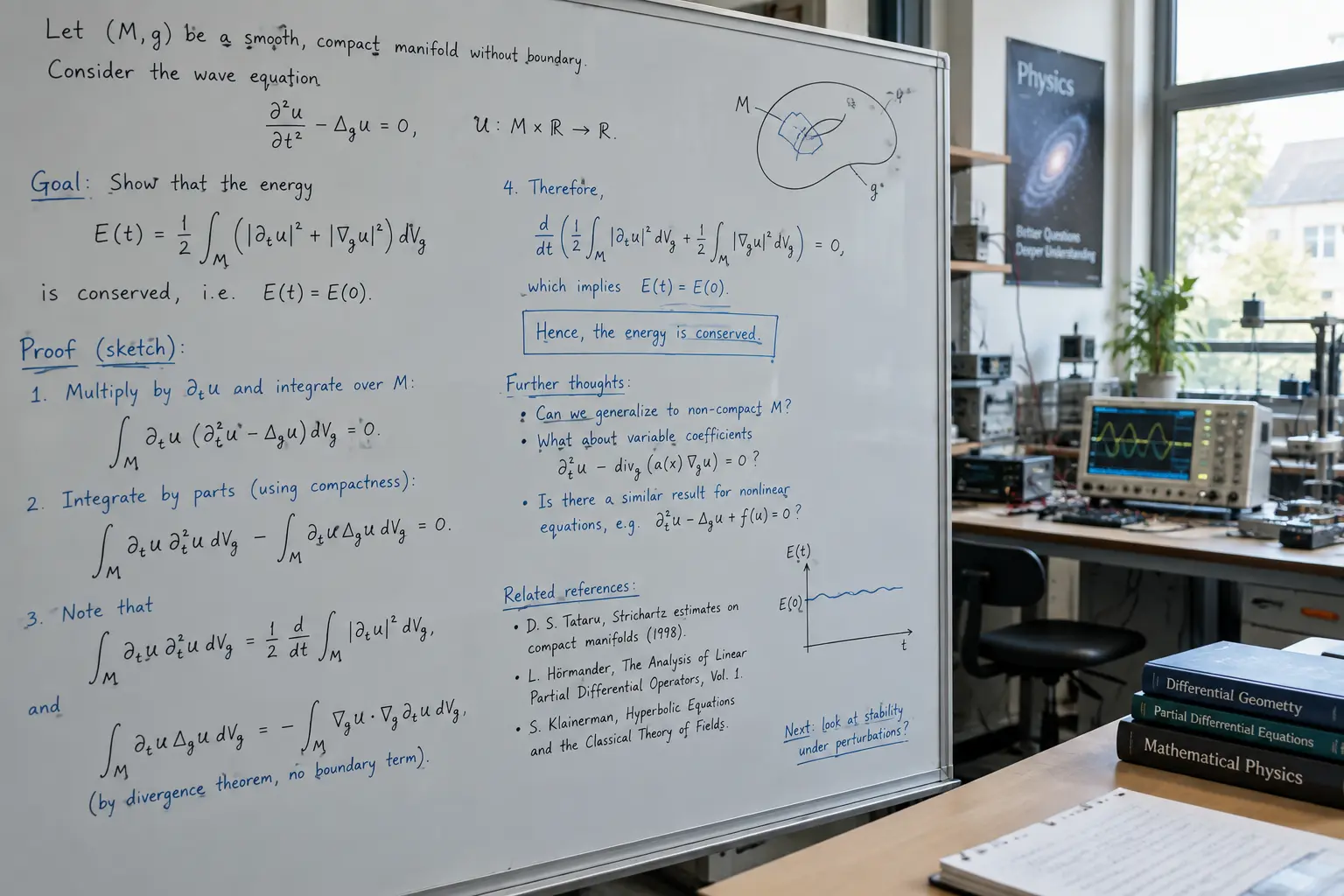
A PhD research proposal in mathematics or physics is judged on a different axis to one in the social sciences: not on ethics or access, but on whether the problem is genuinely open, whether your proposed approach could plausibly make progress on it inside a funded three-to-four-year studentship, and whether you already show enough technical command to be trusted with it. Here is how to build one, section by section, with a full worked example.
Step 1: Understand What a Maths or Physics Proposal Is Actually Judged On
A funding panel or admissions committee reading a mathematics or physics proposal is not checking your writing style or your literature-review breadth first — they are checking three things in order: is the problem real and currently open (not solved, not trivial), is the proposed approach technically credible given what is already known about the problem, and is the scope realistic for the funding period rather than a lifetime research programme compressed into a four-year plan. Get these three right and a proposal that is short and plainly written will outperform a long one that hedges on all three.
Step 2: State the Research Problem With Precision, Not Just a Topic Area
“Machine learning” or “quantum computing” is a field, not a problem. A credible proposal states a specific open question inside that field and says, in one or two sentences, why it is currently unresolved. Illustrative examples across the two disciplines:
- Pure mathematics: “Can the spectral gap of a random d-regular graph be bounded uniformly as the graph size grows, for a class of graphs where existing bounds rely on assumptions that do not hold?”
- Applied mathematics / numerical analysis: “Do existing finite-element error estimates for a class of nonlinear PDEs remain sharp when the boundary condition is time-dependent, and if not, what replaces them?”
- Theoretical physics: “Does a proposed extension to a standard effective field theory produce testable deviations at energy scales reachable by current or near-future experiments?”
- Experimental / condensed matter physics: “Can a specific fabrication technique produce a material with a predicted but not yet observed phase transition, and what measurement would confirm it?”
Each example names a gap in what is currently proven, computed or measured — not a general area of interest. Illustrative only: none of these is a real, currently open problem attributed to any named researcher.
Step 3: Write Objectives as a Sequence a Reviewer Can Check Off
Three to five objectives, each one a concrete, checkable milestone rather than an aspiration. A worked, illustrative example built around the numerical-analysis problem above:
- Reproduce the existing finite-element error bounds for the fixed-boundary case, to establish a verified baseline implementation.
- Extend the bound to a simplified time-dependent boundary case and identify where the existing proof technique breaks down.
- Develop a modified estimate for the general time-dependent case, and prove it under stated regularity assumptions.
- Validate the new estimate numerically against a benchmark problem with a known analytic solution.
- Write up the result for submission to a relevant numerical analysis journal ahead of thesis submission.
Notice the shape: each objective produces something checkable (a reproduced result, an identified failure point, a proof, a numerical validation, a manuscript) rather than a vague verb like “investigate” or “explore.”
Step 4: Choose and Justify Your Methodology by Branch
Unlike an empirical social-science thesis, “methodology” in mathematics and physics usually means one (or a combination) of three genuinely different toolkits, and a proposal has to commit to which:
- Proof-based (pure and much of applied mathematics): the methodology section states which existing theorems, techniques or proof strategies (perturbation arguments, spectral methods, variational techniques, combinatorial counting arguments) the work will build on, and where a genuinely new technique is expected to be needed.
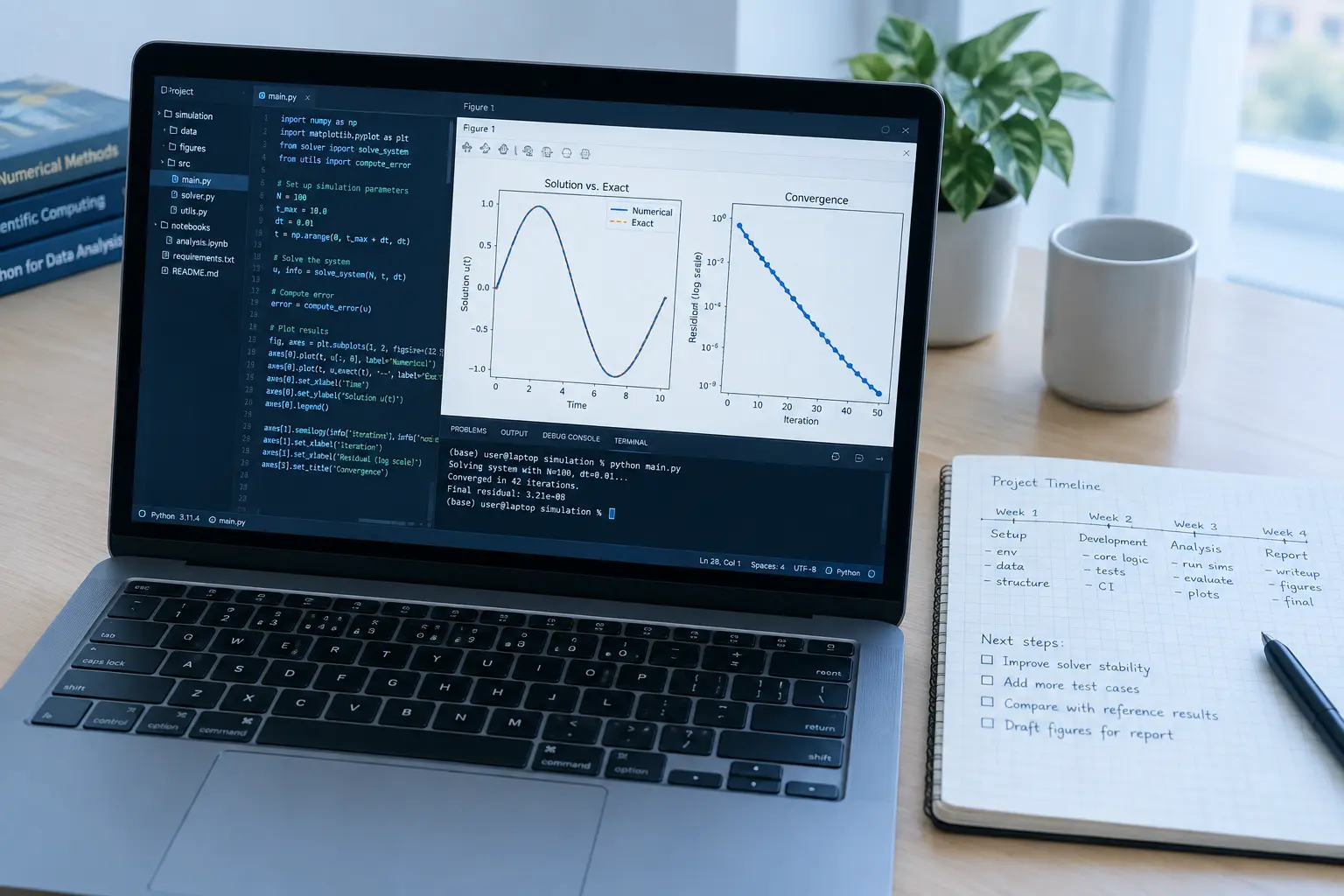
- Computational (numerical analysis, computational physics, data-driven mathematics): the methodology states the numerical scheme, the software or high-performance computing resource the university provides access to, the validation strategy against known benchmark cases, and the error/convergence analysis that will accompany any new code.
- Experimental (most of physics beyond pure theory): the methodology names the apparatus, the measurement technique, the expected sensitivity or resolution needed to detect the effect in question, and the safety and equipment-access arrangements — typically inherited from the supervisor’s existing lab rather than built from scratch by a new PhD student.
A proposal that mixes all three without saying which chapter uses which is an easy feasibility red flag for a reviewer to spot at this stage.
Step 5: A Worked Example Proposal, Section by Section
Putting Steps 1–4 together, an illustrative (not real) proposal outline:
| Section | Illustrative content |
|---|---|
| Working title | Sharpening finite-element error estimates for nonlinear PDEs with time-dependent boundary conditions |
| Problem statement | Existing error bounds assume fixed boundary conditions; whether they remain sharp under time-dependence is currently unresolved |
| Objectives | Baseline reproduction → simplified extension → general proof → numerical validation → manuscript |
| Methodology | Primarily proof-based (variational techniques), supported by a computational validation phase using the department’s existing finite-element code base |
| Year 1 | Literature review, baseline reproduction, first attempt at the simplified extension |
| Year 2–3 | General proof, iterating with supervisor feedback; numerical validation phase; first paper drafted |
| Year 3–4 | Thesis write-up, viva preparation, any resubmission of the paper |
This is a labelled, illustrative structure only, built to show how a problem, objectives, method and a realistic timeline lock together — the same general shape any UK PhD proposal follows, whatever the discipline, as covered in how to write a PhD research proposal for a UK studentship application.
How Much Literature Review Does a Maths or Physics Proposal Need?
Considerably less than a humanities or social-science proposal, and structured differently. Where a humanities proposal often surveys a field to justify why the topic matters, a mathematics or physics proposal cites only the specific results your problem depends on: the theorem whose assumptions you are trying to weaken, the experiment whose result your theory needs to be consistent with, the numerical method whose limitation you are addressing. A page or two, tightly focused on the immediate technical context, reads as stronger than five pages of general background — reviewers in this area are looking for evidence you know exactly where the boundary of current knowledge sits, not evidence you have read broadly around it. This is a different skill from the general survey approach covered for other disciplines in how to write a PhD research proposal in computer science, which sits closer to mathematics and physics than a social-science proposal does, but still usually carries more contextual framing than a pure-mathematics problem statement needs.
Step 6: Know Your Funding Route Before You Write the Proposal
Most funded mathematics and physics PhDs in the UK run through UK Research and Innovation’s research councils rather than a single university scholarship pot, and the route shapes what a proposal needs to demonstrate. EPSRC funds the majority of mathematics and much of physics through Centres for Doctoral Training (CDTs), while STFC is the primary funder for particle physics, astronomy and nuclear physics studentships — the current landscape, including the number of active CDTs and the annual STFC studentship total, is set out in which research council funds your PhD. A CDT application usually asks for a shorter, more provisional proposal at the application stage, with the fully worked version developed in your first months alongside your supervisor and cohort — check your specific CDT or DTP’s own timeline rather than assuming the traditional single-supervisor model applies.
Step 7: What a Reviewer Checks at the Proposal Stage
Beyond the three criteria in Step 1, reviewers in mathematics and physics specifically look for: whether you cite the actual current state of the art rather than a textbook-level summary of the field, whether your timeline allocates enough time to the parts of the plan that could fail (a proof that does not go through, an experiment that does not resolve the predicted effect) rather than assuming linear progress, and whether you show early technical command — a worked calculation, a small proof, or a preliminary simulation result, even a simplified one, signals more than a paragraph of motivation. If you already have a supervisor, ask them directly what a strong first-page problem statement looked like for the last student they took on; departmental norms vary more in mathematics and physics proposal writing than the general advice above can capture.
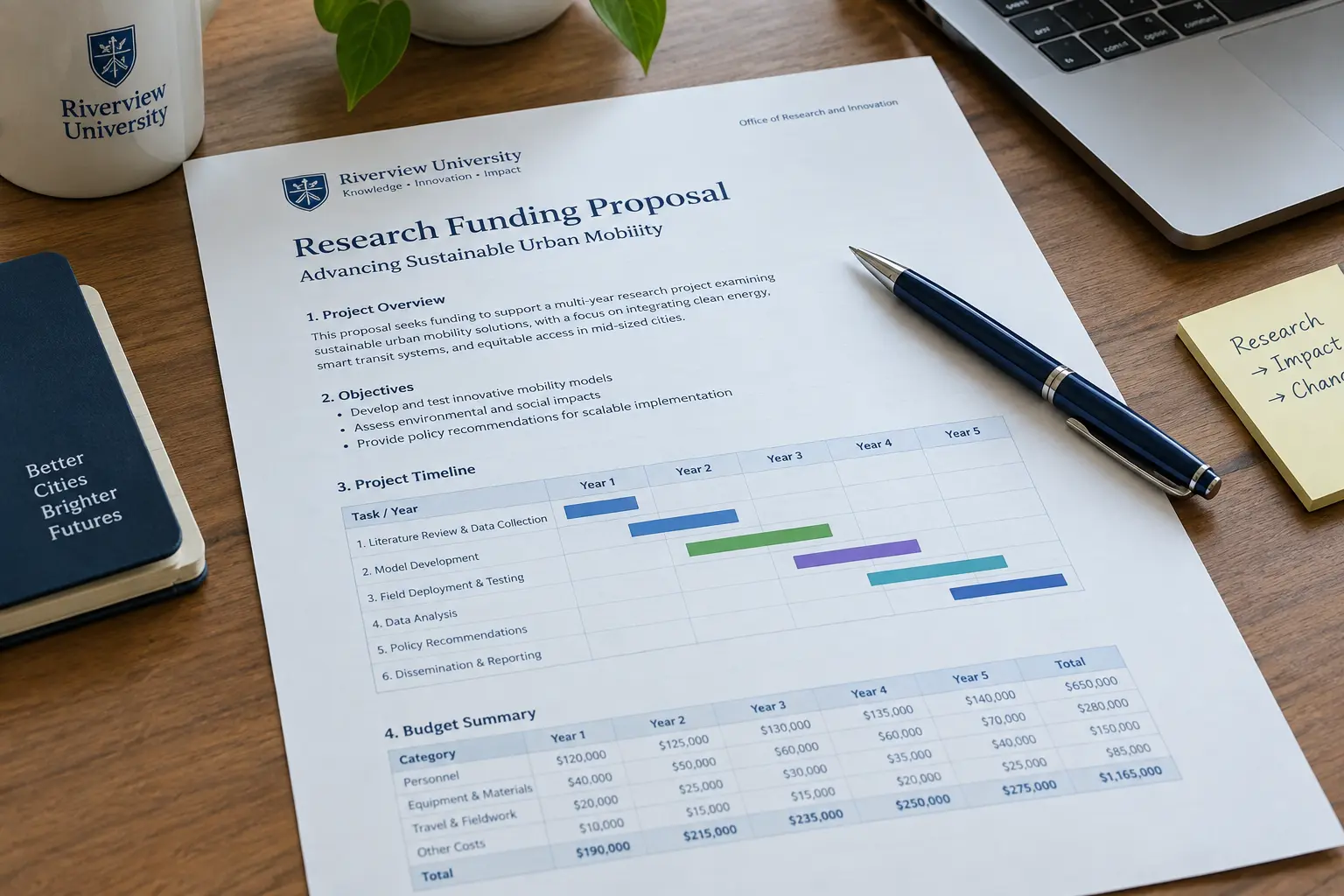
The timeline itself deserves the same rigour as the technical content. A four-year plan in mathematics or physics almost never proceeds as a straight line from problem to solution — proofs stall for months on a single lemma, an apparatus takes a full term longer to calibrate than expected, a promising approach turns out to reduce to a known result once you push it further. A realistic timeline names at least one point where the plan branches depending on whether an early result holds up, rather than presenting a single unbroken path from Year 1 to submission. The general principle of building contingency into a multi-year plan, rather than assuming everything proceeds on schedule, is the same one covered for any discipline in a PhD thesis chapter planner that covers the whole candidature — the specific branch points just look different in a proof-based or experimental project than in a fieldwork-based one.
Frequently Asked Questions
What is the biggest difference between a maths/physics proposal and one in the social sciences?
There is no ethics or human-participant access section in most maths and physics proposals. The equivalent scrutiny falls on technical feasibility: is the problem genuinely open, and is the proposed method credible for solving part of it within the funded period.
Do I need preliminary results to submit a strong proposal?
Not always required, but a small worked calculation, a simplified proof or a preliminary simulation result signals technical command that a purely descriptive proposal cannot, and it gives a reviewer something concrete to judge.
How specific does the research problem need to be?
Specific enough that a reviewer can tell exactly what is currently unknown and would recognise a solution if they saw one — a topic area or a broad question is not enough on its own.
Should I choose proof-based, computational or experimental methodology?
Whichever the problem actually requires, stated explicitly rather than left implicit — many strong proposals combine two, most commonly proof-based work validated computationally, but the proposal should say which chapter or phase uses which.
Who funds most UK mathematics and physics PhDs?
UK Research and Innovation, mainly through EPSRC Centres for Doctoral Training for mathematics and much of physics, and through STFC for particle physics, astronomy and nuclear physics studentships.
Does a CDT application need the same proposal as a traditional PhD application?
Usually a shorter, more provisional version at application stage, with the full plan developed with your supervisor and cohort in your first months — check your specific CDT or DTP’s own process rather than assuming the single-supervisor model.
How long should the timeline section be?
Long enough to show you have thought about what happens if a proof does not go through or an experiment does not resolve the predicted effect, not just a linear year-by-year plan assuming everything works first time.
Can I use AI tools to help draft a maths or physics proposal?
For structure, language and formatting, yes, with the same rule as anywhere else in this network: the mathematics, the proofs and the technical judgment have to be your own, and the thesis or proposal stays substantively your work.
Should the proposal include a full literature review?
No. A page or two focused tightly on the specific results your problem depends on reads as stronger than a broad survey — reviewers want evidence you know exactly where current knowledge stops, not evidence of wide general reading.
What is a common reason a maths or physics proposal gets rejected?
Scope that does not match the funded period — either a problem too large to make genuine progress on in three to four years, or a methodology section that mixes proof-based, computational and experimental approaches without saying which chapter uses which.