
A supervisor-led mock viva and a paid professional viva-preparation course are not competing for the same job: a mock viva with your own supervisory team tests whether you can defend the specific arguments in your specific thesis, in front of people who already know the work intimately, while a professional or external session tests how you perform in front of genuine strangers to the thesis, under conditions closer to the discomfort of the real thing. Below is a comparison, what each actually offers, and the confidentiality question worth asking before sending a full thesis anywhere external.

Comparison table
| Criterion | Mock viva with your supervisor(s) | Professional/external viva preparation |
|---|---|---|
| Cost | Free, part of standard supervisory support | Fee-based — a named example, NCRM’s “Confident Viva” workshop, costs £65 at the student rate |
| Examiner unfamiliarity simulated | Low — your supervisors already know the thesis and your reasoning | Higher — genuine strangers to the thesis ask questions closer to a real examiner’s first read |
| Depth of thesis-specific challenge | High — supervisors can probe the actual argument in detail | Lower on thesis specifics, higher on general viva craft and nerves management |
| Confidentiality | None — your own supervisory team already has full access | Requires sharing a summary or the thesis itself with an external party; check your institution’s policy first |
| Availability | Depends on supervisor time and typically offered once or twice near submission | Bookable on your own schedule, though group formats have fixed dates |
What does a supervisor-led mock viva actually test?
Most UK graduate schools and supervisory teams organise at least one mock viva close to submission, run by the supervisory team or occasionally with an additional internal colleague from the department standing in as a second questioner. Because your supervisors already know the thesis in depth, this format is strongest for testing the substance: can you defend the specific methodological choices in Chapter 3, restate the contribution to knowledge in one sentence, and respond to the objection your supervisor has been quietly worried about since the second-year review. What it structurally cannot simulate well is the discomfort of facing someone who has never met you and has formed their first impression of your reasoning purely from the written thesis — a supervisor’s questions, however sharp, come from a position of familiarity and goodwill a real examiner does not automatically extend, unlike the people who actually examine a PhD thesis in the UK.
What does professional or external viva preparation actually offer?
External viva-preparation options range from free university-run sessions to fee-based specialist workshops outside your own institution. The National Centre for Research Methods runs a paid workshop specifically for this, “Confident Viva,” a 90-minute online group-coaching session (£65 at the student rate, VAT included, at the time this was checked) facilitated by a researcher with over two decades of experience in doctoral supervision and examining, covering what examiners are actually looking for, common examination questions, anxiety management and how to prepare efficiently without rereading the entire thesis. The format is genuinely different from a supervisor mock viva: small-group live coaching among doctoral candidates who do not know each other’s theses, which better simulates the discomfort of explaining your work to genuine strangers, and structured guidance on viva craft generally rather than deep interrogation of your specific argument.
What about paid commercial “viva support” or “thesis defence” services?
A search for professional viva preparation also surfaces private tutoring and essay-support companies offering one-to-one mock vivas and defence coaching for a fee. Before using any such service, two things are worth checking deliberately rather than assuming: first, whether your own institution’s academic integrity policy has anything to say about sharing an unpublished, unexamined thesis with a third party outside the university — most UK institutions’ codes of practice are written around plagiarism and authorship of the written work rather than viva coaching specifically, but the confidentiality of unexamined research is a separate question worth asking your graduate school directly rather than assuming it is unregulated; and second, what the specific service’s qualifications actually are for the discipline in question, since “former UK academic” as a marketing claim varies enormously in what it actually means. A named, accountable training provider with a stated facilitator and institutional affiliation, of the kind the NCRM course represents, is easier to evaluate on both counts than an unnamed “academic” a commercial service assigns after payment.
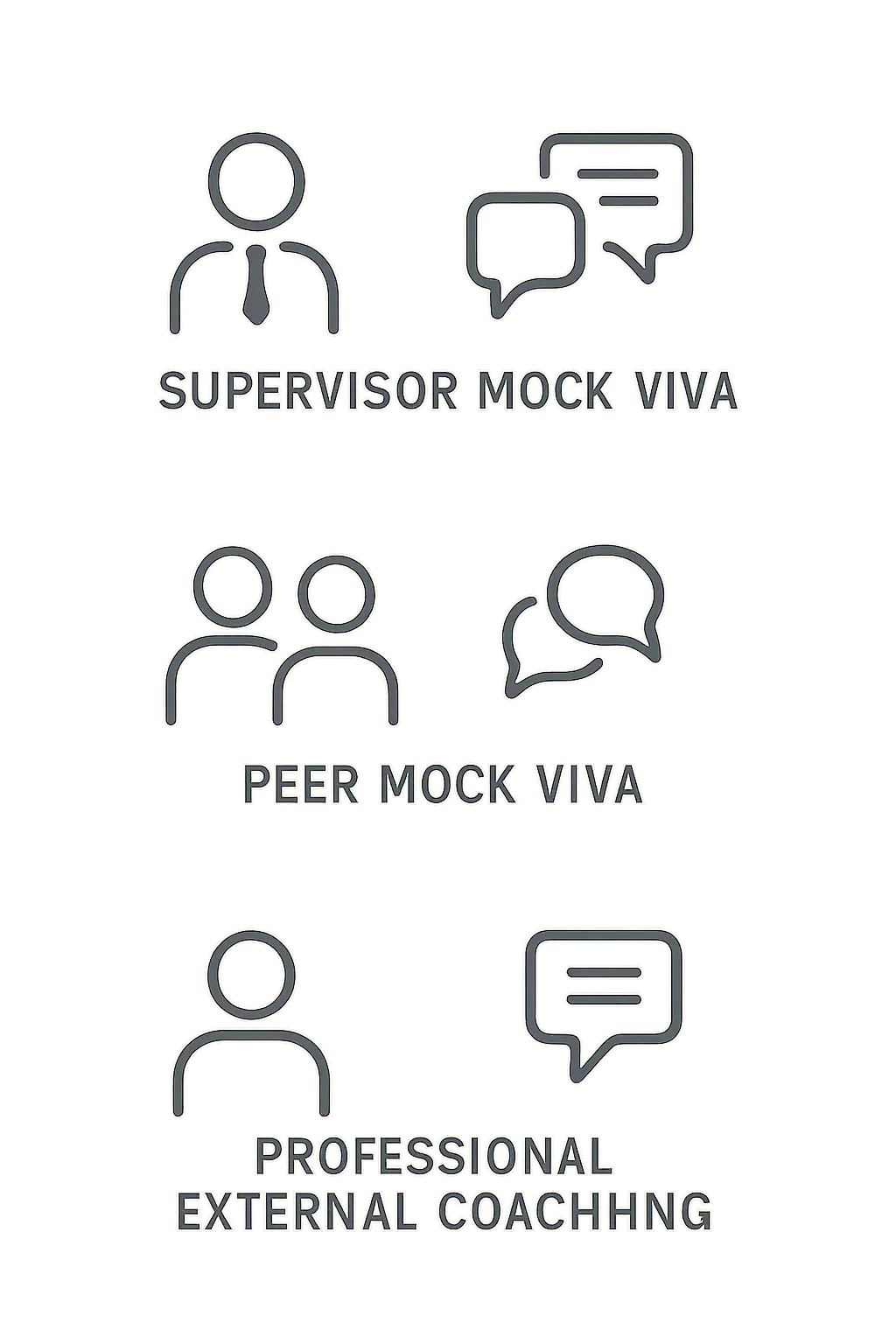
Is there a middle option — a peer mock viva?
Yes, and it is worth considering alongside both ends of this comparison. A peer mock viva, run with a fellow doctoral candidate in a related but distinct field, splits the difference: it is free, involves someone genuinely unfamiliar with your specific thesis (unlike a supervisor), and does not raise the confidentiality question an external paid service does, since the peer is still bound by the same institutional norms you are. The trade-off is that a peer questioner lacks an examiner’s disciplinary authority and may not know what UK examiners are formally asked to assess, so a peer mock viva works best as a rehearsal of delivery and composure rather than a substitute for either a supervisor’s substantive challenge or a trained facilitator’s structured coaching.
How do you structure any mock viva so it is actually useful, not just reassuring?
Whichever format you use, three design choices separate a mock viva that genuinely prepares you from one that only reassures you. First, the questioner needs to have actually read the thesis, or at minimum the abstract and contribution statement, before the session — a mock viva run from memory of a conversation months earlier produces soft, generic questions. Second, build in at least one deliberately hostile or sceptical question that a real examiner plausibly would ask but a supervisor might avoid out of politeness — asking a peer or an external facilitator to play this role can surface it more honestly than a supervisor who already believes in the work, and checking your predictions against the actual pattern of UK viva outcomes data can temper unrealistic worst-case worry. Third, record the session, or at least take notes on which questions caused you to hesitate, and treat that list as the specific revision agenda for the two weeks before the real viva, rather than treating the mock viva as a one-off confidence exercise with no follow-up.
Does rehearsing with an AI tool replace either option?
No, but it is a genuinely useful third layer rather than a competitor to either — this site’s own guide to preparing for your viva with AI covers a structured method for generating discipline-specific rehearsal questions from your own thesis text and practising answering them aloud, which is useful groundwork before either a supervisor mock viva or a paid external session, not instead of them. An AI rehearsal tool cannot replicate the social pressure and live follow-up questioning either human format provides, which is precisely the skill both a mock viva and professional coaching are built to test.
What is the recommended sequence?
A sensible order for most candidates: start rehearsing likely questions and your contribution statement alone or with an AI tool weeks before submission, run a peer mock viva once a full draft exists to practise composure with a genuine stranger to the thesis, book a supervisor-led mock viva close to submission for deep substantive challenge on the specific argument, and treat a paid professional workshop as an optional addition for candidates who specifically want structured coaching on viva craft and nerves from someone entirely outside their own institution — useful, but not a replacement for the supervisor mock viva that tests the thesis itself.
Recommendation
For testing whether you can defend your specific thesis: the supervisor-led mock viva is irreplaceable and free — use it. For testing composure in front of genuine strangers and structured viva-craft coaching: a reputable, named training provider such as NCRM’s workshop is a reasonable paid addition, and a peer mock viva achieves a similar effect for free with a confidentiality profile closer to your existing supervisory relationship. Before using any commercial “viva support” service, check your institution’s own policy on sharing unexamined work externally rather than assuming it is unregulated — and treat AI-based question rehearsal, covered in this site’s viva preparation with AI guide, as useful early-stage groundwork rather than a substitute for either human format.
Frequently asked questions
How many mock vivas should I actually have before submission?
Most supervisors suggest at least one formal mock viva close to submission; some candidates supplement this with an earlier peer mock viva or AI rehearsal, but there is no fixed sector-wide number — check what your own supervisory team and graduate school typically offer.
Is it normal for a mock viva to feel easier than the real thing?
Yes — a supervisor mock viva is structurally gentler because your supervisors already know and, in most cases, support the work; this is exactly why some candidates add a peer or professional session that better simulates unfamiliar examiners.
Should I share my full thesis with a paid external viva-preparation service?
Check your institution’s policy on sharing unexamined work with a third party before doing so — most codes of practice are written around plagiarism and authorship rather than viva coaching specifically, but confidentiality of unpublished research is worth confirming directly with your graduate school rather than assuming.
What does the NCRM “Confident Viva” course actually cover?
A 90-minute live group-coaching session covering what examiners look for, common examination questions, anxiety management and how to prepare efficiently without rereading the entire thesis, facilitated by a researcher with doctoral supervision and examining experience — it is a paid workshop, not free.
Can my external examiner find out I used a paid viva-preparation service?
There is no mechanism by which an examiner would know, and using a viva-preparation service — supervisor-led, peer, or paid professional coaching on general viva craft — is not an integrity issue in the way that having someone else write your thesis content would be, provided the service is coaching delivery and composure rather than supplying answers about the research itself.
Is a peer mock viva as useful as a professional one?
It achieves a similar “stranger to the thesis” effect for free, but a peer typically lacks an examiner’s disciplinary authority and formal knowledge of UK examination criteria, so it works best as delivery-and-composure practice rather than a substitute for structured coaching or your supervisor’s substantive challenge.
Does department size affect how much mock-viva support is available?
Yes in practice — larger departments and graduate schools more often run scheduled, free mock-viva or viva-preparation sessions as part of researcher development provision, while candidates in smaller departments more often rely solely on their own supervisory team, which is one reason external paid or peer options are worth considering where in-house provision is thin.
Should the mock viva happen before or after the thesis is fully submitted?
Before — a mock viva is most useful when there is still time to act on what it reveals, typically scheduled in the weeks after the thesis is finalised internally but before the formal submission deadline, so any last substantive gaps it surfaces can still be addressed in the submitted text or flagged for the real viva.