
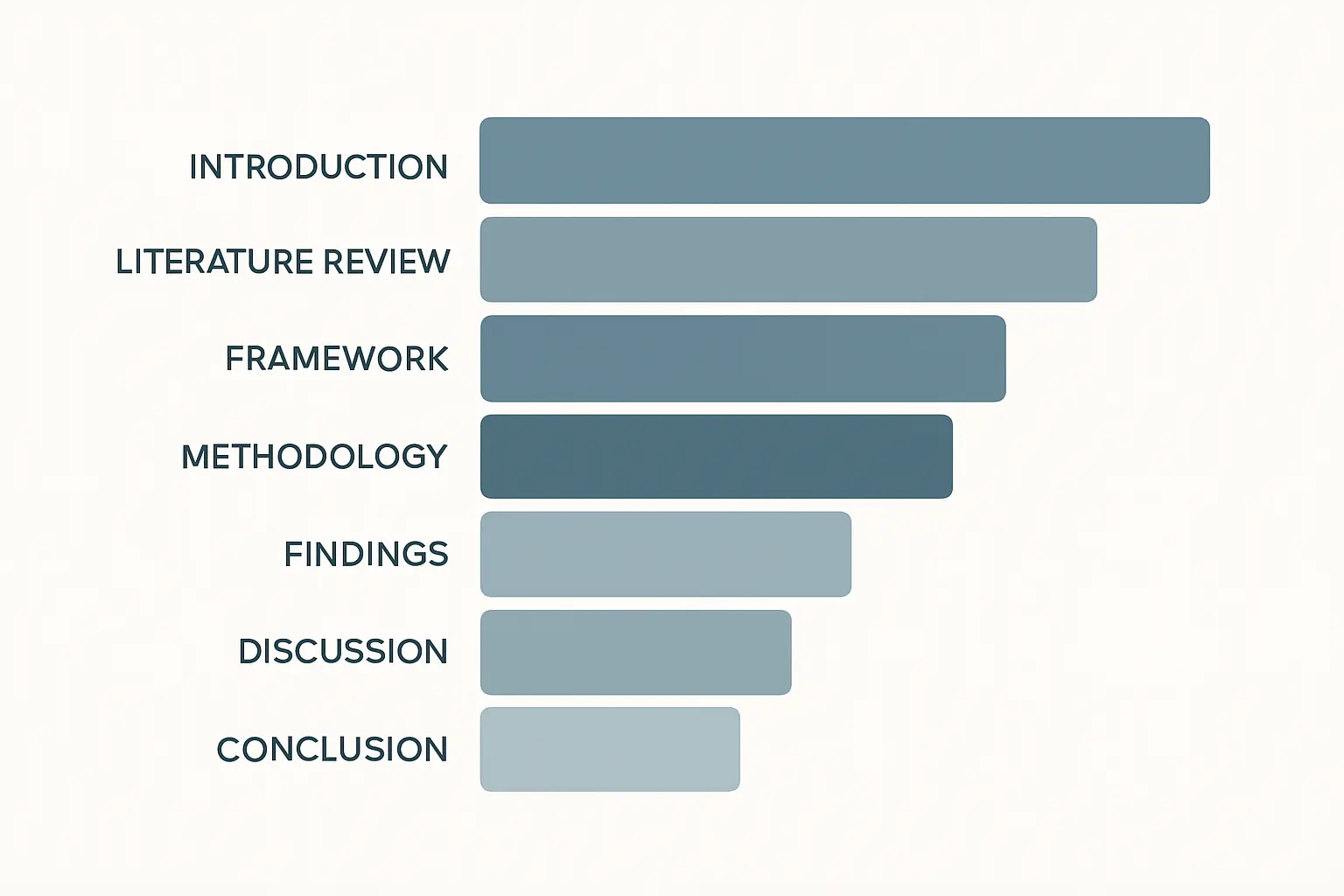
A complete nursing PhD thesis is built from roughly eight parts that each do a distinct examinable job: title and abstract, introduction, literature review, theoretical or conceptual framework, methodology, findings, discussion, and conclusion with contribution — bound together by governance (HRA/IRAS) evidence and a reference list running to several hundred sources. Below is an annotated, section-by-section model with an illustrative worked passage for each part. Nothing here is a real study: every finding, participant number and quotation is invented and labelled as such, built only to show the shape and register a nursing thesis has to hit.
What goes on the title page and in the abstract?
The title states the population, the setting and the phenomenon in one line — not the method, and rarely a question mark. A worked example: “Transitioning to Independence: A Constructivist Grounded Theory Study of Adolescents Living with Type 1 Diabetes in Northern England.” It names who (adolescents with Type 1 diabetes), where (Northern England) and what kind of claim is coming (a grounded theory of a transition process), without pre-announcing the finding.
The abstract that follows is almost always structured, even when the rest of the thesis is not: background, aim, design, methods, findings, conclusion, in that order, inside a strict word limit set by the candidate’s own institution (commonly 300–350 words). A worked opening line, illustrative only: “Background: adolescents with Type 1 diabetes face a marked increase in complications and disengagement from care during the transition to adult services, yet little is known about how they construct independence during this period.” Examiners read the abstract to locate the thesis before they read anything else — a vague abstract costs credibility before chapter one starts.
What does the introduction chapter have to establish?
The introduction chapter answers four questions in order: why this matters clinically, what is already known, what is not known, and what this thesis specifically contributes to closing that gap. A worked passage, illustrative: “Diabetes-related outcomes can worsen after transfer to adult services (see Chapter 2), yet existing transition guidance says little about how adolescents themselves experience that transfer. This thesis addresses that gap by generating a substantive theory of how adolescents themselves construct the transition, to inform the design of transition services.” The last sentence there is the contribution statement in miniature — examiners will hold the candidate to it for the rest of the viva, so it has to be a claim the study can actually support, not an aspiration.
What is the literature review chapter actually for?
A nursing literature review is a synthesis, not a summary — it is organised by theme or by debate, never paper by paper, and it ends by stating precisely what gap the thesis fills. Themes commonly run through developmental psychology of adolescence, self-management theory, health-service transition models (like the “Ready Steady Go” framework used across several UK paediatric services) and the existing empirical literature on diabetes transition specifically. A worked closing sentence, illustrative: “What remains absent from this literature is an account of transition built from adolescents’ own constructions of independence, rather than from clinician or parent proxy reports — the gap this thesis addresses.”
Where does the theoretical or conceptual framework sit?
For a qualitative nursing thesis this chapter states the paradigm (commonly constructivist or interpretivist for grounded theory, critical realist for some mixed-methods designs) and the specific theoretical lens, if one is adopted before data collection. A worked line, illustrative: “This study adopts a constructivist grounded theory position (Charmaz), treating the emerging theory as co-constructed between researcher and participants rather than discovered as a pre-existing reality.” A quantitative or trial-based nursing thesis instead states its conceptual model up front — for example, the Health Belief Model or the Theory of Planned Behaviour — and derives its hypotheses from it, which is the seam this piece hands off to a dedicated hypotheses-and-variables treatment rather than duplicating.
What does the methodology chapter have to cover that a general research-methods chapter does not?
A nursing methodology chapter is read twice, by a methodologist checking the design is justified and by a clinician checking the governance route is real. It needs the paradigm, the specific design (grounded theory, phenomenology, a randomised trial, a mixed-methods convergent design), the sampling strategy and its justification, the recruitment route through NHS or university ethics, HRA and IRAS approval evidence, data collection procedure, and the analysis method named with its software version. A worked passage, illustrative: “Purposive sampling recruited 18 adolescents aged 13–17 from two paediatric diabetes clinics in [region], continuing to the point of theoretical sufficiency. Ethical approval was granted by the NHS Health Research Authority (IRAS ID [invented]) and the university’s research ethics committee.” A dedicated piece on this site works through sample size rules for postgraduate nursing and health research in full if that is the section a reader needs next; this model keeps governance to one illustrative paragraph.
How are the findings chapter and the results actually organised?
In a grounded theory nursing thesis the findings chapter is organised around the categories and the core category that emerged from the coding process, each illustrated with anonymised participant quotations and a coding memo excerpt. A worked category name and quotation, both illustrative: category “Renegotiating who is in charge,” illustrated by an invented quotation attributed to a pseudonymised participant, “Participant 7 (age 15): ‘My mum still books the appointments but I’m the one answering the questions now.’” In a quantitative nursing thesis this chapter instead runs through the statistical results in the order the hypotheses were stated, reporting effect sizes and confidence intervals rather than only p-values, following the same convention this site’s engineering and political-science statistical-test pieces model for their own fields.

What does the discussion chapter add that the findings chapter has not already said?
The discussion interprets the findings against the literature reviewed in chapter two, states what is genuinely new, and is explicit about limitations rather than defensive about them. A worked line, illustrative: “The category of renegotiating authority extends existing transition models, which position readiness as an individual competency rather than a relational shift between adolescent and parent.” Limitations for a nursing thesis commonly include a single-region sample, a cross-sectional design that cannot show change over time, and researcher positionality where the candidate has a clinical nursing background — each stated as a bounded claim about what the study can and cannot support, not as an apology.
What has to be in the conclusion, and how is the contribution to knowledge actually stated?
UK doctoral regulations require an original contribution to knowledge, and examiners will ask the candidate to state it in a single sentence in the viva whether or not the thesis states it plainly. A worked contribution statement, illustrative: “This thesis contributes a substantive theory of adolescent-constructed transition, extending the ‘Ready Steady Go’ framework with a relational account of authority renegotiation that the existing model does not capture, with direct implications for how transition consultations are structured.” The conclusion chapter also states the clinical and policy implications and a short, honest set of recommendations for future research — not a list of everything the candidate did not have time to do.
What goes in the appendices, and how big does the reference list actually get?
Appendices carry the interview schedule or topic guide, the participant information sheet and consent form, the ethics approval letters, an example of the coding process (a coded transcript excerpt), and any instrument used. A nursing PhD reference list commonly runs to 200–350 sources by submission, reflecting both the empirical nursing literature and the theoretical and methodological literature the thesis draws on — reference-management discipline from year one avoids a rebuild at the end. The number and shape of chapters this model assumes is the default case, not the only legal one; the site’s own piece on how many chapters a PhD thesis has covers the sector-wide variation.
How does the thesis-by-publication route change this model?
A nursing candidate on the thesis-by-publication route replaces the single findings-then-discussion arc above with three or four linked papers, each written to a target journal’s specifications, framed by an extended introduction that states the connecting contribution and a synthesising discussion chapter that argues the papers together answer more than any one of them alone. The individual papers still need every element this model walks through — a stated gap, a justified design, governed data collection, an interpreted finding — but distributed paper by paper rather than chapter by chapter, and the connecting narrative becomes the place an examiner looks first for the single contribution sentence.
Using an annotated model as a working checklist, not a template to fill in
The value of a model like this is diagnostic: read your own draft chapter against the questions each section above answers, and where your chapter cannot answer its question in one or two sentences, that is the paragraph that needs rewriting before a supervisor sees it. Tools that read a full-length manuscript for structural gaps — Tesify’s thesis planning and editing workflow among them — are built for exactly this kind of section-by-section check at 80,000-word scale, where a candidate rereading their own fourth chapter for the twentieth time stops being able to see what is actually missing.
The annotated model at a glance
| Section | Typical share of a ~80,000-word thesis | What it must contain | Failure examiners name most often |
|---|---|---|---|
| Introduction | ~8% | Clinical rationale, gap, contribution statement | Contribution stated too broadly to test at viva |
| Literature review | ~20% | Thematic synthesis, explicit gap | Summary of papers instead of synthesis |
| Framework | ~7% | Paradigm, theoretical lens, justification | Framework picked after analysis, not before |
| Methodology | ~20% | Design, sampling, governance, analysis method | Governance evidence incomplete or undated |
| Findings/Results | ~20% | Categories or results, illustrated, ordered logically | Quotations included without analytic commentary |
| Discussion | ~15% | Interpretation against literature, honest limitations | Limitations minimised or omitted |
| Conclusion | ~5% | One-sentence contribution, implications, recommendations | No single testable contribution sentence |
| Appendices/References | ~5% | Governance letters, instruments, 200–350 references | Reference list assembled retrospectively, full of gaps |
Frequently asked questions
Is this a real nursing PhD thesis I can copy from?
No. Every finding, participant, quotation and identifier here is invented for illustration. A real nursing PhD thesis this model resembles in shape can be found through your own institution’s repository or other UK universities’ open-access repositories (the British Library’s EThOS service has been offline since the 2023 cyberattack) — read two or three completed theses in your own sub-field before you draft your own chapter plan.
Does every nursing PhD follow this exact structure?
No. A grounded theory or phenomenological thesis is usually organised the way this model shows; a trial-based or systematic-review-led nursing PhD instead follows a more conventional introduction–methods–results–discussion shape close to a journal article, and a thesis-by-publication route reorganises the whole thing around three or four linked papers, as the section above sets out.
How long does a nursing PhD thesis actually run?
Most UK nursing PhDs sit at 60,000–80,000 words of main text, set by the candidate’s own institution’s presentation-of-theses regulations — check your own code of practice rather than assume a network-wide figure.
Does the methodology chapter need both HRA and university ethics approval evidence?
When the research recruits through the NHS or uses NHS patient data, yes — HRA approval sits alongside, not instead of, the university’s own research ethics committee approval. Purely university-recruited studies (staff, students, non-NHS settings) usually need only the university route.
What is theoretical sufficiency, and is it the same as saturation?
In classic and constructivist grounded theory, “theoretical sufficiency” or “saturation” describes the point at which new data stops adding new properties to the categories — it is a judgement the candidate has to justify methodologically, not a fixed sample-size number.
Can the findings chapter include direct quotations from participants?
Yes, and nursing examiners expect them — but every quotation needs a pseudonym or code, an analytic sentence explaining what it illustrates, and confirmation in the methodology chapter that the consent process covered anonymised quotation in the final thesis.
What is the single most common reason a nursing thesis structure is challenged at viva?
A contribution to knowledge that is stated too broadly to test — “this thesis contributes to understanding of diabetes transition” cannot be examined, while a specific, bounded claim about what is new and to whom it matters clinically can be.
Should the discussion chapter repeat the findings before interpreting them?
No — a short signpost back to the relevant finding is enough; a discussion chapter that re-reports results at length before interpreting them is one of the most common candidate self-corrections between the draft and the final submission.
Does a quantitative or trial-based nursing thesis need a findings chapter organised around categories?
No — categories and a core category are specific to grounded theory. A trial or survey-based nursing thesis instead states its results hypothesis by hypothesis, in the same order those hypotheses were introduced in the methodology chapter, which keeps the findings chapter legible to an examiner checking the study against its own stated design.
How many completed nursing theses should I read before drafting my own?
Most supervisors suggest at least two or three completed theses in a closely related sub-field, read specifically for structure rather than content — how long each section runs, how the contribution is worded, how governance evidence is presented — rather than as literature-review material.