
A PhD thesis on AI ethics in Philosophy is not a survey of what people think about AI — it is a sustained philosophical argument for one specific claim, defended against the strongest existing positions in the field. Here is how to get from “I want to write about AI ethics” to a defensible problem, a set of argumentative objectives, a genuinely philosophical method, and a source base examiners will recognise as current.
Step 1: Narrow the Topic to a Genuine Philosophical Problem
“AI ethics” is a field, not a thesis question. A viable philosophy PhD problem is a specific, contestable claim that a competent philosopher could reasonably deny — not a description of a technology or a summary of a debate. Compare the two:
- Not a philosophical problem: “This thesis examines the ethics of artificial intelligence.”
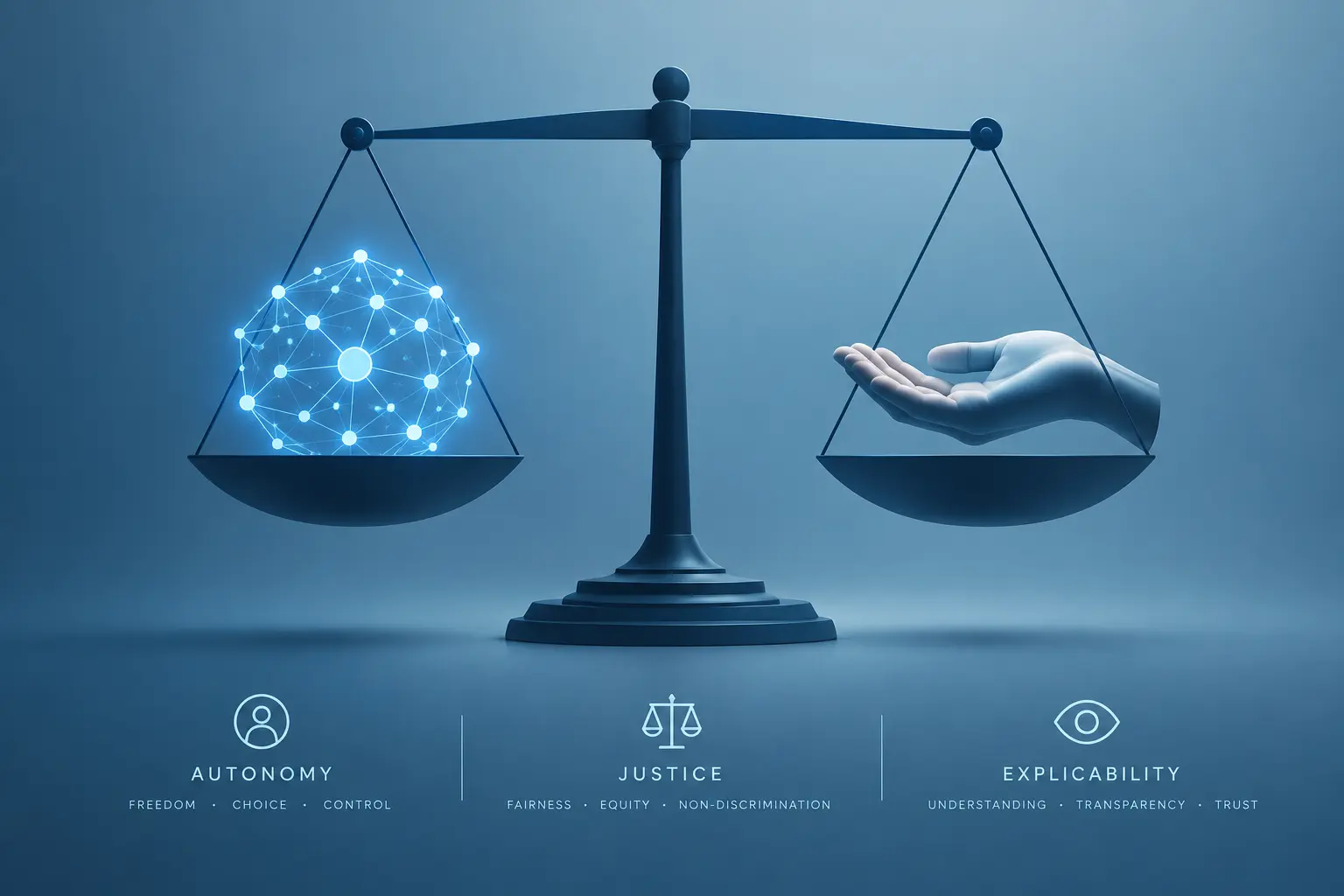
- A philosophical problem: “Does the AI4People framework’s principle of explicability do independent normative work, or is it parasitic on autonomy and justice — and if the latter, what follows for how AI governance frameworks should be structured?”
The second version names a specific target (a published framework), states a specific philosophical worry (that a principle is not independently justified), and commits to a conclusion with consequences (for governance design). That combination — target, worry, consequence — is what an examiner is checking for when they ask what your thesis actually argues.

Step 2: State Your Objectives as Argumentative Claims, Not Research Questions
Empirical disciplines state research questions and hypotheses; a philosophy thesis states the claims it intends to defend and the order in which it will defend them. A worked, illustrative example built around the explicability problem above:
- Reconstruct the strongest version of the AI4People argument (Floridi, Cowls and colleagues) for treating explicability as a fifth, independent principle alongside the four bioethics-derived principles (beneficence, non-maleficence, autonomy, justice).
- Argue that explicability, on its most defensible reading, reduces to an enabling condition for autonomy and justice rather than standing as an independent principle.
- Defend this reduction against the strongest objection: that explicability can conflict with autonomy and justice in cases where they point in different directions, which an enabling-condition account cannot accommodate.
- Draw out the consequence for AI governance frameworks that currently list explicability as a co-equal fifth principle, such as recommending they instead treat it as a structural requirement on how the other four are satisfied.
Every objective here is a claim you commit to defending, not a question you commit to investigating — illustrative only, not a real published position of this site.
Step 3: Choose a Genuinely Philosophical Method
A philosophy PhD’s methodology chapter (or methodology section, since many philosophy theses do not have a discrete chapter by that name) has to name and justify a method from the discipline’s own toolkit, not borrow a social-science methodology by default:
- Conceptual analysis — breaking a term (autonomy, moral status, explicability, alignment) into its necessary and sufficient conditions, and testing candidate analyses against counterexamples.
- Thought experiments — constructed scenarios (in the tradition of the trolley problem, extended by AI ethics to cases like the self-driving car’s crash-optimisation dilemma) used to isolate which of two or more considerations should take priority when they conflict.
- Argument reconstruction and critique — setting out an existing philosopher’s argument in premise-conclusion form, identifying the premise doing the real work, and showing it is false, question-begging or does not support the conclusion it is meant to.
- Applied ethics case study — taking one real or realistic AI deployment (a clinical diagnostic system, a content-moderation algorithm, an autonomous weapons system) and using it to test whether a general ethical framework gives a plausible verdict.
Most philosophy PhDs on AI ethics combine two or three of these across different chapters, and a thesis that is honest about which method each chapter uses — rather than moving between them without saying so — is easier for an examiner to follow and easier for you to defend at viva.
Step 4: Position Your Argument Against the Named Literature
An examiner in this area expects your thesis to locate itself against real, specific positions, not a vague sense of “the debate.” Depending on your specific problem, the literature a UK philosophy PhD in this area typically has to engage with includes:
- Nick Bostrom, on the risks of a superintelligent system capable of independent initiative and its own planning — the reference point for long-termist and existential-risk framings of AI ethics.
- Wendell Wallach and Colin Allen, Moral Machines: Teaching Robots Right from Wrong, whose central conclusion is that trying to build ethical machines exposes gaps in existing normative theory itself — a useful move if your thesis argues that AI forces philosophy to sharpen an existing concept.
- Stuart Russell, whose proposal for beneficial AI systems rests on three conditions: systems should aim at realising human preferences, remain uncertain about what those preferences are, and learn about them from human behaviour rather than optimise a fixed, pre-specified goal.
- Luciano Floridi, Josh Cowls and eleven co-authors, “AI4People — An Ethical Framework for a Good AI Society” (Minds and Machines 28(4), 2018, pp. 689–707), proposing five principles — the four familiar from bioethics (beneficence, non-maleficence, autonomy, justice) plus explicability, understood as covering both intelligibility (how does it work?) and accountability (who is responsible for how it works?). Cite it as Floridi et al. (2018).
- Shannon Vallor, on a virtue-ethics approach to AI design — asking not only whether an AI system produces good outcomes but what habits of character its design and use cultivate in the humans who build and rely on it.
- Joseph Weizenbaum, an early and still-cited voice arguing that AI should not be substituted into roles that require respect and care, on the grounds that doing so threatens human dignity.
- Thomas Metzinger, who has called for caution around creating artificial systems that might be conscious, warning of the ethical stakes if machine suffering became possible at scale.
You do not need to cite all seven in one thesis — a well-scoped philosophy PhD typically positions itself against two or three of these directly and treats the rest as background literature in the introduction.
Step 5: A Worked Example, Problem to Chapter Outline
Putting Steps 1–4 together, an illustrative (not real) thesis plan might look like this:
| Element | Illustrative content |
|---|---|
| Problem | Does explicability do independent normative work in AI4People’s five-principle framework, or does it reduce to an enabling condition for autonomy and justice? |
| Method | Argument reconstruction (Ch. 2), conceptual analysis of “independent principle” (Ch. 3), an applied case study using a clinical diagnostic AI (Ch. 4) |
| Ch. 1 | Introduction: states the problem, previews the reduction argument and its governance consequence |
| Ch. 2 | Reconstructs the AI4People argument for explicability as a fifth principle in premise-conclusion form |
| Ch. 3 | Conceptual analysis: what would it take for a principle to be genuinely independent, and does explicability meet that standard? |
| Ch. 4 | Applied case study testing the reduction against a case where explicability and autonomy appear to conflict |
| Ch. 5 | Consequence for AI governance frameworks and reply to the strongest objection |
This is a labelled, illustrative structure only — not a real published thesis — built to show how a problem, a method and a chapter plan lock together, the way an original contribution to knowledge has to for any UK PhD, regardless of discipline.
Step 6: Decide Whether You Need Ethics Committee Approval at All
This is one place a philosophy PhD genuinely differs from most of the doctorates on this site. If your thesis is purely conceptual — argument reconstruction, conceptual analysis, thought experiments using constructed scenarios — it typically does not involve human participants and does not need university research ethics committee approval in the way an empirical social-science thesis does. That changes the moment your design adds an empirical component: interviewing AI developers or ethicists about their reasoning, surveying public attitudes to a named AI application, or running any study that collects data from real people. At that point the same baseline rule applies as everywhere else in this network — ethics committee approval before you collect anything — and it is worth confirming this with your supervisor and your department’s research ethics office at the proposal stage, not after you have already planned the interviews into your research proposal.
Where This Kind of Thesis Gets Published and Examined
Work in this area regularly appears in journals such as Minds and Machines, Ethics and Information Technology, and AI & Society, and a literature review chapter that shows you know which of these outlets has published the closest prior work to your own argument signals field awareness an examiner will notice. The general discipline-by-discipline pattern for locating a genuine gap in the literature, rather than restating an existing debate, is covered in research gap and problem statement: worked examples, and the same care about not inventing precision applies if you are using an AI tool to help manage or summarise that literature — see is it safe to put unpublished thesis data into an AI tool for the general principles, which apply even to unpublished argument drafts you would not want appearing anywhere else before your viva.
Frequently Asked Questions
What makes a philosophy PhD problem different from a research question in other disciplines?
It is a specific, contestable claim you commit to defending against the strongest opposing position, not a question you investigate empirically. A competent philosopher has to be able to reasonably deny it for it to be worth defending.
Do I need to survey the whole field of AI ethics before I can start?
No. A well-scoped thesis positions itself against two or three named positions directly and treats the rest as background literature in the introduction, rather than attempting an exhaustive survey.
What is the AI4People framework?
A 2018 paper in Minds and Machines by Luciano Floridi, Josh Cowls and colleagues, proposing five principles for AI in society: the four familiar bioethics principles (beneficence, non-maleficence, autonomy, justice) plus a fifth, explicability, covering both intelligibility and accountability.
Is a thought experiment a legitimate PhD-level method?
Yes, when it is used precisely — to isolate which of two or more considerations should take priority when they conflict — rather than as illustrative colour. The trolley-problem tradition, extended to cases like autonomous-vehicle crash optimisation, is a recognised method in this literature.
Do I need ethics committee approval for a purely conceptual AI ethics thesis?
Not usually, if the thesis involves no human participants — argument reconstruction, conceptual analysis and constructed thought experiments do not typically require it. Adding any empirical component, such as interviews or a survey, changes that.
What is Stuart Russell’s proposal for beneficial AI?
That beneficial systems should aim at realising human preferences, remain uncertain about what those preferences actually are, and learn about them from human behaviour rather than optimising a fixed, pre-specified goal.
What did Wallach and Allen conclude in Moral Machines?
That the attempt to build ethical machines exposes gaps in existing normative theory itself — the project of machine ethics can sharpen philosophical understanding of morality, not just apply it.
Which journals publish this kind of work?
Minds and Machines, Ethics and Information Technology, and AI & Society are among the field’s recognised outlets, and knowing which has published the closest prior work to your own argument is worth demonstrating in your literature review.
Can I use an AI writing tool while drafting a philosophy thesis about AI ethics?
The same rules apply as for any other thesis: keep the argument and the final wording your own, and treat any unpublished draft argument the way you would treat unpublished data — checking a tool’s own data-handling terms before pasting anything you would not want appearing elsewhere before your viva.
Does a virtue-ethics approach to AI count as a legitimate thesis angle?
Yes. Shannon Vallor’s work asks what habits of character an AI system’s design and use cultivate in the people who build and rely on it, rather than only judging the system by its outcomes — a recognised alternative to the consequentialist and deontological framings more common in the field.