
Four sources cover most of what a UK political science or international relations PhD needs: the UK Data Service for national surveys, census microdata and qualitative deposits; the European Social Survey for cross-national attitude data across 31 countries as of its most recent completed round; official UK government statistics for domestic policy analysis; and World Bank Open Data for country-level development and economic indicators when a project has an international comparative dimension. A fifth, the Uppsala Conflict Data Program, is the standard source once a project turns to conflict or security specifically. Here is what each actually holds, and what each is best used for.
| Source | What it holds | Coverage | Access |
|---|---|---|---|
| UK Data Service | Surveys, census data, international data, qualitative deposits | UK-focused, ESRC-funded, with an international-data learning hub | Free to deposit; most access requires registration, with some studies restricted to UK academic use |
| European Social Survey | Cross-national public attitudes, beliefs and behaviour | 31 countries in Round 11 (2023/24); operating since 2002, up to Round 13 referenced on its own site | Free, open access via the ESS Data Portal |
| UK government statistics (ONS, gov.uk departments) | Official domestic statistics: economy, population, policy outcomes | UK-wide, published by named departments and the Office for National Statistics | Free, published openly |
| World Bank Open Data | World Development Indicators: development, poverty, economic statistics by country | Global, with individual indicator series running as far back as 1960 depending on the measure | Free and open access |
| Uppsala Conflict Data Program (UCDP) | State-based conflicts, non-state conflicts, one-sided violence | Global, since 1946; updated annually | Free, via the UCDP Conflict Encyclopedia |
The UK Data Service: The Core Deposit for UK-Focused Work
The UK Data Service describes itself as providing “trusted access and training to use the UK’s largest collection of economic, population and social research data for teaching, learning and public benefit,” funded by the ESRC. For a UK political science thesis, it is typically the first stop for national survey series (attitude surveys, election studies, panel data), census microdata, and an international-data section for comparative projects. Deposit into the service’s ESRC-funded catalogue is free, and most datasets can be accessed after registration, though some restricted studies are limited to verified UK academic use — check the specific study’s access conditions before building a methodology chapter around a dataset you have not yet confirmed you can actually obtain.
The European Social Survey: Cross-National Attitude Data
The European Social Survey describes itself as providing “high-quality open access data measuring public attitudes, beliefs and behaviour” across Europe. Its most recently completed data collection, Round 11 (2023/24), covered 31 countries — 30 using face-to-face interviews and Czechia using self-completion — and the survey has been running since 2002 with rounds referenced up to Round 13 on its own site. The ESS was awarded European Research Infrastructure Consortium (ERIC) status in 2013, a formal EU legal designation for cross-border research infrastructure, and marked ten years of that status in 2023. All ESS data and documentation is accessed through its own ESS Data Portal, free of charge — a genuinely comparative political attitudes project across multiple European countries is difficult to build without it, and a thesis that claims to be cross-nationally comparative but does not engage with the ESS where it is the obvious existing source will draw an examiner’s attention to the omission.
UK Government Statistics: The Domestic Policy Baseline
For a thesis focused on UK domestic politics, policy outcomes or public administration, official government statistics are the baseline evidentiary source: the Office for National Statistics for economic and population data, and individual government departments for policy-area-specific statistics (education, health, justice, immigration and others each publish their own official statistics series). These are free and published openly, though as with any official statistics series, definitions and methodology can change between publications — a time series spanning a methodology change needs that change flagged explicitly in your thesis, not silently treated as one continuous series.
World Bank Open Data: For a Comparative or IR Dimension
Where a project has an international relations or comparative-development dimension — state capacity, economic development and conflict, aid effectiveness, democratisation — World Bank Open Data provides “free and open access to global development data” through its World Development Indicators, a compilation the Bank itself describes as “relevant, high-quality, and internationally comparable statistics about global development.” Coverage varies by indicator, with some series running from 1960 to the present and others starting later; check the specific indicator’s own start date rather than assuming uniform historical coverage across the whole database. For IR work specifically, this is usually paired with a named international organisation’s own data (UN agencies, IMF, or a specific conflict or governance dataset relevant to your sub-field) rather than used alone.

The Uppsala Conflict Data Program: The Standard Source for Conflict and Security Research
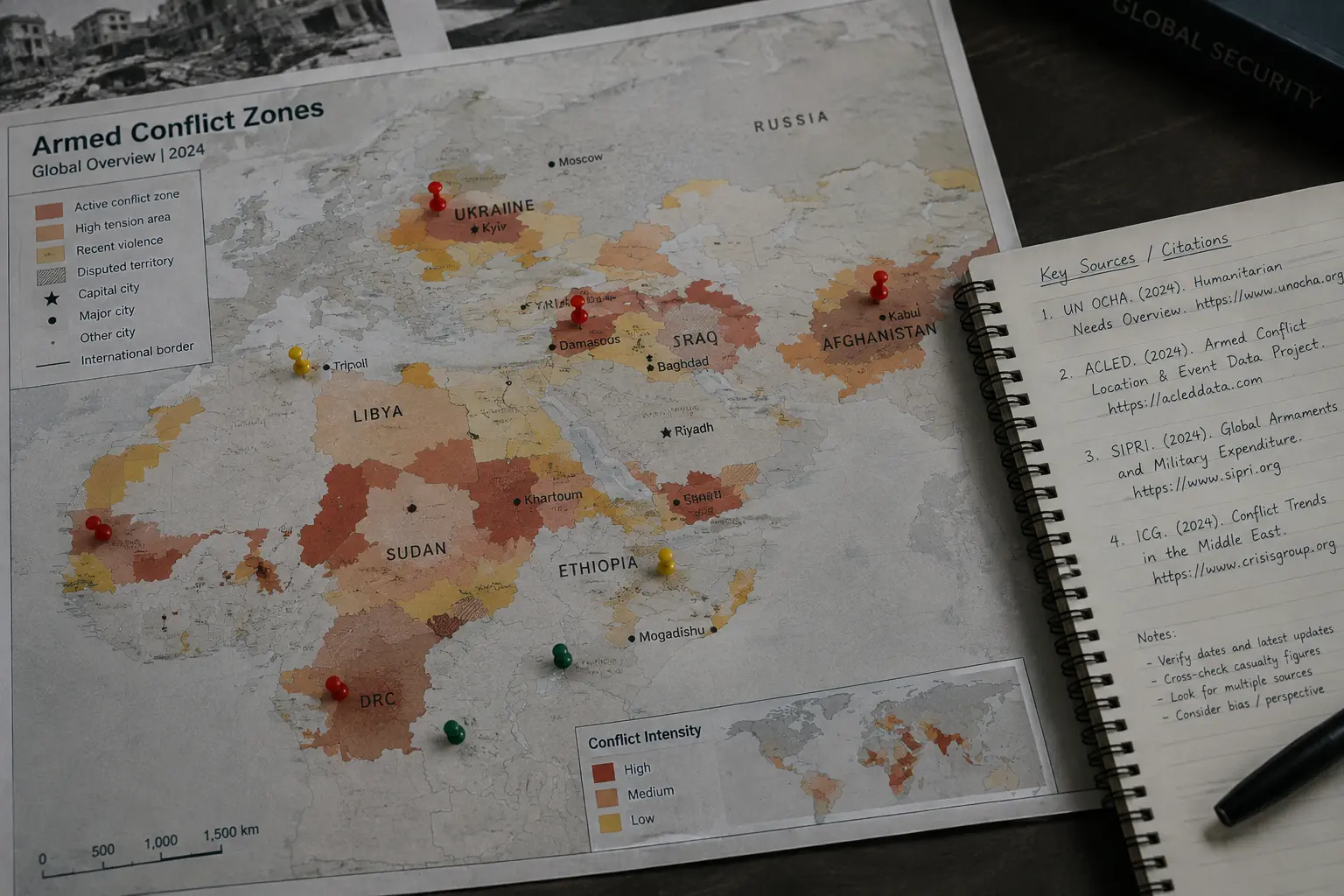
Once a project turns specifically to armed conflict, civil war or organised violence, the Uppsala Conflict Data Program (UCDP), based at Uppsala University’s Department of Peace and Conflict Research, is the field’s standard reference dataset. It covers three categories — state-based conflicts, non-state conflicts, and one-sided violence — going back to 1946, and is described as the oldest ongoing data collection project for civil war, with a history of almost forty years. Data is updated annually and is freely available through the UCDP Conflict Encyclopedia, a web-based tool for visualising, handling and downloading the data at no cost. A thesis on civil war, insurgency or one-sided violence that does not engage with UCDP’s own coding of the conflict in question — even where the thesis draws its central argument from elsewhere — will read as unfamiliar with the field’s baseline reference source to an examiner working in this sub-field.
Getting Access in Practice
The practical sequence matters as much as knowing the sources exist. Register with the UK Data Service and the ESS Data Portal early in your first year, well before you need the data for a specific chapter — some UK Data Service studies carry an approval step that can take longer than a self-service download, and building that lead time into your candidature timeline avoids a data-access delay becoming a thesis-timeline problem in year two. Where a dataset requires institutional verification (a UK academic email address, a signed end-user licence, or in a smaller number of cases a formal data-access application to the depositing organisation), start that process as soon as you know you will need the dataset, not when you are ready to begin analysis. For elite interviews or original data collection alongside a secondary dataset — interviewing officials at an international organisation, for instance, to supplement UCDP’s coding of a specific conflict — the ethics and access considerations are covered by your university’s standard research ethics process, the same baseline that applies whatever dataset sits alongside your own fieldwork.
Version control matters more with secondary data than it might first appear. UCDP, the ESS and World Bank indicators are all updated periodically — a conflict’s coding can be revised as more information becomes available, an ESS round’s weights can be recalculated, and a World Bank indicator can be revised for a past year as national statistical offices update their own figures. Recording the exact version, download date and, where the source provides one, the dataset’s own citation or DOI at the point you download it is the only way to reproduce your own analysis later, or to explain to an examiner why your figures differ slightly from a value someone else quotes from the same nominal source at a different date.
How This Differs From Case Selection and Sampling
Finding a dataset is a different task from deciding which cases, countries or time periods within it your thesis actually analyses. The general logic of case selection, elite interview sampling and cross-national panel coverage for a UK political science or IR doctorate — including how King, Keohane and Verba’s design logic applies — is covered separately in population, sample and case selection for a political science or IR PhD thesis. Read that alongside this piece: a dataset being available is necessary but not sufficient justification for using it, and an examiner will ask why these specific countries, years or cases were selected from within whatever dataset you drew on.
How Political Science Compares With Other Fields’ Data Sources
Every field on this site that has been through this exercise finds the same underlying pattern: a small number of named, freely or institutionally accessible sources cover most of the field’s empirical needs, and the skill is knowing which one answers which specific question rather than defaulting to the most familiar one. Accounting and finance PhDs face an equivalent choice between WRDS, Compustat, Datastream and Companies House; medical and epidemiology PhDs choose between UK Biobank, CPRD, HES and OpenSAFELY; history PhDs choose between Discovery, Archives Hub and EEBO-TCP. Political science and IR’s equivalent shortlist is smaller and more concentrated on a handful of major cross-national and official sources, which makes getting the choice right for your specific research question more consequential, not less.
Frequently Asked Questions
What is the main source for UK-focused political science survey data?
The UK Data Service, an ESRC-funded service providing access to the UK’s largest collection of economic, population and social research data, including national survey series, census microdata and international-data resources.
How many countries does the European Social Survey cover?
31 countries participated in Round 11 (2023/24), its most recently completed round at the time of writing. The survey has run since 2002, with further rounds referenced up to Round 13.
Is European Social Survey data free to access?
Yes. All ESS data and documentation is freely accessible through the ESS Data Portal.
Do I need to register to access UK Data Service datasets?
Most studies require registration, and some restricted datasets are limited to verified UK academic access — check the specific study’s own access conditions before relying on it.
What is the best source for UK government policy statistics?
The Office for National Statistics for economic and population data, and the relevant government department for policy-area-specific official statistics (education, health, justice, immigration and others each publish their own).
What does World Bank Open Data cover?
Global development, poverty and economic indicators through the World Development Indicators, with historical coverage varying by indicator — some series run back to 1960, others start later.
Is World Bank data suitable for a UK-focused thesis?
It is more suited to a project with an international, comparative or development dimension. A purely UK-domestic thesis is usually better served by the UK Data Service and official UK government statistics.
What is the Uppsala Conflict Data Program used for?
It is the standard reference dataset for conflict and security research, covering state-based conflicts, non-state conflicts and one-sided violence globally since 1946, updated annually and freely available.
How early should I register for data access?
As early as possible in your first year, particularly for UK Data Service studies with an approval step, so an access delay does not become a thesis-timeline problem later in your candidature.
Does finding the right dataset replace the need for a sampling strategy?
No. A dataset being available and relevant is necessary but not sufficient — you still have to justify which specific countries, cases, years or respondents within it your thesis analyses, and why.
What is ERIC status, and why does it matter for the ESS?
European Research Infrastructure Consortium status is a formal EU legal designation for cross-border research infrastructure, awarded to the ESS in 2013. It signals the survey’s institutional stability and long-term funding basis as a piece of shared European research infrastructure, not just a one-off project.
Why does the version or download date of a dataset matter?
Secondary datasets like UCDP, the ESS and World Bank indicators are updated periodically, so recording the exact version, download date and citation or DOI at the point of download is the only way to reproduce your analysis later or explain any discrepancy with a figure quoted elsewhere.
Should I combine multiple sources in one thesis?
Commonly, yes — a comparative project might pair ESS attitude data with World Bank development indicators, or UK Data Service survey data with ONS official statistics, as long as each source’s own definitions and coverage period are kept clearly distinct in your methodology chapter.