
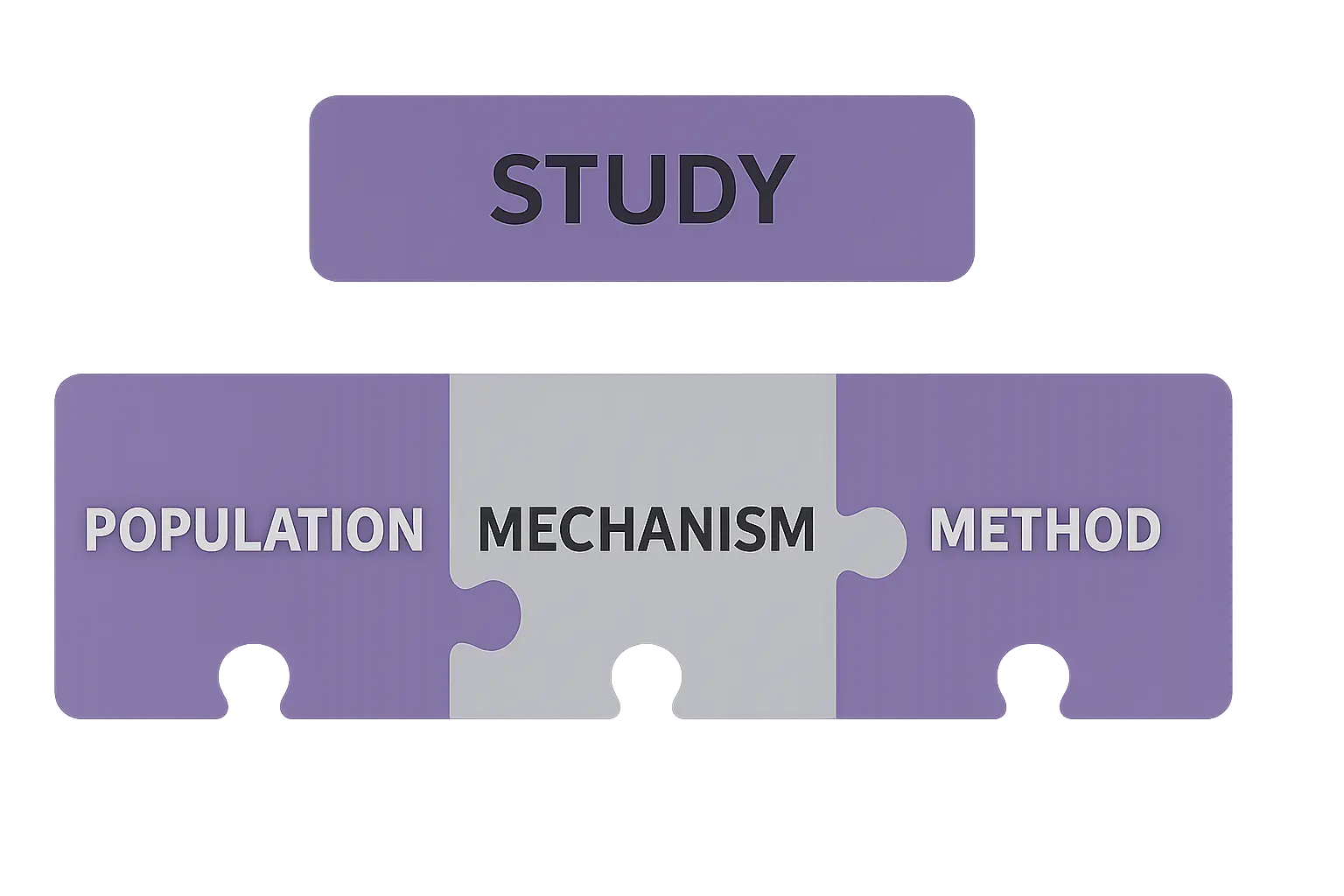
Submission is close and the working title from your upgrade panel three years ago no longer describes the thesis you actually wrote — it still names the population you started with but says nothing about the mechanism you ended up finding. A UK psychology PhD title is built from three components: the population or context, the specific variable or mechanism under study, and — where relevant — the design or method, usually joined by a colon into a main title and subtitle. Below is the method and 30 worked title examples across eight psychology sub-fields. All 30 are invented for illustration.
Why the working title stops fitting the finished thesis
A title chosen at the proposal stage names the topic a candidate expects to study; a title chosen at submission has to name what the thesis actually found and argues, which is very often narrower and more specific than the original proposal. A working title like “Anxiety in University Students” describes a starting point, not a contribution — by submission, the title needs to say what about anxiety, in which specific student population, studied how, and (often) what the thesis found or argues.
The three-part formula
| Component | What it specifies | Example |
|---|---|---|
| Population/context | Who or what the study is about | “first-generation university students” |
| Mechanism/variable | The specific psychological process or relationship studied | “anticipatory anxiety and academic self-efficacy” |
| Design/method (often in the subtitle) | How the thesis studied it, when this adds real information | “a longitudinal mixed-methods study” |
Assembled: “Anticipatory Anxiety and Academic Self-Efficacy in First-Generation University Students: A Longitudinal Mixed-Methods Study.” Not every psychology title needs all three parts explicit in the words themselves — a tightly scoped experimental thesis sometimes states the mechanism and population without a method subtitle — but every title an examiner reads should let them answer “about whom, about what specifically” within the first line.
30 worked title examples by sub-field (all invented for illustration)
Clinical psychology (4)
- Emotion Regulation Strategies and Relapse Risk in Adults Recovering from Major Depressive Episodes: A Prospective Cohort Study
- Therapeutic Alliance and Outcome in Remote versus In-Person CBT for Generalised Anxiety Disorder
- Self-Stigma and Help-Seeking Delay in Young Men with First-Episode Psychosis
- Parental Expressed Emotion and Symptom Trajectory in Adolescent Eating Disorder Treatment
Cognitive psychology (3)
- Working Memory Load and Susceptibility to Misinformation in Eyewitness Recall
- Attentional Bias to Threat-Related Stimuli in Adults with Subclinical Health Anxiety
- The Role of Prior Belief Strength in Resistance to Corrective Information: A Reaction-Time Study
Developmental psychology (4)
- Joint Attention and Early Vocabulary Growth in Infants at Elevated Likelihood of Autism
- Sibling Relationship Quality and Emotion Understanding in Middle Childhood: A Longitudinal Study
- Screen-Mediated Communication and Peer Attachment Security in Early Adolescence
- Executive Function Development and School Readiness in Children Born Preterm
Social psychology (4)
- Intergroup Contact Quality and Prejudice Reduction Among Mixed-Faith University Cohorts
- Social Identity Threat and Academic Disengagement in First-Generation Ethnic-Minority Students
- Perceived Norm Violation and Bystander Intervention in Online Harassment Contexts
- Collective Efficacy and Community Response to Local Environmental Risk
Health psychology (4)
- Illness Perception and Medication Adherence in Newly Diagnosed Type 2 Diabetes Patients
- Anticipatory Regret and Screening Uptake in Adults at Elevated Familial Cancer Risk
- Self-Compassion and Burnout Trajectory Among Early-Career NHS Nurses: A Diary Study
- Health Literacy and Treatment Decision-Making in Older Adults with Multimorbidity
Forensic psychology (4)
- Interrogative Suggestibility and False Confession Risk in Adults with Mild Learning Disability
- Desistance Narratives and Identity Change Among Long-Term Prisoners Approaching Release
- Risk Assessment Tool Concordance and Clinical Judgement in Community Forensic Teams
- Victim Impact Statement Delivery and Juror Sentencing Recommendations: An Experimental Study
Educational psychology (4)
- Teacher Feedback Specificity and Growth Mindset Development in Secondary Mathematics Classrooms
- Peer Tutoring Structure and Reading Comprehension Gains in Children with Dyslexia
- Test Anxiety and Working Memory Interference in GCSE Examination Performance
- Educational Psychologist Consultation Style and Teacher Implementation Fidelity in Behaviour Support Plans
Organisational/occupational psychology (3)
- Psychological Safety and Speaking-Up Behaviour Among Junior Doctors in Acute Wards
- Remote Leadership Communication Style and Team Trust in Distributed Knowledge-Work Organisations
- Moral Injury and Turnover Intention Among Frontline Social Workers: A Mixed-Methods Study
Common title failures examiners flag
| Failure | Why it fails | Fix |
|---|---|---|
| Topic-only title, no mechanism | “Anxiety in University Students” describes a field, not a contribution | Name the specific variable and relationship the thesis actually tested |
| Method-only title, no substance | “A Mixed-Methods Study of Wellbeing” foregrounds design over finding | Move the method to a subtitle after the colon |
| Title overpromises the design | “The Causes of X” from a cross-sectional correlational study | Use language the design actually supports (“associated with,” not “causes”) |
| Population too broad | “in Adults” when the sample was one specific clinical group | Name the actual population studied, not a generic superset |
| Title drifted from the final contribution | Kept from the proposal stage, no longer matches the findings chapter | Redraft the title only after the discussion chapter is substantially complete |
A sixth, less obvious failure worth naming: a title that is technically accurate but reads as a full abstract compressed into one sentence, cramming every variable, every moderator and every sub-analysis into the title itself. An examiner reading a title with four “and”s and two parenthetical clauses is reading a title that has not yet decided what its single central claim actually is — the discipline of choosing which relationship is the title’s job to name, and which belongs in the abstract instead, is itself part of demonstrating the thesis has a clear central contribution.
When to actually finalise the title
Titling too early is the single most common cause of the mismatch this piece opened with — a title finalised before the discussion chapter exists is a title written before the thesis knows what it actually argues. The practical sequence: draft a working title at the proposal stage for administrative purposes, treat it as provisional throughout data collection and analysis, and only lock the final title once the discussion chapter’s contribution statement is stable, because the contribution statement and the title should say close to the same thing at two different lengths.
Does a DClinPsy portfolio title work the same way?
Not quite — a DClinPsy portfolio, built from a systematic review, an empirical paper and a critical appraisal rather than a single monograph, typically needs a separate title for each component plus an overarching portfolio title, and the same three-part discipline (population, mechanism, method where useful) applies to each piece individually rather than to one combined title trying to cover a systematic review and an empirical study at once.
Where this fits with the rest of the site’s thesis-craft pieces
A title is the shortest possible version of the same claim the site’s piece on what counts as an original contribution to knowledge in a UK PhD thesis asks a candidate to state in one sentence — if the title and the contribution statement do not agree, one of them is wrong. Once the title reflects the actual findings, the results and discussion chapters piece on this site covers writing those chapters to APA and JARS standards, study by study, and the validated instruments comparison piece is the natural companion for a methodology chapter that needs to justify which named scale was used.
Retitling without losing three years of citation trail
A retitled thesis needs its abstract, keywords and any already-submitted conference abstracts or published chapters checked for consistency, and — for a thesis-by-publication candidate — the connecting narrative chapter needs to explicitly bridge the individually titled papers to the new overall thesis title, since those paper titles themselves typically cannot change once submitted to a journal. Tesify’s thesis planning and editing workflow can flag every place a stale working title still appears across a multi-chapter document once a new one is settled — a mechanical check that is easy to skip by hand across an 80,000-word file and easy to miss until an examiner spots the mismatch.
Frequently asked questions
Are any of the 30 titles above from real, published theses?
No. All are invented for illustration, built to show the three-part formula and the conventions of each sub-field, not to represent any actual study or its findings.
Does a psychology PhD title always need a colon and subtitle?
No — it is a common and useful convention, especially when the method adds real information the main title cannot carry economically, but a tightly scoped title without a subtitle is equally acceptable where the main clause already specifies population and mechanism clearly.
How long should a psychology thesis title actually be?
Most UK psychology theses run 12 to 20 words including the subtitle; considerably shorter often means the mechanism or population is underspecified, and considerably longer usually means the title is trying to summarise the whole thesis rather than name its central claim.
Can I change my thesis title after the upgrade or confirmation review?
Yes, generally — most UK institutions treat the confirmed title as provisional through to submission, though check your own institution’s regulations, since some require the Graduate School to be notified of a substantive title change before the viva.
Should the title state the finding, or just the question?
Convention varies by sub-field and supervisor — many quantitative psychology titles state only the variables and relationship studied without pre-announcing the direction of the finding, while some qualitative and applied theses do foreground the finding itself; check what is standard in your own recently examined departmental theses.
Is it a problem if my title uses causal language like “effect of” or “impact of”?
Only if the design cannot support it — an experimental or intervention-based thesis can usually justify causal language, while a cross-sectional or correlational design should generally use associative language (“associated with,” “and”) to avoid overstating what the method can establish.
What should I do if my supervisor and I disagree on the final title?
Treat it the same as any other substantive methodology disagreement — bring both versions and the reasoning for each to a supervision meeting specifically about the title, since it is one of the few sections of the thesis every examiner reads before opening the file, and a genuine disagreement here is worth resolving deliberately rather than defaulting to whichever version was drafted first.
Does the title need ethics-committee approval if I change it after data collection has started?
Not usually, provided the change reflects the same approved study rather than a substantively different research question — a title change driven by refined framing of already-approved research is different from a change that would require its own ethics amendment, and the distinction is worth checking with your ethics office if there is any doubt.
Is it acceptable for a title to include a semicolon or a question mark?
A colon-separated main title and subtitle is by far the dominant UK convention; a semicolon reads unusually to most examiners, and a question-mark title is more common in less formal or magazine-style academic writing than in a submitted doctoral thesis, where a declarative title is the safer default.
Should every sub-field in psychology follow this exact three-part formula?
The underlying logic (name whom, name what specifically, name how if it adds information) holds across sub-fields, but the emphasis shifts — a forensic or clinical title often needs to name the specific population precisely for ethical and applicability reasons, while a cognitive or experimental title sometimes foregrounds the mechanism and paradigm more than the population, as several of the worked examples above show.