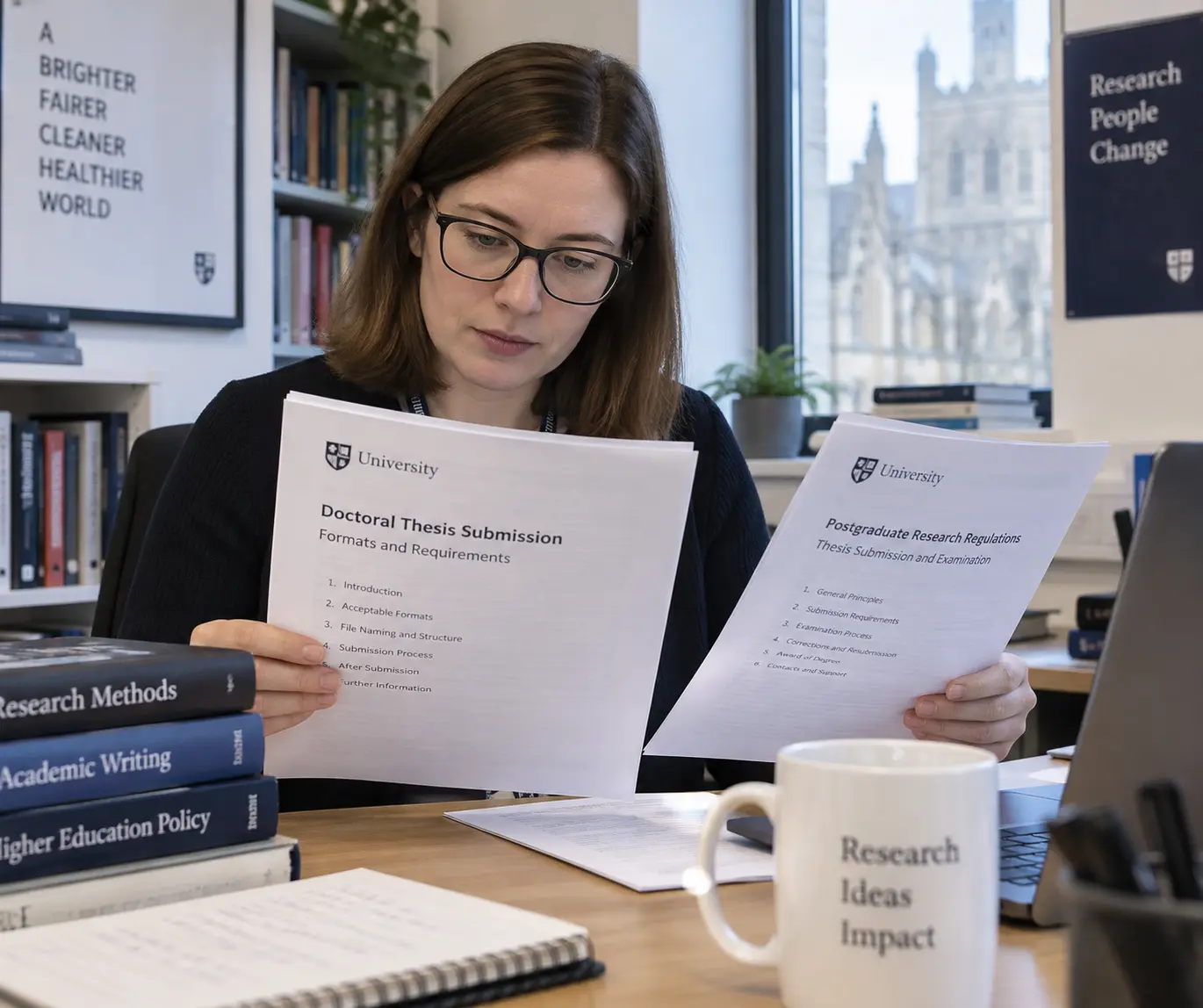
There is no national UK dataset tracking how many papers the average PhD candidate publishes, and a figure this precise cannot honestly be given — but for candidates on the formal thesis-by-papers route specifically, two UK universities’ own published regulations state an exact minimum: three papers of publishable quality at Essex, and a minimum of three substantive core papers at Southampton, with either institution’s faculties permitted to set a higher minimum but not a lower one. This article separates that precisely regulated minimum from the much softer, undocumented expectations informally discussed for a conventional monograph thesis.

What does “three papers” actually mean, precisely, at a university that offers this format?
The University of Essex’s guidance notes for submitting a thesis as a series of papers, published August 2025 and due for review June 2026, state the requirement in exact terms: “The thesis as a series of paper consists of a minimum of three papers of publishable quality, preceded by a substantial introduction and a conclusion.” The same document requires the introductory section to set out the overarching, unifying research question, include a literature review and methodology outline, and states explicitly that “the overall work must constitute a coherent and continuous thesis, rather than a series of disconnected papers” — the minimum paper count is only part of what the regulation actually requires.
How does Southampton’s version of the same format differ?
Southampton’s guidance for what it calls the “Three-Paper PhD” format, approved in 2014 and published on the university’s own site, requires “a minimum of three substantive core papers containing distinct research contributions,” while explicitly allowing individual faculties to set a higher minimum for their discipline, but never a lower one. Southampton’s version adds detail Essex’s does not state as precisely: the introduction should typically run to around 15,000 words (though this does not count as a substantive contribution to the required content itself), the papers must be “published or publishable in reputable peer reviewed journals,” and where a paper has joint authors, the candidate must be a principal author and the supervisor must formally certify the candidate’s stated personal share in the work at the front of the thesis. Southampton’s guidance also states plainly that submission for an MPhil is not permitted in this format, though examiners retain the discretion to award an MPhil if a thesis submitted in three-paper format does not meet the PhD standard.
Essex and Southampton compared
| Requirement | Essex (guidance dated Aug 2025) | Southampton (guidance approved 2014) |
|---|---|---|
| Minimum papers | Three, of publishable quality | Three substantive core papers with distinct contributions |
| Can a faculty raise the minimum? | Not stated explicitly in the series-of-papers section | Yes, explicitly permitted; never lower than three |
| Introduction length | “Substantial,” with no specific word count stated in the series-of-papers section | Typically around 15,000 words |
| Published vs publishable | “Publishable quality” (not necessarily already published) | “Published or publishable in reputable peer reviewed journals” |
| Joint authorship rule | Governed by a separate co-authorship section of the same document | Candidate must be principal author; supervisor certifies personal-share statement |
| MPhil submission in this format | Not addressed in the series-of-papers section | Explicitly not permitted |
Does “three papers” mean the average PhD candidate publishes three papers?
No — this is the single most common confusion around the figure, and it is worth separating deliberately. The three-paper minimum above governs only the specific, formal thesis-by-papers submission format, which is optional and only available in some disciplines at institutions that offer it — a candidate has to actively choose this route rather than the conventional monograph thesis, and many UK doctoral candidates never submit in this format at all. A conventional monograph-format PhD has no equivalent formal publication-count requirement in either of these institutions’ regulations; a candidate on that route may publish zero, one, several, or considerably more papers during their candidature, entirely outside any regulatory minimum, and no national dataset tracks that number across the sector.
Why does no national dataset exist for this figure?
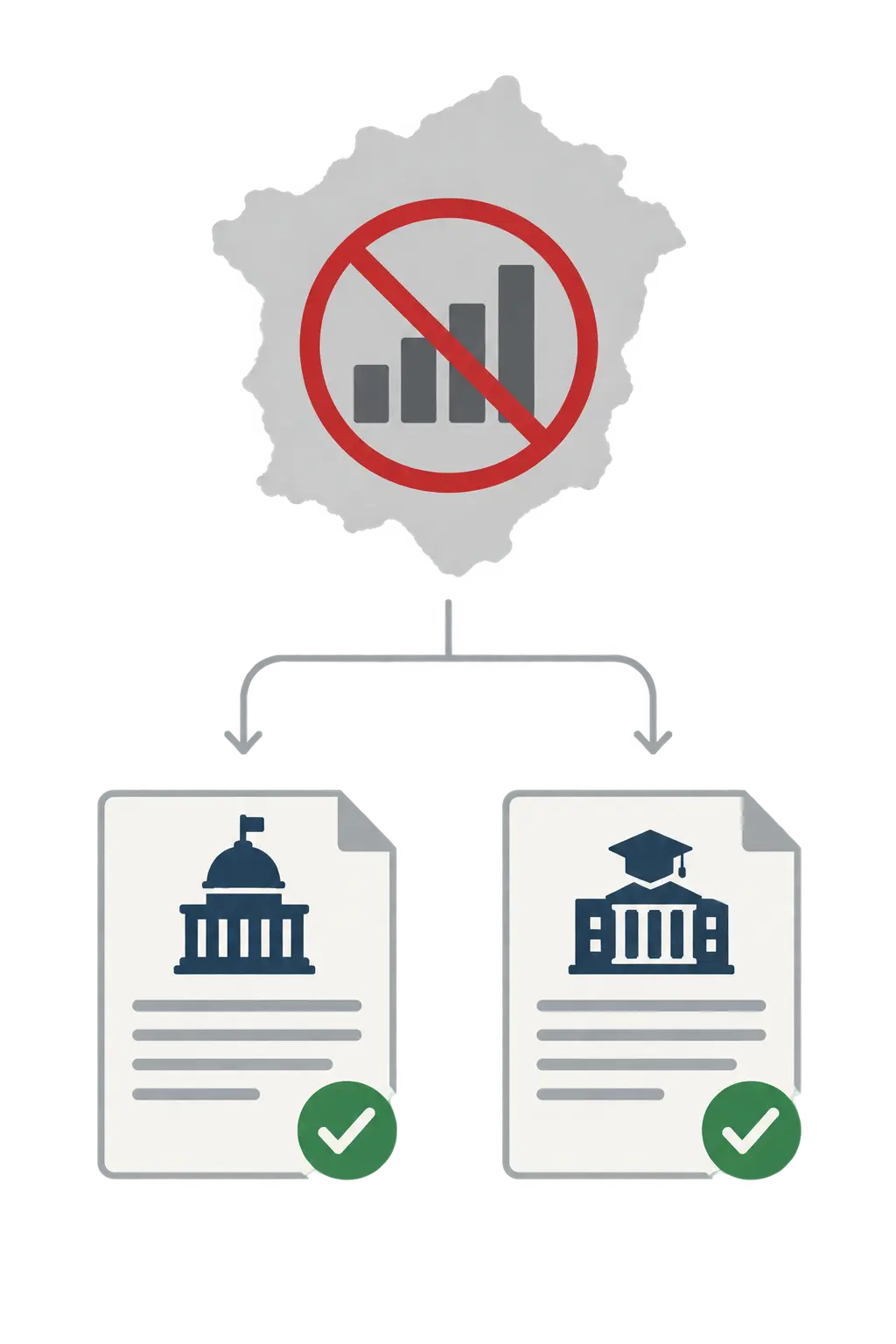
HESA, the body that publishes the UK’s authoritative higher education statistics, collects and reports enrolment, qualification and destination data (covered in this site’s own guides to how many PhD students are there in the UK and to what UK PhD graduates actually do after graduating) — it does not collect or publish a field tracking how many papers each doctoral candidate published during candidature, because publication activity is recorded by journals and citation databases such as Scopus or Web of Science, not by the higher-education sector’s own enrolment and qualification records. A researcher wanting an approximate, discipline-specific figure would need to construct one directly from a citation database, filtering by author affiliation and career stage over a defined period, rather than from any single published sector statistic — a research exercise in its own right, which is why this article does not offer an approximate national average.
How does this relate to the thesis-by-publication route generally?
This site’s own guide to what a thesis by publication actually requires, institution by institution, sets out the wider picture — how radically the format’s rules differ between universities beyond just the paper count discussed here, including word limits, examination conventions and which disciplines typically offer it. The specific three-paper minimum this article documents at Essex and Southampton is one instance of a pattern that varies meaningfully institution to institution, which is precisely why a candidate considering this format needs their own institution’s current regulation, not a network-wide assumption.
Does publishing during the PhD matter even outside the thesis-by-papers format?
Yes, separately from any formal thesis-format requirement — this site’s own guide to publishing a paper from your PhD thesis covers why candidates on the conventional monograph route are still commonly encouraged to publish at least one paper before submission, for reasons distinct from any thesis-format regulation: strengthening a post-PhD academic job application, and establishing priority on a finding before someone else publishes something similar. That guidance is about career and priority strategy, not a formal submission requirement, and should not be confused with the regulated minimum this article documents for the specific thesis-by-papers format.
What do examiners actually flag when a thesis-by-papers submission is weak?
Beyond simply counting papers against the regulatory minimum, examiners of a thesis-by-papers submission most often flag two structural problems. The first is exactly what Essex’s guidance warns against directly — papers that read as genuinely disconnected, where the introduction has not done the work of stating a single overarching question the separate papers jointly answer, leaving the thesis reading as a bound collection rather than a unified argument. The second is a mismatch between the candidate’s claimed contribution and what the joint-authorship statement actually supports — where a paper has several co-authors and the candidate’s own contribution is not stated with enough precision for an examiner to judge what portion of the work is genuinely theirs, which is exactly the gap Southampton’s supervisor-certified personal-share statement is designed to close. A candidate assembling a thesis-by-papers submission should treat the connecting introduction and the authorship statements as being at least as examinable as the papers themselves, not as administrative formalities attached to work that is otherwise already finished.
What should a candidate actually check before assuming either figure applies to them?
Three things, specifically: whether their own institution offers the thesis-by-papers format at all (not every university or every discipline within a university does), what that specific institution’s current minimum paper count and introduction requirements are (not Essex’s or Southampton’s, unless that happens to be the candidate’s own institution), and whether their specific faculty has set a higher minimum than the university-wide floor, which both institutions discussed here explicitly permit. A supervisor or the graduate school’s research degrees office is the right first point of contact for all three, since none of this is standardised across the UK sector.
Frequently asked questions
Is three papers the UK-wide minimum for a thesis by publication?
No — there is no single UK-wide minimum. Three is the specific figure set in Essex’s and Southampton’s published regulations; other institutions that offer the format may set a different minimum, and not every institution offers the format at all.
Do the papers need to already be published, or just publishable?
This varies by institution — Essex’s guidance uses “publishable quality” without requiring prior publication, while Southampton’s guidance requires the papers to be “published or publishable in reputable peer reviewed journals,” which reads slightly more strictly. Check the specific wording of your own institution’s regulation rather than assuming either standard applies.
Can I include papers I co-authored with my supervisor in a thesis by papers?
Generally yes, but with conditions — Southampton’s guidance requires the candidate to be a principal author with a formally certified personal-share statement; check your own institution’s co-authorship section, since this is one of the more tightly regulated parts of the format.
Is an MPhil available in the thesis-by-papers format?
At Southampton, explicitly not as a submission format, though examiners retain the discretion to award an MPhil if a three-paper-format PhD thesis does not meet the PhD standard — check your own institution’s equivalent rule, since this varies.
How many papers does the average UK PhD candidate actually publish, across all thesis formats?
No national dataset tracks this figure across the whole UK sector — the honest answer is that it varies substantially by discipline and department, and a candidate should ask their own supervisor and research group for a realistic, field-specific expectation rather than rely on an unsourced average.
Does the introduction word count for a thesis by papers count toward the overall thesis word limit?
At Southampton, the roughly 15,000-word introduction does not count as a substantive contribution in its own right, though the guidance does not state whether it is excluded from the overall word-limit count — check your own institution’s specific word-limit regulation for this detail rather than assuming.
Is the thesis-by-papers format available in every discipline?
No — Southampton’s guidance states the format is available “if appropriate to the subject discipline,” meaning individual faculties decide whether to offer it; a candidate should ask their own department directly rather than assume it is available.
Could a citation database like Scopus give me an approximate figure for my own field?
In principle yes — a researcher could construct an approximate, discipline-specific figure by filtering a citation database for early-career authors at a defined institution over a defined period, but this is a research exercise in its own right rather than a published statistic, and the result would still be an estimate specific to the filters chosen rather than an authoritative sector figure.
What is the most common reason a thesis-by-papers submission is sent back for revision?
A connecting introduction that lists the papers without stating the single overarching question that unifies them, leaving the thesis reading as a bound collection of separate outputs rather than a coherent argument — both Essex’s and Southampton’s guidance state this coherence requirement explicitly, not just the minimum paper count.