| Method | Best suited to | Typical data | Reliability check | Named framework |
|---|---|---|---|---|
| Content analysis | Testing a pre-specified set of categories, or building categories systematically from a large volume of text | Documents, policy text, media coverage, open-ended survey responses at volume | Krippendorff’s alpha (intercoder reliability) | Mayring’s qualitative content analysis |
| Thematic analysis | Identifying patterns of meaning across interview or focus-group data without a strong prior theoretical lens | Semi-structured interviews, focus groups, open-ended qualitative data of moderate volume | Reflexive engagement with coding, not a numeric reliability statistic | Braun and Clarke’s six-phase framework |
| Discourse analysis | Examining how language constructs power, identity or social relations, not just what participants say | Interview transcripts, policy documents, media texts, institutional talk | Not reliability-tested in the psychometric sense; validity rests on close textual and contextual argument | Fairclough’s three-dimensional model |

When Content Analysis Fits Your Data
Content analysis is the right choice when your research question is best answered by counting or systematically categorising what is present in a large body of text — how often a theme appears across hundreds of newspaper articles, how a set of local authority safeguarding policies differ in their stated thresholds, how open-ended survey responses cluster into a manageable set of categories. Philipp Mayring’s qualitative content analysis is the framework most UK sociology and social work theses cite: it combines deductive category application (categories drawn from your theoretical framework before you start coding) with inductive category development (categories that emerge from the data itself), and it explicitly requires pilot testing of your coding categories and rules before you code the full dataset.
The distinguishing feature that sets content analysis apart from the other two methods in this comparison is its use of a numeric reliability check: Krippendorff’s alpha, which measures how consistently two or more coders apply the same categories to the same data. The commonly cited thresholds treat a value above 0.800 as reliable, a value between 0.667 and 0.800 as sufficient only for tentative conclusions, and a value below 0.667 as insufficient to draw reliable inferences at all. If your thesis needs to defend the consistency of your coding to an examiner with a quantitative background, content analysis is the method built to do that; thematic and discourse analysis do not offer an equivalent statistic, and would not gain credibility by inventing one.
When Thematic Analysis Fits Your Data
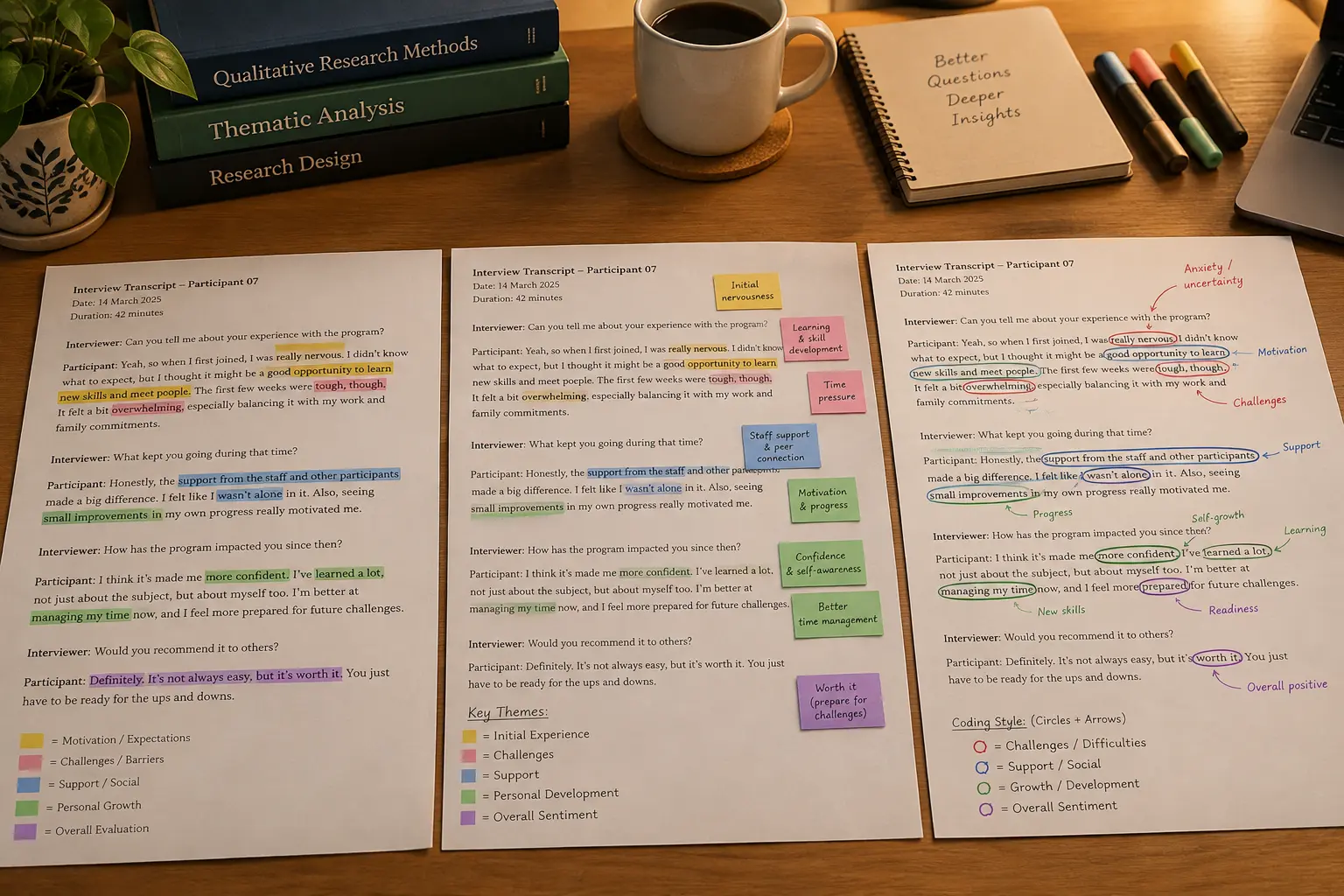
Thematic analysis is the default choice for a huge share of UK sociology and social work PhDs working with interview or focus-group data, precisely because it does not commit you to a particular theoretical lens in advance the way discourse analysis does, and does not require the coding-scheme rigidity content analysis does. Virginia Braun and Victoria Clarke’s widely cited six-phase framework structures the process: familiarisation with the data, generating initial codes, searching for themes, reviewing themes, defining and naming themes, and producing the report. Braun and Clarke describe thematic analysis as a method for “identifying, analysing and reporting patterns (themes) within data,” which minimally organises and describes a dataset in rich detail — a deliberately flexible definition that is also thematic analysis’s main risk: a thesis that applies the six phases loosely, without being explicit about which theoretical assumptions are shaping the coding, invites one of the critiques examiners raise most often against it.
Reflexivity substitutes for a numeric reliability statistic here: you are expected to document your own positionality and the decisions behind your coding choices, rather than report an intercoder agreement score. This makes thematic analysis well suited to smaller-scale qualitative projects, including single-researcher PhD theses where a second coder is not available or not methodologically necessary.
When Discourse Analysis Fits Your Data
Discourse analysis is the right choice when your research question is not really “what did participants say” but “how does the way this is said construct power, identity or social relations” — how a safeguarding policy document constructs the family as a site of risk, how a set of media texts position a marginalised group, how professionals in an institutional setting talk their way into or out of accountability. Norman Fairclough’s three-dimensional model is the most commonly cited framework in UK sociology and social work theses using this approach, mapping three levels of analysis onto each other: description of the text itself, interpretation of the discursive practice (how the text is produced, distributed and consumed), and explanation of the wider social practice the text is embedded in — connecting the micro level of the text to the macro level of social and institutional context.
Discourse analysis does not offer, and should not claim, a numeric reliability statistic; its rigour comes from close, well-evidenced textual argument and explicit engagement with the social and institutional context, not from intercoder agreement. A thesis that tries to bolt a Krippendorff’s alpha score onto a Faircloughian discourse analysis is combining two different validity logics that do not actually reinforce each other, and an examiner familiar with either tradition will notice.

The Same Extract, Coded Three Ways
An illustrative (invented, not a real participant) interview extract makes the difference concrete: “The social worker kept saying it was a family decision, but really we all knew the panel had already made up its mind.”
- Content analysis would code this against a pre-specified category such as “perceived professional authority” or “participant scepticism about process,” counting how often that category recurs across the full transcript set, and reporting Krippendorff’s alpha for how consistently a second coder applied the same category to the same extracts.
- Thematic analysis would treat this as one instance contributing to a broader theme developed inductively across the dataset — perhaps something like “the appearance of choice versus the experience of predetermined outcomes” — built up through familiarisation and iterative coding rather than counted against a fixed category.
- Discourse analysis would examine how the phrase “family decision” does discursive work: constructing an appearance of participant agency that the speaker’s own words simultaneously undercut, and situating that construction within the wider institutional practice of how safeguarding panels present their decisions to families.
Three legitimate, methodologically distinct readings of the same single sentence — which is exactly why the method has to be chosen to fit the research question, not retrofitted afterward to justify whatever coding felt natural.
Software: Does the Method Determine the Tool?
Loosely, yes, though all three can technically be run in any qualitative software package. Content analysis’s category-and-frequency logic and its need for a documented intercoder-agreement calculation is the best fit for software with strong coding-comparison features; thematic and discourse analysis both rely more on the researcher’s own close reading and annotation than on a tool’s statistical output. The general comparison of what NVivo, ATLAS.ti and Taguette actually offer at doctoral scale — including which of them calculates intercoder reliability statistics natively — is covered in NVivo vs ATLAS.ti vs Taguette for qualitative PhD research; the choice of software should follow the choice of method, not the other way round.
Which One Should You Actually Use?
If your research question is about frequency, category or systematic comparison across a large text corpus, choose content analysis and report Krippendorff’s alpha. If your research question is about patterns of meaning across interview or focus-group data and you want a widely recognised, flexible framework that does not commit you to a specific theoretical lens up front, choose Braun and Clarke’s thematic analysis. If your research question is fundamentally about how language constructs power, identity or social relations — the kind of question that sits closest to critical social theory — choose Fairclough’s discourse analysis and be prepared to defend it through textual and contextual argument rather than a reliability statistic. Many sociology and social work theses use two of the three in combination (most often thematic analysis for a first-pass organisation of interview data, followed by a discourse-analytic close reading of a smaller number of especially revealing extracts) — state explicitly, in your methodology chapter, which method is doing which job if you do this, rather than blending them without comment.
Whichever method you choose, the instrument that generated your data in the first place still has to be built and justified separately — the general principles for a semi-structured interview guide or survey are covered in how to design data collection instruments for postgraduate research, the sample size and access strategy that determines how much data you will actually have to code is covered in how to choose and justify a sampling strategy, and the ethics approval that governs collecting it in the first place is covered for this discipline in what ethics approval do you need for a sociology or social work PhD. However you write up the findings chapter, including with Tesify, the analysis and the argument stay yours — 100% written by you.
Frequently Asked Questions
Which method should I use for interview data in a sociology PhD?
Thematic analysis is the most common default for interview and focus-group data, especially where you do not want to commit to a specific theoretical lens before you start coding. Discourse analysis is the better fit if your question is about how language constructs power or identity rather than what themes recur.
Do I need to report Krippendorff’s alpha for thematic or discourse analysis?
No. Krippendorff’s alpha is specific to content analysis’s intercoder-agreement logic. Thematic analysis relies on documented reflexivity; discourse analysis relies on close textual and contextual argument. Neither needs, or benefits from, a borrowed reliability statistic.
What are Braun and Clarke’s six phases of thematic analysis?
Familiarisation with the data, generating initial codes, searching for themes, reviewing themes, defining and naming themes, and producing the report.
What is Fairclough’s three-dimensional model?
A framework analysing text at three levels: description of the text itself, interpretation of the discursive practice (production, distribution and consumption), and explanation of the social practice the text sits within, linking the micro level of language to the macro level of social context.
Can I combine two of these methods in one thesis?
Yes, commonly thematic analysis for a first-pass organisation of interview data followed by a discourse-analytic close reading of key extracts. State explicitly which method is doing which job rather than blending them without comment.
What reliability threshold does Krippendorff’s alpha use?
Values above 0.800 are commonly treated as reliable, 0.667 to 0.800 as sufficient only for tentative conclusions, and below 0.667 as insufficient for drawing reliable inferences.
Is content analysis only for large datasets?
It is best suited to volume and systematic categorisation, but the deciding factor is your research question, not dataset size alone — a smaller dataset with a strong deductive category scheme can still suit content analysis.
Do I need a second coder for thematic analysis?
Not necessarily. Thematic analysis is well suited to single-researcher PhD projects because it substitutes documented reflexivity for a numeric intercoder statistic, unlike content analysis.
Which method is easiest to defend at viva?
Whichever one your data and research question genuinely fit, applied consistently and explained honestly — examiners are far more likely to challenge a mismatch between method and question, or an unexplained mixing of validity logics, than any one method chosen and applied correctly.
Can I change methods partway through analysis if the data does not fit?
Yes, and it is far better to change early than to force a mismatched method through to the findings chapter. Document the reasoning for the change in your methodology chapter as a considered decision rather than treating it as something to hide — examiners generally read an explained mid-project pivot as evidence of methodological maturity, not as a weakness.