Yes. Warwick’s Doctoral College publishes its own “Guide to Examinations for Higher Degrees by Research,” and it sets out word limits by degree (80,000 words for a PhD), the title page and declaration wording, examiner appointment rules, and nine distinct outcomes a viva can produce — from a straight award to no degree at all. None of it is folklore; it is read directly below from the guide itself.
What word limit does Warwick actually set for a PhD thesis?
Warwick’s University Regulations set the word limit by degree, and for the thesis-based degrees the limit excludes appendices, footnotes, tables and the bibliography. The Doctoral College’s Guide to Examinations for Higher Degrees by Research lists them as follows.
| Degree | Word limit |
|---|---|
| Master by Research (MA, MSc, LLM by Research), MMedSci, MS | 40,000 |
| MPhil | 60,000 |
| PhD | 80,000 |
| PhD by Published Work | Covering document 5,000–10,000 |
| MD | 70,000 |
| EdD (Department of Education Studies) | One study of 50,000, or two studies of 20,000 each |
| EngD | No word limit specified for the portfolio |
| DClinPsych | 20,000 (research thesis) |
| DBA | Portfolio not exceeding 80,000 |
Any request to exceed these limits needs the Academic Director’s approval, usually requested before submission with a statement supported by your supervisor, and that approval does not stop examiners recommending the thesis be shortened anyway. For a PhD, the total length of all appendices may not exceed 5,000 words unless the Academic Director agrees otherwise, and an appendix cannot contain material that is an essential or integral part of the thesis — if it does the work belongs in the main text, not the appendix.
What has to be on the title page and in the declaration?
The title page of every volume must give, in order: the full title and subtitle, the total number of volumes and which one this is, the author’s full name (followed, if desired, by qualifications and distinctions), the full name of the qualification (for example “Doctor of Philosophy in Physics”), the name of the University and of the department, school or centre, and the month and year of submission or resubmission. If your title page does not meet these requirements, you will be asked to provide a corrected version.
The declaration that follows must use Warwick’s own wording, not a paraphrase:
“This thesis is submitted to the University of Warwick in support of my application for the degree of [Doctor of Philosophy]. It has been composed by myself and has not been submitted in any previous application for any degree… The work presented (including data generated and data analysis) was carried out by the author except in the cases outlined below… Parts of this thesis have been published by the author…”
Where any material was previously submitted for another degree, is collaborative, or has already been published, the declaration has to say so explicitly, with a list. Silence is not an option — an undeclared reuse of prior work is exactly the kind of thing an internal examiner is trained to notice.
How is the abstract regulated, and is there anything else easy to get wrong?
The summary or abstract must not exceed 300 words and must fit on a single side of A4, which is why single-spaced typing is permitted for the abstract alone — the rest of the thesis is typed at 1.5 line spacing. The guide also asks you to proofread carefully, because any typographical errors have to be corrected to the examiners’ satisfaction before the award is approved. A thesis that plainly exceeds its limit may simply not be accepted for examination, which is a worse outcome than asking your supervisor for the Academic Director’s sign-off in advance.
Who examines a Warwick thesis, and who is not allowed to?
Normally two examiners are nominated: one internal (a member of Warwick’s academic staff) and one external to Warwick. If you are, or were within the 12 months before submission, a member of the University’s academic, research, administrative or library staff, the examination is conducted by two external examiners instead — unless you are a full-time student, in which case one internal and one external examiner may still be nominated. An EngD adds an industrial examiner, who need not hold a qualification equivalent to the degree being examined but should normally be working in a senior position in a commercial organisation relevant to the research. A PhD by Published Work goes to two external examiners plus an experienced examination advisor.
Your own supervisor should not serve as internal examiner. The guide lists specific potential conflicts a department must disclose before an examiner is confirmed: substantial involvement in your research, a close personal or professional relationship with you, your supervisor or the other examiner, having been your personal tutor, the examiner’s own work being the focus of your thesis, or a direct commercial interest in the outcome. Honorary staff cannot be external examiners at all, and where an honorary member of staff is the internal examiner an examination advisor is normally appointed alongside them.
Every research-intensive UK university writes its own version of these rules, and they are not interchangeable. Manchester’s Presentation of Theses Policy and Aston’s General Regulations both set their own word limits, examiner composition and outcome categories, and none of the three is a safe stand-in for either of the others. For the general, sector-wide picture of who is allowed to sit on a UK viva panel and why, see who examines a PhD thesis in the UK — Warwick’s specific rules above are the exception cases, not the norm, to check against.
How long do examiners have, and when does the viva actually happen?
An electronic copy of the thesis goes to each examiner as soon as possible after submission, and examiners are asked to examine it within a maximum of four months of receiving it (three months for a Master’s by Research or a resubmitted thesis). Each examiner prepares an independent report before the oral examination or any conferral with the other examiner. The oral examination itself is required for every doctoral and MPhil candidate on first submission. A second viva is not automatically required after a resubmission, but examiners can hold one if they judge it necessary, and one is usual where they are considering a lower degree or a fail.
What are the nine possible outcomes of a Warwick viva?
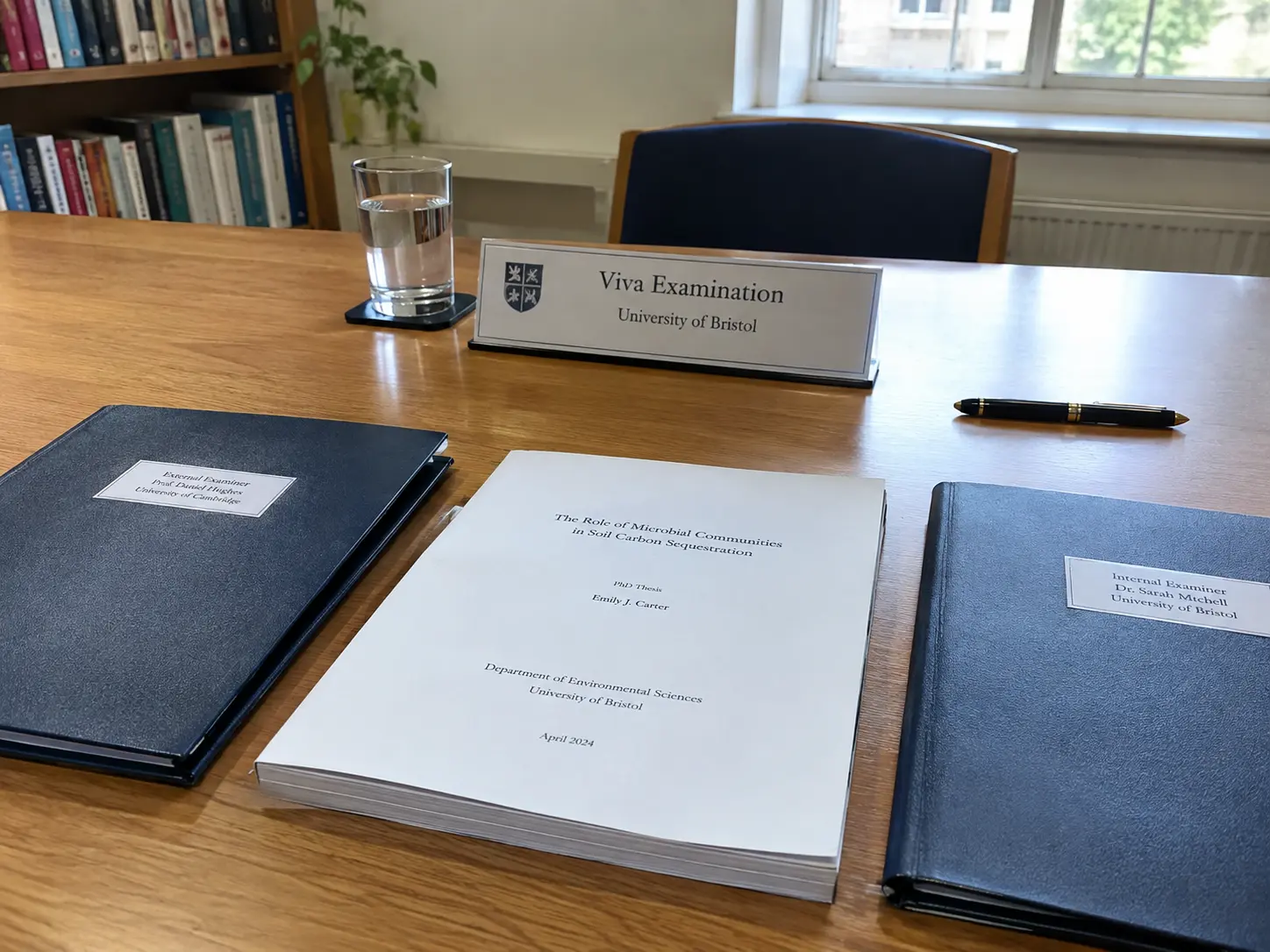
Regulation 38.11 gives examiners nine recommendations to choose from, not the three or four most candidates expect. The Doctoral College’s guide spells out what each one actually means and how long you get.
| Recommendation | What it means |
|---|---|
| a) Award the degree | Met the requirements; thesis is essentially free of typographical errors |
| b) Pass with minor corrections | Correctable in 3 months or less; no further significant research, no substantial change to results or conclusions |
| c) Pass with major corrections | Up to 6 months; more substantial than minor, but not a significant amount of further research or analysis |
| d) Consider a Master’s by Research thesis for an MPhil | Exceptional route where the first submission is close to MPhil standard |
| e) Consider an MPhil thesis for a PhD | Exceptional route where the first submission is close to PhD standard |
| f) Award a Master’s by Research with distinction | Only for work of highly exceptional quality |
| g) Resubmission of the thesis | Up to 12 months; permitted once, and major corrections are not available on the resubmitted version |
| h) Award a lower qualification | PhD may fall to MPhil or a Master’s by Research, MD to MMedSci, EngD to MPhil/MSc by Research, EdD to MA/MSc by Research, LLM to the Diploma in Legal Studies |
| i) No degree awarded | Exceptional; the thesis is judged unlikely to reach an acceptable standard within the 12-month resubmission window |
For a PhD by Published Work the guide adds one clarification rather than extra outcomes: minor or major corrections apply to the covering document only, since the published material itself is not being corrected, and major corrections are available on first submission only.
What is the real difference between minor and major corrections at Warwick?
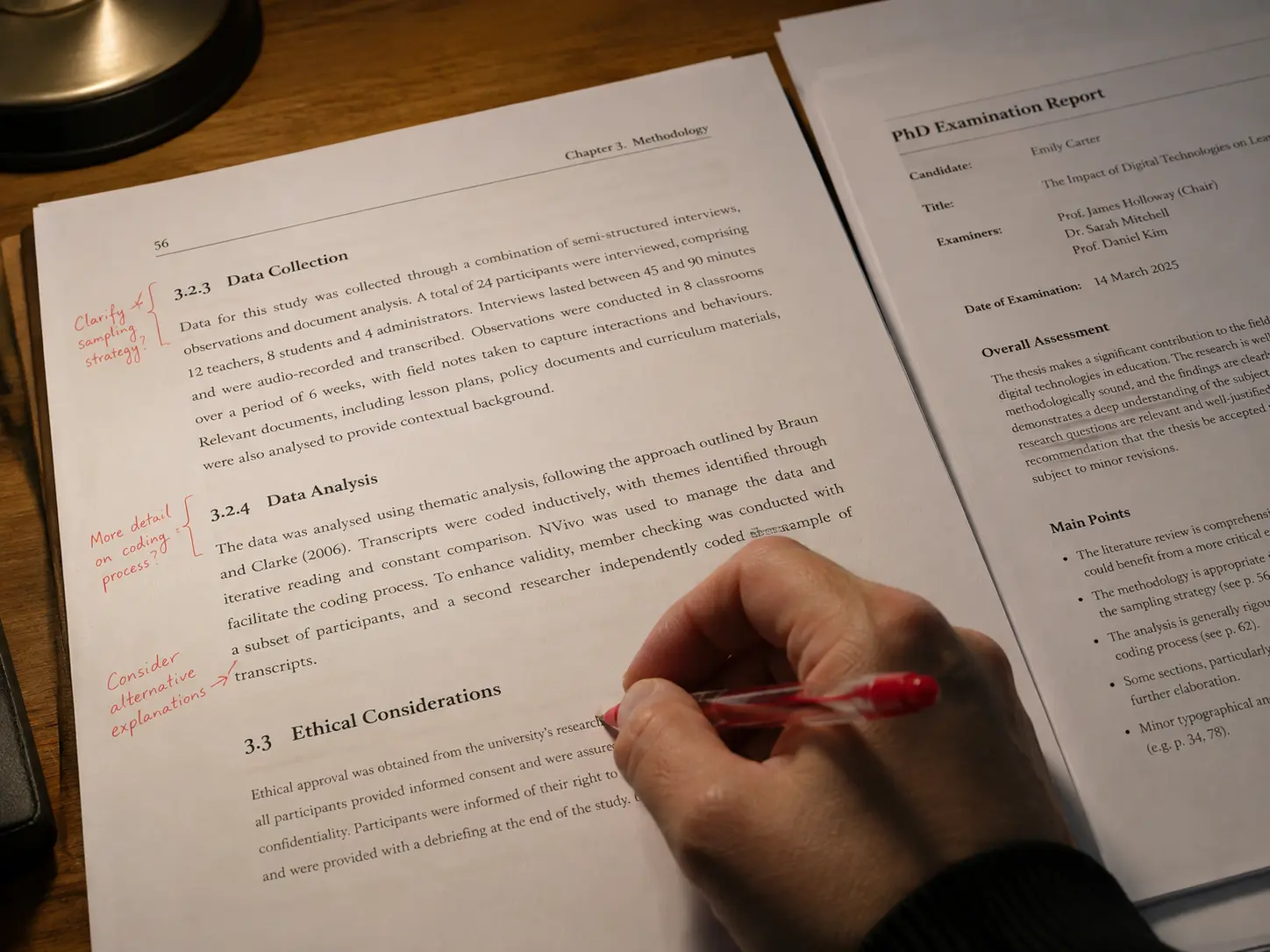
Minor corrections (recommendation b) are meant to be finished inside three months and should not require further significant research or substantially alter your results or conclusions — the guide’s own examples are clerical errors and omissions, minor changes in phraseology and small improvements in description or explanation. Major corrections (recommendation c) get up to six months and can go further, but the guide is equally explicit that they “should not entail a significant amount of further research or analysis” either; they are normally offered where the research has been done but not fully articulated in the thesis. If the required rewrite genuinely needs new research, the correct recommendation is resubmission, not an over-stretched major-corrections list. For the mechanics of actually working through a corrections list against your examiners’ report, see how to complete your PhD corrections and write the response letter.
Can I resubmit a Warwick thesis more than once?
No. On a resubmission the examiners have the same range of recommendations as on the first submission, except that a candidate may complete major corrections or resubmit on only one occasion — so major corrections are not available on the resubmitted thesis and a second resubmission is not an option (the exception is a resubmission specifically for a higher degree under recommendations d or e). The resubmission deadline is set by the examiners, up to a maximum of 12 months, and a fee is payable when you resubmit. There is no requirement for a second oral examination on a resubmission unless the examiners consider one necessary, though one is usual where a lower degree or a fail is being weighed. If you are already facing this outcome, how to rebuild your thesis for a resubmission after a referral walks through the rebuild itself, separate from Warwick’s own timeline rules above.
Does Warwick require a generative-AI declaration, the way Sheffield now does?
Not according to this guide. Searching Warwick’s Guide to Examinations for Higher Degrees by Research for “generative AI” or “artificial intelligence” returns nothing — there is no declaration requirement in it of the kind Sheffield introduced from 1 October 2026. That does not mean AI use is unregulated at Warwick; it means the rule, if your department has one, sits in departmental or Doctoral College guidance the examination guide does not reproduce. Ask your supervisor or the Doctoral College directly rather than assuming either way, and check again closer to submission — sector practice on this point is changing quickly.
Frequently asked questions
What is the maximum length of a Warwick PhD thesis?
80,000 words, excluding appendices, footnotes, tables and the bibliography, unless the Academic Director has approved a longer limit.
Can my supervisor be my internal examiner at Warwick?
No. The guide says a supervisor should not serve as internal examiner, and lists other relationships — personal, professional or commercial — that a department must disclose before an examiner is confirmed.
How long do I get for minor corrections?
Up to three months, as specified by your examiners, and they should not require any further significant research.
How long do I get for major corrections?
Up to six months, still without requiring a significant amount of further research or analysis — if it does, resubmission is the correct route instead.
How many times can I resubmit my Warwick thesis?
Once, for the degree in question, within a maximum of 12 months. Major corrections are not available on the resubmitted thesis, and a further resubmission is not permitted.
Is an oral examination compulsory at Warwick?
Yes, for every doctoral and MPhil candidate on first submission. For a Master’s by Research it is held only if one or both examiners consider it necessary.
How long is a Warwick thesis abstract allowed to be?
300 words, fitting on a single side of A4; it is the only part of the thesis where single-spaced typing is permitted.
What happens if my examiners cannot agree on a recommendation?
An external adjudicator, from outside the University, is appointed, and their decision is normally expected to prevail.
Does Warwick require a generative-AI declaration in the thesis?
Not in the Doctoral College’s Guide to Examinations for Higher Degrees by Research, which contains no mention of generative AI or artificial intelligence — unlike Sheffield’s declaration requirement from October 2026. Check departmental guidance directly.
Can Warwick fail a PhD candidate outright?
Yes, but only exceptionally — where the examiners judge the thesis too poor to be brought to an acceptable standard for any degree within the 12-month resubmission period.
Writing to Warwick’s own rules, not a guess at them
The nine-outcome table above, the exact declaration wording, and the corrections timelines all come from reading Warwick’s own Guide to Examinations directly — the same discipline worth applying to every institution-specific claim in your thesis. Tesify is used by 9,000+ students to structure and draft their thesis chapters from their own material, and the thesis stays 100% written by you — built around what your specific institution actually requires, not a generic template.