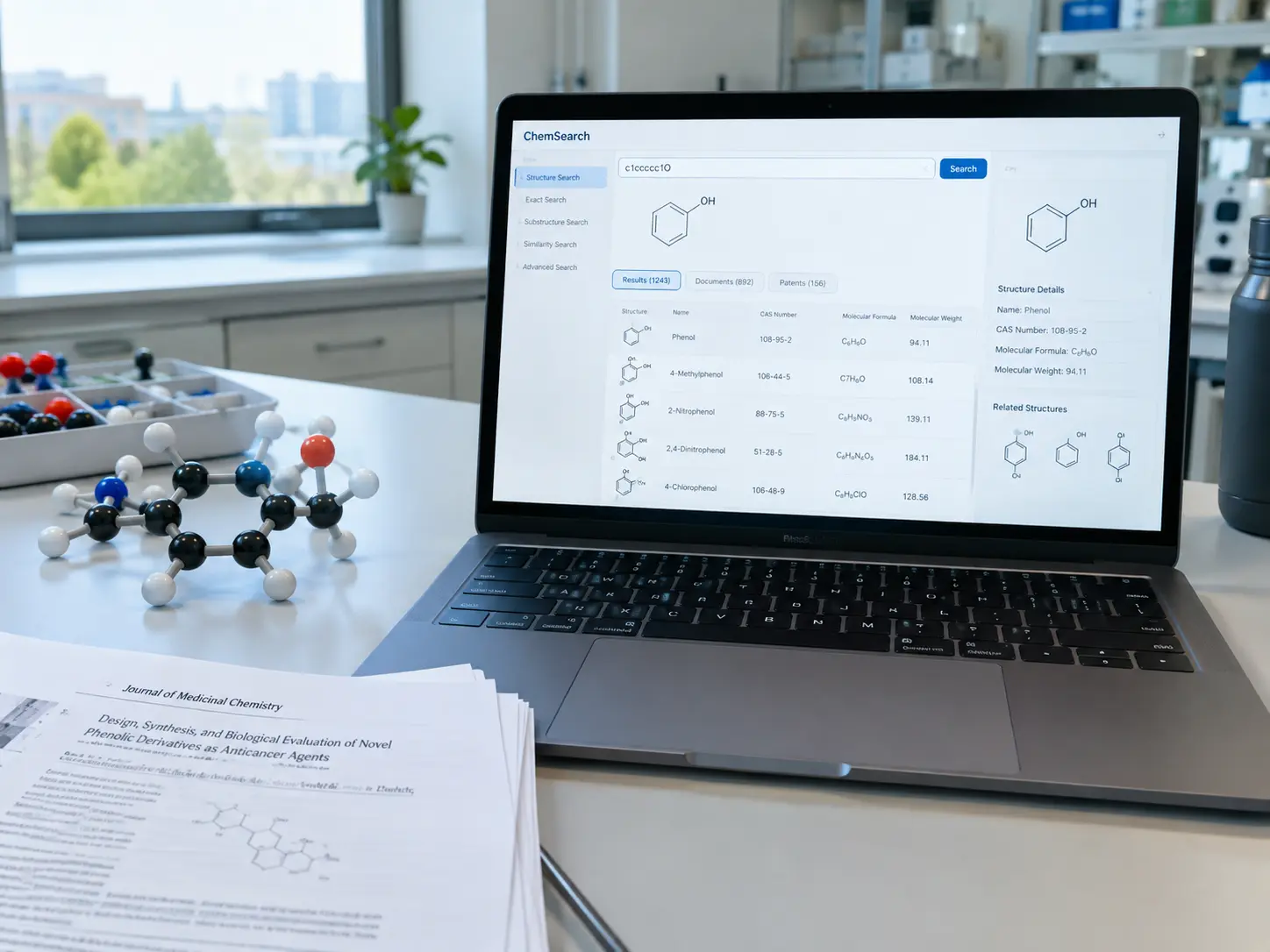
For a chemistry thesis, start in CAS SciFinder or Reaxys, because only they search structures and reactions directly; for a biology thesis, start in PubMed with MeSH terms. In both cases, widen into Scopus or Web of Science for citation tracking and use Google Scholar only as a final sweep. The comparison below shows why.
| Database | Owner | Best for | Structure/reaction search | Access |
|---|---|---|---|---|
| CAS SciFinder(n) | CAS (Chemical Abstracts Service), part of the American Chemical Society | Substances, reactions and retrosynthesis; the deepest chemistry-specific index | Yes, extensive | Institutional subscription |
| Reaxys | Elsevier (includes content from the former Beilstein and Gmelin handbooks) | Reaction search, experimental property data, journals and patents | Yes, extensive | Institutional subscription |
| Web of Science | Clarivate | Citation indexing and impact metrics across disciplines | No | Institutional subscription |
| Scopus | Elsevier | Broad citation coverage, strong author and affiliation profiling | No | Institutional subscription |
| PubMed | US National Library of Medicine | Biomedical and life-sciences literature, MeSH-indexed | No | Free to search |
| Google Scholar | Fast, broad discovery; a supplement, not a systematic-review tool on its own | No | Free to search |
Which database should a chemistry or biology PhD actually start with?
It depends on what the literature review is actually reviewing. A chemistry thesis working with substances, reactions or synthetic routes needs CAS SciFinder or Reaxys, because they index structures and reactions directly, not just papers that happen to mention them — a citation index like Web of Science or Scopus simply cannot answer “which papers report this transformation” the way a structure-searchable database can. A biology or life-sciences thesis, by contrast, is usually better served starting in PubMed, whose MeSH indexing is built specifically for biomedical and life-sciences literature, then widening into Scopus or Web of Science for citation tracking and cross-disciplinary coverage. Google Scholar sits underneath both as a fast supplementary check, not a replacement for either. A thesis spanning both worlds — chemical biology, medicinal chemistry, biochemistry — often needs a genuinely hybrid strategy, starting in whichever database matches the chapter’s own centre of gravity rather than picking one database for the whole thesis.
What actually separates SciFinder from Reaxys?
Both allow structure and reaction searching, which is the feature that sets them apart from Web of Science and Scopus, but they come from different lineages and have different strengths. SciFinder is built on CAS’s own substance collection, which CAS describes as the world’s largest collection of organic and inorganic compounds. Reaxys draws on curated journals, patents and major chemistry handbooks, including the former Beilstein Handbook of Organic Chemistry and Gmelin Handbook of Inorganic and Organometallic Chemistry; the Beilstein data alone covers literature back to 1771, which matters for a thesis that needs historical reaction precedent rather than only recent literature. Where a department holds a licence for only one, it is worth checking early in candidature which one, since building a search strategy around a tool you later lose access to is expensive to redo. A practical illustrative comparison: a thesis on a specific named reaction class benefits more from Reaxys’s deep reaction-search history, while a thesis mapping the substance landscape around a target compound — every reported derivative, every reported synthesis route — tends to be better served by SciFinder’s substance-centric indexing; the two questions are subtly different even though both sound like “search the literature on this chemistry.”
Why does PubMed matter so much for a biology thesis specifically?
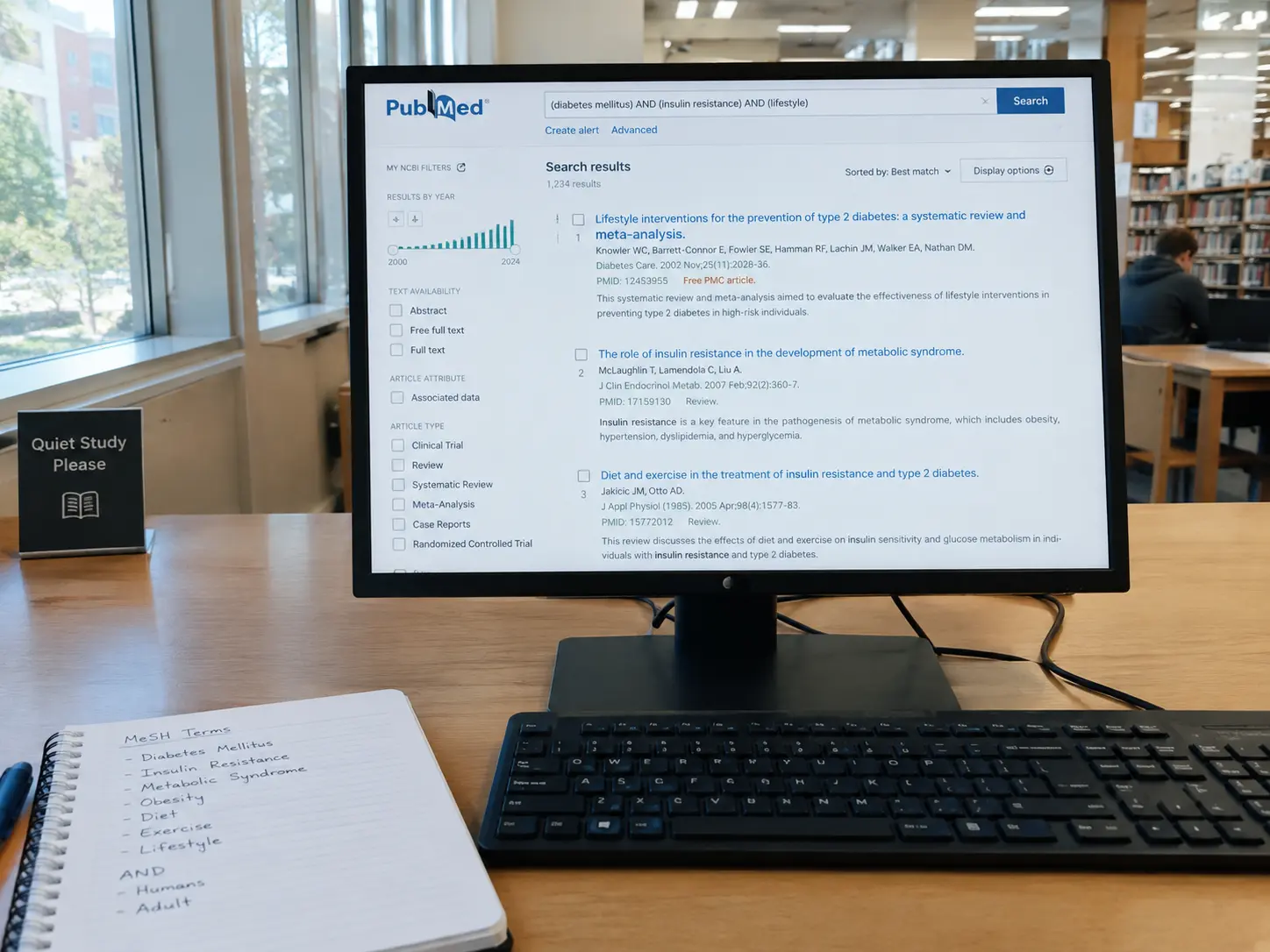
PubMed’s MeSH (Medical Subject Headings) indexing is controlled-vocabulary indexing built specifically for biomedical and life-sciences literature, which makes a systematic or scoping search far more precise than a free-text search in a general citation index. For a biology PhD reviewing a clinical, physiological or molecular-biology literature, starting the search strategy in PubMed and only then cross-checking coverage in Scopus or Web of Science generally produces a tighter, more reproducible search string than starting broad and narrowing down. Being free to search also matters practically: a PubMed-anchored search strategy survives a change of institution or a lapsed licence in a way a SciFinder-anchored one does not.
What do Web of Science and Scopus actually add once you already have SciFinder, Reaxys or PubMed?
Citation tracking and cross-disciplinary reach. Neither Web of Science nor Scopus can structure-search a reaction or reliably out-perform PubMed’s MeSH precision for biomedical topics, but both are strong at showing who has since cited a given paper, which is exactly what a literature review needs when demonstrating that a body of work is still active and being built on, or has stalled. They are also useful when a chemistry or biology thesis needs to reach into an adjacent discipline — materials science, environmental science, pharmacology — that a chemistry- or biomedicine-specific database does not index as deeply. Web of Science and Scopus also differ from each other in coverage and in how they calculate citation and impact metrics, so a thesis that reports a citation count or an impact figure should state explicitly which of the two it came from, rather than treating the numbers as interchangeable.
Is Google Scholar ever good enough on its own?
Not for a doctoral-level systematic or scoping search, though it is a genuinely useful supplement. Google Scholar’s coverage is broad and fast, and it often surfaces preprints, theses and grey literature that subscription databases miss, but its search logic is not transparent or reproducible in the way a search string built in PubMed, SciFinder or Scopus is, which matters if an examiner asks how the search was conducted and expects it to be repeatable. Use it to catch what the primary databases missed, not as the primary search itself. For the general craft of turning a large pile of search results into an actual literature review chapter, rather than the database-selection question this piece focuses on, you have read 300 papers and have no literature review chapter covers that next step.
How does the literature database fit alongside your lab tools?
Database choice is only one half of a chemistry or biology PhD’s tool stack. LabArchives vs Benchling vs GraphPad Prism, the wet-lab tool stack for a chemistry or biology PhD covers the electronic-lab-notebook and analysis side of the workflow; the literature-database choice above feeds into that same workflow at the front end, since a well-documented search strategy and a well-kept lab notebook are both defending the same thing in a viva — that the thesis’s evidence base, whether literature or data, was assembled systematically rather than assembled to fit a conclusion already reached. A candidate who can show both a coherent database strategy and a coherent notebook, side by side, is answering the same underlying examiner question — how do I know this is trustworthy — from two different directions at once.
Does this differ from how a systematic review documents its search?
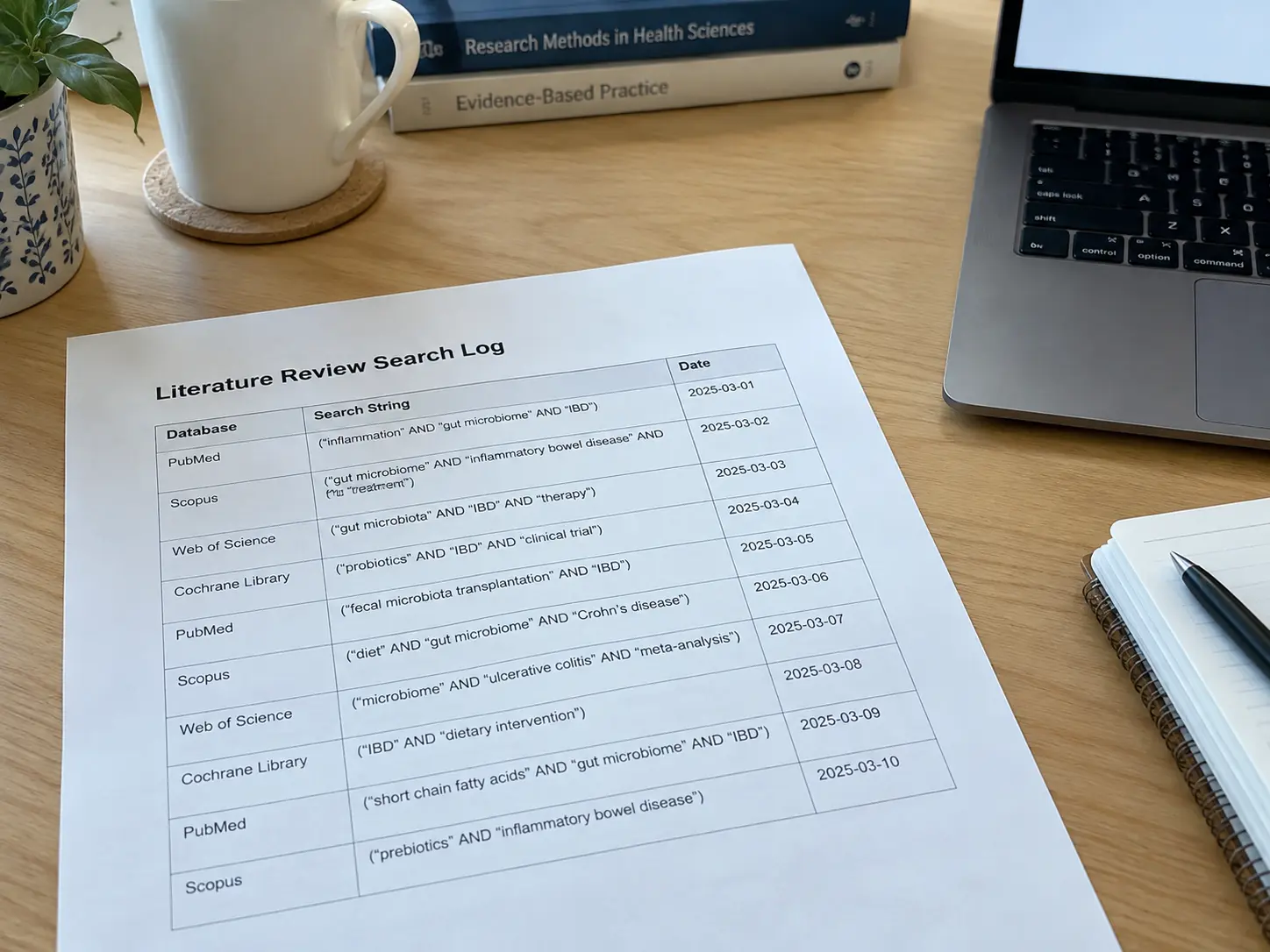
Not much, structurally. How to write a PRISMA systematic review chapter for a public health dissertation sets out the fuller version of the same discipline — a documented, reproducible search string, dates, databases and a screening record — for a thesis where the literature review itself is the primary methodology rather than a preliminary chapter. A chemistry or biology thesis with a narrative rather than systematic review can borrow the same documentation habit without needing the full PRISMA flow diagram: record exactly which databases, which search terms and which date range were used, so the search is auditable even if it was not run as a formal systematic review.
What about checking the literature you do find is still sound?
A database search finds papers; it does not tell you whether one of them has since been retracted. Have you cited a retracted paper? The retraction data, and how to audit your own bibliography covers how to check a reference list against the retraction record before submission — a step worth building into the same literature-management workflow as the database search itself, particularly for a fast-moving sub-field where a foundational paper is more likely to have been corrected or withdrawn since it was first cited.
What is the actual recommendation?
For a chemistry thesis: build the core search in CAS SciFinder if the institution holds a licence, using Reaxys as the reaction-search alternative or supplement where SciFinder access is unavailable or reaction data specifically is needed, then cross-check citation reach in Scopus or Web of Science. For a biology or life-sciences thesis: build the core search in PubMed using MeSH terms, then widen into Scopus or Web of Science for citation tracking and cross-disciplinary coverage. In both cases, use Google Scholar as a final supplementary sweep, and document the exact search strings and dates in the methods chapter so the search is reproducible — a reviewer or examiner should be able to rerun it and get a comparable result.
Frequently asked questions
Do I need access to both SciFinder and Reaxys?
Not necessarily. Many chemistry departments hold only one; check early which your institution licenses, since a search strategy built around one is not trivially portable to the other.
Is PubMed enough on its own for a biology literature review?
For a biomedical or life-sciences topic, PubMed is usually the strongest starting point, but a doctoral-level review still needs the broader citation reach of Scopus or Web of Science to check for relevant work PubMed’s indexing scope does not cover.
Can I structure-search in Web of Science or Scopus?
No. Structure and reaction searching is specific to SciFinder and Reaxys; Web of Science and Scopus search text, titles, abstracts and citation metadata rather than chemical structures.
Why does search reproducibility matter for a thesis?
An examiner assessing the literature review’s rigour expects the search to be repeatable — documented strings, databases and dates let someone else rerun the search and get a comparable result, which is part of demonstrating a systematic rather than an ad hoc approach.
Does Google Scholar count as a systematic database?
Not on its own, because its search logic and coverage are not transparent or fully reproducible; it is best used as a supplementary check after the primary databases.
How far back does Reaxys’s coverage go?
Its historical depth comes from the former Beilstein and Gmelin handbook data it includes; the Beilstein database covers literature from 1771, which matters for a thesis needing historical reaction precedent rather than only recent literature.
Who actually owns SciFinder?
CAS, the Chemical Abstracts Service, which is part of the American Chemical Society, not a university library product.
Should I still learn Scopus or Web of Science if my thesis is purely synthetic chemistry?
Yes, for citation tracking — showing that a synthetic route or a reagent class is an active area, or demonstrating the gap your thesis fills, is a citation-index job that SciFinder and Reaxys do not do as well.
What is MeSH, and why does it matter for a biology search?
Medical Subject Headings is PubMed’s controlled vocabulary for indexing biomedical concepts; searching by MeSH term rather than free text catches papers using different wording for the same concept, which meaningfully tightens a systematic-style search.
Can I switch databases partway through my PhD without redoing everything?
Partly — a well-documented search string and date can usually be re-run in a different database, but structure and reaction searches built in SciFinder or Reaxys do not transfer directly to a citation index, so switching mid-thesis is more disruptive for a chemistry-heavy search than for a citation-tracking one.
Keeping the search itself organised
Whichever combination of databases your thesis ends up using, the search strategy itself needs to stay documented and defensible from the first search onward. Tesify is used by 9,000+ students across 15,000+ chapters to help structure a literature review chapter around exactly that kind of documented search, and the thesis stays 100% written by you.