
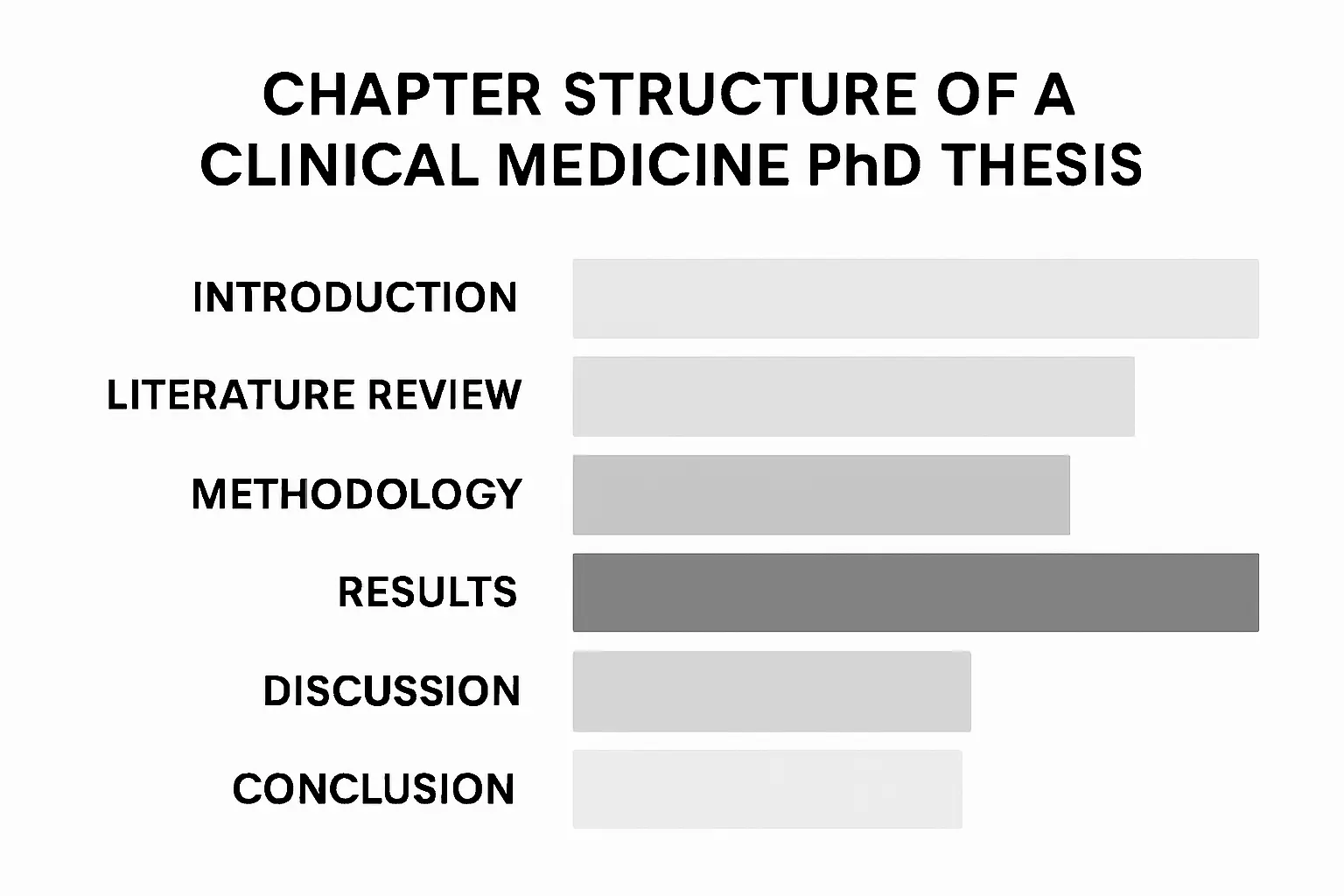
A clinical medicine PhD or MD(Res) thesis is built from the same broad chapter set as any UK science doctorate — introduction, literature review, methodology, results, discussion, conclusion — but two things make it distinct: a governance trail (HRA approval, and MHRA authorisation as well when the study is a clinical trial of an investigational medicinal product) that has to be evidenced chapter by chapter, and a results chapter written to reporting conventions borrowed from clinical journals rather than general social-science norms. Below is an annotated, chapter-by-chapter model with an illustrative worked passage for each part. Nothing here is a real study: every finding, patient number and result is invented and labelled as such, built only to show the shape and register a clinical thesis has to hit.
What has to be different about the title and abstract of a clinical thesis?
The title names the clinical population, the intervention or exposure, and the outcome — rarely the statistical method. A worked example: “Early Mobilisation After Elective Hip Arthroplasty and Length of Inpatient Stay: A Prospective Cohort Study.” The structured abstract that follows almost always uses the IMRaD headings clinical journals use — background, methods, results, conclusions — inside a strict word limit set by the candidate’s own institution. A worked opening line, illustrative only: “Background: delayed mobilisation after elective hip arthroplasty is associated with longer inpatient stay in observational data, but the effect of a structured early-mobilisation protocol has not been tested in this patient group at [named trust].” An examiner locates the whole thesis from this paragraph before reading a word of chapter one, so vague or unquantified language here costs credibility early.
What must the introduction chapter establish?
The introduction chapter states the clinical burden, what is already known, the specific gap, and the contribution the thesis will make to closing it — in that order. A worked passage, illustrative: “Length of inpatient stay after hip arthroplasty remains a key driver of bed-day cost and readmission risk (see Chapter 2), yet no randomised evidence exists on structured early mobilisation in a UK NHS population with this case-mix. This thesis addresses that gap through a two-arm cohort comparison and an embedded qualitative process evaluation.” That final sentence is the contribution statement in miniature, and examiners hold a candidate to exactly that claim for the rest of the viva — it has to be a claim the study design can actually support.
How is the literature review organised in a clinical thesis?
A clinical literature review is organised by clinical question or by mechanism, not paper by paper, and it typically separates the observational evidence base from any existing trial evidence, closing on the precise gap. Where a systematic component exists, PRISMA reporting conventions govern the search and screening record, in the same way this site’s own PRISMA systematic review chapter guide sets out for public health dissertations. A worked closing sentence, illustrative: “What the existing observational literature cannot establish is a causal effect of mobilisation timing independent of case-mix and surgeon — the question this thesis’s prospective design is built to answer.”
What does the methodology chapter have to evidence that a non-clinical thesis does not?
A clinical methodology chapter is read by a methodologist checking the design and by a clinician checking the governance route is genuinely in place. It needs the design (cohort, trial, case-control, mixed-methods), the eligibility criteria, the sample-size and power calculation with its stated assumptions, the outcome definitions, HRA Research Ethics Committee approval, NHS Research and Development sign-off at each participating site, and — for any trial of a medicine or device meeting the legal definition of a clinical investigation — MHRA authorisation alongside REC approval, not instead of it. A worked passage, illustrative: “Consecutive eligible patients undergoing elective hip arthroplasty at [named trust] were recruited between [invented dates], with informed consent taken by a delegated member of the clinical team. Ethical approval was granted by an NHS Research Ethics Committee (REC reference [invented]), with local Research and Development approval confirmed at each site before recruitment began.” Where a thesis includes retrospective analysis of routinely collected data instead, the equivalent governance trail runs through the data controller’s own approval process rather than a REC, and the chapter needs to say plainly which route applied to which part of the study.
How are the results reported, and how does this differ from a social-science findings chapter?
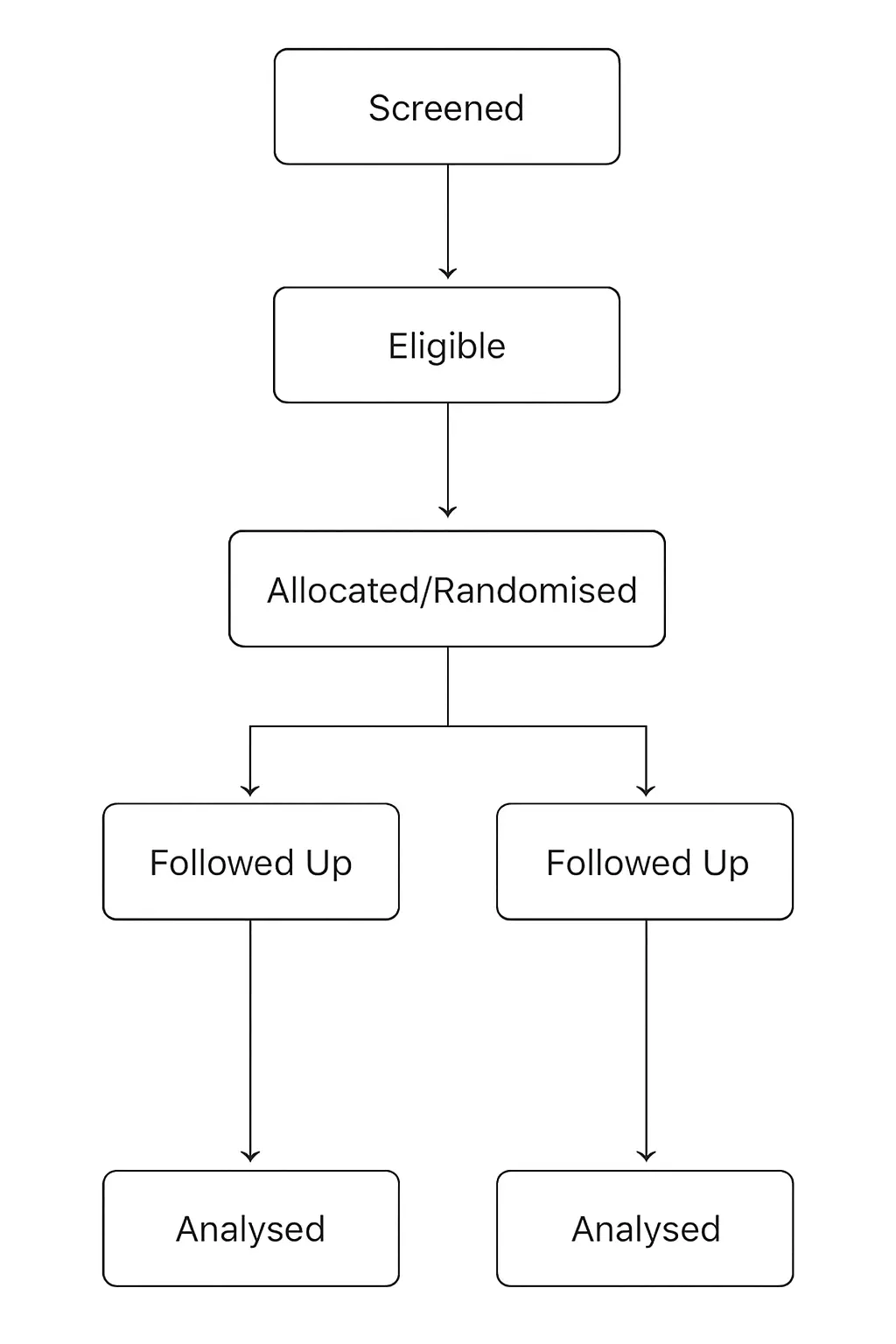
A clinical results chapter runs hypothesis by hypothesis or outcome by outcome, in the order set out in the methodology, and reports effect sizes with confidence intervals rather than p-values alone — the same convention this site’s engineering and political-science statistics pieces model for their own fields. Where the design is a trial, a CONSORT-style participant flow diagram (screened, eligible, randomised or allocated, followed up, analysed) is close to mandatory rather than optional. A worked line, illustrative: “Median length of stay was 3.1 days (IQR 2.4–4.0) in the early-mobilisation group compared with 4.6 days (IQR 3.5–5.8) in the standard-care group (invented figures, illustrative only), a difference that remained after adjustment for age, ASA grade and surgeon in the pre-specified regression model.”
What does the discussion chapter need to do that the results chapter has not already said?
The discussion interprets the findings against the literature reviewed in chapter two, states plainly what is genuinely new, and addresses limitations as bounded methodological claims rather than as an apology. Limitations common to a single-centre or few-centre clinical thesis include generalisability beyond the case-mix and surgical technique studied, the practical limits of blinding in a mobilisation intervention, and loss to follow-up. A worked line, illustrative: “The reduction in length of stay observed here is consistent with the direction of effect in existing observational cohorts, but this is the first prospective UK evidence to adjust for surgeon as a fixed effect, addressing a confounder the existing literature has not controlled for.”
How is the contribution to knowledge stated in a clinical thesis?
UK doctoral regulations require an original contribution to knowledge, and a clinical examiner will still ask the candidate to state it in one testable sentence at the viva. A worked contribution statement, illustrative: “This thesis contributes the first prospective, surgeon-adjusted evidence on early mobilisation timing after elective hip arthroplasty in a UK NHS population, with a defined clinical pathway that a participating trust could adopt directly.” The conclusion chapter also has to state the clinical and service implications precisely, and a short, honest set of recommendations for further trial evidence rather than a list of everything left undone.
How does an MD(Res) thesis differ structurally from a PhD in the same field?
An MD(Res) is typically shorter (commonly around 40,000–50,000 words against a PhD’s 80,000-word ceiling, set by the candidate’s own institution’s presentation-of-theses regulations — check your own code of practice rather than assume a network-wide figure) and is usually built around a single, tightly scoped clinical study rather than the three or four linked studies a clinical PhD often contains. Both award types carry the same governance and reporting expectations described above; the difference is scope and depth, not rigour. Candidates on the MD(Res) route are frequently clinicians completing the degree alongside ongoing clinical duties or a training rotation, which shapes the timeline in ways a full-time PhD candidate does not face — recruitment windows have to be planned around on-call commitments, and the single-study design exists partly because a shorter, protected research period is what most funding and study-leave arrangements actually provide. A candidate weighing the two routes is better served by this site’s dedicated comparison of a professional doctorate against a PhD than by assuming MD(Res) automatically means a shorter viva.
Using this model as a diagnostic checklist
The value of a chapter-by-chapter model like this is diagnostic: read a draft chapter against the question it is supposed to answer, and where it cannot answer that question in one or two sentences, that is the paragraph that needs rewriting before a supervisor sees it. Building the timeline that fits ethics-approval lead time around this chapter structure is its own separate step, covered in this site’s clinical medicine thesis timeline guide. Tools that read a full-length manuscript for structural gaps — Tesify’s thesis planning and editing workflow among them — are built for exactly this kind of section-by-section check at 80,000-word scale, where a candidate rereading their own results chapter for the twentieth time stops being able to see what is actually missing.
The annotated model at a glance
| Chapter | What it must establish | Governance/reporting convention | Failure examiners name most often |
|---|---|---|---|
| Introduction | Clinical burden, gap, contribution statement | — | Contribution too broad to test at viva |
| Literature review | Synthesis of observational and trial evidence, explicit gap | PRISMA where a systematic component exists | Summary of papers instead of synthesis |
| Methodology | Design, sample size/power, eligibility, governance route | HRA REC; MHRA where applicable; local R&D sign-off | Governance trail incomplete or undated |
| Results | Outcome-by-outcome, effect sizes with confidence intervals | CONSORT-style flow diagram for trials | p-values reported without effect size or CI |
| Discussion | Interpretation against literature, honest limitations | — | Limitations minimised or generic |
| Conclusion | One-sentence contribution, clinical implications | — | No single testable contribution sentence |
Frequently asked questions
Is this a real clinical medicine thesis I can copy from?
No. Every finding, patient number and result here is invented for illustration. Read two or three completed theses in your own sub-specialty through your own institution’s repository before drafting your own chapter plan.
Does every clinical thesis need MHRA authorisation as well as HRA approval?
No — MHRA authorisation applies specifically to clinical investigations of a medicine or device meeting the legal definition of a clinical trial or investigation. An observational cohort study, a retrospective data analysis or most qualitative process evaluations need HRA/REC approval and local R&D sign-off, not MHRA authorisation.
How long does a clinical medicine PhD thesis actually run?
Most UK clinical PhDs sit in a similar band to other science doctorates, commonly 60,000–80,000 words of main text, set by the candidate’s own institution’s presentation-of-theses regulations — check your own code of practice rather than assume a network-wide figure.
Can a clinical thesis include a qualitative process evaluation alongside the quantitative results?
Yes, and it is increasingly common — a mixed-methods clinical thesis typically reports the quantitative outcome chapter and the qualitative process-evaluation chapter separately, then brings them together explicitly in the discussion rather than merging the reporting conventions of each.
What is the single most common reason a clinical thesis structure is challenged at viva?
A contribution to knowledge stated too broadly to test clinically — a specific, bounded claim about what changed, in which patient group, and what a service could do differently is what an examiner can actually interrogate.
Does the results chapter need a CONSORT diagram if the study is not a randomised trial?
Not the trial-specific CONSORT diagram, but an equivalent participant flow diagram — screened, eligible, recruited, followed up, analysed — is expected for almost any prospective clinical design, not only randomised trials.
How is an MD(Res) thesis examined differently from a PhD in the same clinical area?
The examination format (internal and external examiner, viva voce) is the same; the difference is scope — an MD(Res) is usually built around one tightly defined study rather than several linked studies, and the word limit is correspondingly shorter at most institutions.
Should the discussion chapter restate the results before interpreting them?
No — a short signpost back to the relevant result is enough. Re-reporting results at length before interpreting them is one of the most common self-corrections candidates make between a draft and the final submission.
Who typically supervises a clinical medicine PhD, and does that affect the chapter structure?
A clinical thesis usually has a supervisory team combining a clinical academic and a methodologist (a statistician or a qualitative-methods specialist for a mixed-methods design) — the split matters less for chapter structure than for who reviews which chapter first, since the methodologist is usually the better first reader for the methods and results chapters and the clinical academic for the introduction, discussion and clinical implications.