
At Edinburgh a PhD thesis may not exceed 100,000 words, and the examiners choose from ten possible recommendations, from outright award to fail. The current thesis guidance, effective 1 August 2026, also lists a lay summary and, where relevant, a declaration of any generative AI use in composing the thesis. Check each rule against your own programme.
Which Edinburgh documents decide what your thesis must do?
Three University documents between them answer most questions, and each is dated, so quote the edition you are working under.
- Postgraduate Assessment Regulations for Research Degrees. Governs examiners, the viva, the examiners’ recommendations and deadlines. The edition read for this guide is the Academic Year 2025/26 document (approved 22 May 2025), together with the University’s published list of key changes for 2026/27.
- Postgraduate Research Thesis Guidance. Governs format, front matter, the lay summary and publications in the thesis. The edition read is dated 22 January 2026 and is effective from 1 August 2026.
- Postgraduate Degree Programme Regulations 2026/27. Governs the degree itself, including the word limits. The edition read is the 2026/27 Degree Regulations and Programmes of Study document (regulations 48 to 51 for the PhD and MPhil); the University Court’s draft resolution of 15 June 2026 sets out the same figures. Check the edition for the year in which you submit.
The assessment regulations also say that the word-count specifications themselves live in the Degree Regulations and Programmes of Study, which is why the limit below comes from the programme regulations, not the assessment ones. Some doctoral programmes add their own entrance, curriculum and examination requirements, and the regulations say you must complete all of them to be awarded the degree, so read your programme handbook as well.
What is the word limit and what does it count?
| Degree | Maximum | What is counted | What is not counted |
|---|---|---|---|
| PhD by Research | 100,000 words; no minimum | Main text, preface material, footnotes and references | Appendices, bibliography, image captions, abstract, lay summary |
| MPhil by Research | 60,000 words; no minimum | As in the programme regulations for the degree | As in the programme regulations for the degree |
| PhD by Research Publications | Total submission, including the critical review, should not exceed 100,000 words; critical review between 10,000 and 25,000 words | Portfolio plus critical review | See the regulations for the degree |
In the PhD regulation, the College may grant permission to exceed the stated length in exceptional circumstances, on the recommendation of the supervisor, where the extension is needed for adequate treatment of the topic. The table above quotes the regulation’s own list, which names both references and the bibliography; where those two terms look inconsistent in practice, ask your Graduate School how it counts a reference list. A word limit is a ceiling, not a target: the regulations state there is no minimum, and what the examiners assess is whether the thesis meets the criteria for the degree.
What does the thesis guidance require in format and front matter?
The guidance sets out standards for how the thesis is presented. The points most researchers need are these.
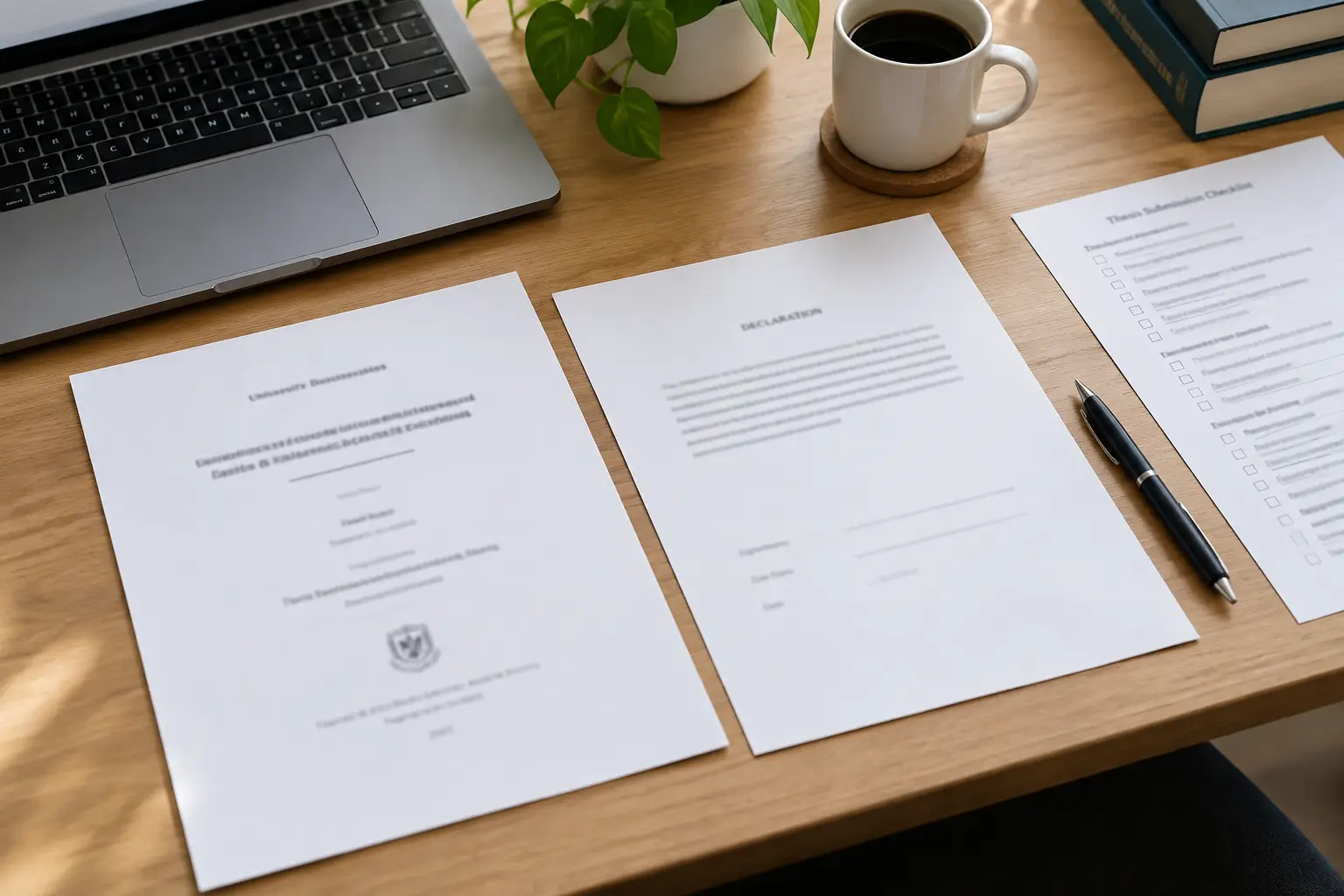
- Declaration. Every student incorporates a declaration at the front of the thesis submitted for assessment. It states that the thesis has been composed by the student; that the work is the student’s own, or that the student made a substantial contribution with that contribution clearly indicated if they were in a research group; that it has not been submitted for any other degree or professional qualification except as specified; that any included publications are the student’s own work except where indicated; and, where relevant, any use of generative AI in the composition of the thesis. The guidance includes exemplar declarations for use, and a declaration is not required in the final version.
- Typeface. Where there is a choice of character style, a sans serif font such as Helvetica or Arial should be used for the main text, at 12 points. Hyphenation at line ends should be avoided if possible.
- Title page. The title of the thesis and the author’s name, and at the foot of the page the name of the degree, the University of Edinburgh and the year of presentation. For a resubmitted thesis, the year of presentation is the year of resubmission.
- Abstract and lay summary. Both go after the title page. The lay summary must be incorporated at the beginning of the submitted thesis, written in simple, non-technical terms for a lay audience, and it is not included in the word count. It is supplementary to the abstract.
- Contents. A full table of contents follows the abstract and includes a list of tables, photographs and other materials. Every separate section, such as the bibliography or list of abbreviations, should be identified on the contents page.
- Images and third-party material. Images should be good quality and high resolution; use of third-party material must be fair, limited to what is necessary and correctly attributed; and the guidance recommends alternative text for images for accessibility.
- Submission. The thesis is submitted electronically, and the final version after examination is also submitted electronically.
What does the generative AI line in the declaration mean for you?
The thesis guidance lists the declaration of any use of generative AI in the composition of the thesis, where relevant, among the matters the declaration states, and it points to the University’s separate Generative AI Guidelines for Postgraduate Research Students. Those guidelines, revised in March 2026, say that the University does not ban the use of generative AI in your research, though its use is restricted for work assessed by the University, and that some programmes and disciplines may restrict it further, so you should always check with your supervisors. The practical points are to read the guidelines in full before you use any tool on thesis text, to keep a note of what you used and for what, to check your funder’s conditions, and to ask your supervisor what your programme expects the declaration to say.
This is also where a research integrity question you will be asked in the viva begins. If you use any writing support, you need to be able to say precisely which words, analysis and arguments are yours. A related question about putting unpublished research into online tools is set out in whether it is safe to put unpublished thesis data into an AI tool.
Can you include published papers in the thesis?
Yes, but the guidance is specific. There is no requirement for publications to be included in a PhD thesis, and a thesis that includes them must still form a coherent body of interrelated work. Included publications should effectively form a chapter with introductory and concluding text that places the publication within the structure of the thesis. Published journal articles are not expected to be subject to correction, though corrections can be dealt with in the introduction or conclusion of the chapter. Text from unpublished or proof articles is expected to match the format of the thesis body. The whole body of work must be equivalent to a monograph thesis in length, students may not include articles for which they do not retain copyright without permission, and jointly authored publications need permission and a clear statement of the student’s contribution. The separate PhD by Research Publications route has its own regulations, and the wider UK picture is covered in what a thesis by publication is, institution by institution.

Who examines the thesis and what happens in the viva?
Each student is assessed by at least one external examiner and one internal examiner. A second external examiner may be appointed in particular cases such as an interdisciplinary topic, and where the student is or has been a member of University staff during the degree there must be two external examiners and one internal examiner. A person who is or has been a supervisor of the student at any time cannot be the internal examiner, and a person who has held an appointment on the teaching or research staff, or been a student or honorary member of the University, is not eligible as an external examiner until four years have elapsed, with a waiver possible in exceptional circumstances. The College must appoint a non-examining chair if the internal examiner is acting for the first time or is honorary staff; the chair ensures due process and must not express an opinion on the merits of the thesis.
The Head of School consults the supervisors before nominating examiners, and supervisors tell the student the names of possible examiners. Students must say if problems are likely with a particular examiner, but they have no right to determine the recommendation and no right to veto an appointment. How examiner appointment works across UK institutions is described in who examines a PhD thesis in the UK.
The expectation is that the oral examination is held within three months of submission, and the 2026/27 key changes add that College approval is required where it will be held more than three months after submission. The examiners use the oral to establish knowledge of the field, the extent of any collaboration and that the work is the student’s own, and they assess jointly whether the thesis and the defence of it satisfy the requirements for the award. Supervisors may attend with the consent of the student and examiners but do not take part in the discussion, and the examiners may indicate their recommendation at the end while stressing that it is not final until the written report goes to the College.
What are the ten possible outcomes?
| Recommendation | What it means | Time or condition stated |
|---|---|---|
| (a) Award PhD | Meets the requirements; no further changes can be made | None |
| (b) Minor corrections | Editorial corrections or stated minor weaknesses, without further original research | Within three months; certification by the internal examiner(s), and by the external if requested |
| (c) Additional oral examination | Thesis acceptable but the oral defence inadequate in specified respects; further assessment and any corrections | Not more than four months |
| (d) Additional work, no re-oral | Work beyond minor corrections, resubmission for PhD | Set by the examiners, not exceeding six months; exceptionally up to 12 months with College permission |
| (e) Substantial work and re-oral | Substantially inadequate; resubmit for oral examination in revised form | Not exceeding 12 months; exceptionally up to 24 months with College permission |
| (f) Award MPhil | Cannot be revised to doctoral standard but meets MPhil | None stated |
| (g) Award MPhil after minor corrections | As (f), with stated minor corrections | Within three months |
| (h) MPhil resubmission | Substantial work needed to meet MPhil standard | Not exceeding 12 months |
| (i) Award MSc by Research | Not revisable to MPhil but merits the MSc by Research | None stated |
| (j) Fail | Substantially deficient and not revisable to any research degree standard | College provides a written explanation |
Four rules sit around the list. Students cannot resubmit the thesis more than once under (d), (e) or (h). If a student receives (b), (c), (d), (e), (g) or (h) and does not meet the requirements by the deadline, the result is a fail. The College Office provides a written statement of the revisions to be made, and the supervisor must confirm with the student their understanding of them. And the key changes for 2026/27 add that a student who does not submit the final electronic thesis within one month of approval of corrections or recommendation of award will be excluded from study with no award issued, with the College able to allow an extension in exceptional circumstances. Plan your corrections timetable with that final deadline in view; the practical work is described in how to complete your PhD corrections and write the response letter and, for the resubmission routes, in how to rebuild your thesis for a resubmission.
How does Edinburgh compare with other universities?
Rules differ, and the differences matter when a supervisor or a friend at another university gives you advice. For a comparison, Warwick’s own regulations set different word limits by degree and a different set of recommendations. Always check your own university’s documents, and treat any summary, including this one, as a pointer to the primary source, not a replacement for it.
Frequently asked questions
What is the word limit for a PhD thesis at the University of Edinburgh?
The Postgraduate Degree Programme Regulations for 2026/27 set a maximum of 100,000 words for a PhD thesis, with no minimum. The count includes main text, preface material, footnotes and references and excludes appendices, bibliography, image captions, the abstract and the lay summary. The College may permit a longer thesis in exceptional circumstances on the supervisor’s recommendation.
Is there a different limit for an MPhil?
The same regulations set a maximum of 60,000 words for the MPhil by Research.
Do I need a lay summary?
Yes. The Postgraduate Research Thesis Guidance requires a lay summary at the beginning of the submitted thesis, written in simple, non-technical terms, and it is not included in the word count.
Who examines an Edinburgh PhD thesis?
Each student is assessed by at least one external examiner and one internal examiner. A person who has supervised the student cannot be their internal examiner, and a non-examining chair must be appointed if the internal examiner is acting for the first time or is honorary staff.
Can I choose or veto my examiners?
No. The regulations say students have no right to determine the Head of School’s recommendation and no right to veto any particular appointment, although comments are taken into account and objections can be made to the College committee in good time.
How soon after submission is the viva?
The expectation is that the oral examination is held within three months of submission. The 2026/27 key changes add that College approval is needed where it will be held later than that.
How many outcomes can examiners recommend for a PhD?
Regulation 22 lists ten recommendations, from (a) award PhD through minor corrections, an additional oral, resubmission routes, MPhil and MSc by Research awards, to (j) fail.
How long do I have for minor corrections?
Three months, with the corrections subject to certification by the internal examiner or examiners and by the external examiner where the examiner so requests.
Can I resubmit more than once?
No. The regulations state that students cannot resubmit the thesis more than once under the resubmission recommendations, and failing to meet the examiners’ requirements by the deadline results in a fail.
Do I have to declare the use of generative AI in my thesis?
The Postgraduate Research Thesis Guidance, effective 1 August 2026, lists among the declaration contents, where relevant, any use of generative AI in the composition of the thesis. Read the University’s generative AI guidelines for postgraduate research students and check with your supervisor and programme.
Writing up to a word limit and a deadline
A 100,000-word ceiling, a front-matter checklist and a corrections clock all land on the same months of your candidature. Tesify is used by 9,000+ students across 15,000+ chapters to organise a thesis chapter by chapter, and the thesis stays 100% written by you. That includes the declaration: what you write, what you decide and what you disclose remain your own responsibility under your university’s rules.