
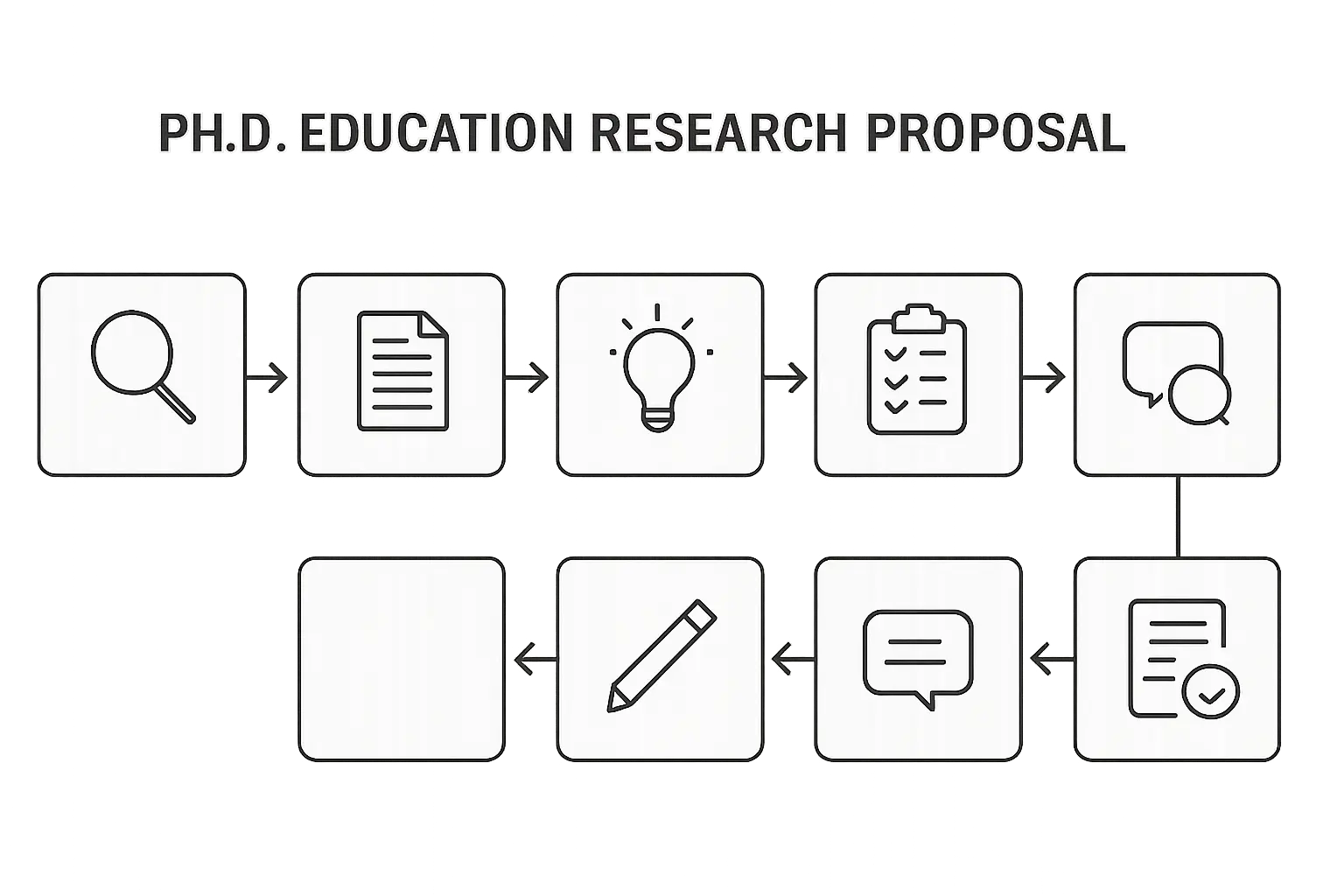
An education PhD or EdD research proposal is built in a fixed order — problem and significance, literature-derived conceptual framing, research questions, design and method, ethics and access, then a realistic timeline — and the single most common reason a proposal is rejected or sent back for revision is a design that promises access to schools or settings the candidate has not actually secured. Below is a step-by-step method with a worked, illustrative example at every stage, building on the general UK studentship proposal structure with what changes specifically for education fieldwork. The example is invented for illustration; it is not a real submitted proposal.
Step 1: State the problem and why it matters now
The opening section has to state a genuine problem in educational practice or policy, not a general area of interest — “assessment” is not a problem; “the widening attainment gap in GCSE outcomes between pupils eligible for free school meals and their peers, and the limited evidence on which formative assessment interventions narrow it in secondary mathematics” is. A worked opening, illustrative: “Formative assessment is widely promoted as a means of narrowing socioeconomic attainment gaps in secondary mathematics, yet the evidence base for which specific formative practices work for disadvantaged pupils, rather than for pupils generally, remains thin (see Section 2). This proposal sets out a mixed-methods study of formative assessment practice in three secondary schools to address that gap.” Panels and funders read this paragraph to decide whether the problem is real, current and researchable within a doctoral timeframe — vague framing here is the most common reason a proposal is returned before the rest is even read.
Step 2: Build the conceptual framing from the literature, not around it
The literature section of a proposal is shorter than the eventual theoretical framework chapter but does the same job in miniature: it names the theoretical lens the study will use (Black and Wiliam’s formative assessment framework, sociocultural theory, or a specific model of self-regulated learning, for instance), states what is already established, and states precisely what is not. A worked line, illustrative: “Black and Wiliam’s (1998) five strategies for formative assessment are well evidenced for attainment overall, but their differential effect for pupils eligible for free school meals has not been isolated in UK secondary mathematics classrooms specifically — the gap this study addresses.” A proposal that reviews literature broadly without narrowing to this kind of specific, stated gap reads as unfocused to a review panel.
Step 3: Write research questions the design can actually answer
Each research question has to map onto a specific part of the design — a proposal with more questions than the timeline can realistically answer is one of the fastest ways to signal scope creep. A worked set, illustrative: “RQ1: Which formative assessment practices do mathematics teachers in the three case-study schools report using with disadvantaged pupils? RQ2: How do disadvantaged pupils experience these practices, compared with their peers? RQ3: What relationship, if any, exists between the intensity of formative assessment practice observed and attainment progress over two terms?” RQ1 maps to teacher interviews, RQ2 to pupil focus groups, RQ3 to lesson observation plus attainment data — each question has a named method behind it before the methodology section is even written.
Step 4: Justify the design and method
Education doctorates draw on a wider range of designs than most fields — case study, action research, design-based research, ethnography and mixed-methods survey designs are all common, and the proposal has to justify the specific choice against the research questions rather than defaulting to whichever method the candidate already knows. A worked passage, illustrative: “A multiple case-study design (three schools, purposively sampled for contrasting free-school-meal proportions) combines semi-structured teacher interviews, pupil focus groups and lesson observation using a structured protocol, triangulated with anonymised attainment data provided by each school.” Where the study is action research rather than case study, the proposal instead has to specify the change cycle (plan, act, observe, reflect) and who owns the “action” — the candidate as an insider-researcher, or the participating teachers as co-researchers, since the ethics and consent implications differ sharply between the two.
Step 5: Address ethics, access and gatekeepers before the panel asks
Education research involving schools has two gatekeeping layers most other fields do not: the university’s own research ethics committee, and the school’s own gatekeeper (headteacher or governing body) who has to consent separately, on top of any individual participant or parental consent required for pupils. BERA’s fifth-edition Ethical Guidelines for Educational Research (2024) is the standard UK reference for this: it requires gatekeeper consent as a distinct, documented step from participant consent, and sets out specific requirements for informed assent from children in addition to parental consent, rather than treating parental consent alone as sufficient. A worked passage, illustrative: “Written gatekeeper consent will be sought from each headteacher prior to any fieldwork; pupil participants will provide informed assent in addition to parental consent, following BERA’s (2024) guidelines on research involving children.” A proposal that names schools without evidence that access has genuinely been discussed with a gatekeeper is a common reason a panel asks for revision rather than approving outright.
Step 6: Build a timeline that survives contact with the school calendar
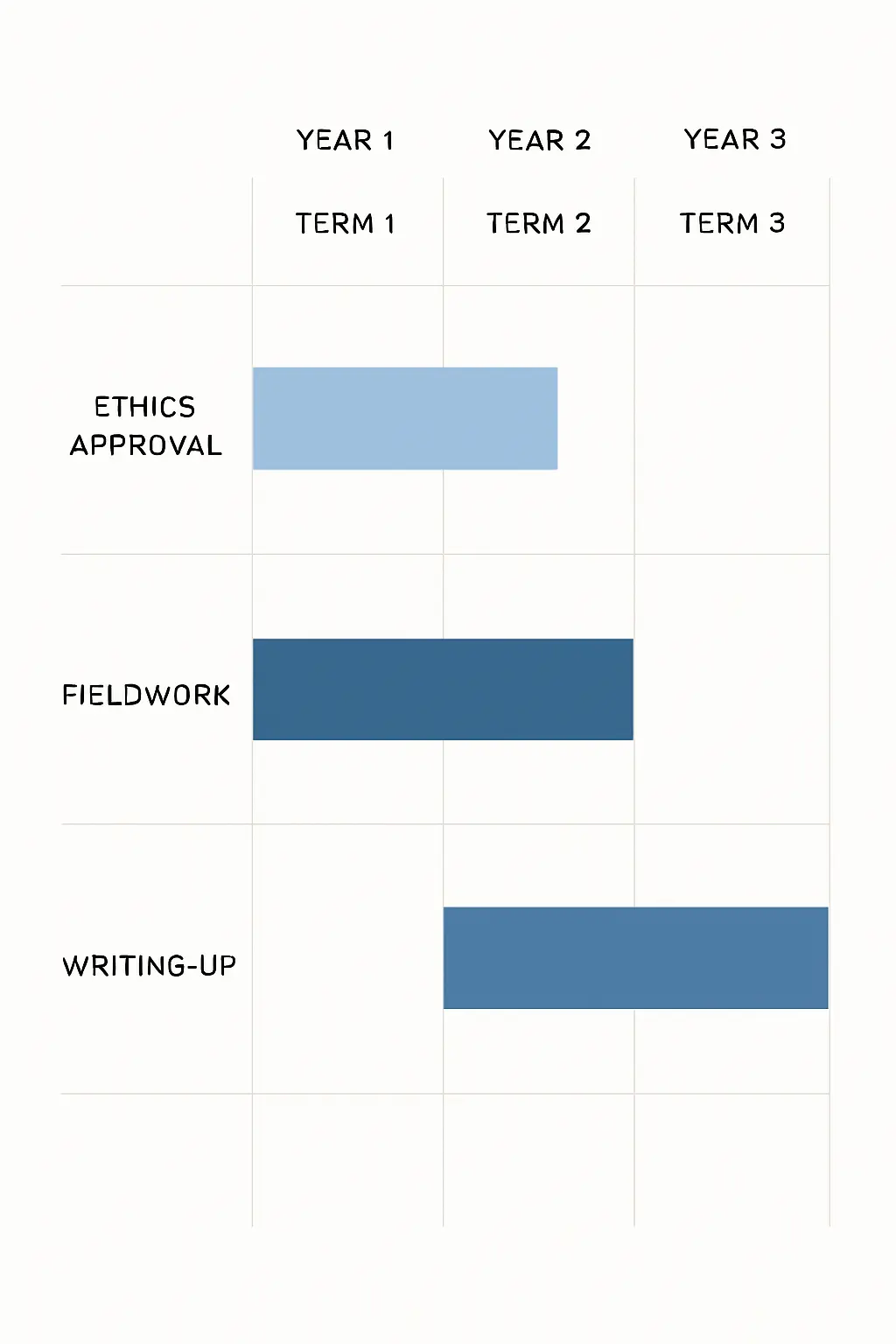
An education fieldwork timeline has to work around the academic year, not against it — data collection inside a school is realistically confined to term time, excluding exam periods, and ethics approval has its own lead time before any fieldwork can start. A worked timeline, illustrative and invented: Year 1, terms 1–2: literature review and ethics application; Year 1, term 3: pilot interviews at one school; Year 2, terms 1–3: main fieldwork across three schools, avoiding the exam-heavy final half of the summer term; Year 3, terms 1–2: analysis and writing up findings and discussion chapters; Year 3, term 3: final write-up and submission. A proposal that schedules fieldwork across a summer holiday, or assumes ethics approval and gatekeeper consent can run in parallel with the first week of fieldwork, is a design a panel will flag immediately.
Step 7: State the expected contribution and significance
The closing section states, in one or two sentences, what the study will add that is not already known, and to whom it matters — practitioners, policy, or the theoretical literature, ideally more than one. A worked contribution statement, illustrative: “This study will contribute the first UK case-study evidence on how formative assessment practice differs, and is experienced differently, for disadvantaged secondary mathematics pupils specifically — with direct implications for departmental CPD design.” This is the sentence the candidate will be held to at the eventual interview and focus-group stage and, years later, in the viva — write it as a claim the design can actually support, not an aspiration.
What do panels most often send back for revision?
Beyond the failures named at each step above, three patterns account for most revision requests education review panels raise. A design that treats the researcher’s own workplace as the case-study site without addressing insider-researcher bias explicitly — dual-role conflicts (teacher-researcher, or manager-researcher in an EdD context) need a stated mitigation, not a silent assumption that professional familiarity is purely an advantage. A sampling rationale that says “convenience sample” without justifying why that specific school or teacher group is analytically appropriate, rather than simply accessible. And a literature section that cites only UK sources on an international topic, or only pre-2015 sources on a fast-moving policy area such as generative AI in classrooms — panels increasingly expect at least some literature published within the last three to five years to show the proposal is current.
The proposal at a glance
| Section | What it must establish | Common failure |
|---|---|---|
| Problem and significance | A specific, current, researchable problem | Too broad — an area of interest, not a problem |
| Conceptual framing | Named theoretical lens, stated gap | Literature summarised, not synthesised into a gap |
| Research questions | Each question maps to a named method | More questions than the timeline can answer |
| Design and method | Justified against the questions, not habit | Method chosen before questions are finalised |
| Ethics and access | Gatekeeper and participant consent both evidenced | Schools named without confirmed gatekeeper access |
| Timeline | Realistic against the academic year and ethics lead time | Fieldwork scheduled in holidays or exam periods |
| Contribution | One testable sentence, named audience | Aspirational claim the design cannot support |
Using the worked example as a template, not a script
Every worked passage above is illustrative and invented — the value is in the shape and the order, not the specific topic. A proposal that follows this sequence but substitutes a genuinely different problem, theoretical lens and design will read as considered rather than formulaic. Tools that check a proposal draft section by section against exactly this kind of structural expectation — Tesify’s proposal and thesis workspace among them — are built for the stage before a supervisor sees the first full draft, catching a missing gatekeeper-consent sentence or an unmapped research question before it costs a review cycle.
Frequently asked questions
How long should an education PhD research proposal be?
Most UK institutions and funders ask for 1,500–3,000 words at the application stage, with a fuller version (commonly 5,000–8,000 words) expected at upgrade or confirmation of registration — check your own institution’s or funder’s stated limit rather than assume a network-wide figure.
Do I need to have already secured a school’s agreement before submitting the proposal?
Not usually at the initial application stage, but a panel will expect evidence that access is realistic — naming a school where the candidate has an existing professional relationship, or describing a credible recruitment strategy, rather than simply asserting access will be arranged later.
Is action research treated differently from case study in an ethics application?
Yes — action research typically involves participants as co-researchers with a stake in the intervention being studied, which raises distinct consent and role-conflict questions an ethics committee will probe, especially where the candidate is also the participants’ colleague or manager.
What does BERA’s fifth edition actually require for research involving children?
It requires informed assent from the child in addition to, not instead of, parental or carer consent, and sets out gatekeeper responsibilities distinct from parental consent — the guidelines do not themselves mandate a DBS check, which is instead a matter for the individual school or institution’s own safeguarding policy.
Can the timeline change significantly between the proposal and the confirmation-of-registration review?
Yes, and it commonly does — the proposal timeline is a planning document, not a binding contract, and most supervisory teams expect it to be revised once ethics approval timelines and school access become concrete.
Does an EdD proposal differ from a PhD proposal in education?
The core structure is the same, but an EdD proposal typically has to justify the practice-based or professional relevance of the problem more explicitly, since the degree is examined partly on its contribution to professional practice as well as to the academic literature.
Should the proposal include a budget section?
Only where the funder or institution asks for one — a UKRI or ESRC studentship application typically expects a budget line for transcription, travel to schools and any participant incentives, while an internally funded proposal often does not require this level of detail.
How should an insider-researcher proposal address the risk of bias?
By naming the dual role explicitly in the methodology section and stating concrete mitigations — such as using an external second coder for a sample of the data, or building reflexivity memos into the analysis process — rather than leaving the panel to infer that familiarity with the setting is purely a methodological asset.