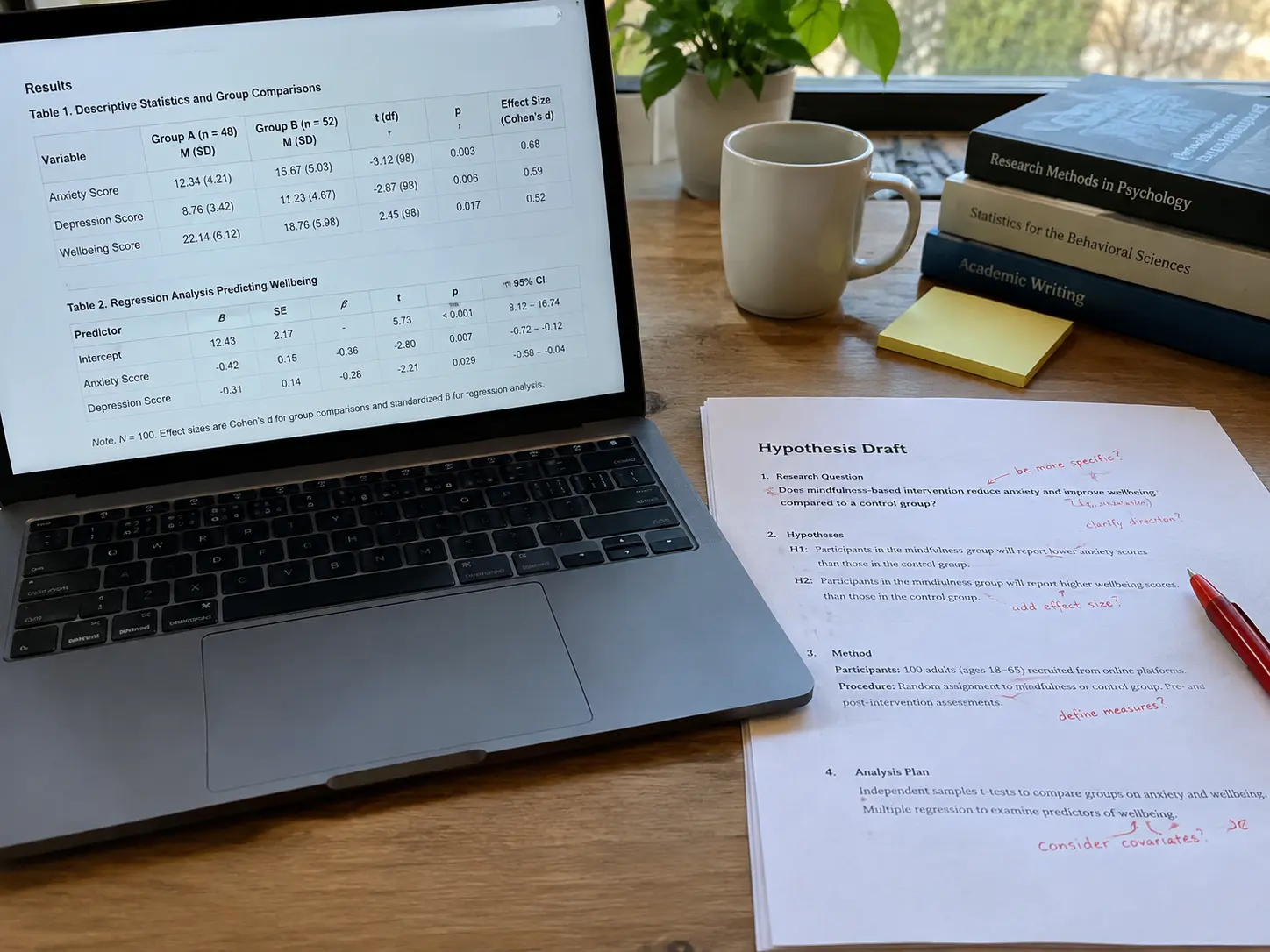
Psychology examiners have their own recurring list of objections, and most of them are methodological rather than about the writing itself: hypotheses that quietly shifted after the results came in, statistical assumptions never checked, effect sizes missing, and instruments used without reporting how they actually performed in this specific sample. Every one is fixable before submission.
What does “sent back” actually mean at a psychology viva?
As Warwick’s own examination regulations show, UK examiners choose among several distinct recommendations, not a simple pass/fail split — award, minor corrections, major corrections, resubmission, a lower degree, and, rarely, no degree. The general rules on examiner appointment and report-writing are covered in who examines a PhD thesis in the UK. What follows is not that sector-wide picture; it is the specific, recurring methodological objections psychology examiners raise, and how to close each one before submission.
Objection 1: the hypotheses look suspiciously well-fitted to the results
HARKing — hypothesizing after the results are known — is the term Norbert Kerr defined in a 1998 paper in Personality and Social Psychology Review (volume 2, pages 196–217): presenting a post hoc hypothesis, one based on or informed by your results, as if it had been an a priori hypothesis. Examiners who have supervised enough psychology theses develop an eye for it: a hypothesis stated with unusually precise direction and magnitude, that happens to match the result exactly, with no trace of the messier a priori reasoning a genuine advance prediction usually shows. The fix is not to hide exploratory findings — it is to label them as exploratory explicitly, distinct from the pre-specified hypotheses, so the distinction between confirmatory and exploratory analysis is visible on the page rather than blurred. Kerr identified several forms of HARKing, and not all of them involve inventing a hypothesis from scratch. A version candidates can fall into innocently is tightening a hypothesis’s wording during the writing-up stage, after the results are in, without realising the tightened version now presents a post hoc prediction as an a priori one.
Objection 2: statistical assumptions were never checked, or checked but not reported
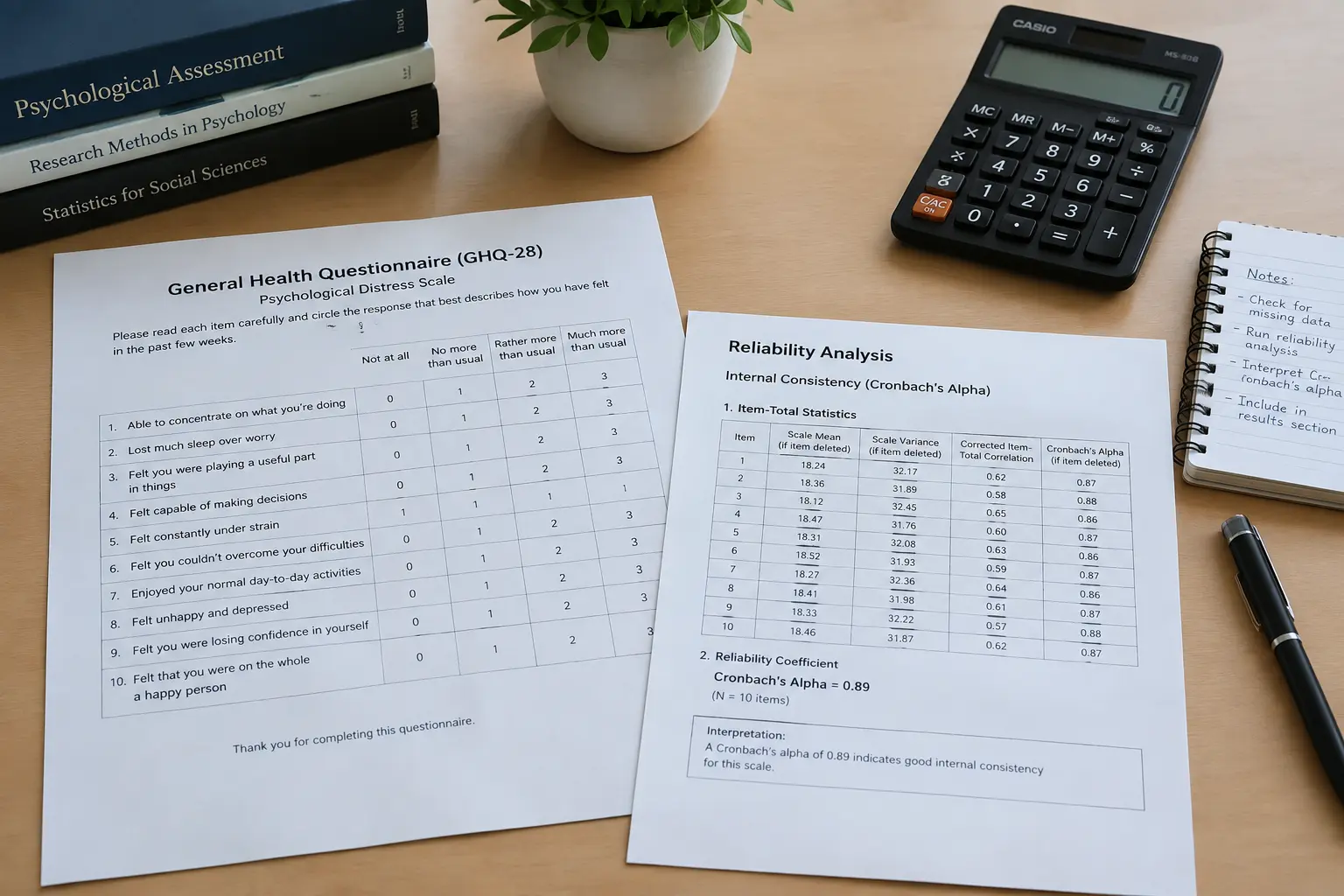
Running a parametric test without checking or reporting normality, homogeneity of variance, or the relevant assumption for that specific test is one of the fastest ways to draw a methodological query, even when the substantive result is not actually threatened by a minor violation. The examiner’s question is rarely “is this result wrong” — it is “did the candidate know to check.” A thesis that silently switches from a planned parametric test to a non-parametric alternative, without stating why, raises exactly that question by implication; stating the assumption check and the resulting choice explicitly removes the ambiguity entirely. A single sentence reporting the assumption check and its outcome, for every inferential test used, closes this gap far more cheaply than the query itself would cost in corrections time. Statistical software often reports the relevant assumption test alongside the main analysis; the gap is not usually a missing test, but a results chapter that quietly deletes that line rather than reporting it. Where a parametric test was run anyway despite a violated assumption, because the test is known to be reasonably robust to that specific violation at that sample size, say so explicitly rather than leaving the reader to wonder whether the violation was noticed at all.
Objection 3: p-values are reported without effect sizes or confidence intervals
Writing the results and discussion chapters of a psychology PhD to APA and JARS standards already covers this in depth: APA’s Journal Article Reporting Standards for quantitative research (Appelbaum and colleagues, American Psychologist, 2018) call for effect-size estimates and confidence intervals alongside significance tests, not a p-value standing alone. A result reported as “significant, p < .05” with no effect size tells an examiner nothing about whether the effect is practically meaningful, and examiners familiar with those standards notice the omission specifically. A worked, illustrative comparison (invented numbers) shows the gap: “the difference between groups was statistically significant (p = .03)” tells a reader almost nothing on its own; “the difference between groups was statistically significant, t(58) = 2.24, p = .03, d = 0.58, 95% CI [0.05, 1.11]” gives the same reader the test statistic, the effect size and its precision — everything needed to judge whether the effect is small, meaningful, or somewhere genuinely uncertain.
Objection 4: a validated instrument’s psychometrics are assumed, not reported for this sample
PHQ-9 vs GAD-7 vs DASS-21 vs WEMWBS: which validated instrument should your psychology PhD use? covers choosing the right instrument; a separate and equally common gap is reporting the instrument’s original published reliability (say, Cronbach’s alpha from the developer’s validation study) instead of calculating and reporting the alpha for your own sample. An instrument’s psychometric properties are not fixed across every population it is used with — a scale validated on one clinical group may behave differently in your own sample, and an examiner expects the sample-specific reliability figure to be reported, not borrowed from the original paper. Where the sample-specific reliability comes back notably lower than the instrument’s original published value, that is itself worth reporting and discussing rather than quietly omitting — a low alpha in your own data is a genuine finding about how the instrument performed in your population, and hiding it is a harder position to defend than reporting and interpreting it honestly.

Objection 5: multiple comparisons or multiple outcome measures are not addressed
Running many statistical tests across several outcome measures or subgroups, without any correction or explicit acknowledgement of the multiple-comparisons problem, inflates the chance of a false positive somewhere in the results table — and an examiner scanning a results chapter with a dozen uncorrected significance tests will ask about it directly. The fix does not always have to be a formal correction (Bonferroni or otherwise); sometimes the honest and defensible answer is to state explicitly that the analysis was exploratory and the multiple-comparisons risk is acknowledged as a limitation. What does not work is silence. A worked, illustrative case: a study measuring five outcome variables across three subgroups runs fifteen comparisons. If every null hypothesis were true and the tests were independent, a .05 threshold would produce 0.75 false positives on average, and the chance of at least one false positive would be about 54%. Naming that arithmetic explicitly in the limitations, rather than hoping the reader does not do the multiplication themselves, is the more defensible position in a viva.
Objection 6: the theoretical framework is asserted, not applied
A theory named in the introduction and never returned to in the discussion reads as decorative. Whichever framework a psychology thesis adopts — and developing a theory end-to-end, as this site’s management-thesis piece on Stakeholder Theory shows for a different field, is the same underlying discipline — needs to be visibly doing work: shaping the hypotheses, interpreted against in the discussion, not simply cited once in the opening chapter and left there. A quick self-check worth running on a finished draft: search the thesis for the theory’s name and see where each occurrence falls. If every mention clusters in the introduction and theoretical-framework section, with none in the discussion, that is itself the objection made visible — the theory has not actually been used to interpret anything.
Objection 7: qualitative rigour is claimed but not demonstrated
For a qualitative or mixed-methods psychology thesis, the same pattern that trips up other fields applies directly: naming a rigour framework or an analytic method without showing the specific technique that evidences it. If your design uses thematic analysis, member checking or an audit trail, each needs a concrete, checkable instance in the thesis, not just the vocabulary. What makes examiners send back a nursing PhD thesis covers this exact trap — naming a rigour framework without the evidence — in a different field, with a worked illustration of what “demonstrated” actually has to look like on the page. Reading it alongside this piece is a reasonable ten minutes spent, since the underlying objection is identical even though the surface vocabulary differs by discipline.
Frequently asked questions
Is it normal for a psychology thesis to need corrections?
Yes. Corrections are a routine outcome at UK vivas across every field, not a sign of a weak thesis.
What is HARKing, and why do examiners care about it?
Presenting a hypothesis formed after seeing the results as if it had been specified in advance, as defined by Kerr (1998). Examiners flag it because it blurs confirmatory and exploratory analysis, which affects how much weight a finding should carry.
Do I need to report effect sizes for every test?
APA’s Journal Article Reporting Standards call for effect-size estimates and confidence intervals alongside significance tests, so treat them as standard practice, not an optional extra.
Should I report the original published reliability of a validated instrument, or calculate my own?
Calculate and report the reliability (such as Cronbach’s alpha) for your own sample; an instrument’s psychometric properties can differ across populations, and examiners expect the sample-specific figure.
What should I do if I ran many statistical tests without correcting for multiple comparisons?
State the issue explicitly as a limitation and frame the relevant analyses as exploratory, rather than leaving the multiple-comparisons risk unaddressed.
Can I include exploratory findings that were not part of my original hypotheses?
Yes, but label them explicitly as exploratory and keep them visibly distinct from your pre-specified, confirmatory hypotheses.
Does a named theoretical framework need to appear in the discussion chapter too?
Yes — a theory that only appears once in the introduction and is never returned to in the discussion reads as decorative rather than genuinely applied.
Is checking statistical assumptions really worth a whole sentence per test?
Yes — it is the cheapest way to pre-empt a methodological query that otherwise costs far more time to resolve as a correction after the viva.
How many uncorrected comparisons is too many?
There is no fixed number, but the more comparisons run, the more explicitly the multiple-comparisons risk needs to be acknowledged; a handful of pre-specified confirmatory tests reads very differently from a dozen exploratory ones left unaddressed.
Does HARKing mean I can never report an unexpected finding?
No — unexpected findings are genuinely valuable, but they need to be presented as exploratory discoveries, not retrofitted into the introduction as if they had been predicted from the start.
What if I switched from a planned parametric test to a non-parametric one partway through analysis?
State why explicitly — the assumption that failed and the alternative chosen — rather than presenting the final choice silently as though it had always been the plan.
Should I pre-register my hypotheses to avoid these objections?
Pre-registration is not generally a formal requirement for a UK psychology PhD, but it directly addresses the HARKing objection by creating a timestamped record of what was predicted before the data were seen — worth considering if your design and timeline allow it.
What if my final sample size was smaller than originally planned?
State the planned and achieved sample sizes explicitly, and discuss what the shortfall means for the study’s power to detect the effects it was designed around, rather than presenting only the achieved figure as though it had always been the target.
Do I need to report both parametric and non-parametric results if I ran both as a check?
It is good practice to report both briefly where they were both run, particularly if they point to different conclusions; silently reporting only the result that came out significant, without mentioning the other test was run at all, is its own version of the objections covered above.
Catching these before the viva does
Every objection above is a specific, checkable gap — not a sign the underlying research is weak. Tesify is used by 9,000+ students across 15,000+ chapters to work through a results or methods chapter section by section, and the thesis stays 100% written by you.