
The WHO treats burn-out as an occupational phenomenon resulting from chronic workplace stress that has not been successfully managed, not as a medical condition, and your thesis must define it that way before it measures it. Context figures are easy to misuse: HSE counted 964,000 workers suffering work-related stress, depression or anxiety in 2024/25, which is a different construct from burnout.
| Fact | Source | Date | Use in a thesis |
|---|---|---|---|
| Burn-out is “a syndrome conceptualized as resulting from chronic workplace stress that has not been successfully managed”; it is not classified as a medical condition | World Health Organization, ICD-11 statement on burn-out | 2019 | The definition to adopt or argue against in the introduction |
| Three dimensions: energy depletion or exhaustion; increased mental distance from the job, or negativism or cynicism about it; reduced professional efficacy | World Health Organization | 2019 | Structure for variables and hypotheses |
| 964,000 workers suffering work-related stress, depression or anxiety | HSE, key figures for Great Britain | 2024/25 | Context for the problem statement only; not a burnout prevalence |
| The MBI is proprietary and a licence must be purchased to administer it | Mind Garden, publisher | Checked October 2026 | Budget and methods-chapter licence statement |
Why is burnout one of the most written-about constructs in doctoral theses?
Burnout appears in psychology, nursing, medicine, education, social work and management theses because it sits at the point where a measurable psychological outcome meets an organisational cause. It has a named definition, established instruments, several competing theories and a steady supply of accessible populations, from clinical staff to teachers. That also makes it easy to write a thesis on burnout that is similar to a hundred others. The difference is made by precision: a clear definition, a justified instrument, a framework that makes predictions, and a population and setting that your design can actually reach.
This guide takes the construct apart in the order a doctoral thesis needs: definition, dimensions, theories, instruments, designs, hypotheses and titles, with the data you can safely cite for context.
How should you define burnout?
Define it from a named source and use that definition consistently. The WHO wording in the table is the most citable current definition, and it is explicit in two ways that matter for design. First, it describes burn-out as an occupational phenomenon that refers to the work context and should not be applied to experiences in other areas of life. Second, it states that burn-out is not classified as a medical condition. Both points have consequences. They mean that a study of burnout in a clearly occupational group is straightforward to defend, and that a thesis presenting burnout scores as a diagnosis would be overreaching.
The scholarly literature is much older than the WHO statement. Maslach and Jackson (1981), “The measurement of experienced burnout” in the Journal of Organizational Behavior, is the classic account behind the Maslach Burnout Inventory, and Maslach and Leiter (2016), “Understanding the burnout experience: recent research and its implications for psychiatry” in World Psychiatry, is a later overview by the same research tradition. Cite whichever source you take your working definition from, and state where it differs from the WHO wording.
What are the dimensions of burnout?
The WHO describes three dimensions. The Maslach tradition measures three that map closely onto them, with names that differ by instrument version. The following mapping is useful when you write the variables section.
| WHO dimension | MBI Human Services and Educators versions | MBI General Survey |
|---|---|---|
| Energy depletion or exhaustion | Emotional Exhaustion | Exhaustion |
| Mental distance, negativism or cynicism | Depersonalization | Cynicism |
| Reduced professional efficacy | Personal Accomplishment | Professional Efficacy |
The table shows an alignment of concepts, not an identity of items, so say in your thesis that the correspondence is conceptual. Whichever dimension names you adopt, treat each as a variable in its own right. Analysing a single total burnout score from an instrument built around three dimensions is a frequent reason for an examiner’s query.
Which theories frame a burnout thesis?
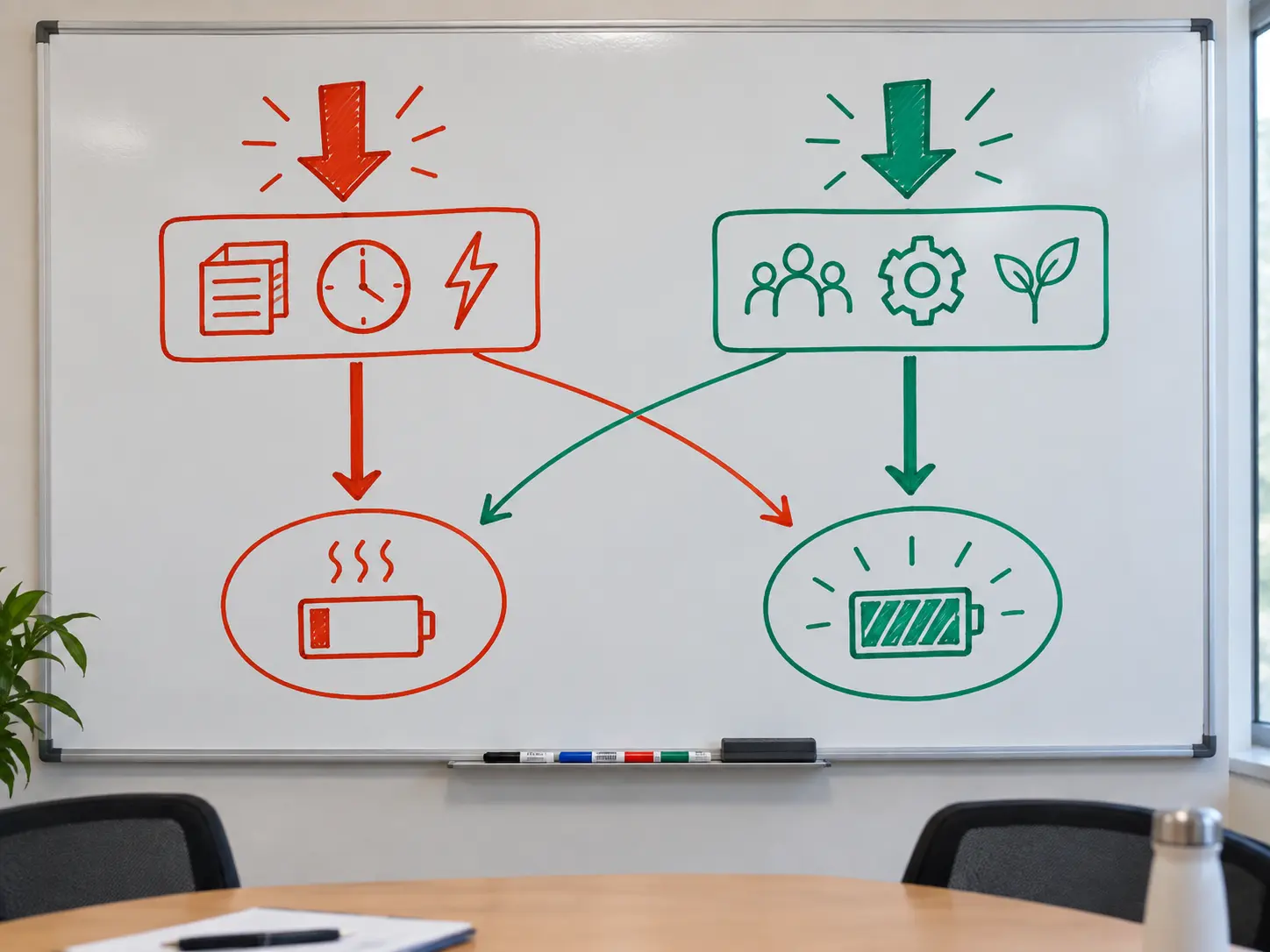
A framework tells you what to expect, which is the difference between a descriptive survey and a doctoral argument. Three are common.
- The job demands-resources model. Demerouti, Bakker, Nachreiner and Schaufeli (2001), “The job demands-resources model of burnout” in the Journal of Applied Psychology, set out the model in which job demands and job resources are distinct sets of working conditions linked to burnout. It generates clear hypotheses about which working conditions predict which dimension.
- Conservation of resources theory. Hobfoll (1989), “Conservation of resources: A new attempt at conceptualizing stress” in American Psychologist, frames stress as arising from threatened or actual loss of resources. It suits designs that follow resource loss over time.
- The Maslach and Leiter account. The 2016 overview above is a later account from the Maslach research tradition. Read it to see how it frames the causes of burnout and whether that framing suits an organisational comparison or intervention design.
Pick one as the organising framework and treat the others as context. If you are not sure which assumptions you are adopting, write down what each framework predicts for your population and keep the one whose predictions your design can actually test, then carry it from the definition through the hypotheses to the limitations.
How do the main instruments compare?
Instrument choice is the most consequential methods decision in a burnout thesis, and the details below come from the publishers and original papers, not from memory.
| Instrument | Structure | Population | Access | Watch out for |
|---|---|---|---|---|
| Maslach Burnout Inventory, Human Services Survey | 22 items; Emotional Exhaustion, Depersonalization, Personal Accomplishment | Nurses, physicians, social workers, therapists and similar | Proprietary; licence purchased from Mind Garden | Licence cost; use the version that fits the occupation |
| Maslach Burnout Inventory, Educators Survey | 22 items; same three dimensions | Teachers, administrators, education staff | As above | As above |
| Maslach Burnout Inventory, General Survey | 16 items; Exhaustion, Cynicism, Professional Efficacy | Occupational groups outside human services and education | As above | Different item content, so results are not interchangeable with the HSS |
| Copenhagen Burnout Inventory | Three subscales: personal, work-related and client-related burnout (Kristensen and colleagues, 2005, Work & Stress) | Developed for a range of work settings | Check the authors’ terms of use for your study | Client-related subscale only makes sense where respondents work with clients |
Whichever you choose, report the evidence you will rely on: the original validation, any validation for a group like yours and the reliability in your own sample. The expectations for that section are set out in what examiners expect on validity and reliability, and a comparison of what a good instrument comparison looks like for a related construct is in PHQ-9 vs GAD-7 vs DASS-21 vs WEMWBS. Newer instruments exist as well, and a newer instrument can be an advantage or a risk depending on how much validation exists in your population, so state the evidence either way.
What does the UK data actually tell you?
HSE’s key figures for Great Britain for 2024/25 report 964,000 workers suffering work-related stress, depression or anxiety. That number is useful in a problem statement because it shows that work-related mental ill health is a large issue in the UK workforce. It cannot do more than that. Work-related stress, depression and anxiety is a different construct from burnout as the WHO defines it and as the MBI or CBI measure it, so the figure must not be quoted as a burnout prevalence, and it should be cited with its source and reporting period. If your thesis needs a UK burnout prevalence for a specific occupation, the honest options are a published study that measured it with a named instrument, or your own study.
The same caution applies to the wellbeing of doctoral researchers themselves. A separate set of survey data exists on postgraduate research experience, which is discussed in what PRES 2025 shows about wellbeing and supervision, and it should likewise not be presented as a measurement of burnout.

Which designs suit a burnout thesis?
- Cross-sectional survey. The most common design. It supports claims about association and about differences between groups, and it is limited on direction of effect.
- Longitudinal or multi-wave survey. It supports claims about change and about whether resources protect against later exhaustion, but it needs retention planning and a larger initial sample. Sample-size reasoning for health-related samples is covered in sample size rules for postgraduate nursing and health research.
- Mixed methods. A survey followed by interviews that explain high-scoring or low-scoring groups, which gives an examiner both the pattern and the mechanism.
- Qualitative designs. Interviews or focus groups that explore how people in a role understand and manage exhaustion. They answer a different question and need their own rigour criteria.
If you recruit health or social care staff through NHS organisations, build the governance route into the timeline from the start; the methods side of that is explained in how to write the methodology chapter of a nursing PhD thesis. Because burnout questions can distress participants, your ethics application should include signposting to support and a plan for disclosure of serious distress.
What hypotheses can you test?
These illustrative hypotheses show the shape of a testable statement under a demands-and-resources framework. They are examples, not findings, and each names a burnout dimension rather than a vague “burnout”.
- H1: Higher workload demand is positively associated with emotional exhaustion in a sample of ward-based staff.
- H2: Perceived supervisor support is negatively associated with cynicism after controlling for workload.
- H3: Autonomy moderates the relationship between workload and exhaustion, so that the association is weaker at higher autonomy.
- H4 (longitudinal): Exhaustion at the first wave predicts intention to leave at the second wave.
Each hypothesis needs a variable defined in advance, and the way a construct becomes a measured variable is laid out in building a variable operationalisation matrix.
Ten researchable titles for a burnout thesis
These are illustrative thesis titles shaped by design and population, not published works.
- Workload, autonomy and emotional exhaustion among hospital ward staff: a cross-sectional study.
- Does supervisor support protect against cynicism? A two-wave study of secondary school teachers.
- Resource loss and exhaustion over a year: a longitudinal study of newly qualified social workers.
- Client-related burnout in community mental health services: a mixed-methods study.
- Burnout and intention to leave in primary care: a moderated mediation model.
- How early-career lecturers describe exhaustion: an interpretative phenomenological analysis.
- Comparing two burnout instruments in a single sample of emergency service staff.
- Job demands, resources and engagement as the opposite of burnout in the public sector.
- Shift patterns and personal burnout among paramedics: a repeated-measures design.
- An intervention to reduce exhaustion in teaching assistants: a pilot controlled study.
What goes wrong in burnout theses?
- Using a stress or depression statistic as a burnout rate. Different constructs.
- Treating a total score as a diagnosis. The WHO does not classify burn-out as a medical condition.
- Choosing the wrong version of an instrument for the occupation.
- Claiming causation from a cross-sectional survey.
- Ignoring licence cost until the ethics form is submitted.
Frequently asked questions
How does the WHO define burnout?
The WHO describes burn-out in ICD-11 as a syndrome conceptualised as resulting from chronic workplace stress that has not been successfully managed, with three dimensions: energy depletion or exhaustion, increased mental distance from one’s job or negativism or cynicism about it, and reduced professional efficacy. It states that burn-out is not classified as a medical condition.
Is burnout the same as work-related stress, depression or anxiety?
No. The HSE statistic counts workers suffering work-related stress, depression or anxiety, which is a different construct from burnout as defined by the WHO and measured by instruments such as the MBI. Do not use the HSE figure as a burnout prevalence.
Which instrument should I use to measure burnout?
The Maslach Burnout Inventory is the best known and exists in versions for human services, education, general occupational groups and students, but it is proprietary and requires a purchased licence. The Copenhagen Burnout Inventory has personal, work-related and client-related subscales. Choose by construct fit, population, cost and the validation evidence for your group.
Do I need permission to use the MBI?
Yes. Mind Garden publishes the MBI as a proprietary instrument and users purchase a licence to administer it, so budget for it and keep the licence record for your methods chapter.
Which theory should frame a burnout thesis?
Common choices are the job demands-resources model (Demerouti and colleagues, 2001), the conservation of resources theory (Hobfoll, 1989) and Maslach and Leiter’s account of burnout. Choose the one whose assumptions match your design and be ready to say what each predicts.
Can a cross-sectional survey show that work causes burnout?
Not on its own. It can show associations, and the discussion should say so. Longitudinal or multi-wave designs support stronger claims about direction.
Is a cut-off score for burnout acceptable in a thesis?
Only if your instrument’s authors or a validation study for your population support it. Because the WHO does not classify burn-out as a medical condition, avoid presenting scores as a diagnosis.
Do I need NHS ethics approval to study burnout in health workers?
It depends on how you recruit and whether participants are recruited as NHS staff through NHS organisations. Ask your university research ethics committee and the relevant research office early, and see the guidance for your own route.
Can I study burnout in doctoral researchers themselves?
Yes, but note that burnout as the WHO defines it refers to the occupational context, so justify why doctoral research is an occupational setting for your purposes, and think carefully about ethics and recruitment within your own university.
How many hypotheses should a burnout thesis test?
As many as your research questions require and your sample can support. A focused set tied to one framework is easier to defend than a long list, and each should name the dimension of burnout it concerns.
From construct to chapters
A burnout thesis has a long definitions-and-instruments section that is easy to leave until late. Tesify is used by 9,000+ students across 15,000+ chapters to organise a thesis chapter by chapter, and the thesis stays 100% written by you. Your definition, your instrument choice and your hypotheses are your own decisions; planning the chapters around them is the part that can be made easier.