
Choosing a civil or mechanical engineering PhD topic is a feasibility exercise as much as an intellectual one: the topic has to survive contact with lab access, equipment lead times, a supervisor’s actual expertise and a funder’s stated priorities, not just sound interesting. Below is a five-step method for narrowing “engineering” to a fundable, examinable topic, followed by 40 illustrative topics across eight sub-areas, each with a one-line research question. The topics are starting points for a literature search, not finished research questions — every one needs its own novelty check before it becomes a proposal.
Step 1: Narrow from a field to a problem class
“Structural engineering” or “renewable energy” is not a topic — it is a department. A workable topic names a specific structural element, material, failure mode or system boundary: not “concrete durability” but “chloride-induced corrosion initiation in reinforced concrete exposed to de-icing salts in UK coastal bridges.” The narrowing test is whether a specialist in the sub-field, on hearing the topic, could immediately name the two or three papers it sits between — if they cannot, the topic is still too broad to be a thesis.
Step 2: Check feasibility before the literature review, not after
An experimental engineering topic lives or dies on equipment access, material lead times and lab scheduling — a topic that requires a piece of test equipment the department does not own, or a six-month material-procurement lead time inside a three-year funded studentship, is not feasible regardless of how strong the literature gap is. A worked feasibility check, illustrative: a fatigue-testing topic needing 2 million load cycles per specimen at a realistic test frequency implies weeks of continuous rig time per specimen — multiplied across a planned specimen matrix, this alone can consume a full year of a funded studentship, and the proposal has to state that arithmetic honestly rather than assume the rig will always be free.
Step 3: Match the topic to your supervisor’s actual expertise, not their department’s
A supervisor’s publication record, not their job title, tells you whether they can genuinely support a topic — a structural engineer with a strong fatigue-testing publication record is a different supervisor from one whose recent work is entirely in building information modelling, even inside the same “structures” group. Read a prospective supervisor’s last five years of publications before proposing a topic, and where the fit is only partial, plan explicitly for a co-supervisor or external advisor who covers the gap.
Step 4: Run an actual novelty check, not an impression
A topic that “feels” novel because the candidate has not personally seen it before is not the same as a topic that is genuinely unaddressed in the literature. A proper novelty check runs a structured search across at least two databases (Scopus or Web of Science plus a field-specific one such as Compendex for engineering) using the specific terms of the narrowed topic, not the broad field name, and reads the most recent three to five years of results in full rather than only the abstracts. Where a very similar study already exists, the honest move is to state precisely what this thesis adds beyond it — a different material, a different scale, a different environmental condition — not to claim the whole area is untouched.
Step 5: Align the topic to what funders and industry are actually prioritising
UKRI’s engineering funding (through EPSRC, one of the research councils funding UK doctoral training) is organised around named research themes that shift over funding rounds — net zero and decarbonisation, resilient infrastructure, advanced manufacturing and materials, and digital engineering (including AI-assisted design and structural health monitoring) have all carried sustained funding priority in recent years. A topic that sits inside one of these named themes, and states that alignment explicitly in the proposal, has a materially easier path to studentship funding than an equally rigorous topic with no stated policy or industrial relevance — this does not mean choosing a topic purely for fundability, but a genuinely interesting topic that also aligns is worth surfacing that alignment plainly rather than leaving a panel to infer it.
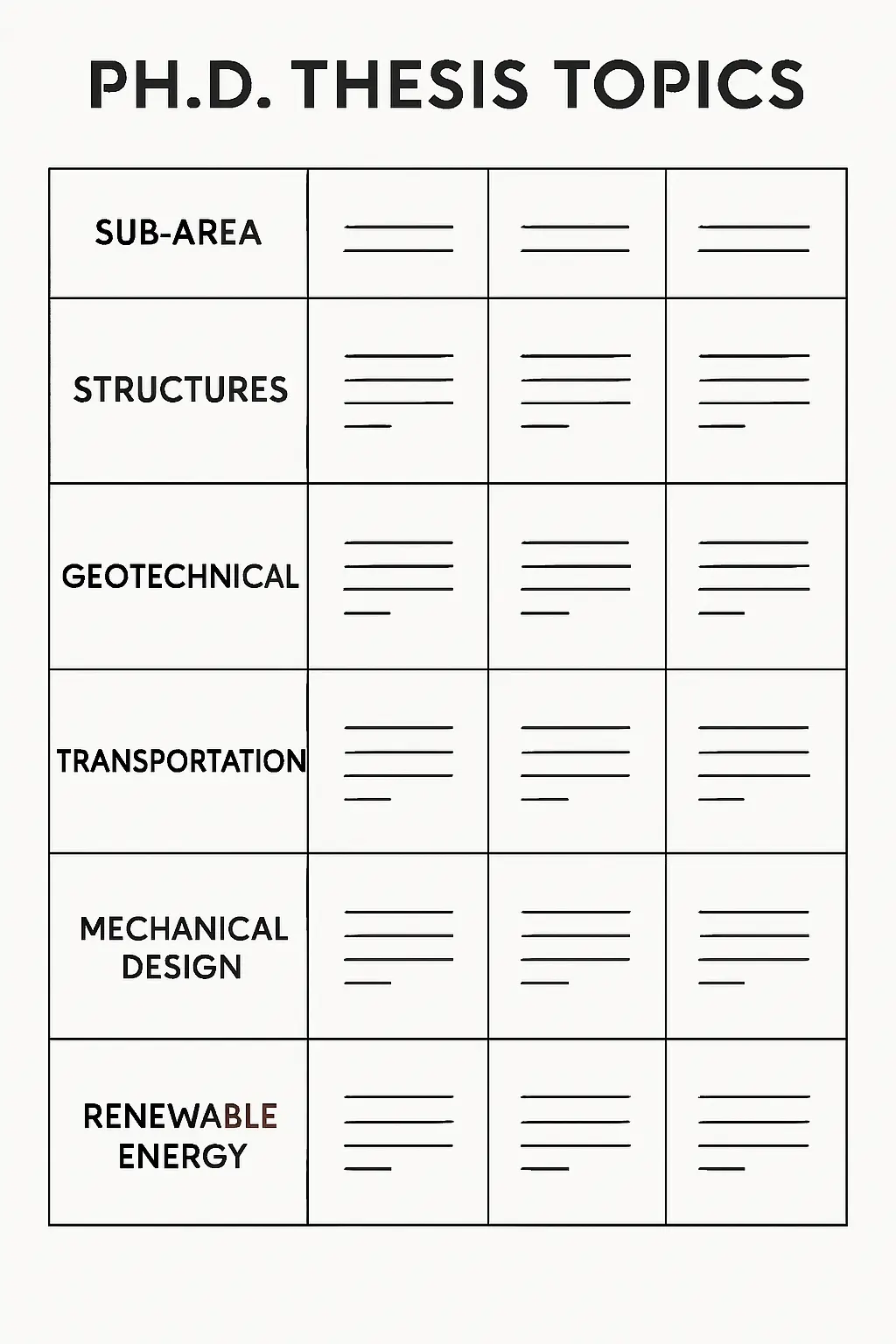
40 illustrative thesis topics, by sub-area
Each topic below is a starting point for your own literature search and novelty check, not a ready-made research question — narrow and verify before adopting any of these.
Structural engineering and materials
- Chloride-induced corrosion initiation in reinforced concrete exposed to de-icing salts. RQ: how does exposure regime affect the time to corrosion initiation in UK coastal bridge conditions?
- Fibre-reinforced polymer retrofitting of ageing masonry structures. RQ: what bond-strength degradation occurs under cyclic freeze-thaw loading?
- Digital twin-based structural health monitoring for post-tensioned bridges. RQ: can sensor-fusion data predict tendon degradation earlier than scheduled inspection?
- Low-carbon concrete mix design using recycled aggregate. RQ: what replacement ratio preserves compressive strength within current design codes?
- Seismic retrofit strategies for non-ductile reinforced concrete frames. RQ: which retrofit method offers the best cost-to-performance ratio for UK-relevant seismic zones?
Geotechnical and foundation engineering
- Ground-source heat pump pile foundations (energy piles). RQ: what is the long-term thermo-mechanical effect on pile bearing capacity?
- Liquefaction risk in reclaimed coastal land under climate-driven groundwater change. RQ: how does rising groundwater level alter liquefaction susceptibility?
- Nature-based slope stabilisation using vegetation root reinforcement. RQ: what root architecture provides measurable shear-strength improvement in UK clay soils?
- Reuse of existing foundations in brownfield redevelopment. RQ: what site-investigation protocol reliably verifies residual capacity of legacy foundations?
- Machine-learning prediction of settlement from cone penetration test data. RQ: does a trained model outperform established empirical correlations for UK soil types?
Transportation and infrastructure systems
- Pavement performance under increased heavy-goods-vehicle electrification weight. RQ: how does battery-added axle weight change rutting rates on existing asphalt designs?
- Resilience of transport networks to compound flood-and-heat events. RQ: which network topology metrics best predict cascading failure under combined stressors?
- Life-cycle carbon accounting for road maintenance strategy selection. RQ: does a predictive maintenance strategy reduce whole-life carbon versus a reactive one?
- Active travel infrastructure and modal shift measurement methods. RQ: which observational method most reliably attributes modal shift to a specific infrastructure change?
Mechanical design and manufacturing
- Additive manufacturing process parameters and fatigue life in titanium aerospace components. RQ: which build-parameter combination minimises porosity-driven fatigue crack initiation?
- Digital design-for-remanufacture frameworks for circular-economy products. RQ: what design rules measurably increase remanufacture yield?
- Human-robot collaborative assembly cell safety and productivity trade-offs. RQ: how does proximity-sensing threshold affect both safety incidents and cycle time?
- Topology optimisation for lightweighting in electric vehicle structural components. RQ: what performance is lost or gained versus conventionally designed equivalents?
- Predictive maintenance using vibration signature analysis in rotating machinery. RQ: which feature set best predicts bearing failure ahead of catastrophic breakdown?
Thermofluids, energy systems and HVAC
- Heat-pump performance degradation in UK retrofit housing stock. RQ: what building-fabric factors explain the gap between rated and in-use coefficient of performance?
- Phase-change material integration for passive building cooling. RQ: what melting-point selection best balances summer cooling against winter heat loss?
- Hydrogen embrittlement in repurposed natural-gas pipeline steel. RQ: what hydrogen-blend threshold triggers measurable crack-growth acceleration?
- Computational fluid dynamics optimisation of wind turbine blade tip design for low-wind-speed sites. RQ: what tip geometry improves annual energy yield at UK-typical wind speeds?
- District heating network thermal loss under variable demand profiles. RQ: which pipe insulation and routing strategy minimises loss under realistic UK demand variability?
Renewable and low-carbon energy systems
- Grid-scale battery degradation under frequency-response duty cycles. RQ: how does duty-cycle intensity affect calendar versus cycle-driven capacity fade?
- Offshore floating wind mooring-system fatigue under combined wave-wind loading. RQ: which mooring configuration best reduces fatigue accumulation in UK offshore conditions?
- Green hydrogen electrolyser efficiency under intermittent renewable supply. RQ: what operating strategy minimises efficiency loss from intermittent power input?
- Life-cycle assessment of solar photovoltaic recycling routes. RQ: which end-of-life recycling route has the lowest embodied-carbon payback?
- Tidal stream turbine blade erosion under UK coastal sediment conditions. RQ: what coating strategy most extends blade service life against sediment-laden flow?
Digital engineering, robotics and AI-assisted design
- AI-assisted generative design constrained by manufacturability rules. RQ: does constraining a generative model to manufacturable geometry reduce post-design rework?
- Building information modelling data interoperability across the construction supply chain. RQ: what data-schema mismatches cause the most costly rework at handover?
- Autonomous inspection drones for bridge and tunnel condition assessment. RQ: does drone-based visual inspection detect defects an engineer would miss on a scheduled walkover?
- Digital twins for real-time structural load monitoring in existing buildings. RQ: what sensor density is the minimum needed for reliable load-path inference?
- Explainable machine learning for structural defect classification from image data. RQ: does an explainable model sacrifice classification accuracy versus a black-box equivalent?
Sustainability, life-cycle assessment and circular economy
- Embodied carbon comparison of timber versus concrete mid-rise structural frames. RQ: at what building height does the embodied-carbon advantage of timber narrow or reverse?
- Circular-economy material passports for structural steel reuse. RQ: what verification protocol reliably confirms residual structural capacity of reclaimed steel?
- Whole-life carbon accounting methodologies compared across UK infrastructure projects. RQ: how much does the choice of accounting boundary change the reported carbon figure for the same project?
- Water-energy nexus optimisation in industrial process design. RQ: what process redesign reduces combined water and energy demand without shifting the burden between them?
- End-of-life strategies for wind turbine blade composite material. RQ: which repurposing or recycling route has the best combined economic and environmental case at current UK scale?
Topic viability checklist
| Check | Question to answer before adopting the topic |
|---|---|
| Narrowness | Could a specialist name the two or three papers this sits between? |
| Equipment/lab access | Does the department already own what the method requires? |
| Material/procurement lead time | Does it fit inside the funded period, with margin? |
| Supervisor fit | Does their last five years of publications actually cover this? |
| Novelty | Has a structured, multi-database search confirmed the gap? |
| Funding/industrial alignment | Does it sit inside a named EPSRC theme or industrial priority? |
Turning a topic into a proposal
A topic from this list is a starting point, not a finished proposal — the next step is stating a specific research problem, method and timeline around it, which this site’s own guide to writing a PhD research proposal for a UK studentship sets out in full, and which the choice of statistical test for the eventual results chapter should be planned around from the start rather than left until the data arrives. Once a topic is chosen, mapping the chapter structure early avoids the drift that turns a well-scoped topic into an unfocused thesis — a workspace like Tesify’s thesis planning tool is built for exactly that early-stage structuring, before the first chapter draft exists.
Frequently asked questions
Should I choose a topic before or after contacting a potential supervisor?
Contact potential supervisors with a rough topic area first, then narrow the specific topic together — a supervisor’s stated capacity and current projects will often reshape the topic more usefully than narrowing alone before any conversation.
How do I know if a topic is too ambitious for a funded studentship?
Map the topic’s experimental or data-collection plan against the funded period honestly, including equipment scheduling and any procurement lead time — if the core experimental work alone consumes more than half the funded period, the topic needs narrowing before it becomes a proposal.
Is it a problem if my topic overlaps partly with an existing PhD student’s work in the same group?
Overlap is only a problem if the specific research question is the same — engineering groups commonly run several PhDs on the same broad system (a bridge type, a material class) studying genuinely different aspects, which is normal and often strengthens the group’s combined output.
Do I need an industrial partner to work on an applied engineering topic?
Not always, but for topics requiring proprietary data, specialist equipment or real-world deployment testing, an industrial partner materially improves both feasibility and funding competitiveness — check whether your department already holds relevant industrial relationships before assuming you need to find one independently.
How often do EPSRC funding priorities actually change?
Named themes shift gradually rather than year to year, but a topic’s framing should still be checked against the current round’s published priorities before a funding application, since the same underlying research can often be framed to align more or less clearly with what is currently prioritised.
What is the difference between a novelty check and a full literature review?
A novelty check is a fast, structured search to confirm a topic is not already directly addressed; the full literature review, written later, synthesises the broader field and situates the eventual specific contribution within it — the novelty check comes first and is narrower in scope.
Can a topic from this list be used directly as a thesis title?
No — each entry here is a starting area for a literature search, not a finished, defensible research question. A workable title needs the specific gap, method and scope added after your own novelty check, following the same object-method-scope logic this site’s guide to constructing a thesis title sets out for other fields.