
For a UK discipline search, use EThOS to discover theses, the awarding university’s open access repository to read them, and ProQuest Dissertations & Theses Global through your library when you need worldwide coverage. The DART-Europe portal no longer helps: it closed in February 2025.
| Source | What it is | Full text? | Cost and access | Best for | Where it falls short |
|---|---|---|---|---|---|
| EThOS (British Library) | Open access discovery platform for UK doctoral theses | Often via a link to the university repository record; not guaranteed | Open access | Finding UK theses across all universities | Not every thesis is available from the repository it links to |
| University repositories (for example Edinburgh Research Archive, Warwick WRAP) | The awarding university’s own open access archive | Frequently, where deposited and not embargoed | Open access | Reading full text; browsing by school or department | One institution at a time; deposit practice varies |
| ProQuest Dissertations & Theses Global | Subscription database of theses from institutions worldwide | For many records, through subscription | Institutional subscription | International comparisons and non-UK theses | Needs your library’s access; not UK-specific |
| DART-Europe | Former European e-theses portal | Not applicable | Closed 3 February 2025 | Nothing now | Removed; use the routes above |
Which source should you start with?
Start with EThOS if you want every UK university at once, and then move to the repository of the university that awarded the thesis you have found. That is the sequence most researchers end up using, because the discovery tool tells you a thesis exists and the repository is where the file usually lives. Use ProQuest when your question reaches beyond the UK or when a thesis you need is not in an open repository. The rest of this guide explains how each behaves and how to search it in your discipline.
What is EThOS and is it working?
The EThOS homepage describes the service as an open access discovery platform for UK doctoral theses, managed by the British Library. On the date this guide was checked, 4 October 2026, the homepage stated that EThOS (E-Theses Online Service) “is now available again following restoration work” and that the platform was continuing to be updated, with an initial backlog of content to work through. It also said it holds metadata for over 650,000 UK doctoral theses from UK universities from the 1700s onwards.
Two points follow. First, EThOS is primarily a place to find and identify theses rather than a guarantee of a download. Its records often contain an “Access thesis from university” button that links to the thesis record in the university’s repository, where the thesis may be downloadable if the university has made it available. The homepage is explicit that not all theses are available from the university repository. Second, the status of the service has changed before, so read the homepage banner before you build a literature search around it.
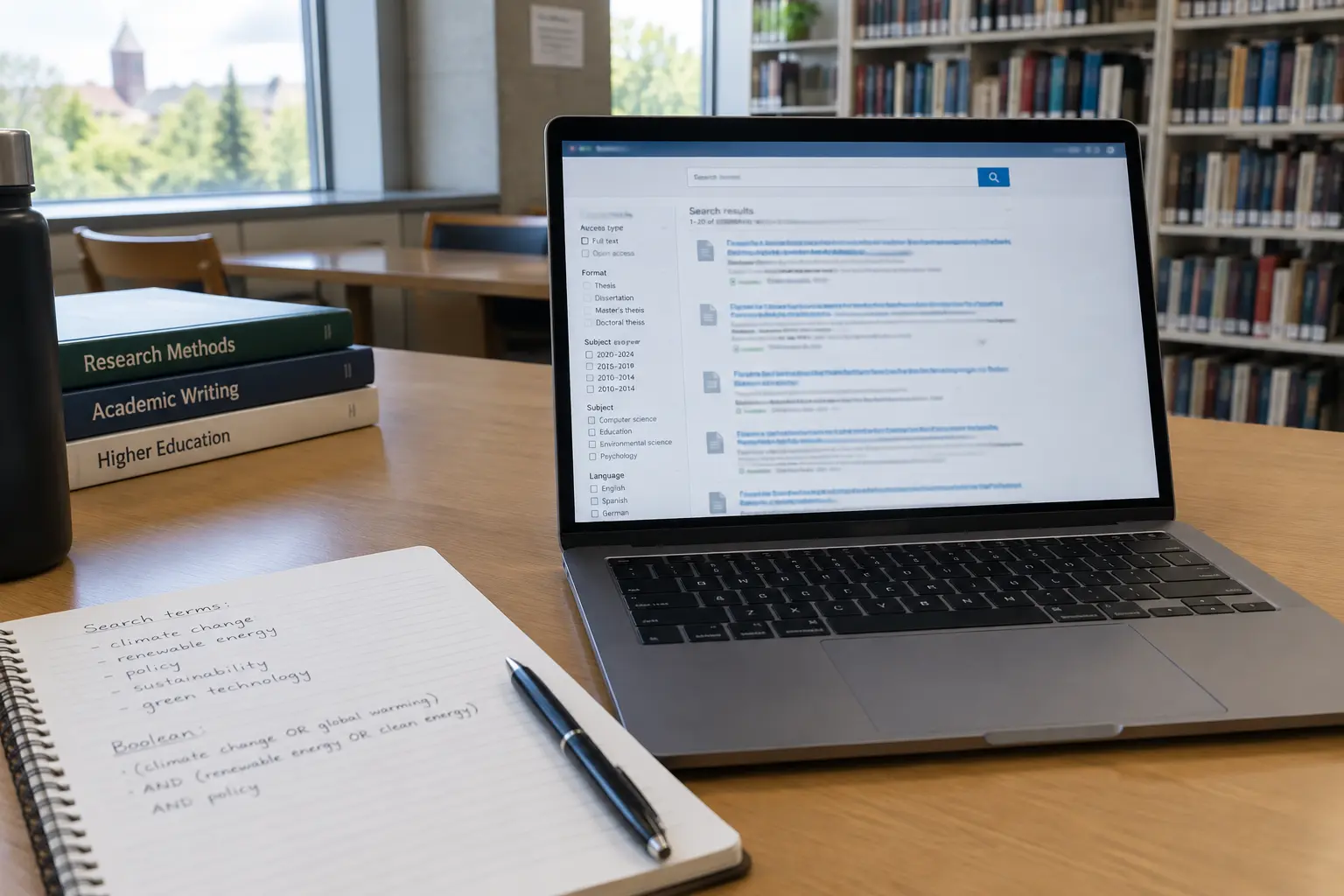
Why are university repositories the best place to read a thesis?
A university repository holds the thesis itself. Edinburgh Research Archive describes itself as a digital repository of original research produced at the University of Edinburgh and lists full-text digital doctoral theses among its holdings, organised by school and centre. The Warwick Research Archive Portal describes itself as the home of the university’s full-text, open access research content, includes Warwick doctoral dissertations, and offers browsing of theses by department. Other universities run similar archives, each with its own search and browse structure.
Practical consequences for a search:
- Browse by department or school when the repository offers it. This surfaces theses in your discipline that a keyword search misses because they use different vocabulary.
- Look at your own university first. Theses from your department show the local conventions for structure, length and presentation, and they were examined under regulations close to yours.
- Expect gaps. Deposit practice and embargo rules differ. If a thesis has no full text, the record may still give you the abstract and supervisor details.
When is ProQuest worth using?
ProQuest describes Dissertations & Theses Global as providing access to over six million metadata records, including four million full-text documents, from more than 3,600 institutions in more than 70 countries, and it is sold as an institutional subscription. In practice that means your university library, not you, decides whether you can use it. It is useful when you want to see how a question has been tackled in other countries, or when the thesis you need was awarded outside the UK. For a UK-only search it adds little to EThOS and the repositories, so check what your library holds before spending time on it.
What happened to DART-Europe?
If an older guide or reading list recommends DART-Europe, update it. A notice from UCL Library Services states that the DART-Europe e-theses portal, which was a searchable database of open access electronic research theses held in European repositories, was closed down permanently on 3 February 2025. The same notice points researchers to general open access aggregators, naming BASE, CORE and NDLTD, and to individual institutional repositories, which is also the practical route for European theses.
How do you search by discipline?
A thesis search is a literature search in miniature, so plan it. Keep a log of the sources, the search terms and the dates, as you would for a literature review, and note which theses you have read and which you have only seen as records. Discipline changes what you look for.
- Law: search by the statute, doctrine or jurisdiction as well as the topic. Doctrinal, socio-legal and comparative theses are structured differently, as how a law PhD thesis is structured explains.
- Nursing and health: search by design and setting (for example a named method and a care context), then read how the methods chapter handles governance. The expectations are set out in an annotated model of a nursing PhD.
- Computer science: theses are often built around a thesis statement and contribution chapters that reuse published papers. See how to structure a computer science PhD thesis to know what to look for.
- History and humanities: search by period, place and archive. The archives and databases behind such theses are compared in which archives and databases a history PhD should use.
- Clinical and medical research: search by population and outcome, then compare how each thesis you find presents its design, its ethics approvals and its outcome measures.
Use the vocabulary of your own methods too. Searching for the name of an analysis approach together with your population often finds theses that a topic-only search buries.
What should you read first in a thesis you have found?
- The abstract and contents page. They show the structure and length in a minute.
- The introduction. It shows how the contribution was stated and how the research question was framed.
- The methods chapter. It shows what that department accepted as adequate, including how ethics and instruments were handled.
- The reference list. It is a ready-made shortlist for your own literature review.
- The year and awarding institution. Regulations and word limits change, so compare them with your own university’s current rules rather than assuming the thesis is a template. How such rules read is shown in the piece on Warwick’s regulations.
What if the thesis you need is embargoed or not online?
Some theses are held back for a period, and some were never deposited as full text. Do not assume that a missing file means the thesis is unavailable. The EThOS or repository record usually gives the awarding institution, so contact that university’s library or repository team and ask what the access arrangements are. Ask your supervisor too, because they may know the author or the supervisor of the thesis. Check whether the work was later published as journal articles or a book, because the published version is often easier to obtain and is the version you should cite when it exists. Avoid unofficial copies of theses hosted on third-party sites, since you cannot tell whether they are the final, examined version.
How reliable is a previous thesis as a source?
A thesis has been examined, which is a serious form of scrutiny, but it has not been through journal peer review in the way a published paper has. Treat its claims as you would any unpublished study: read the methods critically, check whether the results were subsequently published, and weigh the evidence rather than the title. Also bear in mind that degree level matters: a doctoral thesis, a professional doctorate and a master’s dissertation carry different expectations of originality and scale, and your literature review should say which kind you are citing.
How do you use previous theses without borrowing from them?
A previous thesis is a source like any other and a model of what is acceptable, never a template to copy. Learn from the structure and level of argument, and then write your own chapters, claims and wording. If you rely on a result, method or idea from it, cite it. A closely related thesis often belongs in your literature review, because it may be an unpublished source of findings that examiners know, as set out in how to build the literature review chapter. Cite a thesis using the template in your referencing style guide for an unpublished doctoral thesis, which normally needs the author, year, title, degree, awarding institution and the repository address or persistent identifier.
Recommendation
Use EThOS to find, the awarding university’s repository to read, and your library’s ProQuest access only when you need an international view. Start the search early, log it, and check the status of each service on its own site rather than relying on a reading list that may predate a change.
Frequently asked questions
Where can I find previous UK PhD theses for free?
Start with EThOS, which is an open access discovery platform for UK doctoral theses, and with the open access repository of the awarding university, where many theses are available as full text. Not every thesis is available in full, because that depends on the university and any embargo.
Is EThOS still working?
The EThOS homepage states that the service is available again following restoration work and that there was an initial backlog of content to work through. Check the homepage for its current status before you rely on it.
What happened to DART-Europe?
A notice from UCL Library Services states that the DART-Europe e-theses portal was closed down permanently on 3 February 2025. Use EThOS, institutional repositories or open access aggregators such as BASE, CORE and NDLTD instead.
Does ProQuest cover UK theses and do I have to pay?
ProQuest Dissertations & Theses Global is a worldwide subscription database sold to institutions, so access normally comes through your university library rather than an individual purchase.
Can I read a thesis from a different university?
Often yes, where the awarding university has made it openly available in its repository. Some theses are embargoed or not deposited, and EThOS notes that not all theses are available from the university repository.
How do I cite a PhD thesis I found online?
Follow your referencing style guide’s template for an unpublished doctoral thesis: author, year, title, degree type, awarding institution and the repository address or persistent identifier you used.
Can I copy the structure of a previous thesis?
You can learn from how a thesis in your discipline is organised, but your chapters, argument and wording must be your own, and anything you take from another thesis must be cited.
How old a thesis is still useful?
Recent ones are better for current regulations, word limits and ethics practice, and older ones can still be valuable as sources of method or theory. Check the awarding university’s rules for the year the thesis was examined.
Should previous theses appear in my literature review?
Yes, where they are directly relevant. A closely related thesis is often an unpublished source of results and methods, and examiners may know it, so cite it and say how your work differs.
Turning what you read into your own chapters
Reading other theses is useful only if it ends in your own structure and your own sentences. Tesify is used by 9,000+ students across 15,000+ chapters to organise a thesis chapter by chapter, and the thesis stays 100% written by you. Use what you learn from other theses to plan your chapters, and keep every claim and every sentence your own.