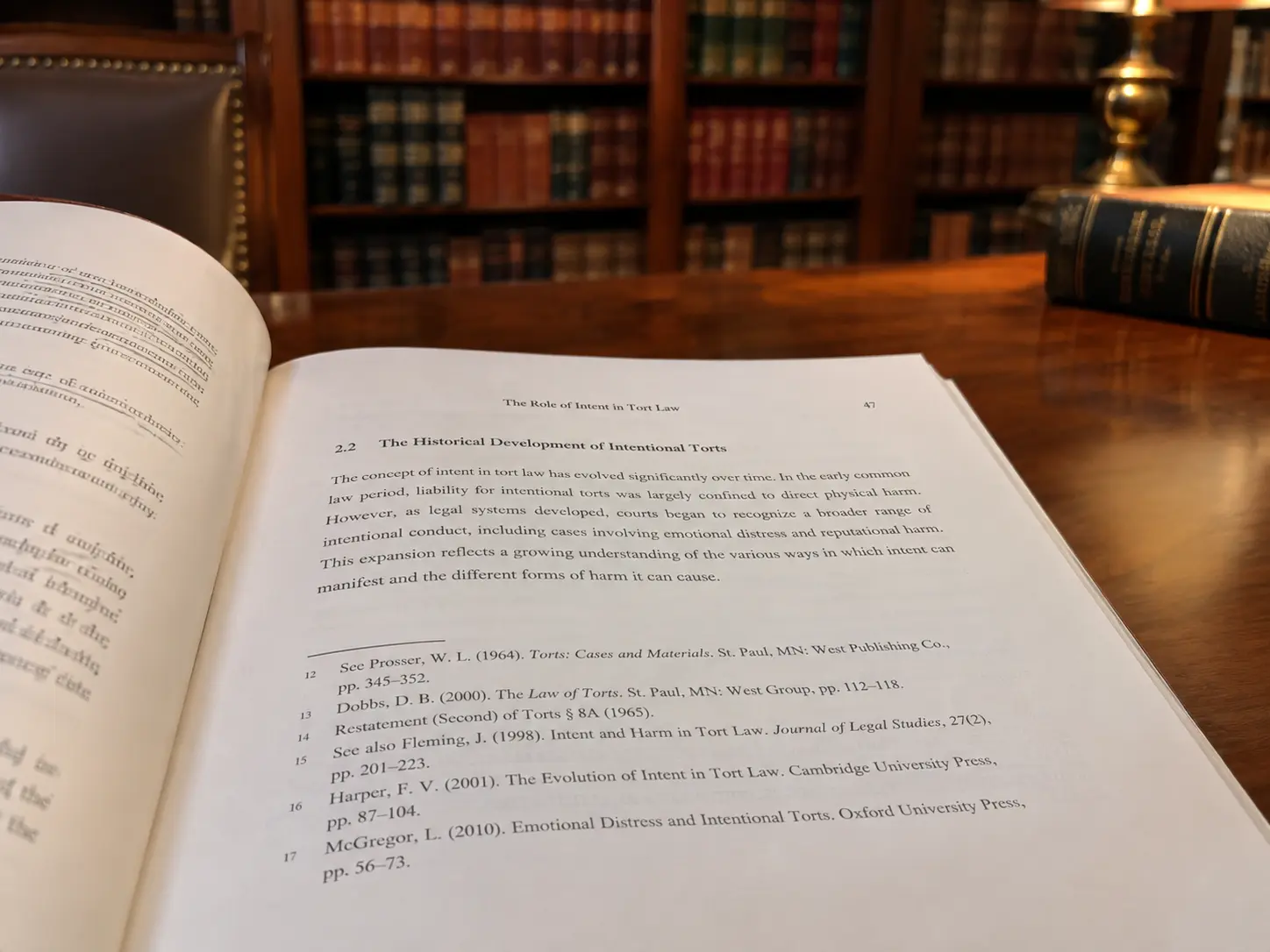
A UK law thesis has its own register: formal, precise, sparing with the first person, and built to carry an argument through footnotes as much as through prose. Getting the discipline’s voice right is a separate skill from getting the citation format right — and examiners notice when a thesis borrows social-science phrasing instead.
How is a law thesis’s register different from a social-science thesis?
A social-science thesis narrates a research process: what you did, what you found, what it means. A law thesis argues a position and defends it against the strongest counter-argument available, chapter by chapter. That difference shows up immediately in the verbs: a law thesis states, submits, contends and argues; it rarely “explores” or “investigates” a question the way a qualitative methods chapter does. Where a law PhD’s structure is organised by legal problem rather than by method, its register is organised the same way — every paragraph is working toward a position, not toward a description of process.
How formal does the voice actually need to be?
Formal, but not archaic. Modern UK legal academic writing avoids Latin maxims except where the term of art has no accurate English equivalent (ratio decidendi, obiter dictum, ultra vires), and it avoids ornate Victorian phrasing in favour of precise, plain sentences that still read as legal argument rather than journalism. The test examiners apply is whether a sentence could be read aloud in a professional legal setting without sounding either too casual or too theatrical. First person is used sparingly and deliberately — “this thesis argues” rather than “I will explore” — because the argument, not the author’s process, is meant to carry the sentence.

What does “hedging” mean in legal writing, and why does it matter so much?
Every claim in a law thesis needs to be pitched at the right level of certainty, because overclaiming is one of the fastest ways to lose an examiner’s confidence in the whole argument. “It is submitted that” and “it is arguable that” are not filler — they signal precisely how confident the claim is meant to be, and swapping them carelessly changes what the sentence is actually claiming. A stronger claim (for example, that the court’s reasoning in a leading case is difficult to reconcile with the statute it applies) needs the evidence to support that strength; a more tentative claim (“it may be argued that…”) should be used where the law is genuinely unsettled, not as a habitual hedge that weakens every sentence in the chapter.
How does a law thesis actually build an argument through its footnotes?
In UK legal writing, footnotes are not just citation housekeeping — they carry qualifications, counter-authority and secondary argument that would clutter the main text if stated there directly. A well-built footnote might acknowledge a conflicting line of authority, note a statutory amendment, or point to a stronger source for a proposition the main text only summarises. Examiners read footnotes as part of the argument, not as an appendix to it, so a thesis with thin or purely mechanical footnotes (citation only, no substantive content) reads as less developed than one where the footnotes are doing real argumentative work. A hypothetical, illustrative comparison shows the difference (no real case is being cited): a mechanical footnote does no more than give the citation for the authority just mentioned in the text. A footnote doing argumentative work adds a clause noting a narrower reading in a later, conflicting decision, and flags that the tension is picked up again in a later chapter. The second version is not longer for its own sake; every extra clause is doing work the main text does not have room for. The formatting side of this — how a case, statute or secondary source is actually cited — is covered separately in how to cite UK legislation and case law in a postgraduate thesis; register and citation format are distinct skills that both matter.
How precise does legal terminology actually need to be?
Precisely, and consistently. A thesis that uses “illegal,” “unlawful” and “void” interchangeably, when the doctrine actually distinguishes between them, signals to an examiner that the candidate has not fully understood the legal effect being described — even where the substantive argument is otherwise sound. The same discipline applies to jurisdiction-specific and period-specific terms: “claimant” is the term the Civil Procedure Rules use in current English civil procedure, where older cases and texts say “plaintiff”, and a defined term should be used consistently once it has been introduced, rather than switching between synonyms for stylistic variety. Define a term of art precisely on first use, then use exactly that term throughout the thesis rather than varying it.
How does a doctrinal thesis’s register differ from a socio-legal or comparative one?
A purely doctrinal chapter stays close to the black-letter law and argues from case and statute; its register is the most formally legal of the three. A socio-legal chapter, examining how law operates in practice, borrows some social-science vocabulary (data, participants, findings) but still needs to state its own legal argument clearly rather than letting the social-science framing dominate. A comparative chapter has to signal jurisdiction constantly and precisely — naming the jurisdiction in the same sentence as the rule being described, not leaving the reader to infer it from context — because a comparative argument collapses the moment a reader loses track of which system a given rule belongs to. Register also has to carry over into the viva itself: who examines a PhD thesis in the UK covers the sector-wide rules on examiner appointment, but for a law candidate specifically, the oral defence is where the written register is tested out loud — a candidate who has been careful about hedging and precision on the page is generally far more comfortable defending a claim verbally than one who has written more confidently than the underlying law actually supports.
Does the discipline’s register show up in your title and headings too?
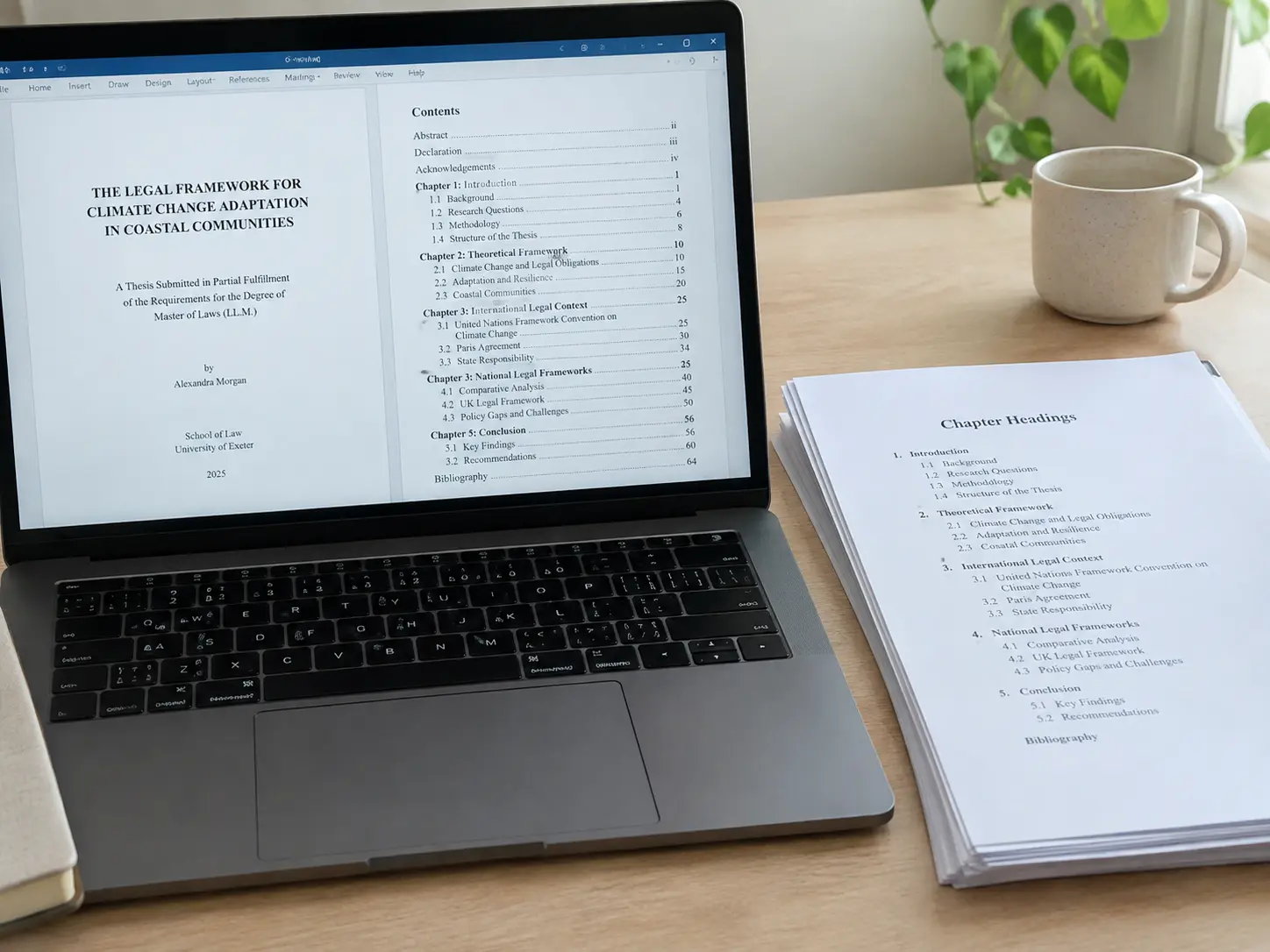
Yes — the same precision and argumentative framing that governs the body of the thesis governs its title and chapter headings. How law PhD thesis titles are actually built shows the pattern: a strong title states the legal problem and often signals the position taken, rather than describing a topic area vaguely (“An Analysis of Contract Law” reads as a social-science title stapled onto a legal subject; “Reconciling Estoppel and Contractual Certainty in Commercial Agreements” reads as a legal argument in miniature). Chapter headings follow the same logic: a heading that states a position (“The Doctrine of Frustration Cannot Accommodate Long-Term Supply Contracts”) does more work than one that merely names a topic (“Frustration in Commercial Contracts”).
How do you actually learn a register you were not trained to write in?
By close, deliberate reading, not by imitation of a single source. Reading widely in leading judgments and the strongest monographs and journal articles in your own sub-field, specifically noticing how hedging, footnoting and terminology are handled, is the most reliable way to internalise the register over time. Which legal research platform a law PhD should actually use matters here beyond finding authority: a platform with strong full-text judgment search makes it far easier to read broadly across a body of case law and absorb how senior judges and leading academics actually write, rather than relying on a handful of sources you already know.
What are the register mistakes examiners flag most often?
- Overclaiming without evidence: “it is clear that” or “it is beyond doubt that” attached to a genuinely contested point of law.
- Interchangeable use of near-synonyms that the doctrine actually distinguishes (illegal/unlawful/void), or drifting between current and outdated procedural terms (claimant/plaintiff).
- First person drifting into narration of the research process rather than the argument, borrowed from a social-science register.
- Thin footnotes that cite but do not qualify, acknowledge counter-authority, or extend the argument.
- Unsignalled jurisdiction switches in comparative chapters, leaving the reader to work out which system a rule belongs to.
- Latin maxims used decoratively rather than because the term of art has no accurate English equivalent.
Frequently asked questions
Is first person ever appropriate in a UK law thesis?
Sparingly, and usually to state the thesis’s own contribution (“this thesis argues”) rather than to narrate the research process. Heavy first-person narration borrowed from a social-science register reads as a mismatch.
Should I avoid Latin phrases entirely?
No — established terms of art with no accurate English equivalent (ratio decidendi, obiter dictum, ultra vires) are standard. What examiners flag is decorative Latin used where a plain English term would do just as well.
What is the difference between “it is submitted that” and “it is arguable that”?
They signal different levels of confidence. The first pitches a claim the thesis is prepared to defend firmly; the second flags genuine uncertainty in the law itself. Using them interchangeably blurs how strong each claim is meant to be.
Do footnotes need full sentences, or just citations?
Where a footnote is doing substantive work — qualifying a claim, noting counter-authority, extending an argument — it should read as a proper sentence, not a citation fragment. Purely mechanical citations can stay short.
How do I keep a comparative chapter’s jurisdiction clear?
Name the jurisdiction in the same sentence as the rule you are describing, every time you introduce a new point, rather than relying on a reader to remember which system the paragraph is about.
Is “claimant” always correct, or does it depend on context?
In current English civil procedure, claimant has replaced plaintiff; use the term that matches the procedural context and period you are actually discussing, and stay consistent once you have chosen it.
Does a socio-legal thesis need the same formal register as a doctrinal one?
It needs its own legal argument stated clearly, even where it also uses social-science vocabulary for its empirical component — the two registers have to work together, not let one crowd out the other.
Can register mistakes on their own lead to corrections?
On their own, rarely enough to drive a full recommendation, but they compound with substantive issues — an examiner who has already flagged overclaiming is reading the rest of the argument more sceptically as a result.
Should a law thesis title describe a topic or state an argument?
A title that signals the position taken, or at least the specific tension being resolved, generally reads as stronger and more legal in register than one that only names a topic area.
Does register matter as much in a PhD by published work?
Yes, and often more: journal articles already written for a legal audience set a register the covering document then has to match, so an inconsistent voice between the two is more visible than in a single continuous monograph.
Reading your own thesis in the discipline’s own voice
The register mistakes above are exactly the kind of thing that is easier to spot in someone else’s writing than your own. Tesify is used by 9,000+ students across 15,000+ chapters to work through a thesis draft section by section, and the thesis stays 100% written by you — a structured second pass on your own argument, not a rewrite into a different voice.